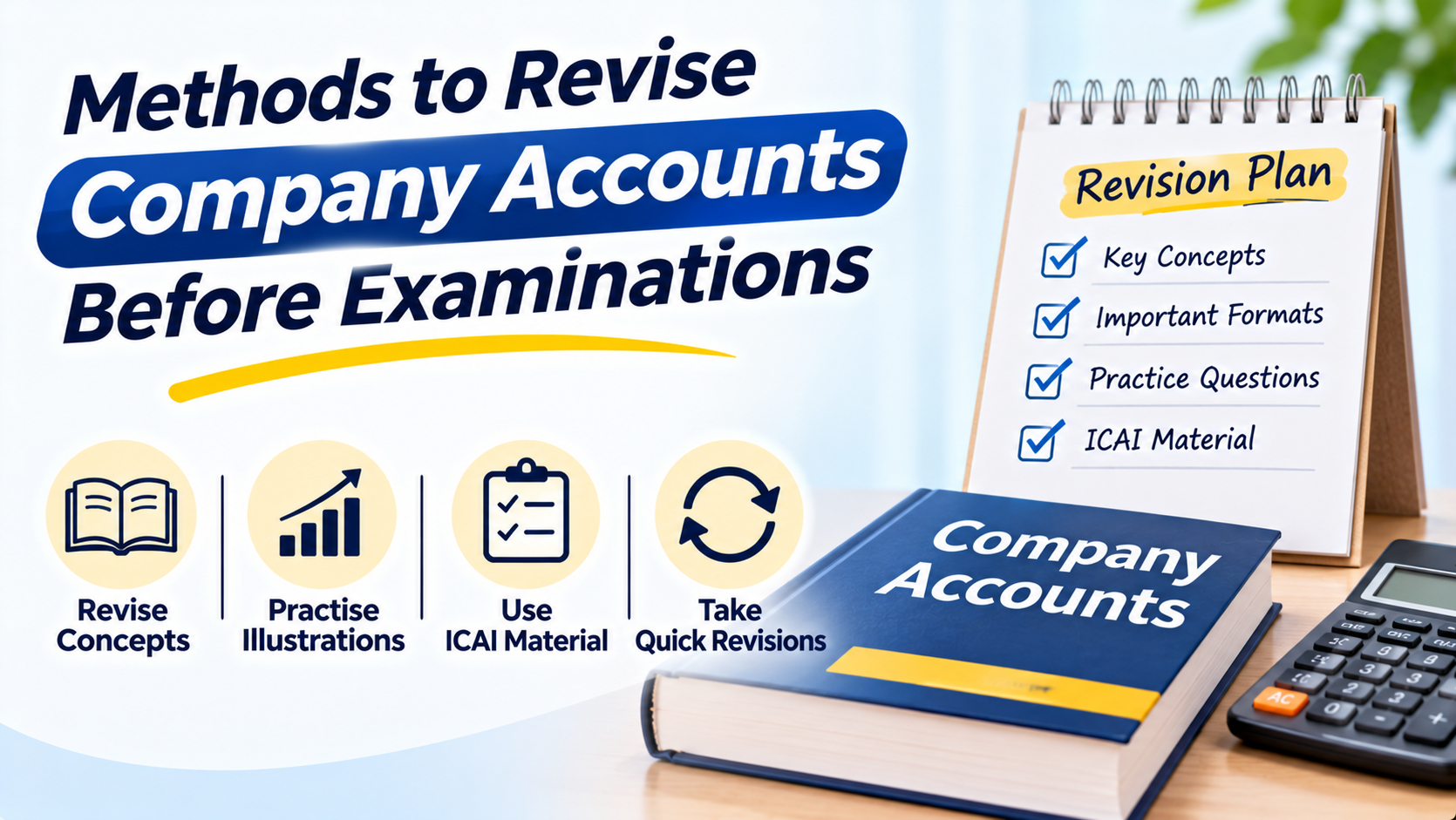
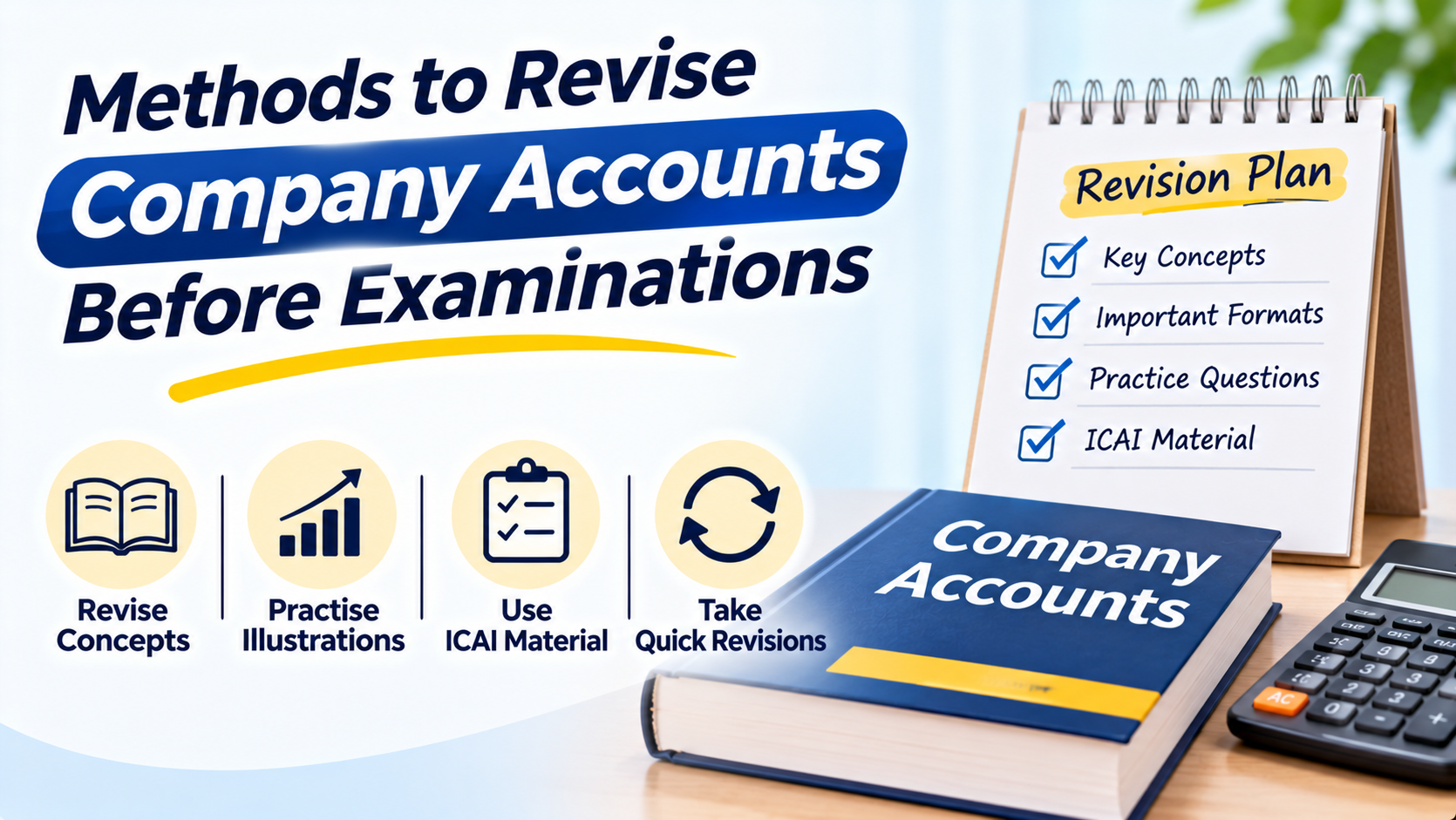
Company Accounts requires students to understand accounting treatments, apply the relevant provisions and present calculations in a clear format. During revision, simply reading solved illustrations may create familiarity, but it does not always prepare students to solve a new problem independently.
An effective revision method combines concept recall, format practice, repeated problem-solving and review of common errors. A planned approach helps students use their revision time carefully and identify the areas that need additional attention.
Begin with a chapter-wise revision checklist
List the chapters and divide them into concepts, accounting treatments, formats and common question types. Mark each area as comfortable, needs practice or requires relearning. This helps you avoid spending equal time on every topic when your understanding is not equal.
Use the syllabus and applicable ICSI material to confirm coverage. Keep your checklist updated as you complete questions and revise weak areas. Do not mark a topic as complete merely because you have read its explanation.
Recall accounting treatments before solving
Before attempting a question, revise the accounting treatment or principle it tests. Identify the relevant recognition, measurement, classification or presentation requirement. Understanding the reason behind a treatment makes it easier to handle changed figures or a differently worded problem.
Prepare concise notes for treatments that are easy to confuse. Include the conditions and important steps rather than copying lengthy textbook explanations. Check these notes against current study material to maintain accuracy.
Practise formats and working notes
Company Accounts questions often require a clear sequence of calculations and presentation. Revise the formats relevant to your syllabus and practise setting out workings in a logical order. Label figures, show important steps and make the final answer easy to trace.
Do not memorise a format without understanding what each item represents. If the question changes, you should be able to identify where the information belongs and why the treatment is appropriate.
Solve illustrations independently
Read the illustration, identify the requirement and attempt the solution before checking the answer. If you get stuck, note the exact step where the difficulty begins. Then study the explanation and solve the question again without looking.
After mastering a standard illustration, attempt a similar question with different figures or a changed condition. This checks whether you understand the method rather than remember the original solution.
Use a graded practice sequence
Begin with basic questions that test one treatment, then move to questions combining multiple adjustments. Once the method is stable, attempt examination-style questions under a time limit. This progression builds accuracy before adding pressure.
If a complex question goes wrong, break it into smaller steps and identify which treatment caused the error. Rework that part separately before attempting the full question again.
Maintain an error and adjustment log
Record repeated mistakes such as incorrect classification, missed adjustments, calculation errors, incomplete workings or misunderstanding the requirement. Write the correct approach in a short form and note the chapter to revise.
Review the log before practice sessions. Reattempt selected questions after a gap to check whether the correction has become part of your method. This is more effective than reading the same solution repeatedly.
Revise concepts at planned intervals
Company Accounts includes details that can be forgotten if there is a long gap between study sessions. Use short revision intervals: recall the treatment soon after learning it, revisit it during the week and include it in subject-level revision.
Active recall is useful here. Close the book and write the steps, format or treatment from memory. Then compare it with your notes and correct missing points. This reveals what you can actually reproduce.
Practise mixed and timed questions
Chapter-wise practice is useful for learning, but mixed questions help you identify the correct treatment without being told which chapter is involved. Timed practice adds the pressure of completing calculations within the examination duration.
Track both accuracy and speed. If you are fast but make repeated errors, slow down and strengthen the method. If your answers are accurate but incomplete, practise allocating time and prioritising the required workings.
Use past practice papers carefully
Use applicable institute practice questions, revision resources and mock papers to become familiar with different question formats. Check that the material matches the current syllabus and relevant examination requirements. Avoid relying on predictions or assuming that a question will repeat exactly.
After each paper, identify which chapters caused difficulty and revise the connected concepts. A paper should guide your next revision actions, not simply provide a score.
Assess preparation with CS Exams Test Series
A CS Exams Test Series can provide structured assessments to check Company Accounts preparation under timed conditions. Use topic-level practice to strengthen individual treatments and subject-level tests to review the complete paper strategy.
After evaluation, review calculation steps, working notes, accuracy and time use. Return to the relevant ICSI study material for concepts that need attention. Combine regular assessment with focused revision rather than depending on tests alone.
Quick Reference Table
| Revision area | Suggested method | Expected outcome |
|---|---|---|
| Accounting treatments | Recall rules and conditions | Stronger conceptual understanding |
| Formats | Practise layouts and workings | Clearer presentation |
| Illustrations | Solve independently | Better application |
| Common errors | Maintain an error log | Fewer repeated mistakes |
| Full-paper practice | Attempt timed mixed questions | Improved speed and paper management |
Conclusion
Consistent preparation depends on understanding the subject, practising relevant questions and reviewing mistakes honestly. Use the applicable ICSI study material as your foundation and make each assessment part of a clear improvement plan. A structured approach with CS Exams Test Series can help you practise with discipline and identify where further revision is needed.