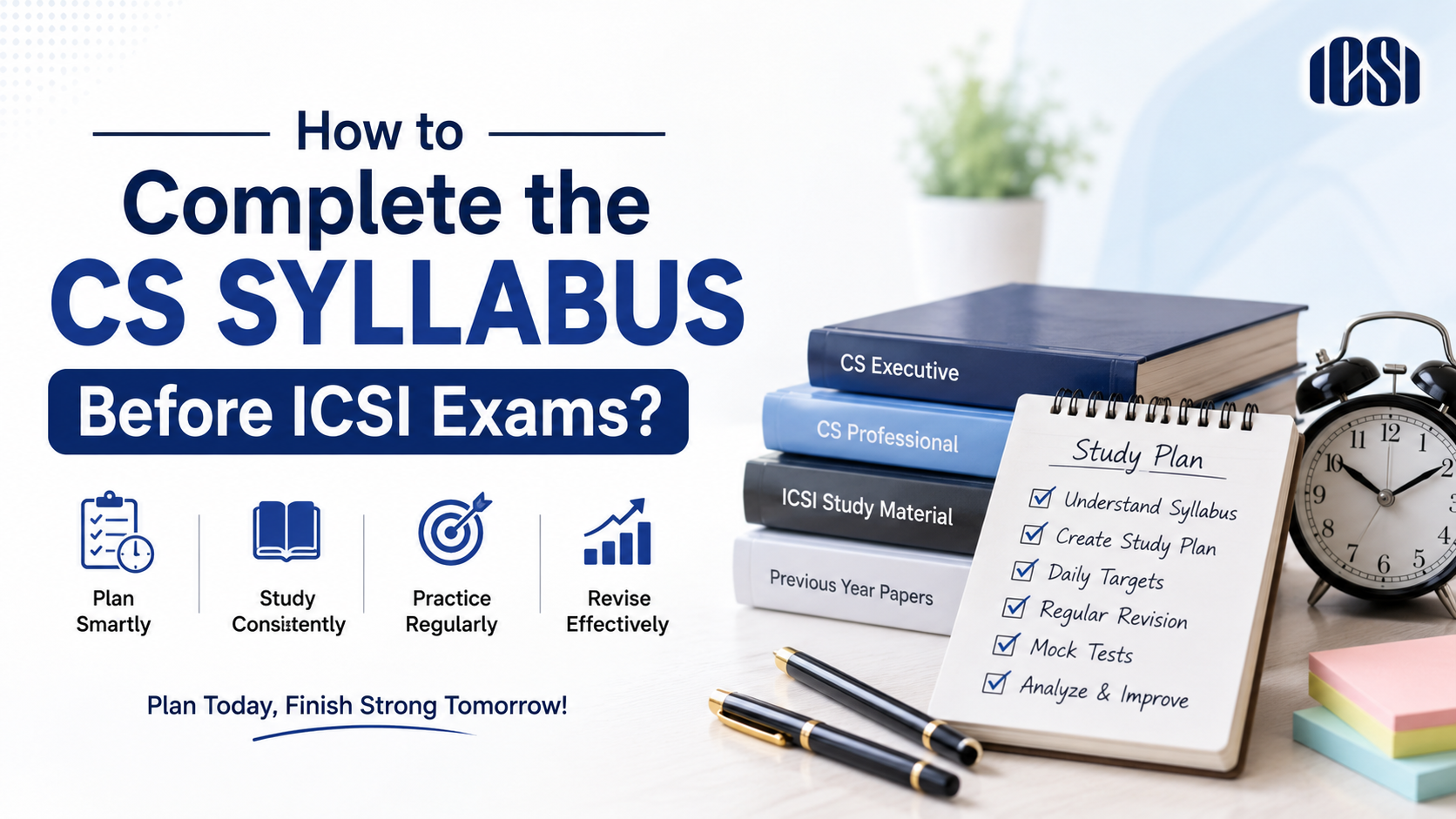
Preparing for the ICSI (Institute of Company Secretaries of India) examinations can feel overwhelming, especially when the syllabus seems never-ending. Whether you're appearing for the CS Executive or CS Professional examination, one question remains common among every aspirant:
"Can I really complete the entire CS syllabus before the exams?"
The answer is yes, but only if you follow a structured strategy instead of relying on last-minute preparation.
Many students fail not because they lack intelligence, but because they start studying without a proper roadmap. They spend weeks on one subject, ignore revisions, and panic during the final month.
This guide will show you a proven method to complete your CS syllabus on time while leaving enough room for revision, mock tests, and confidence building.
Why Most CS Students Fail to Complete the Syllabus
Before discussing solutions, let's understand the common mistakes.
|
Common Mistake |
Impact on Preparation |
|
Studying without a timetable |
Wastes valuable time |
|
Ignoring difficult subjects |
Creates backlog |
|
No revision schedule |
Forgets previously studied topics |
|
Solving very few mock papers |
Low confidence in exams |
|
Spending too much time making notes |
Less time for actual learning |
|
Studying only before exams |
Incomplete syllabus |
The biggest challenge is poor planning, not the syllabus itself.
Step 1: Know Your Entire Syllabus First
Many students immediately start reading books without understanding what they actually need to study.
Instead:
- Download the latest ICSI syllabus.
- List every subject.
- Divide every subject into chapters.
- Mark chapters as Easy, Moderate, and Difficult.
For example:
|
Priority |
Action |
|
Easy Chapters |
Complete within first few days |
|
Moderate Chapters |
Allocate sufficient practice time |
|
Difficult Chapters |
Start early and revise frequently |
This approach helps you track your progress more effectively.
Step 2: Break the Syllabus into Weekly Targets
Instead of thinking,
"I have to complete six subjects."
Think,
"I need to complete three chapters this week."
Small goals are much easier to achieve.
Example Weekly Study Plan
|
Day |
Target |
|
Monday |
Chapter 1 + Revision |
|
Tuesday |
Chapter 2 |
|
Wednesday |
Chapter 3 |
|
Thursday |
Practice Questions |
|
Friday |
Chapter 4 |
|
Saturday |
Mock Test |
|
Sunday |
Weekly Revision |
Weekly planning prevents procrastination and keeps motivation high.
Step 3: Follow the 3-Stage Learning Method
Every chapter should pass through three stages.
Stage 1: Learn
Understand the concepts instead of memorizing everything.
Read carefully.
Watch lectures if required.
Highlight important points.
Stage 2: Practice
Attempt:
- Practical Questions
- Case Studies
- Previous Year Questions
- MCQs (where applicable)
Practice transforms knowledge into exam-ready preparation.
Stage 3: Revise
Without revision, even well-prepared students forget concepts.
Revise:
- After 24 hours
- After one week
- Before exams
This technique dramatically improves retention.
Step 4: Prioritize High-Weightage Topics
Every chapter does not carry equal marks.
Identify:
- Frequently asked topics
- High-weightage chapters
- Important case laws
- Frequently tested practical questions
This increases your scoring potential without increasing study hours.
Step 5: Avoid Perfectionism
One major mistake students make is spending five days on one chapter.
Remember:
The goal is syllabus completion, not becoming an expert in every topic before moving ahead.
You can always improve understanding during revisions.
Progress is more important than perfection.
Step 6: Study Every Subject Every Week
Many students complete one subject entirely before touching another.
This often leads to forgetting earlier subjects.
A better approach is:
|
Subject |
Weekly Sessions |
|
Subject 1 |
3 |
|
Subject 2 |
2 |
|
Subject 3 |
2 |
|
Subject 4 |
2 |
This keeps every subject fresh in your memory.
Step 7: Keep Revision Days Fixed
Revision should never depend on your mood.
Reserve one complete day every week exclusively for revision.
During revision:
- Read summary notes.
- Solve important questions.
- Revise amendments.
- Practice writing answers.
Students who revise consistently perform significantly better than those who study continuously without reviewing previous topics.
Step 8: Solve Mock Tests Under Exam Conditions
Completing the syllabus is only half the battle.
The real preparation begins when you start writing mock tests.
Benefits include:
- Better time management
- Improved answer presentation
- Faster thinking
- Higher confidence
- Identification of weak areas
Try to solve at least 8–10 full-length mock papers before your ICSI examinations.
Step 9: Focus on Answer Writing Practice
Knowing the answer and writing it effectively are two different skills.
While practicing:
- Write within the time limit.
- Use proper headings.
- Mention relevant legal provisions.
- Include points systematically.
- Write neatly.
Better presentation often leads to better marks.
Step 10: Prepare a Final 30-Day Revision Plan
The last month should be reserved primarily for revision rather than learning new topics.
Sample 30-Day Strategy
|
Duration |
Focus Area |
|
Days 1–10 |
First Revision |
|
Days 11–18 |
Mock Tests |
|
Days 19–24 |
Weak Topics |
|
Days 25–28 |
Second Revision |
|
Days 29–30 |
Formulae, Amendments & Short Notes |
Following this structure helps reduce stress while improving retention.
Smart Time Management Tips for CS Students
- Study during your most productive hours.
- Keep your phone away while studying.
- Follow focused study sessions with short breaks.
- Track your daily targets.
- Avoid comparing your preparation with others.
- Sleep for at least 7–8 hours.
- Stay consistent rather than studying excessively on a few days.
Remember, consistency beats intensity.
Common Mistakes to Avoid
- Starting preparation too late.
- Ignoring previous year question papers.
- Not revising regularly.
- Skipping mock tests.
- Spending excessive time on notes.
- Avoiding difficult subjects.
- Studying without clear weekly goals.
- Depending entirely on selective study.
Avoiding these mistakes can significantly improve your chances of completing the syllabus on time.
Final Thoughts
Completing the CS syllabus before ICSI exams is not about studying for 15 hours every day—it is about studying smart.
A clear study plan, weekly targets, regular revisions, consistent mock test practice, and disciplined execution are the real secrets behind successful CS preparation.
Every successful Company Secretary once faced the same challenges you're facing today. The difference is that they stayed consistent, trusted their plan, and kept moving forward even when preparation felt difficult.
Start today. Even one productive day brings you closer to clearing the ICSI examination with confidence.