Scoring well in the ICSI examinations isn't just about knowing the law or memorising provisions. Every year, thousands of CS Executive and CS Professional students complete their syllabus, revise multiple times, and still miss out on excellent marks. The biggest reason? Poor answer writing.
Many students assume that if their answer is technically correct, they will automatically receive high marks. Unfortunately, that's not how professional examinations work.
ICSI examiners evaluate not only what you know, but also how effectively you communicate your knowledge. A well-presented answer that is logically structured, easy to understand, and supported with legal provisions can easily score significantly higher than a lengthy but poorly organised response.
If you're preparing for CS Executive or CS Professional exams, this guide will teach you exactly how to write answers that impress examiners and maximise your marks.
Why Answer Writing Matters in ICSI Exams
Unlike objective examinations, ICSI papers test your analytical thinking, legal understanding, drafting skills, and practical application.
Examiners generally look for:
- Correct interpretation of provisions
- Logical sequence
- Professional presentation
- Relevant sections and case laws
- Practical application
- Clear conclusion
Simply writing everything you know rarely works.
Instead, every answer should solve the question exactly as asked.
Understanding What the Examiner Wants
Before writing anything, understand the demand of the question.
Different directive words require different approaches.
| Directive Word | What Examiner Expects |
| Explain | Detailed explanation with concepts |
| Discuss | Balanced analysis with reasoning |
| State | Short and direct answer |
| Differentiate | Point-wise comparison |
| Comment | Opinion supported by legal provisions |
| Analyse | In-depth interpretation with reasoning |
| Illustrate | Explanation with examples |
| Advise | Practical legal solution |
Students often lose marks because they answer a completely different question than what was asked.
Always spend the first few seconds understanding the requirement.
Step 1: Read the Entire Question Carefully
Never rush.
Read every line carefully.
Notice important words like:
- State
- Explain
- Whether
- Justify
- Comment
- Advise
- Analyse
- Compare
Also identify:
- Relevant facts
- Legal issue
- Applicable provisions
- Final requirement
Many case-study questions contain small facts that completely change the answer.
Step 2: Plan Your Answer Before Writing
Instead of immediately writing, spend around 20–30 seconds preparing a mental structure.
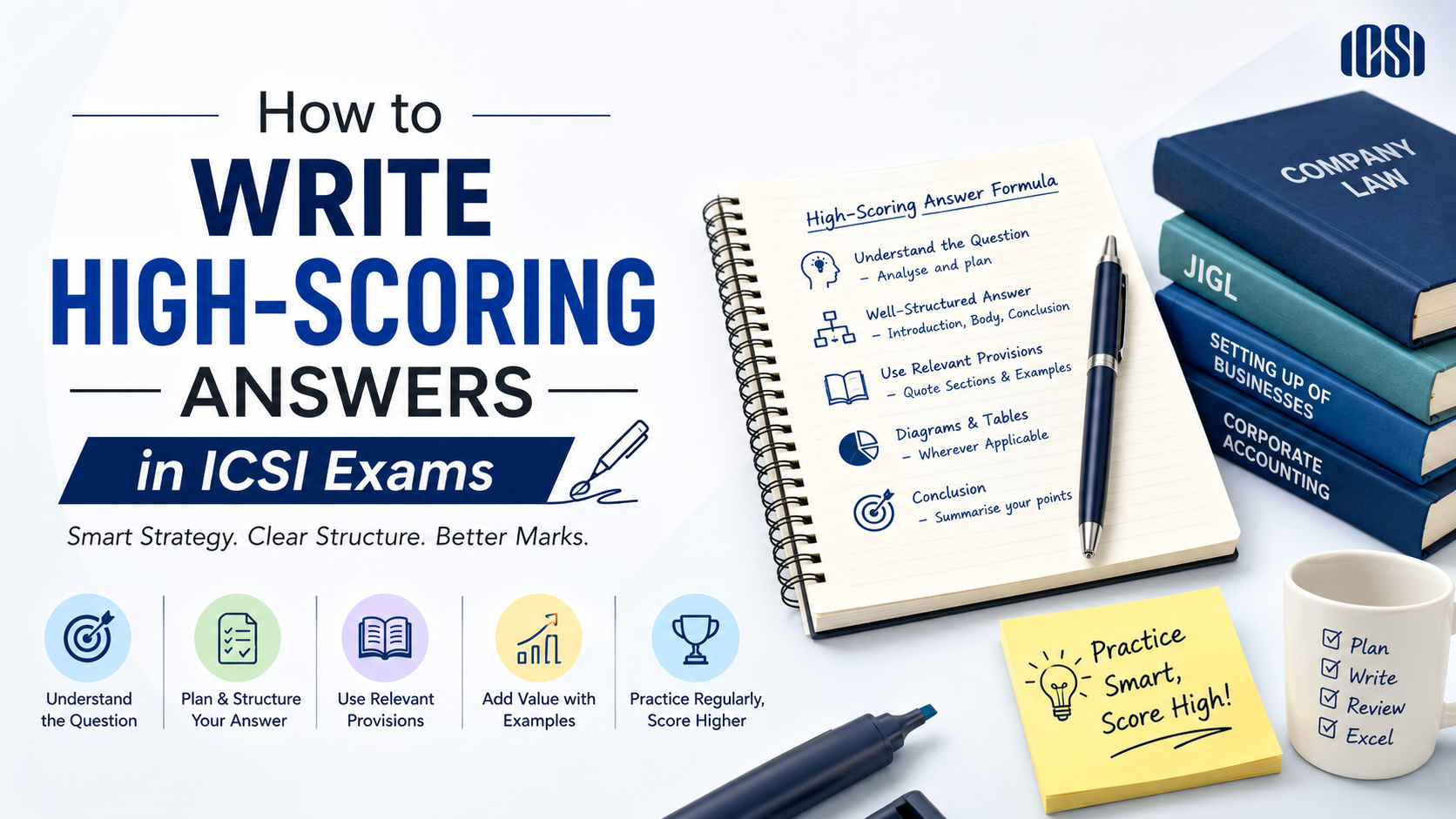
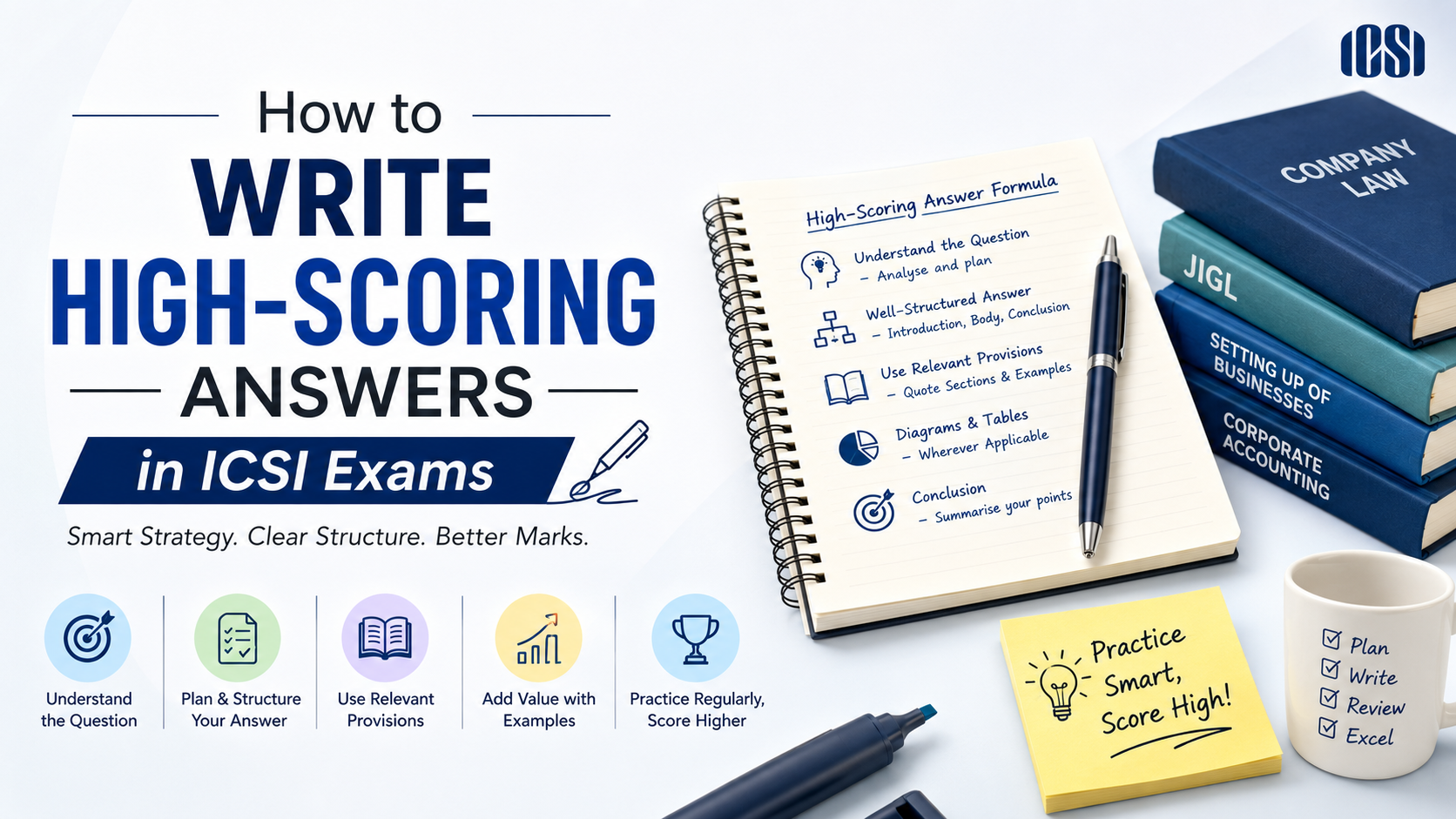
A good answer generally follows this format:
| Structure | Purpose |
| Introduction | Introduce the legal concept |
| Relevant Provision | Mention applicable section/rule |
| Analysis | Apply law to facts |
| Conclusion | Final opinion or advice |
This structure makes your answer easy to evaluate.
Step 3: Write a Strong Introduction
Avoid writing unnecessary history.
Instead, directly introduce the concept.
For example:
Instead of:
"Company law is a very important law in India."
Write:
"As per the Companies Act, 2013, the appointment of directors is governed by specific statutory provisions to ensure proper corporate governance."
A professional opening immediately creates a positive impression.
Step 4: Quote Relevant Sections (Wherever Possible)
ICSI gives extra importance to legal accuracy.
Whenever you remember the exact section, mention it.
Example:
- Section 149
- Section 173
- Section 185
- Regulation 27
- Secretarial Standard (SS-1/SS-2)
Even if you cannot recall the exact number, write the correct legal provision instead of guessing.
Wrong section numbers may reduce credibility.
Step 5: Present Answers in Proper Headings
Large paragraphs discourage examiners.
Instead, divide answers using headings like:
- Facts
- Legal Provision
- Analysis
- Observation
- Conclusion
Example:
Legal Provision
Application of Law
Conclusion
This improves readability instantly.
Step 6: Use Bullet Points Wherever Appropriate
Professional papers appreciate clarity.
Instead of writing:
"The company should appoint a director because..."
Write:
Reasons:
- Compliance requirement
- Better governance
- Statutory obligation
- Protection of stakeholders
Bullet points help examiners award marks quickly.
Step 7: Underline Important Keywords
Never underline entire sentences.
Underline only:
- Section numbers
- Legal terms
- Important conclusions
- Company names
- Key provisions
This helps the examiner identify important points within seconds.
Step 8: Maintain Logical Flow
Your answer should naturally move from one point to another.
Ideal flow:
Question → Provision → Analysis → Conclusion
Avoid jumping randomly between ideas.
A well-connected answer appears more professional.
Step 9: Support Answers with Examples
Whenever possible, include practical examples.
Example:
If explaining Board Meetings, briefly explain how a company would conduct one according to the Companies Act.
Examples improve understanding and demonstrate practical knowledge.
Step 10: Write a Clear Conclusion
Never leave answers incomplete.
Conclude with a precise statement.
Example:
"Therefore, based on the above provisions, the proposed action would not comply with the Companies Act, 2013."
A proper conclusion gives closure to your answer.
Common Mistakes That Cost Marks in ICSI Exams
Many CS aspirants work extremely hard but still fail to convert their knowledge into marks because of avoidable mistakes. Understanding these errors can significantly improve your score.
| Mistake | Impact on Marks | Better Approach |
| Writing without understanding the question | Irrelevant answer | Read the question twice before writing |
| Huge paragraphs | Difficult to evaluate | Use headings and bullet points |
| No legal provisions | Lower technical score | Mention Sections, Rules, or Regulations wherever possible |
| Poor handwriting | Examiner struggles to read | Write neatly and maintain spacing |
| No conclusion | Answer feels incomplete | End every answer with a clear conclusion |
| Guessing section numbers | Can reduce credibility | Mention the provision only if you're confident |
| Spending too much time on one question | Remaining questions suffer | Follow a fixed time strategy |
| Ignoring presentation | Lower overall impression | Underline keywords and maintain structure |
Time Management Strategy for Writing Answers
Knowing the answer is not enough—you also need to complete the paper on time.
A practical approach is to divide your exam based on marks.
| Question Marks | Recommended Time |
| 4 Marks | 5–6 Minutes |
| 6 Marks | 8–9 Minutes |
| 8 Marks | 10–12 Minutes |
| 10 Marks | 13–15 Minutes |
| 15 Marks | 18–20 Minutes |
Useful Tips:
- Keep the last 10–15 minutes for revision.
- Don't spend extra time trying to make one answer "perfect."
- If you get stuck, move to the next question and come back later.
- Attempt every question unless there is a negative marking rule (which generally doesn't apply to descriptive papers).
Ideal Structure of a High-Scoring ICSI Answer
A structured answer is easier for the examiner to evaluate and helps ensure you don't miss important points.
Sample Answer Framework
1. Introduction
Briefly introduce the concept in 2–3 lines.
2. Relevant Legal Provision
Mention:
- Companies Act, 2013
- LLP Act
- FEMA
- SEBI Regulations
- Secretarial Standards
- Relevant ICSI Guidelines
Include the section number if you remember it accurately.
3. Analysis
This is the most important part.
- Apply the law to the facts.
- Explain the reasoning.
- Address every part of the question.
4. Conclusion
End with a precise legal opinion or recommendation.
This format is exactly what examiners expect in professional examinations.
Average Answer vs High-Scoring Answer
| Average Answer | High-Scoring Answer |
| Starts writing immediately | Plans before writing |
| Long paragraphs | Uses headings and bullet points |
| General explanation | Specific legal analysis |
| No Sections mentioned | Relevant Sections quoted |
| No examples | Practical examples included |
| Weak conclusion | Strong legal conclusion |
| Poor presentation | Clean and professional presentation |
| Difficult to evaluate | Easy for examiner to award marks |
A well-structured answer can often score 10–20% higher than an equally knowledgeable but poorly presented one.
Presentation Tips That Impress ICSI Examiners
Presentation doesn't replace knowledge, but it makes your knowledge easier to evaluate.
Here are some simple practices that create a professional impression:
✔ Write Clearly
Legible handwriting is more important than beautiful handwriting.
✔ Leave Proper Space
Avoid squeezing everything together. Leave enough space between headings and paragraphs.
✔ Number Every Point
Instead of writing continuous text, use:
- Point One
- Point Two
- Point Three
This improves readability.
✔ Use Margins
Maintain the margins provided in the answer booklet. Avoid writing outside them.
✔ Underline Important Terms
Underline only:
- Section numbers
- Legal terms
- Case names
- Key conclusions
Avoid excessive underlining, as it loses its effectiveness.
✔ Avoid Cutting and Overwriting
Too many corrections make the answer sheet look untidy. If you make a mistake, strike it neatly with a single line.
Should You Draw Flowcharts or Tables?
Yes—where appropriate.
Some topics become much easier to explain using visual formats.
For example:
- Difference between Public and Private Company
- Board vs General Meeting
- Types of Share Capital
- Stages of Winding Up
- Compliance Calendar
- Secretarial Audit Process
A comparison table is often more effective than a full page of paragraphs.
Importance of Using Professional Language
Remember, you're preparing to become a Company Secretary.
Avoid casual phrases like:
- "I think..."
- "Maybe..."
- "It seems..."
Instead, use professional expressions such as:
- "As per the provisions of..."
- "It is evident that..."
- "Accordingly..."
- "Therefore..."
- "In view of the above..."
- "Hence..."
- "The company shall..."
- "The Board is required to..."
Professional language reflects confidence and maturity.
Practice Is the Secret to Better Answer Writing
Reading alone won't improve answer writing.
You need consistent writing practice.
A weekly routine can make a big difference:
| Activity | Frequency |
| Solve Previous Year Questions | 2–3 Papers per Week |
| Write Full-Length Mock Tests | 1 Every Week |
| Analyse Suggested Answers | After Every Test |
| Review Mistakes | Weekly |
| Improve Presentation | Daily Practice |
After each mock test, ask yourself:
- Did I answer exactly what was asked?
- Was my answer logically structured?
- Did I mention the relevant provisions?
- Could an examiner understand my answer easily?
- Did I finish the paper on time?
Continuous improvement in these areas leads to noticeable score improvements.
Final Thoughts
Writing high-scoring answers in ICSI exams is a skill that develops with practice, not luck. Students who consistently secure top marks don't necessarily know more than others—they present their knowledge in a way that aligns with the examiner's expectations.
Focus on understanding the question, writing in a structured format, quoting relevant legal provisions, using professional language, and maintaining neat presentation. Combine these habits with regular mock test practice and honest self-evaluation, and you'll gradually see your scores improve.
Whether you're preparing for CS Executive or CS Professional, mastering answer writing can become your biggest competitive advantage. Remember, in professional examinations, clarity, precision, and presentation are just as important as knowledge.