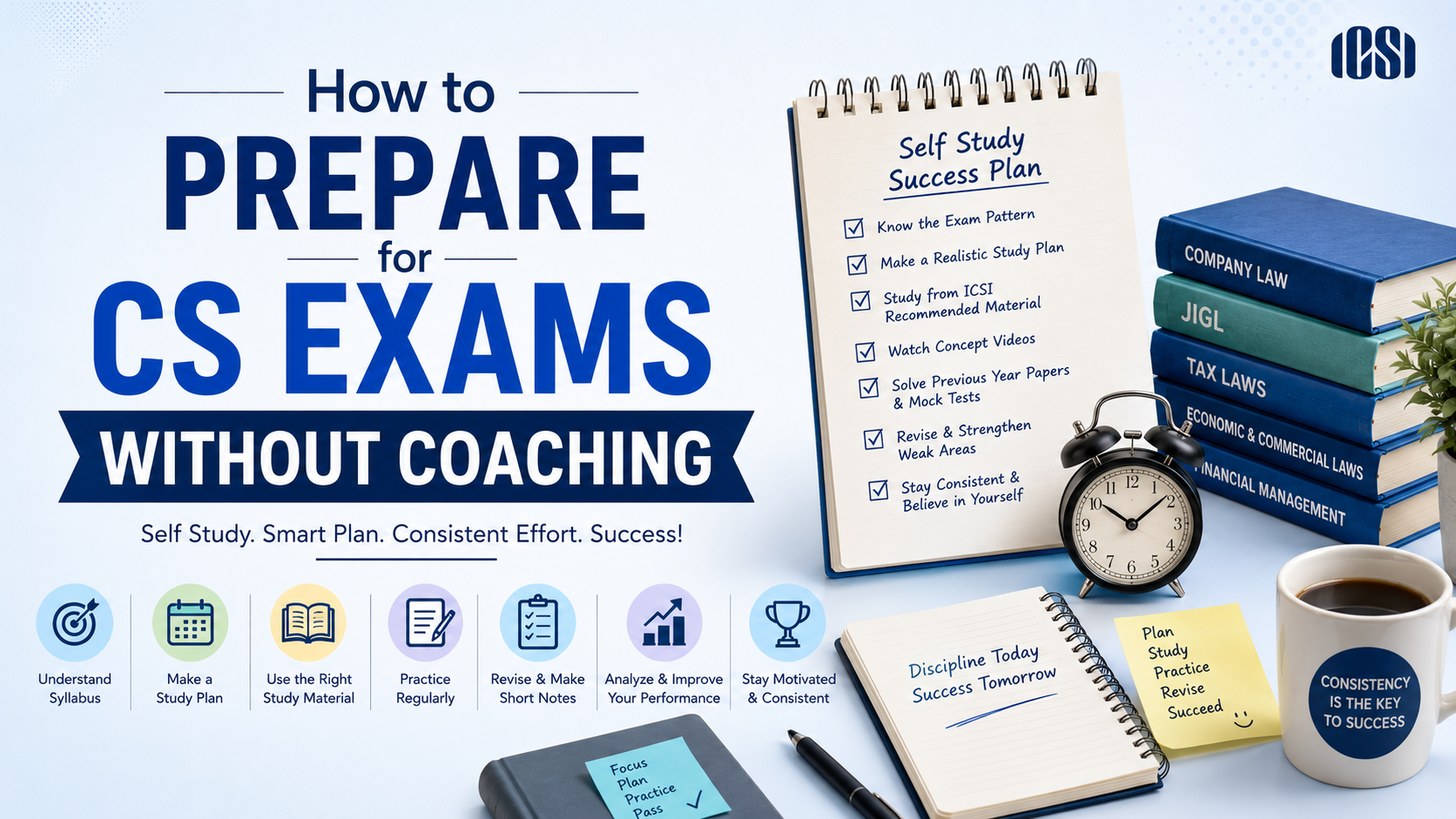
Preparing for the Company Secretary (CS) examination without joining a coaching institute may seem challenging at first. Many students believe that clearing the CS Executive or CS Professional examination is impossible without classroom coaching. However, the reality is completely different.
Every examination session, hundreds of students successfully clear CS examinations through disciplined self-study, smart planning, consistent revision, and regular mock test practice. Coaching can certainly provide guidance, but it is never the only path to success.
The Institute of Company Secretaries of India (ICSI) designs its examinations to evaluate conceptual understanding, legal interpretation, analytical thinking, and presentation skills. These abilities can be developed effectively through self-study if the preparation strategy is well planned.
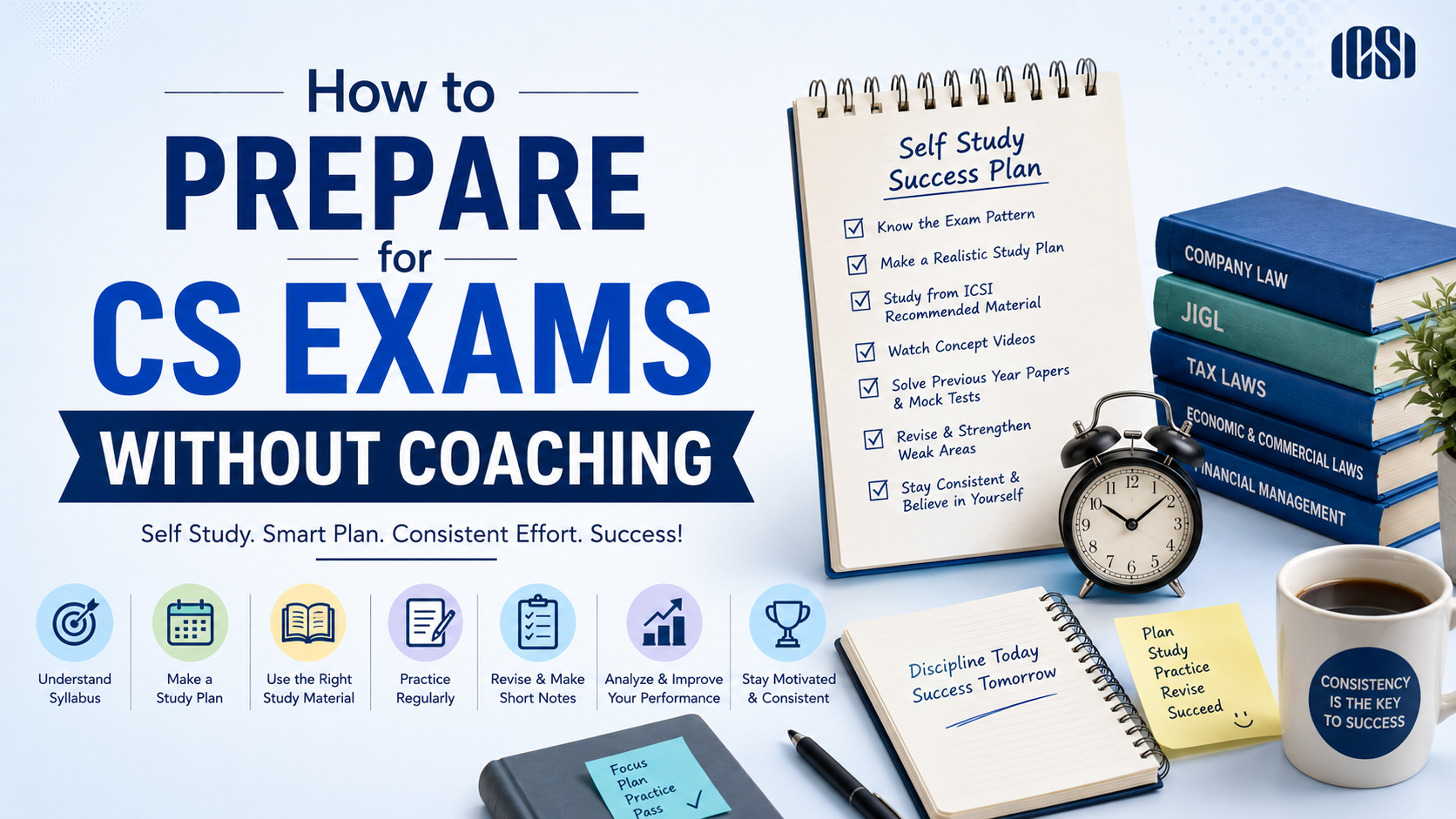
In this guide, you'll learn exactly how to prepare for CS exams without coaching, including study planning, subject-wise preparation, resource selection, revision methods, time management, and exam strategies that have helped many successful candidates.
Can You Really Clear CS Exams Without Coaching?
The simple answer is Yes.
Thousands of successful Company Secretaries have prepared entirely on their own. The deciding factor is not whether you join coaching but whether you remain consistent throughout your preparation journey.
Many coaching students also fail because they depend completely on classroom lectures without revising or practicing answer writing. On the other hand, self-study students often perform exceptionally well because they take full ownership of their preparation.
The CS examination rewards students who:
- Understand concepts instead of memorizing blindly.
- Revise multiple times.
- Practice writing descriptive answers.
- Solve previous years' papers.
- Stay updated with amendments.
- Maintain consistency for several months.
If you can develop these habits, coaching becomes optional rather than compulsory.
Why Many Students Prefer Self-Study
Over the last few years, digital learning has changed how students prepare for professional examinations.
Students now have access to:
- ICSI study material
- Online amendments
- YouTube concept lectures
- Practice question banks
- Mock tests
- Revision notes
- Legal updates
- Student discussion communities
This means almost every learning resource is available online.
Instead of depending on fixed classroom schedules, self-study allows students to prepare according to their own pace.
Benefits of Self-Study for CS Aspirants
| Benefit | How It Helps |
| Flexible Schedule | Study anytime according to your routine |
| Cost Effective | Saves coaching fees |
| Better Revision | More time available for multiple revisions |
| Personalized Learning | Spend extra time on difficult subjects |
| Independent Thinking | Improves analytical ability |
| Better Time Management | Helps develop discipline |
Advantages of Preparing Without Coaching
1. Complete Control Over Your Time
One of the biggest advantages of self-study is flexibility.
Instead of attending fixed coaching classes every day, you can allocate time according to your strengths and weaknesses.
For example:
- More hours for Company Law
- Moderate hours for Tax Laws
- Less time for already strong subjects
This customization significantly improves productivity.
2. Learn at Your Own Speed
Every student learns differently.
Some subjects require repeated reading, while others become easy after solving practical questions.
During self-study, you can:
- Pause difficult concepts
- Repeat chapters
- Watch additional lectures
- Make personalized notes
- Revise important sections multiple times
There is no pressure to match the pace of an entire classroom.
3. Better Focus During Revision
Revision is where most ranks are decided.
Students attending coaching often spend several hours travelling or attending classes, leaving less time for revision.
Self-study students can dedicate additional hours to:
- Revision
- Answer writing
- Mock papers
- Amendment updates
- Previous year questions
This gives them a significant advantage before examinations.
Challenges of Self-Study (And How to Overcome Them)
Self-study is rewarding, but it also comes with challenges. Understanding these in advance helps you prepare better.
| Challenge | Solution |
| Lack of motivation | Set weekly goals and track progress |
| Procrastination | Follow a fixed study timetable |
| No teacher support | Use authentic online resources and reference books |
| Doubt solving | Join student forums or discussion groups |
| Poor revision | Prepare short notes after every chapter |
| Lack of practice | Solve mock tests regularly |
Remember, every successful self-study student has faced these challenges. The difference lies in how consistently they overcome them.
Step-by-Step Strategy to Prepare for CS Exams Without Coaching
Instead of studying randomly, follow a structured approach.
Step 1: Understand the Complete Syllabus
Before opening your books, spend time understanding the syllabus.
Many students waste months studying topics that carry less weight while ignoring high-scoring chapters.
Create a subject-wise checklist that includes:
- Chapters
- Learning objectives
- Weightage (based on previous trends)
- Status of completion
- Revision count
Example:
| Subject | Chapters | Completed | Revision |
| Company Law | 15 | ✔ | 2 |
| Tax Laws | 12 | ✔ | 1 |
| Securities Laws | 10 | Pending | 0 |
| Economic Laws | 9 | In Progress | 1 |
Tracking progress visually keeps you motivated and ensures no topic is overlooked.
Step 2: Choose the Right Study Material
One of the biggest mistakes students make is collecting too many books.
Instead of studying from five different sources, master one trusted source thoroughly.
A recommended resource hierarchy is:
| Priority | Study Material | Purpose |
| 1 | ICSI Study Material | Primary source for concepts |
| 2 | ICSI Module Questions | Concept-based practice |
| 3 | Previous Year Question Papers | Understand exam pattern |
| 4 | Mock Test Papers | Improve answer writing and time management |
| 5 | Bare Acts (where applicable) | Strengthen legal understanding |
Quality of study always matters more than quantity of books.
Step 3: Build a Realistic Daily Study Plan
A common reason students fail is creating unrealistic schedules that they cannot maintain.
Instead of aiming for 14–15 hours every day, focus on a timetable you can consistently follow for months.
Here's an example:
| Time | Activity |
| 6:30 AM – 8:30 AM | Study difficult theory subject |
| 9:30 AM – 11:00 AM | Practical/problem-solving subject |
| 12:00 PM – 1:00 PM | Revision of previous topics |
| 3:00 PM – 5:00 PM | New chapter learning |
| 6:00 PM – 7:00 PM | Practice MCQs or descriptive questions |
| 8:30 PM – 9:30 PM | Quick revision and short notes |
Even 6–8 focused hours of quality study every day can outperform 12 hours of distracted learning.
Develop the Habit of Active Learning
Reading a chapter once is rarely enough for professional exams. Instead of passive reading:
- Highlight important legal provisions.
- Prepare concise handwritten revision notes.
- Create mind maps for interconnected topics.
- Explain concepts aloud as if teaching someone else.
- Write short answers after finishing each chapter.
Active learning improves retention and prepares you for descriptive papers where understanding matters more than memorization.
Subject-Wise Preparation Strategy
Every subject in the CS examination requires a different preparation approach. Studying every paper using the same method is one of the biggest mistakes students make.
Let's understand how to prepare each type of subject effectively.
1. Company Law
Company Law is considered the backbone of the CS curriculum. Instead of memorizing sections, focus on understanding the logic behind legal provisions.
Best Preparation Strategy
- Read every chapter from the ICSI Study Material.
- Understand the objective behind each provision.
- Prepare section-wise summary notes.
- Learn important exceptions.
- Practice case-study-based questions.
- Revise amendments regularly.
Scoring Tips
- ✔ Learn definitions accurately.
- ✔ Quote section numbers whenever possible.
- ✔ Mention relevant provisions while writing answers.
- ✔ Write answers in a structured legal format.
2. Tax Laws
Taxation often appears difficult because students try to memorize instead of practicing.
The only way to master Tax Laws is regular numerical practice.
Preparation Strategy
- Solve practical questions daily.
- Revise provisions repeatedly.
- Keep separate amendment notes.
- Learn computation formats.
- Practice previous examination questions.
3. Securities Laws
This subject contains many regulations.
Instead of reading everything repeatedly, create summary charts.
Example:
| Topic | Important Areas |
| SEBI Regulations | Objectives, Applicability, Compliance |
| Insider Trading | Definitions, Restrictions, Penalties |
| Listing Obligations | Key Provisions |
| Depositories | Functions & Process |
Visual revision always saves time.
4. Economic, Commercial & Labour Laws
This subject becomes easy when divided into smaller portions.
Instead of studying an entire Act in one sitting:
- Read Objectives
- Learn Definitions
- Understand Important Provisions
- Study Penalties
- Practice Questions
Breaking lengthy Acts into smaller sections improves retention.
5. Drafting, Pleadings & Appearances
This paper tests practical knowledge.
Focus on:
- Drafting formats
- Notice writing
- Agreements
- Board resolutions
- Legal documents
The more formats you practice, the more confident you'll become.
6. Governance, Risk Management & Ethics
This subject is conceptual rather than theoretical.
Instead of memorizing paragraphs:
- Understand governance principles.
- Learn practical examples.
- Connect concepts with current corporate practices.
- Prepare flowcharts for revision.
How to Make Short Notes
One of the biggest advantages of self-study is creating personalized revision notes.
Instead of writing complete chapters again, prepare concise notes containing:
- Important definitions
- Key provisions
- Section numbers
- Flowcharts
- Diagrams
- Mnemonics
- Important case laws
- Frequently asked questions
Example:
| Chapter | One-Page Revision Note |
| Company Incorporation | Process Flowchart |
| Share Capital | Types + Conditions |
| Board Meetings | Timeline + Compliance |
| CSR | Applicability + Limits |
One-page revision sheets become extremely useful before examinations.
Importance of Previous Year Question Papers
Many students ignore previous year papers until the last month.
This is a mistake.
Previous year papers help you understand:
- Question pattern
- Repeated topicsSolve chapter-wise
- Important chapters
- Answer presentation
- Difficulty level
- Time management
Recommended Practice Plan
| Preparation Stage | Previous Year Papers |
| First Reading | Observe only |
| Second Reading | Solve chapter-wise |
| Third Revision | Solve complete paper |
| Last Month | Attempt under exam conditions |
Why Mock Tests Are Essential
Mock tests bridge the gap between preparation and actual performance.
Many students know the answers but fail because they cannot complete the paper on time.
Regular mock tests help improve:
- Writing speed
- Presentation
- Confidence
- Time management
- Answer structuring
- Revision planning
Even one mock test every week can significantly improve your exam readiness.
Suggested Mock Test Schedule
| Time Before Exam | Mock Tests |
| 90–60 Days | 1 Mock every 2 weeks |
| 60–30 Days | 1 Mock every week |
| Last 30 Days | 2–3 Full Mock Tests every week |
| Last 10 Days | Full-Length Exam Simulation |
How to Write High-Scoring Answers
Many students lose marks despite knowing the concepts because of poor presentation.
Follow this structure:
Step 1
Read the question carefully.
Identify:
- Keywords
- Requirement
- Applicable law
Step 2
Begin with a short introduction.
Step 3
Mention the relevant legal provision or concept.
Step 4
Explain the provision logically.
Step 5
Support with examples wherever possible.
Step 6
End with a clear conclusion.
Ideal Answer Structure
| Sequence | Content |
| 1 | Introduction |
| 2 | Relevant Provision |
| 3 | Explanation |
| 4 | Illustration |
| 5 | Conclusion |
This structure improves readability and often helps fetch better marks.
Time Management Strategy
Many aspirants complain they never have enough time.
The problem is usually not time—it is planning.
A balanced weekly study routine could look like this:
| Day | Focus Area |
| Monday | New Topics |
| Tuesday | Practical Questions |
| Wednesday | Revision |
| Thursday | Mock Test |
| Friday | Weak Subjects |
| Saturday | Previous Year Questions |
| Sunday | Weekly Revision |
This cycle ensures continuous learning without neglecting revision.
The 3-Revision Rule
One revision is never enough for professional exams.
Follow this proven revision cycle:
| Revision | Purpose |
| First Revision | Understand concepts |
| Second Revision | Improve retention |
| Third Revision | Exam-oriented recall |
Students who revise three or more times generally perform much better than those who only complete the syllabus once.
The 90–60–30 Preparation Strategy
A structured countdown can make your preparation more effective.
90 Days Before Exam
- Complete the remaining syllabus.
- Prepare chapter-wise notes.
- Solve basic questions.
60 Days Before Exam
- Begin intensive revision.
- Solve previous year papers.
- Start full-length mock tests.
- Strengthen weak subjects.
Last 30 Days
- Revise only from your notes.
- Attempt mock papers in exam conditions.
- Focus on amendments and frequently asked topics.
- Avoid starting entirely new books or resources.
Common Mistakes to Avoid
Even hardworking students sometimes miss out on good scores due to avoidable errors.
| Mistake | Better Approach |
| Collecting too many books | Stick to one primary source and revise it multiple times |
| Ignoring ICSI Study Material | Make ICSI modules your foundation |
| Skipping revisions | Schedule at least three revisions |
| Not writing practice answers | Practice descriptive writing every week |
| Avoiding mock tests | Simulate real exam conditions regularly |
| Depending only on videos | Read, write, revise, and practice alongside watching lectures |
| Last-minute cramming | Follow a long-term, consistent preparation plan |
Stay Consistent, Not Perfect
One of the biggest myths surrounding CS preparation is that you need to study 12–15 hours every day.
In reality, consistency beats intensity.
Studying 6–8 focused hours every day for several months is far more effective than studying excessively for a few days and then taking long breaks.
Celebrate small milestones, track your weekly progress, and don't compare your journey with others. Every chapter completed, every mock test attempted, and every revision finished brings you one step closer to becoming a Company Secretary.
A disciplined routine, regular self-assessment, and confidence in your preparation can help you succeed without relying on coaching.
Conclusion
Preparing for the Company Secretary (CS) examination without coaching is not only possible—it has become increasingly common. With access to the official ICSI study material, online educational resources, previous years' question papers, and quality mock tests, self-study can be just as effective as classroom coaching.
The real difference lies in consistency, discipline, and smart preparation. Instead of depending on multiple coaching institutes or collecting dozens of books, focus on mastering the official study material, revising regularly, practicing answer writing, and evaluating your performance through mock tests.
Remember that the CS examination is designed to test your conceptual understanding, analytical thinking, and ability to apply legal provisions. These skills are developed through continuous practice rather than passive learning.
If you create a realistic study schedule, revise each subject multiple times, solve previous years' papers, and maintain confidence throughout your preparation journey, clearing the CS Executive or CS Professional examination without coaching is absolutely achievable.
Your goal should not be to study more than everyone else—it should be to study smarter, revise consistently, and stay committed until the last day of the examination.
Success in the CS examination is not determined by whether you joined coaching. It is determined by how effectively you prepared.Saturday