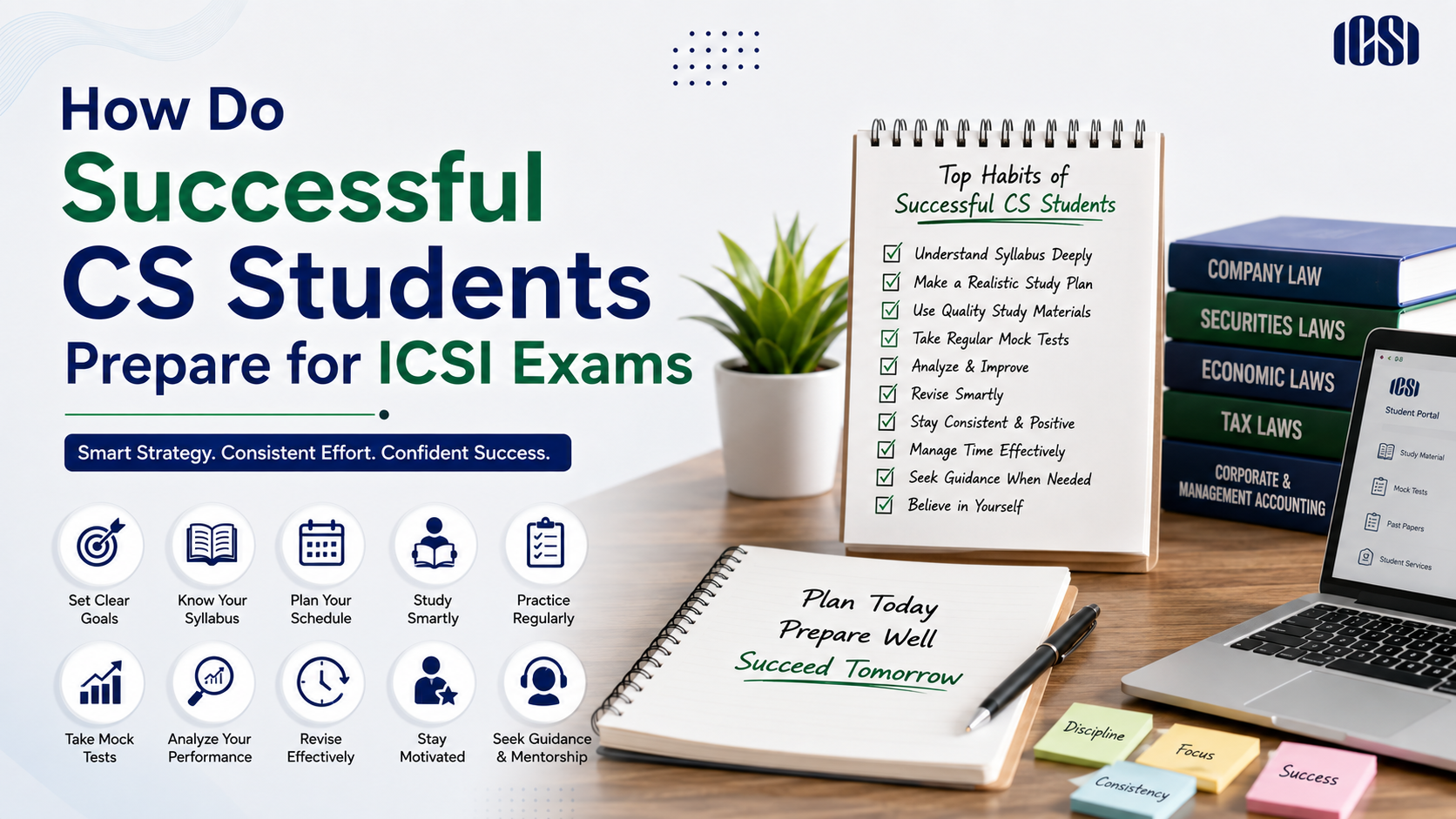
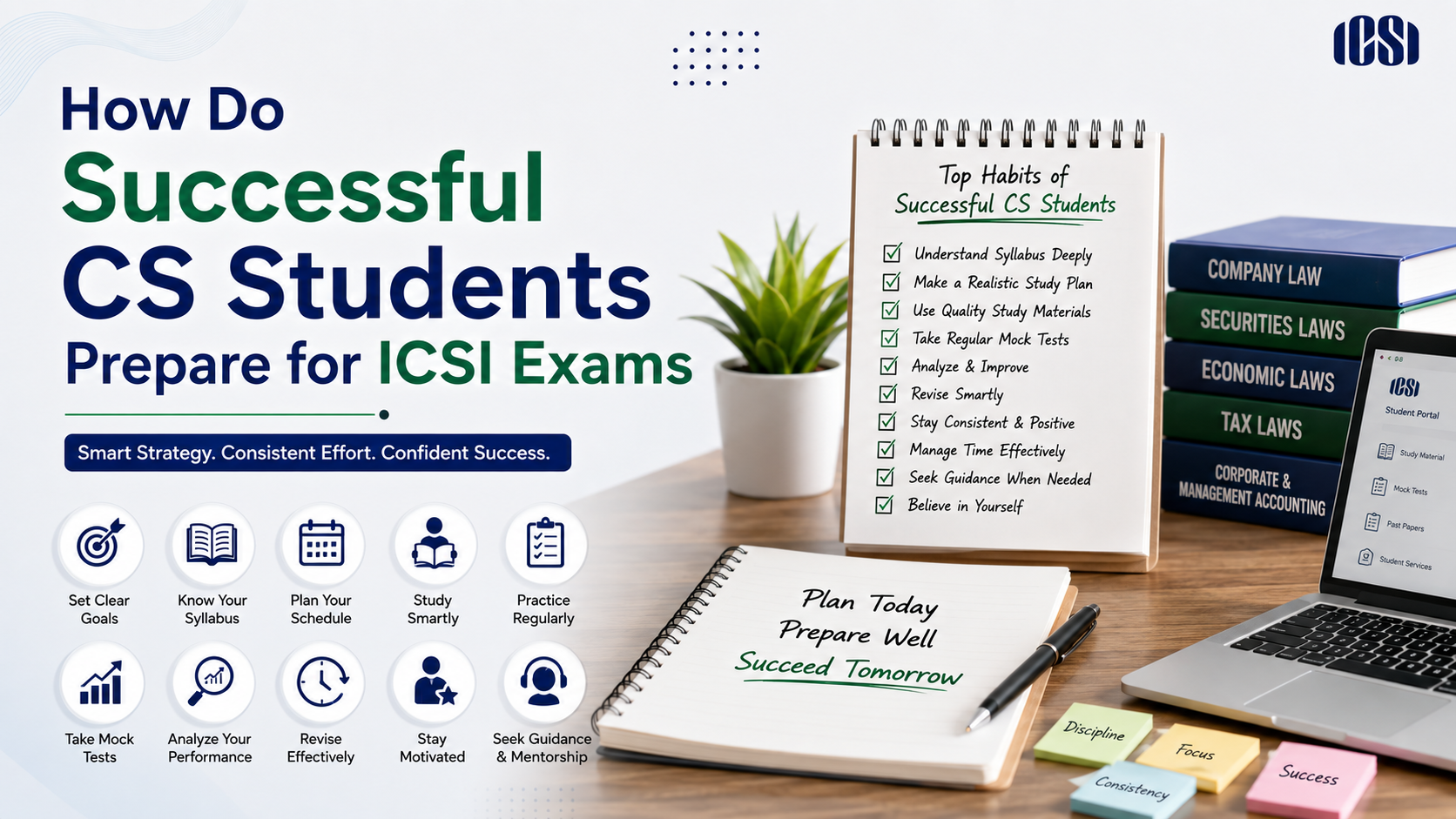
Preparing for an ICSI exam is not simply about studying for long hours. Ask students who consistently perform well, and you will notice something interesting: most of them do not necessarily study 12–14 hours every day.
What they do differently is study with a clear system.
They know what to study, when to revise it, how to practice writing answers, how to analyse their mistakes, and how to use mock tests before the actual examination. They also understand that completing the syllabus is only one part of preparation. The real challenge is being able to recall, present, and complete the paper within the examination time.
Whether you are preparing for the CS Executive or CS Professional examination, the right strategy can make your preparation much more effective.
At CS Exam Test Series, we have seen that students often struggle not because they lack the ability to understand the subjects, but because their preparation lacks structure. They read chapters repeatedly but do not test themselves. They solve questions but do not analyse their mistakes. They revise, but without a proper revision cycle.
Successful CS students approach preparation differently.
Let's understand exactly how.
They Start With the ICSI Syllabus and Study Material
One of the biggest mistakes students make is beginning preparation without understanding the official syllabus properly.
Successful students first create a clear picture of:
- Subjects they have to prepare
- Chapters and modules in every subject
- Important concepts
- Practical and theoretical portions
- Topics that require repeated revision
- Areas where they are personally weak
The objective is not to study everything randomly. It is to create a roadmap.
Your preparation should answer three basic questions:
What do I need to study?
By when should I complete it?
How many times will I revise it before the exam?
Once these questions are clear, preparation becomes much less stressful.
They Create a Realistic Study Plan
A successful CS study plan is not necessarily the most complicated one.
In fact, a simple plan that you can follow consistently is much better than an impressive timetable that you abandon after three days.
A practical plan should divide your preparation into different stages.
|
Preparation Stage |
Main Objective |
What You Should Do |
|
Stage 1 |
Concept Building |
Understand chapters and concepts |
|
Stage 2 |
Syllabus Completion |
Finish remaining topics systematically |
|
Stage 3 |
First Revision |
Revise concepts and important provisions |
|
Stage 4 |
Answer Writing |
Practice writing exam-oriented answers |
|
Stage 5 |
Mock Tests |
Attempt full-length papers under exam conditions |
|
Stage 6 |
Final Revision |
Revise weak areas, amendments and important topics |
This approach prevents the common problem of reaching the final month with a large portion of the syllabus still untouched.
The key is consistency
Studying eight hours on Sunday and almost nothing on Monday does not create strong preparation.
Studying consistently every day, even if the daily target is moderate, usually produces better results.
They Don't Confuse Reading With Preparation
This is one of the most important differences between average and successful students.
Reading a chapter feels productive.
But reading alone does not tell you whether you can reproduce the information in the examination.
Suppose you spend two hours studying a topic. You close the book and feel confident that you understand it.
Now try answering five questions without looking at your notes.
Suddenly, you may realise that you remember only part of the topic.
This is why successful students regularly use active recall.
Instead of repeatedly reading the same material, they ask themselves:
- What did I study?
- Can I explain this concept without looking at the book?
- Can I remember the important provisions?
- Can I solve a practical question based on this concept?
- Can I write a structured answer?
This simple habit can significantly improve retention.
They Follow a Revision Cycle
Successful CS students rarely depend on one final revision.
They revise multiple times.
A simple revision cycle can look like this:
First Revision: Focus on understanding and remembering the core concepts.
Second Revision: Focus on important provisions, concepts, practical applications and frequently tested areas.
Third Revision: Focus on quick recall, weak topics and exam-oriented questions.
Final Revision: Focus on concise notes, amendments, important sections and mistakes identified through mock tests.
The exact number of revisions will depend on your preparation level and available time.
The important thing is that revision should be planned from the beginning, not treated as something you will do if time is left.
They Practice Answer Writing Early
Knowing the answer and writing the answer are two different skills.
This becomes especially important in professional examinations where presentation, structure, keywords and logical explanation matter.
Many students spend months studying but begin answer-writing practice only a few days before the examination.
That can be risky.
Successful students start answer writing during preparation itself.
They practise:
- Understanding the question
- Identifying what the examiner is asking
- Structuring the answer
- Using appropriate headings
- Mentioning relevant provisions
- Applying concepts to practical situations
- Writing conclusions wherever required
- Managing time
- Avoiding unnecessary explanations
A simple answer-writing structure
For many theoretical or practical questions, students can train themselves to think in the following format:
Issue → Relevant Provision/Concept → Explanation → Application/Analysis → Conclusion
Of course, the exact structure depends on the question.
The objective is to make your answer clear, relevant and easy to evaluate.
They Use Mock Tests as a Learning Tool
A mock test should not be treated as just another question paper.
It is a simulation of the actual examination.
This is where a CS test series can become extremely useful.
A good test series allows you to experience:
- Exam-like pressure
- Time limitations
- Full-length paper practice
- Different question formats
- Answer-writing challenges
- Revision under pressure
- Performance analysis
For example, CS Exam Test Series can be used as part of a structured preparation strategy rather than something students attempt only at the end.
The biggest benefit of a mock test is not the marks.
It is the information you get after the test.
They Analyse Their Mistakes After Every Test
This is where many students lose a major opportunity.
They attempt a mock test, check their marks and move to the next test.
Successful students go one step further.
They analyse why they lost marks.
A useful mistake-analysis table can look like this:
|
Mistake Type |
Example |
Corrective Action |
|
Conceptual Error |
Did not understand the provision |
Re-study the concept |
|
Memory Error |
Forgot an important point |
Add to revision notes |
|
Application Error |
Could not apply concept |
Practise similar questions |
|
Presentation Error |
Answer lacked structure |
Improve answer format |
|
Time Management |
Left questions incomplete |
Practise timed tests |
|
Careless Mistake |
Misread the question |
Slow down during reading |
Imagine scoring 52 marks in a mock test.
Instead of simply thinking, "I got 52," ask:
Where did the other 48 marks go?
That question is far more valuable.
They Simulate the Real Examination
Mock tests are most useful when students take them seriously.
Successful students try to recreate actual exam conditions.
That means:
- Sit for the complete duration.
- Keep your phone away.
- Use appropriate stationery.
- Avoid checking notes during the test.
- Follow the time limit.
- Attempt the paper in one sitting.
- Practise writing continuously.
- Review the paper only after completing it.
Why?
Because examination performance is partly about knowledge and partly about mental and physical stamina.
You need to train yourself to think and write effectively for the entire examination duration.
They Learn Time Management Before Exam Day
One of the most common complaints after an examination is:
"I knew the answer, but I couldn't complete the paper."
This is usually a preparation problem, not simply an exam-day problem.
Time management needs to be practised beforehand.
During mock tests, notice:
- How long you spend reading questions
- How much time you spend on long answers
- Whether you over-write certain answers
- Whether you get stuck on difficult questions
- How much time remains for revision
You can then develop a personal time-management strategy.
For example:
|
Activity |
Suggested Focus |
|
Reading the paper |
Understand requirements carefully |
|
First section |
Maintain controlled pace |
|
Long answers |
Avoid excessive time |
|
Difficult questions |
Don't get stuck indefinitely |
|
Final phase |
Keep time for checking |
These are not rigid rules. Your actual approach should be based on your speed and the paper pattern.
They Prioritise Quality Over Random Study Hours
There is a common belief that successful students study all day.
That is not necessarily true.
What matters is the quality of those study hours.
Two focused hours can sometimes be more productive than five distracted hours.
During focused study sessions:
- Keep your phone away.
- Study one specific topic.
- Set a measurable target.
- Take short breaks.
- Test yourself after studying.
- Record difficult areas.
Instead of writing:
"Study Company Law today."
Write:
"Complete Chapter X, revise key provisions, solve 15 questions and write one answer."
The second target is measurable.
That makes progress easier to track.
They Make Short Revision Notes
Successful students do not necessarily rewrite entire textbooks.
Instead, they create concise revision material.
These notes may include:
- Important provisions
- Key definitions
- Frequently confused concepts
- Important exceptions
- Important amendments
- Difficult practical concepts
- Mistakes from mock tests
- Frequently forgotten points
The purpose of these notes is simple:
Make final revision faster.
During the final days before the exam, you should not want to read hundreds of pages again.
You should have a compact resource that helps you quickly refresh important information.
They Give Special Attention to Amendments and Updates
For professional examinations, students must stay alert to applicable amendments, updates and changes relevant to their syllabus.
Successful students don't leave this preparation until the final night.
They maintain a separate section for updates and revise it repeatedly.
A simple approach is:
Learn → Note → Revise → Practise → Revisit
This reduces the possibility of forgetting important updates under examination pressure.
Always ensure that the material you use is applicable to your particular attempt and syllabus.
They Balance Multiple Subjects
Studying one subject for several days continuously may feel comfortable, but it can create a recall problem.
Successful students often rotate subjects strategically.
For example:
Morning: Difficult/technical subject
Afternoon: Theory-based subject
Evening: Revision + question practice
This doesn't mean you must follow the exact same schedule.
The idea is to avoid allowing one subject to consume all your preparation time while others remain untouched.
A weekly review can help:
|
Question |
Status |
|
Is every subject progressing? |
Yes/No |
|
Is any subject significantly behind? |
Yes/No |
|
Which topics need revision? |
List them |
|
How many questions were practised? |
Number |
|
How many mocks were completed? |
Number |
|
What were the biggest mistakes? |
List them |
They Don't Ignore Weak Subjects
Every CS student has subjects they enjoy and subjects they avoid.
The dangerous habit is repeatedly studying favourite subjects because they feel easier.
Successful students identify weak areas early.
Suppose you are very comfortable with one subject and consistently score well in it.
Spending another five hours improving that subject by a few marks may be less valuable than using those five hours to improve a weak subject significantly.
A good strategy is:
Maintain your strengths while systematically repairing your weaknesses.
They Use Performance Data to Improve
One of the advantages of regular mock tests is that preparation becomes measurable.
Instead of saying:
"I think my preparation is improving."
You can track:
|
Mock Test |
Score |
Main Problem |
Next Action |
|
Test 1 |
48% |
Time management |
Timed answer practice |
|
Test 2 |
55% |
Conceptual gaps |
Revise weak chapters |
|
Test 3 |
62% |
Presentation |
Improve answer structure |
|
Test 4 |
68% |
Minor errors |
Final revision |
The objective is not necessarily to score extremely high from the first mock.
The objective is to see a positive trend.
They Know When to Stop Studying and Start Testing
There comes a point when reading more becomes less useful than testing yourself.
If you have completed the syllabus and revised major topics, spending the entire day reading again may create a false sense of preparation.
This is when you should increase:
- Mock tests
- Previous question practice
- Answer writing
- Timed practice
- Mistake analysis
- Rapid revision
Think of it this way:
Study builds knowledge.
Revision strengthens memory.
Mock tests convert knowledge into exam performance.
You need all three.
They Don't Compare Their Preparation With Everyone Else
This may sound simple, but it matters.
One student may study six hours a day.
Another may study ten.
Someone else may complete the syllabus earlier.
None of these numbers automatically determines who will perform better.
Your real competition is your own preparation.
Ask yourself:
- Am I completing my targets?
- Are my mock scores improving?
- Are my mistakes reducing?
- Can I write answers within time?
- Can I recall important concepts without looking at notes?
These are much better indicators of readiness.
A 30-Day Strategy for CS Exam Preparation
If your examination is approaching, you can structure the final month carefully.
|
Period |
Primary Focus |
|
Days 1–10 |
Complete pending topics + Revision 1 |
|
Days 11–20 |
Revision 2 + Answer Writing + Subject-wise Tests |
|
Days 21–25 |
Full-Length Mock Tests + Mistake Analysis |
|
Days 26–28 |
Weak Topics + Important Concepts |
|
Days 29–30 |
Rapid Revision + Exam Strategy |
If you have less time, don't panic.
Prioritise high-value areas, revise intelligently, practise questions and avoid spending excessive time making new notes.
How a CS Test Series Fits Into a Successful Preparation Strategy
A test series should not replace your studies.
It should strengthen them.
The ideal cycle is:
Study → Revise → Test → Analyse → Improve → Retest
This creates a feedback loop.
For example:
You study a topic.
↓
You revise it.
↓
You attempt questions.
↓
You discover that you cannot apply the concept properly.
↓
You revisit the topic.
↓
You practise again.
↓
Your performance improves.
This is much more effective than simply completing mock tests one after another without analysing them.
With CS Exam Test Series, students can make test practice a regular part of their preparation rather than leaving everything for the final stage.
The Successful Student Mindset
Ultimately, successful CS preparation is not about finding a magical timetable.
It is about developing the right habits.
Successful students understand that:
Consistency beats last-minute studying.
Active recall beats passive reading.
Revision beats repeated first-time learning.
Practice beats overconfidence.
Analysis beats simply checking marks.
Strategy beats random hard work.
And perhaps most importantly:
Preparation is not complete when you finish the syllabus. Preparation is complete when you can perform under examination conditions.
Final Takeaway: How Do Successful CS Students Prepare for ICSI Exams?
Successful CS students prepare with a combination of planning, consistency, revision, answer writing, mock tests, mistake analysis and exam-oriented practice.
They don't simply ask, "How many hours did I study today?"
They ask better questions:
What did I learn today?
What can I remember without looking at my notes?
What mistakes did I make?
How can I improve before the next test?
Can I reproduce my knowledge under exam pressure?
That mindset can make a significant difference.
If you are preparing for CS Executive or CS Professional examinations, start by creating a realistic study plan, follow the applicable ICSI syllabus and study material, revise systematically, practise writing answers and regularly attempt exam-oriented mock tests.
And remember: a mock test is not just a test of your preparation—it is a tool that improves your preparation.
With consistent practice and the right feedback, every test can take you one step closer to becoming exam-ready.
Prepare smart. Practise consistently. Analyse honestly. Improve continuously.
That is the approach followed by students who turn preparation into performance.