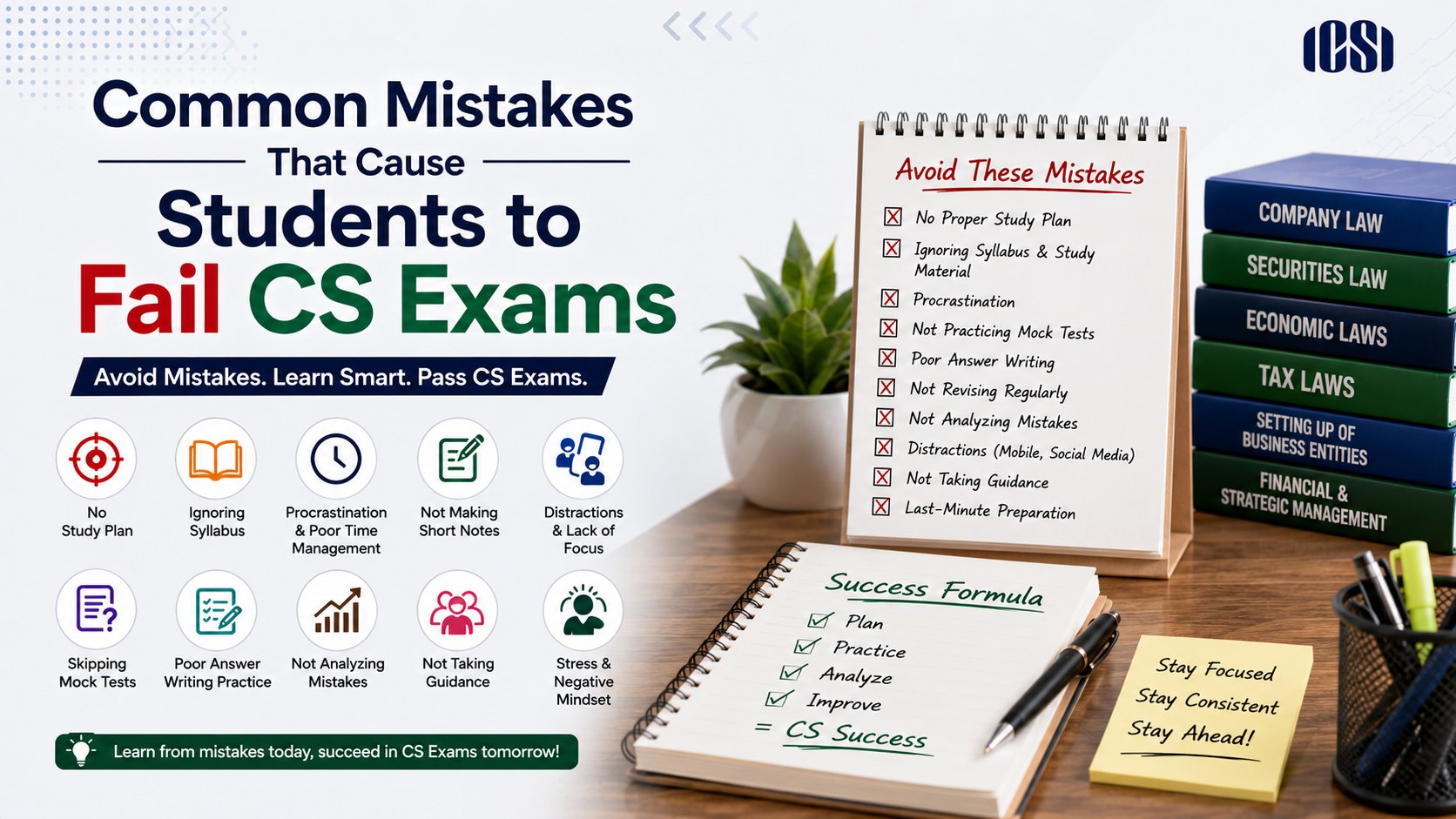
Preparing for a Company Secretary exam is not simply about studying for long hours. It is about studying the right topics, revising them repeatedly, practising answer writing, managing time, and understanding what the examination actually demands from you.
Many CS students work extremely hard but still do not get the result they expect. They attend classes, collect study material, make notes, watch revision videos and even study late into the night. Yet, when the result comes, the marks are not enough.
This can be frustrating.
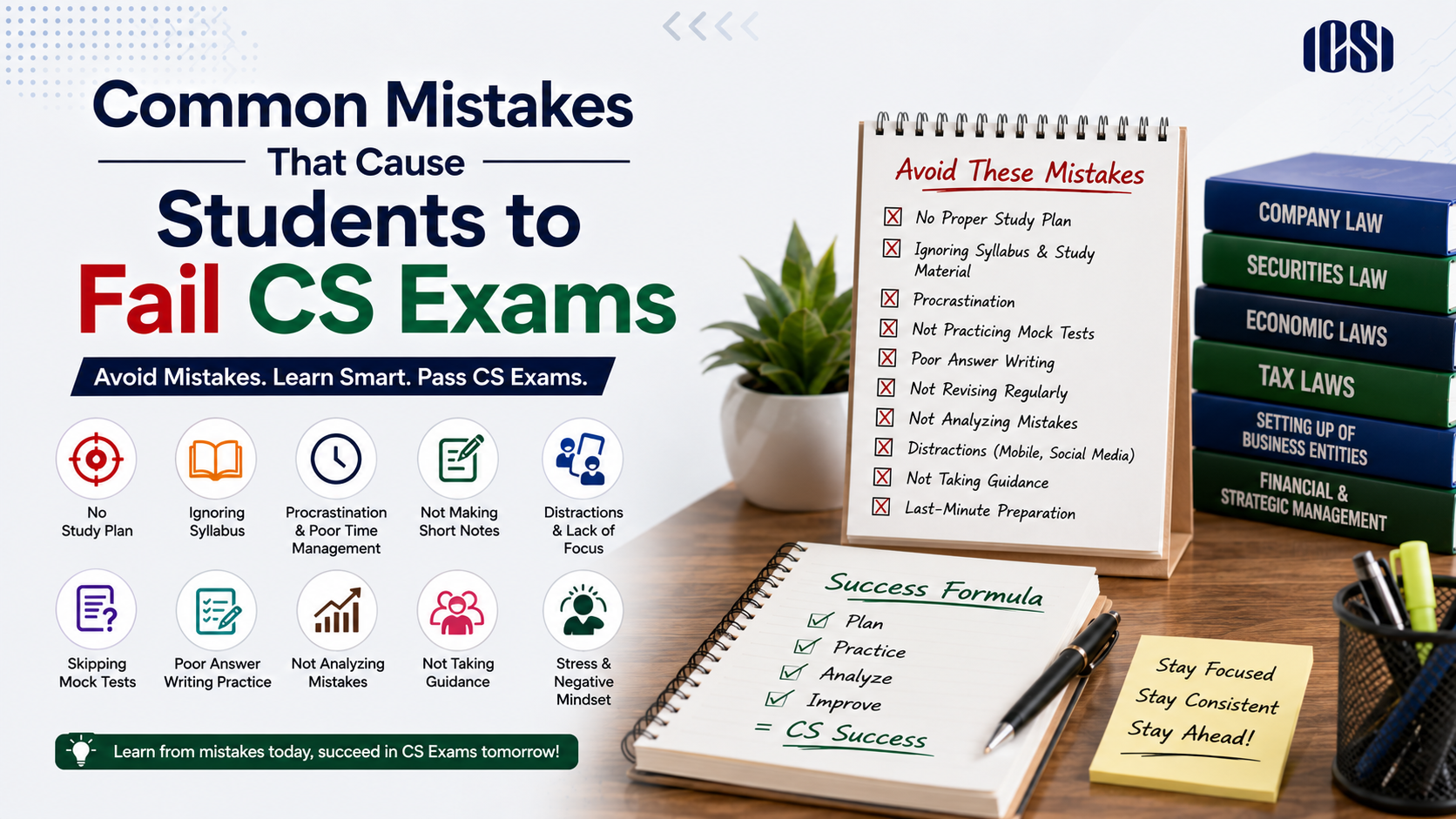
But in many cases, the problem is not a lack of intelligence or effort. The real problem is a set of small mistakes that slowly affect preparation and exam performance.
Some students start their preparation too late. Others keep changing study plans. Some focus entirely on reading and ignore writing practice. Many students revise only once, while others solve very few mock papers before the actual examination.
The good news is that most of these mistakes can be corrected.
Whether you are preparing for the CS Executive or CS Professional examination, understanding these common mistakes can help you prepare more strategically and avoid repeating them.
Why Do Students Fail CS Exams Despite Studying Hard?
One of the biggest misconceptions among CS aspirants is:
“If I study for many hours, I will automatically score good marks.”
Unfortunately, competitive professional examinations do not work that way.
The quality of preparation matters more than simply counting study hours.
For example, a student who studies for 8 hours but spends most of that time passively reading may be less prepared than a student who studies for 5 focused hours and spends time on revision, answer writing, self-testing and mock exams.
CS examinations require more than remembering concepts. Students need to understand provisions, recall them under pressure, present answers properly and complete the paper within the available time.
That is why preparation should cover four important areas:
|
Preparation Area |
What It Means |
|
Conceptual Understanding |
Understanding the subject instead of memorising blindly |
|
Revision |
Recalling concepts multiple times |
|
Answer Writing |
Learning how to present answers effectively |
|
Exam Practice |
Testing preparation through mock papers and timed tests |
Ignoring even one of these areas can create problems during the actual examination.
Starting Preparation Too Late
One of the most common mistakes students make is delaying serious preparation.
At the beginning of the session, students often think:
“There is still plenty of time.”
Then months pass.
Eventually, the examination is only a few weeks away, and the student suddenly realises that several chapters are still untouched.
This creates unnecessary pressure.
Trying to complete the entire CS syllabus in the final few weeks can result in:
- Incomplete syllabus coverage
- Superficial understanding
- Poor revision
- Lack of answer-writing practice
- Increased stress
- Sleep problems
- Poor retention
How to avoid this mistake
Create a realistic preparation schedule from the beginning.
Divide your syllabus into smaller weekly targets instead of keeping one huge target such as “finish the entire subject.”
For example:
Daily Target → Weekly Target → Monthly Target → Full Syllabus Completion
This makes preparation measurable and much easier to manage.
Studying Without a Proper Study Plan
Another common problem is studying randomly.
A student may study one chapter today, switch to another subject tomorrow and then spend the next day watching revision lectures.
There is nothing wrong with changing subjects occasionally, but completely unstructured preparation can create gaps.
A good CS study plan should answer four questions:
- What will I study today?
- What will I revise this week?
- When will I complete each subject?
- When will I start mock-test practice?
Your study plan should also include buffer days.
Why?
Because unexpected things happen. You may take longer than expected to understand a chapter, have college commitments, or need additional revision.
A rigid plan can collapse easily. A flexible plan is more sustainable.
Trying to Cover Everything Without Prioritising
Students sometimes treat every topic exactly the same.
They spend hours on small topics while important chapters remain weak.
This does not mean students should completely ignore any part of the syllabus. Instead, they should understand the weightage, importance and difficulty level of different topics and allocate time accordingly.
A simple priority system can help:
|
Priority |
Type of Topic |
Approach |
|
High |
Important + difficult |
Study deeply and revise frequently |
|
Medium |
Important + manageable |
Understand and practise |
|
Low |
Less difficult/less frequently tested |
Cover after major topics |
The goal is not to “skip the syllabus.”
The goal is to manage preparation intelligently.
Relying Only on Reading
This is one of the most dangerous mistakes in professional exam preparation.
Reading feels productive.
You sit with a book for three hours, highlight important points and feel that you have studied a lot.
But when someone asks you to explain the concept without looking at the book, you may struggle.
This happens because reading is largely a passive learning activity.
CS preparation needs active learning.
Try techniques such as:
- Closing the book and recalling the concept
- Explaining a topic in your own words
- Writing short answers from memory
- Solving questions without looking at solutions
- Creating quick revision notes
- Taking timed tests
A useful rule is:
Read → Recall → Write → Check → Improve
This cycle is much more powerful than reading repeatedly.
Ignoring Revision Until the End
Students often complete a chapter and move on.
Weeks later, they return to the chapter and discover that they remember very little.
This is completely normal.
The human brain naturally forgets information when it is not revisited.
That is why revision should happen throughout the preparation period.
A simple revision cycle can be:
First Revision
Within a few days of completing the topic.
Second Revision
After a couple of weeks.
Third Revision
During the final preparation phase.
Final Revision
Immediately before the examination.
The exact schedule can vary, but the principle remains the same:
Do not wait until the final month to revise everything.
Not Practising Answer Writing
Knowing the answer and writing a high-scoring answer are two different skills.
This is especially important in professional examinations where presentation, structure, relevant provisions, keywords and logical explanation can influence how effectively your knowledge is communicated.
Many students spend months studying but barely write full-length answers.
Then, during the examination, they discover that:
- They cannot structure answers quickly.
- They take too long on one question.
- They write unnecessarily long answers.
- They struggle to recall provisions.
- Their handwriting becomes rushed.
- They cannot complete the paper.
The solution is simple:
Start answer writing before the exam.
You do not need to write 20 answers every day.
Even regularly practising a few questions under timed conditions can make a significant difference.
Not Solving Mock Tests
A CS aspirant should not enter the examination hall without experiencing a realistic exam simulation.
Mock tests help you understand what happens when you have:
- A fixed time limit
- Multiple questions
- Pressure to recall information
- Limited time for revision
- Difficulty deciding which question to attempt first
A good CS test series can therefore become an important part of exam preparation.
Instead of simply checking whether an answer is right or wrong, students should analyse:
What did I know?
What did I forget?
Where did I lose marks?
Did I manage my time properly?
Was my answer presentation effective?
That analysis is where much of the value of a mock test comes from.
Ignoring Time Management
Imagine knowing the answers to most questions but leaving several questions incomplete because you ran out of time.
That is one of the most painful exam situations.
Time management should therefore be practised before the examination.
When solving mock papers, always use a timer.
After completing the test, analyse how much time you spent on:
- Reading questions
- Planning answers
- Writing answers
- Thinking about difficult questions
- Revising the paper
With repeated practice, you begin developing a natural sense of exam pace.
Spending Too Much Time on One Question
Some students become emotionally attached to a difficult question.
They think:
“I know this answer. Let me remember it.”
Five or ten minutes can disappear.
Meanwhile, easier questions remain unanswered.
A better strategy is to move forward when necessary.
If you cannot recall a particular point immediately, leave enough space and continue with the rest of the paper.
You can return to the question later.
Remember:
The objective is not to solve one question perfectly. The objective is to maximise your total marks.
Neglecting Presentation
Good knowledge can lose its impact if the answer is difficult to read.
Presentation does not mean decorating your answer sheet.
It means making your answer:
- Clear
- Structured
- Relevant
- Easy to evaluate
- Logically organised
Where appropriate, students can use:
- Headings
- Subheadings
- Numbered points
- Short paragraphs
- Relevant keywords
- Proper spacing
- Clear conclusions
Avoid unnecessarily long introductions.
Get to the point.
A well-structured answer allows the evaluator to understand your knowledge quickly.
Memorising Without Understanding
Professional examinations contain concepts that are difficult to retain if students simply memorise words.
Blind memorisation can also create confusion when the question is framed differently.
Instead of memorising an entire answer word-for-word, understand:
What is the concept?
Why does the provision exist?
What are its important elements?
What conditions apply?
What conclusion should be drawn?
Once the logic is understood, remembering the relevant information becomes much easier.
Constantly Changing Study Materials
Students sometimes collect too many resources.
One teacher's notes.
Another teacher's summary.
A Telegram PDF.
A YouTube revision video.
Another student's handwritten notes.
A question bank.
A separate guidebook.
Eventually, instead of improving preparation, these resources create confusion.
You do not need ten sources for every subject.
Choose reliable study material and stick with it.
Use additional resources only when they genuinely help you understand a difficult concept.
Ignoring Previous Mistakes
One of the most valuable sources of improvement is your own mistakes.
Unfortunately, many students complete a test, check the marks and move on.
That wastes a major learning opportunity.
After every mock test, maintain a mistake log.
For example:
|
Mistake Type |
Example |
Action |
|
Conceptual |
Did not understand provision |
Re-study topic |
|
Memory |
Forgot important point |
Add to revision list |
|
Presentation |
Answer lacked structure |
Practise format |
|
Time |
Could not complete paper |
Improve speed |
|
Silly Error |
Misread question |
Slow down while reading |
After several tests, patterns become visible.
You may discover that your problem is not knowledge at all.
Maybe you are losing marks because of time management.
Or perhaps your answers lack sufficient explanation.
That insight can completely change your preparation strategy.
Ignoring Weak Subjects
Students naturally enjoy studying subjects they are comfortable with.
But spending most of your preparation time on strong subjects can create a dangerous imbalance.
Suppose you are excellent at three subjects but consistently weak in two.
Those two subjects may ultimately decide your result.
A better strategy is:
Maintain your strengths while systematically improving your weaknesses.
You do not have to become perfect in every topic.
But your weak areas should not remain untouched until the final days.
Studying Only When You Feel Motivated
Motivation is useful, but it is unreliable.
Some days you will feel highly motivated.
Other days, you will want to do absolutely nothing.
Successful preparation depends more on consistency than motivation.
Instead of saying:
“I will study for 10 hours every day.”
Create a minimum daily commitment.
For example:
“Even on a bad day, I will complete my minimum study target.”
Small consistent progress is much better than studying intensely for two days and then doing nothing for three days.
Ignoring Sleep and Health
Another mistake students make is believing that sleeping less automatically means studying more.
It doesn't.
If you regularly sacrifice sleep, concentration, memory and productivity can suffer.
A sustainable routine should include:
- Adequate sleep
- Short breaks
- Regular meals
- Some physical movement
- Limited distractions
Your goal is not to survive the preparation period.
Your goal is to reach the examination with a focused and healthy mind.
Comparing Your Preparation With Other Students
One student says they have completed five revisions.
Another says they study 12 hours daily.
Someone else claims they have solved 50 mock tests.
Social media can make this comparison even worse.
But everyone's starting point, learning speed and circumstances are different.
Instead of asking:
“Am I ahead of everyone else?”
Ask:
“Am I better prepared than I was last week?”
That is the comparison that actually matters.
Avoiding Professional Exam Simulation
Reading a question paper casually is not the same as sitting for a three-hour examination.
To understand your actual readiness, periodically simulate the real exam environment.
Sit at a desk.
Keep your phone away.
Set the appropriate time limit.
Use the required answer-writing format.
Attempt the paper continuously.
Then evaluate your performance honestly.
This helps reduce the gap between studying for the exam and performing in the exam.
How to Avoid Common CS Exam Preparation Mistakes
Here is a practical approach students can follow:
|
Mistake |
Better Approach |
|
Starting late |
Begin early with weekly targets |
|
Random studying |
Follow a structured study plan |
|
Passive reading |
Use active recall and writing |
|
One-time revision |
Revise multiple times |
|
No answer practice |
Write timed answers regularly |
|
Avoiding mock tests |
Take full-length simulated tests |
|
Poor time management |
Practise with a timer |
|
Too many resources |
Follow limited, reliable resources |
|
Ignoring weak subjects |
Give extra time to weak areas |
|
Repeating mistakes |
Maintain a mistake log |
|
Studying only when motivated |
Build a consistent routine |
|
Comparing with others |
Track your own progress |
A Simple CS Exam Preparation Strategy
If you want to reduce the chances of making these mistakes, divide your preparation into four stages.
Stage 1: Build Your Foundation
Understand the syllabus and create your study plan.
Focus on concepts rather than speed.
Do not worry about completing everything immediately.
Stage 2: Complete the Syllabus
Set weekly targets and track your progress.
After completing each topic, spend some time recalling and revising it.
Do not keep revision for the end.
Stage 3: Start Exam Practice
Once a significant portion of the syllabus is complete, begin solving topic-wise and full-length questions.
Focus on answer structure, presentation and time management.
Stage 4: Full-Length Mock Tests and Analysis
During the final phase, simulate the actual examination as much as possible.
After every test, analyse your performance.
Do not just look at your score.
Ask:
Where did I lose marks?
That question is more valuable than simply asking:
How many marks did I score?
Why a CS Test Series Can Help
A well-designed test series can provide something that ordinary studying cannot: a realistic performance check.
With a quality CS test series, students can practise:
- Exam-style questions
- Timed answer writing
- Full-length papers
- Revision through testing
- Performance analysis
- Identifying weak areas
- Improving answer presentation
For students preparing with CS Exam Test Series, the goal should not be to collect test papers simply for the sake of completing them.
The real goal is to use every test as a feedback mechanism.
Think of every mock test as a rehearsal.
The more intelligently you analyse your rehearsals, the better prepared you become for the actual examination.
Final Thoughts: Failure Is Often a Strategy Problem, Not an Ability Problem
Failing a CS examination can be emotionally difficult.
Students often start questioning themselves:
“Maybe I am not capable of clearing CS.”
But one unsuccessful attempt does not define your ability.
Sometimes the issue is simply the preparation strategy.
Maybe you started late.
Maybe you revised too little.
Maybe you knew the concepts but could not present them properly.
Maybe you did not practise enough questions.
Maybe poor time management cost you valuable marks.
The important thing is to identify the actual problem instead of simply studying harder.
A smarter preparation cycle looks like this:
Learn → Revise → Practise → Test → Analyse → Improve → Repeat
That is how preparation becomes stronger with every passing week.
If you are preparing for CS Executive or CS Professional, remember that the examination does not only test what you have studied. It also tests how effectively you can recall, organise and communicate that knowledge under time pressure.
Avoid the common mistakes discussed above, build a realistic study routine, practise answer writing regularly and use mock tests to identify weaknesses before the actual examination.
Most importantly, do not wait until the result to discover what went wrong.
Find your mistakes during preparation — while you still have time to fix them.