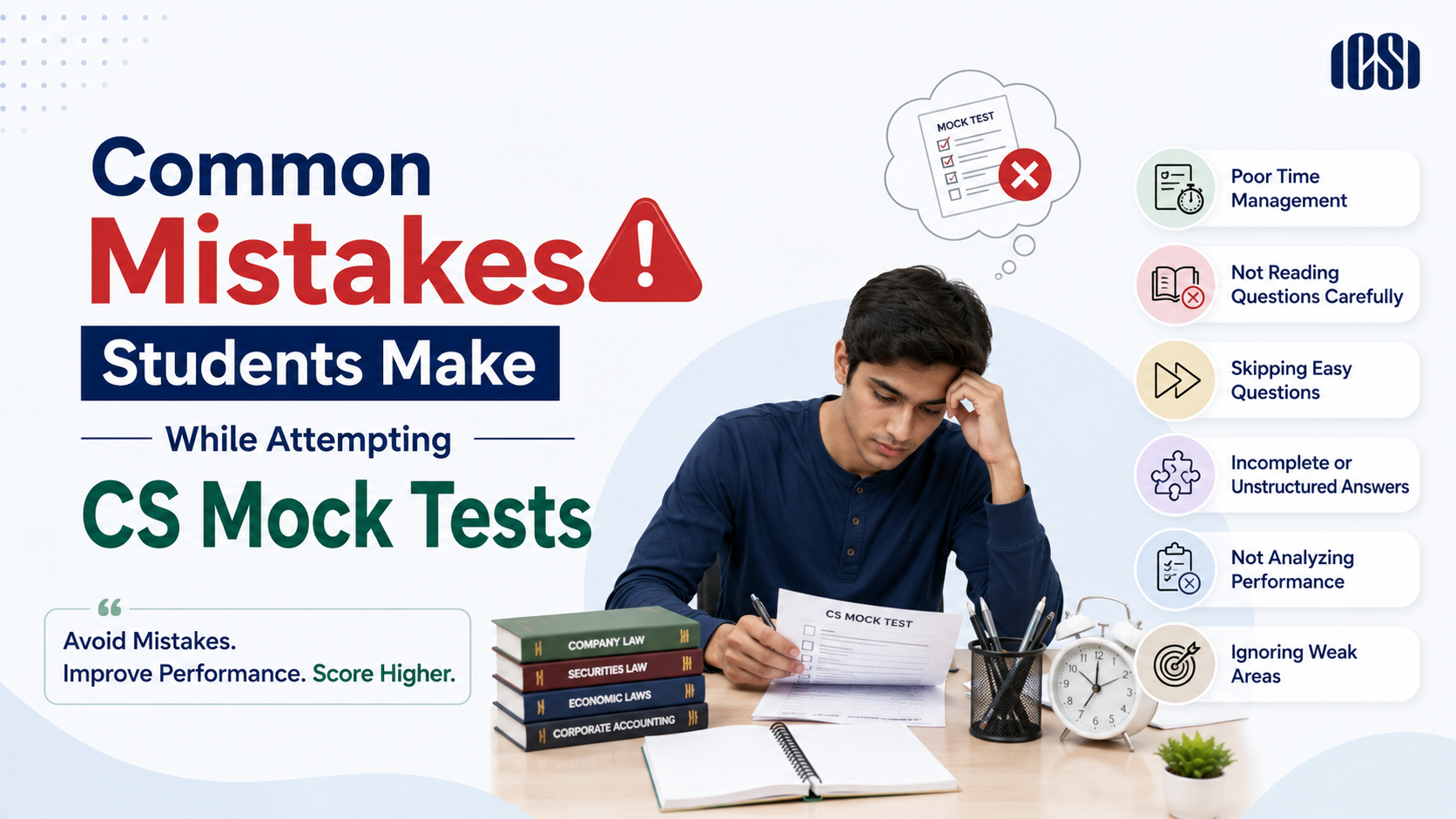
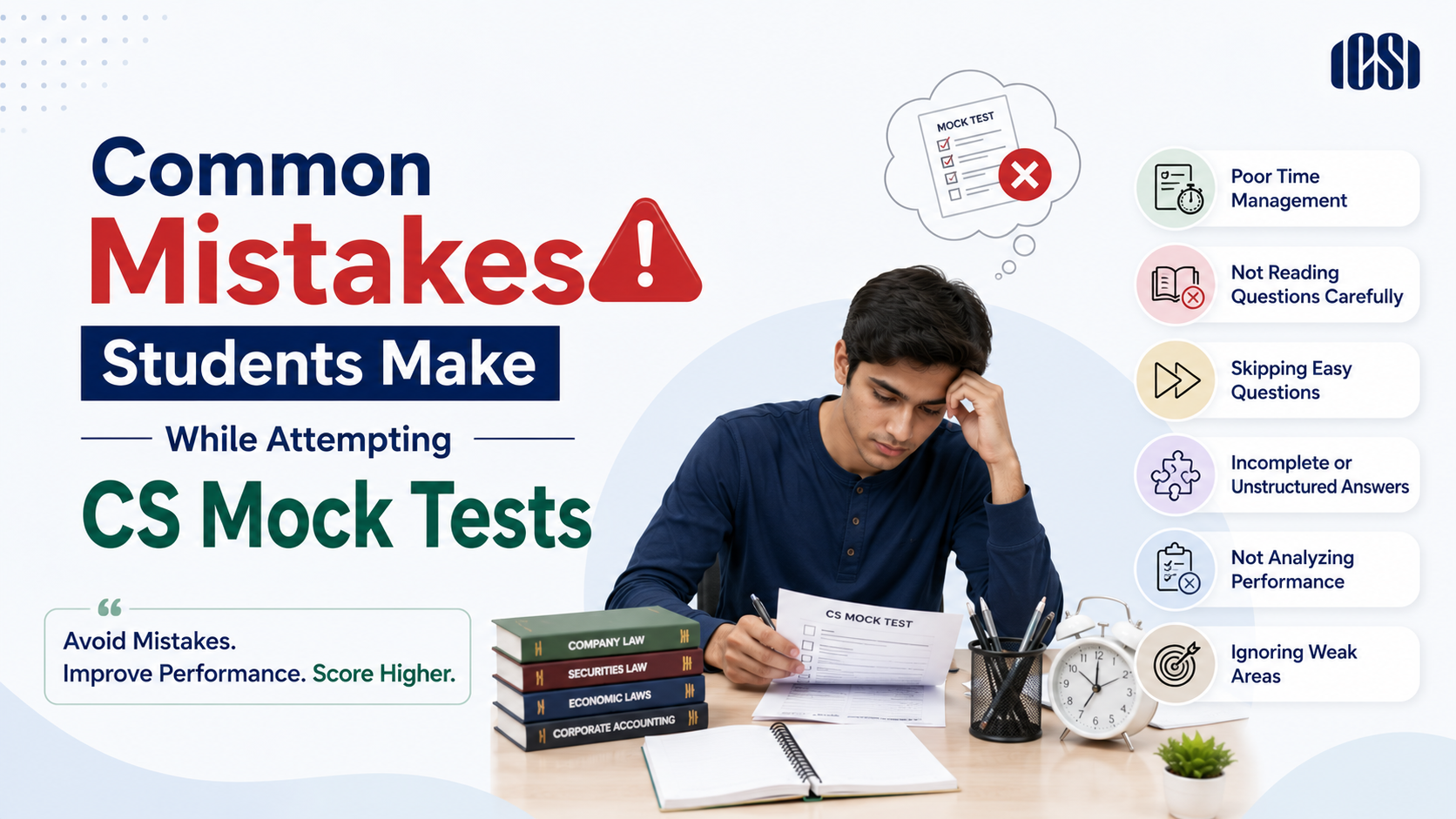
Preparing for the Company Secretary (CS) examination requires more than simply completing the syllabus. Many students spend months studying concepts but fail to convert their knowledge into marks because they make avoidable mistakes while attempting mock tests.
A mock test is not just another practice paper. It is a simulation of the real ICSI examination that reveals your strengths, weaknesses, time management skills, and answer-writing abilities. Unfortunately, many aspirants treat mock tests casually, resulting in repeated mistakes that continue into the actual examination.
Whether you are preparing for CS Executive or CS Professional, understanding these common mistakes can significantly improve your performance and confidence.
In this comprehensive guide, we will discuss the biggest mistakes students make while attempting CS mock tests and practical strategies to overcome them.
Why CS Mock Tests Are More Important Than Most Students Think
Many students believe that finishing the syllabus is enough to clear CS exams. In reality, completing the syllabus is only the first step.
Mock tests help students:
- Understand the actual ICSI paper pattern.
- Build confidence before the final examination.
- Improve answer presentation.
- Learn effective time management.
- Identify weak concepts.
- Practice writing under pressure.
- Develop examination temperament.
Think of mock tests as dress rehearsals. Professional athletes never enter a competition without practice matches. Similarly, CS aspirants should never enter the examination hall without attempting multiple mock tests.
Benefits of Regular CS Mock Tests
|
Benefit |
Impact on Exam Performance |
|
Improves Speed |
Helps complete the paper within time |
|
Better Accuracy |
Reduces silly mistakes |
|
Confidence Building |
Removes exam fear |
|
Better Revision |
Highlights weak areas |
|
Time Management |
Improves question selection |
|
Answer Writing Practice |
Enhances presentation and structure |
|
Performance Tracking |
Measures continuous improvement |
Students who consistently analyze their mock tests usually perform much better than those who only keep reading theory.
Mistake #1: Treating Mock Tests Like Ordinary Practice Questions
This is one of the biggest mistakes students make.
Instead of sitting for three uninterrupted hours, many students:
- Pause the timer.
- Take unnecessary breaks.
- Refer to books while writing.
- Search answers online.
- Discuss questions with friends.
This completely defeats the purpose of a mock test.
A mock test should feel exactly like the real ICSI examination.
Wrong Approach vs Correct Approach
|
Wrong Approach |
Correct Approach |
|
Writing casually |
Writing under strict exam conditions |
|
Looking at notes |
No books allowed |
|
Unlimited time |
Strict 3-hour limit |
|
Attempting selectively |
Attempt the paper seriously |
|
Ignoring presentation |
Maintain professional presentation |
The closer your mock environment is to the actual exam, the better prepared you will be.
Mistake #2: Ignoring Time Management
Many students know the answers but still fail because they spend too much time on a few difficult questions.
This usually happens because students:
- Try to write perfect answers.
- Spend excessive time recalling provisions.
- Over-explain simple concepts.
- Panic during difficult questions.
Remember, the examiner awards marks only for answers written within the examination time.
Ideal Time Distribution
|
Section |
Suggested Time |
|
Reading Question Paper |
10–15 Minutes |
|
Long Questions |
90 Minutes |
|
Medium Questions |
55 Minutes |
|
Short Questions |
30 Minutes |
|
Final Review |
10 Minutes |
Students who practice this distribution during mock tests often complete their papers comfortably in the final examination.
Mistake #3: Not Following the ICSI Answer Writing Style
Knowing the answer is different from presenting it effectively.
ICSI examiners evaluate not only the correctness of your answer but also its clarity, structure, and presentation.
Many students write:
- Large paragraphs.
- No headings.
- No point-wise answers.
- No legal provisions.
- No conclusion.
As a result, even correct answers fail to create a strong impression.
Characteristics of a High-Scoring CS Answer
|
Poor Answer |
High-Scoring Answer |
|
Long paragraphs |
Short paragraphs |
|
No headings |
Clear headings |
|
Random writing |
Logical sequence |
|
No provisions |
Relevant sections and provisions |
|
No conclusion |
Crisp conclusion |
|
Untidy presentation |
Clean and professional formatting |
Always remember that examiners read hundreds of answer sheets. A well-structured answer is easier to evaluate and naturally attracts better marks.
Mistake #4: Skipping Post-Test Analysis
Many students finish a mock test, check their score, and immediately move to the next paper.
This habit prevents improvement.
The real learning begins after completing the mock test.
Every mock test should answer questions like:
- Which chapters consumed the most time?
- Which concepts were incorrect?
- Were statutory provisions remembered correctly?
- Did handwriting remain consistent?
- Which questions were left unanswered?
- Were marks lost because of poor presentation or lack of knowledge?
A Simple Mock Test Analysis Sheet
|
Parameter |
Questions to Ask Yourself |
|
Accuracy |
How many answers were technically correct? |
|
Time |
Did I finish within three hours? |
|
Presentation |
Were headings and formats used properly? |
|
Conceptual Clarity |
Which topics require revision? |
|
Confidence |
Which questions created panic? |
|
Revision Plan |
What should I revise before the next mock? |
Maintaining such an analysis sheet after every mock test allows students to track progress objectively instead of relying on assumptions.
Mistake #5: Memorizing Answers Instead of Understanding Concepts
Many CS aspirants believe that memorizing model answers guarantees success.
This approach works only until the question pattern changes.
ICSI frequently asks:
- Case study–based questions.
- Application-oriented questions.
- Scenario-based legal situations.
- Analytical questions.
- Interpretation-based questions.
Students who rely purely on memorization struggle when questions are framed differently.
Instead of memorizing complete answers, focus on understanding:
- The legal concept.
- The reasoning behind provisions.
- Practical application.
- Exceptions.
- Recent amendments (where applicable).
This enables you to answer confidently, even if the wording of the question changes.
Signs That You're Attempting Mock Tests Incorrectly
If you notice any of the following habits, it's time to change your approach:
|
Warning Sign |
Possible Impact |
|
Referring to books during mocks |
False sense of preparation |
|
Not completing papers |
Poor time management |
|
Ignoring answer presentation |
Lower scores despite good knowledge |
|
Never reviewing mistakes |
Slow improvement |
|
Writing without a timer |
Difficulty finishing the actual exam |
|
Practicing only favourite subjects |
Weak overall performance |
|
Focusing only on scores |
Missing valuable learning opportunities |
Recognizing these warning signs early can save weeks of ineffective preparation and help you make every mock test count.
Mistake #6: Avoiding Difficult Questions During Mock Tests
One of the most common habits among CS students is attempting only the questions they already know well. While this may improve mock test scores, it does very little to prepare you for the actual ICSI examination.
Remember, the real exam will not ask only your favorite topics.
Many students:
- Skip difficult questions.
- Leave lengthy case studies unanswered.
- Ignore newly introduced concepts.
- Avoid subjects they find challenging.
As a result, they enter the examination hall with confidence in only a few areas.
The Better Approach
Instead of avoiding difficult questions:
- Attempt every question seriously.
- Mark the questions you found difficult.
- Revise those topics immediately after the mock.
- Attempt similar questions again within a few days.
Every difficult question solved during preparation is one less surprise in the final examination.
Mistake #7: Ignoring Examiner Expectations
Many students write answers according to what they think is correct rather than what an examiner expects.
ICSI examiners generally appreciate answers that are:
- Structured logically
- Relevant to the question
- Supported with legal provisions
- Easy to read
- Professional in presentation
- Free from unnecessary explanations
Writing everything you know rarely fetches additional marks.
Instead, write exactly what is required.
What Examiners Prefer
|
Examiner Likes |
Examiner Dislikes |
|
Point-wise answers |
Long unstructured paragraphs |
|
Relevant provisions |
Irrelevant theory |
|
Clear headings |
Continuous writing |
|
Logical flow |
Random information |
|
Practical application |
Memorized content without understanding |
|
Neat handwriting |
Untidy presentation |
The easier you make the examiner's job, the better your chances of scoring higher.
Mistake #8: Not Simulating Real Exam Pressure
Many students attempt mock tests in a comfortable environment where there are no distractions or time pressure.
During the actual examination, however, students experience:
- Stress
- Nervousness
- Time pressure
- Fatigue
- Anxiety
If your mock tests do not simulate these conditions, your preparation remains incomplete.
Create a Real Examination Environment
Try to:
- Sit at a proper desk.
- Keep only permitted stationery.
- Avoid checking your phone.
- Set a strict three-hour timer.
- Complete the paper without interruptions.
The more realistic your practice, the more comfortable the actual exam will feel.
Mistake #9: Neglecting Presentation Skills
Presentation plays a significant role in descriptive examinations like CS.
Even when two students write similar answers, the better-presented answer sheet often receives higher marks.
Presentation includes:
- Proper spacing
- Clear handwriting
- Headings
- Underlining important points
- Numbering
- Paragraph breaks
- Logical sequencing
Think of your answer sheet as a professional legal document.
Answer Presentation Checklist
|
Presentation Element |
Importance |
|
Clear Headings |
High |
|
Point-wise Writing |
High |
|
Proper Margins |
Medium |
|
Underlining Keywords |
High |
|
Paragraph Breaks |
High |
|
Neat Handwriting |
High |
|
Correct Question Numbering |
High |
|
Logical Flow |
Very High |
Small improvements in presentation often translate into valuable additional marks.
Mistake #10: Chasing Scores Instead of Learning
Many students become disappointed after receiving low marks in mock tests.
This is a major mindset mistake.
The purpose of a mock test is not to achieve high marks.
Its purpose is to identify mistakes before the final examination.
Students who score 45 in a mock but analyze every mistake usually perform much better than students who score 70 but never review their performance.
Remember
Mock tests are learning tools—not judgment tools.
Treat every mistake as valuable feedback.
How to Review a Mock Test Effectively
Simply checking your marks is not enough.
Follow this systematic review process after every mock test.
Step 1: Check Accuracy
Identify every incorrect answer.
Classify mistakes into:
- Conceptual mistake
- Silly mistake
- Lack of revision
- Poor presentation
- Time management issue
Step 2: Identify Weak Chapters
Create a list of chapters where you lost maximum marks.
Revise those chapters within the next 48 hours.
Step 3: Improve Answer Writing
Compare your answer with:
- Suggested answers
- Model answer sheets
- Expert evaluations
Notice the differences in:
- Structure
- Language
- Presentation
- Legal provisions
- Conclusions
Step 4: Record Learnings
Maintain a notebook called Mock Test Mistakes Register.
For every paper, write:
- Mistakes committed
- Correct approach
- Revision date
- Improvement achieved
This single notebook becomes one of the most valuable revision resources before the examination.
Practical Tips to Get Maximum Value from Every CS Mock Test
Following a structured strategy can dramatically improve your performance.
Before the Mock Test
- Revise important concepts.
- Keep all stationery ready.
- Set a timer.
- Remove distractions.
- Read instructions carefully.
During the Mock Test
- Allocate time wisely.
- Attempt easy questions first.
- Keep answers concise.
- Maintain neat presentation.
- Leave enough space between answers.
After the Mock Test
- Evaluate honestly.
- Review every mistake.
- Revise weak topics.
- Attempt incorrect questions again.
- Monitor your progress.
Ideal Mock Test Routine for CS Students
The frequency of mock tests should increase as the examination approaches.
|
Time Before Exam |
Recommended Mock Test Frequency |
|
3–4 Months |
One mock every week |
|
2 Months |
Two mocks every week |
|
1 Month |
Three to four mocks every week |
|
Final 15 Days |
Full-length papers under exam conditions |
Consistency is more important than quantity.
Ten properly analyzed mock tests are far more valuable than thirty casually attempted papers.
Common Myths About CS Mock Tests
Many misconceptions prevent students from utilizing mock tests effectively.
|
Myth |
Reality |
|
Mock tests are only for toppers. |
Every student benefits from mock tests. |
|
I should attempt mocks only after completing the syllabus. |
Mock tests can begin alongside revision. |
|
Low mock scores mean I will fail. |
They simply highlight areas for improvement. |
|
Reading notes is enough. |
Writing practice is equally important. |
|
One mock test is sufficient. |
Continuous practice builds confidence and consistency. |
Understanding these myths helps students adopt a healthier and more productive preparation strategy.
Expert Tips to Improve Your CS Mock Test Performance
Here are some proven strategies followed by successful CS aspirants:
- Attempt at least one full-length mock test every week.
- Write answers exactly as you would in the final examination.
- Focus on quality rather than quantity.
- Learn from every mistake instead of feeling discouraged.
- Practice answer presentation regularly.
- Keep revising weak chapters identified through mock tests.
- Track your progress using a performance sheet.
- Avoid comparing your scores with others.
- Build consistency instead of chasing perfection.
- Treat every mock test as a stepping stone toward success.
These habits not only improve mock test performance but also enhance confidence and reduce examination stress.
Final Checklist Before Every CS Mock Test
Before you click "Start" or begin writing your next mock paper, go through this quick checklist. Following these simple points can make a noticeable difference in your overall performance.
|
Checklist Item |
Status |
|
Revised the important concepts |
☐ |
|
Read the exam instructions carefully |
☐ |
|
Set a strict 3-hour timer |
☐ |
|
Kept books and notes away |
☐ |
|
Arranged required stationery |
☐ |
|
Planned time allocation for each section |
☐ |
|
Focused on neat presentation |
☐ |
|
Reserved 10 minutes for final review |
☐ |
|
Analyzed mistakes after completion |
☐ |
|
Updated the Mock Test Mistakes Register |
☐ |
Save or print this checklist and use it before every mock test. Over time, these habits become second nature and help you perform more confidently in the actual ICSI examination.
Why Choosing the Right CS Test Series Matters
While self-practice is important, the quality of your mock tests also plays a significant role in your preparation.
A good CS Test Series should provide:
- Papers designed according to the latest ICSI pattern.
- Detailed evaluation by experienced faculty.
- Personalized feedback on answer writing.
- Performance analytics to track improvement.
- Suggested answers for self-analysis.
- All-India ranking and benchmarking.
- Regular mock exams for every subject.
Instead of attempting random question papers from different sources, choose a structured test series that simulates the actual examination experience and helps you improve with every attempt.
Common Mistakes vs Best Practices
|
Common Mistake |
Best Practice |
|
Referring to books during the mock |
Attempt the paper without any external help |
|
Ignoring time limits |
Follow a strict three-hour schedule |
|
Writing lengthy paragraphs |
Use headings, points, and proper structure |
|
Skipping difficult questions |
Attempt every question honestly |
|
Not reviewing the paper |
Analyze every mistake after completion |
|
Memorizing answers |
Understand concepts and their application |
|
Chasing high scores |
Focus on continuous improvement |
|
Attempting very few mocks |
Practice consistently throughout preparation |
|
Ignoring presentation |
Write neat, organized, and examiner-friendly answers |
|
Not tracking progress |
Maintain a performance improvement record |
Key Takeaways
If you remember only one thing from this guide, let it be this:
Mock tests are not meant to prove how much you know—they are meant to reveal what you still need to improve.
Every mock test gives you an opportunity to:
- Improve your answer-writing skills.
- Manage time more effectively.
- Build confidence before the actual examination.
- Identify conceptual gaps.
- Develop a winning exam strategy.
Many students fail not because they lack knowledge but because they never learn how to apply that knowledge under exam conditions.
The students who consistently analyze their mistakes, improve their presentation, and treat every mock test seriously often outperform those who simply spend more hours studying.
Your goal should not be to score the highest marks in mock tests.
Your goal should be to make enough mistakes during practice so that you don't repeat them in the actual examination.
Conclusion
Success in the CS examination is a combination of conceptual clarity, disciplined preparation, effective revision, and smart practice. Mock tests bridge the gap between learning and performance by helping you experience the real examination before the final day.
If you are making any of the mistakes discussed in this article, don't be discouraged. The good news is that every one of these mistakes can be corrected with consistent practice and the right approach.
Treat each mock test as an opportunity to improve—not as a judgment of your abilities.
The more sincerely you practice today, the more confidently you will walk into the examination hall tomorrow.
Remember, the difference between an average student and a top scorer is often not intelligence—it's preparation, consistency, and the willingness to learn from every mock test.
Start applying these strategies from your very next mock test, and you'll notice a significant improvement in both your confidence and your exam performance.