A mock test is useful for more than checking how many marks you can score today. It shows what happens when you have to recall concepts, manage time and present answers under exam-like conditions. For CS students, this is valuable because preparation involves understanding provisions, applying concepts to situations and writing answers in a clear, structured way.
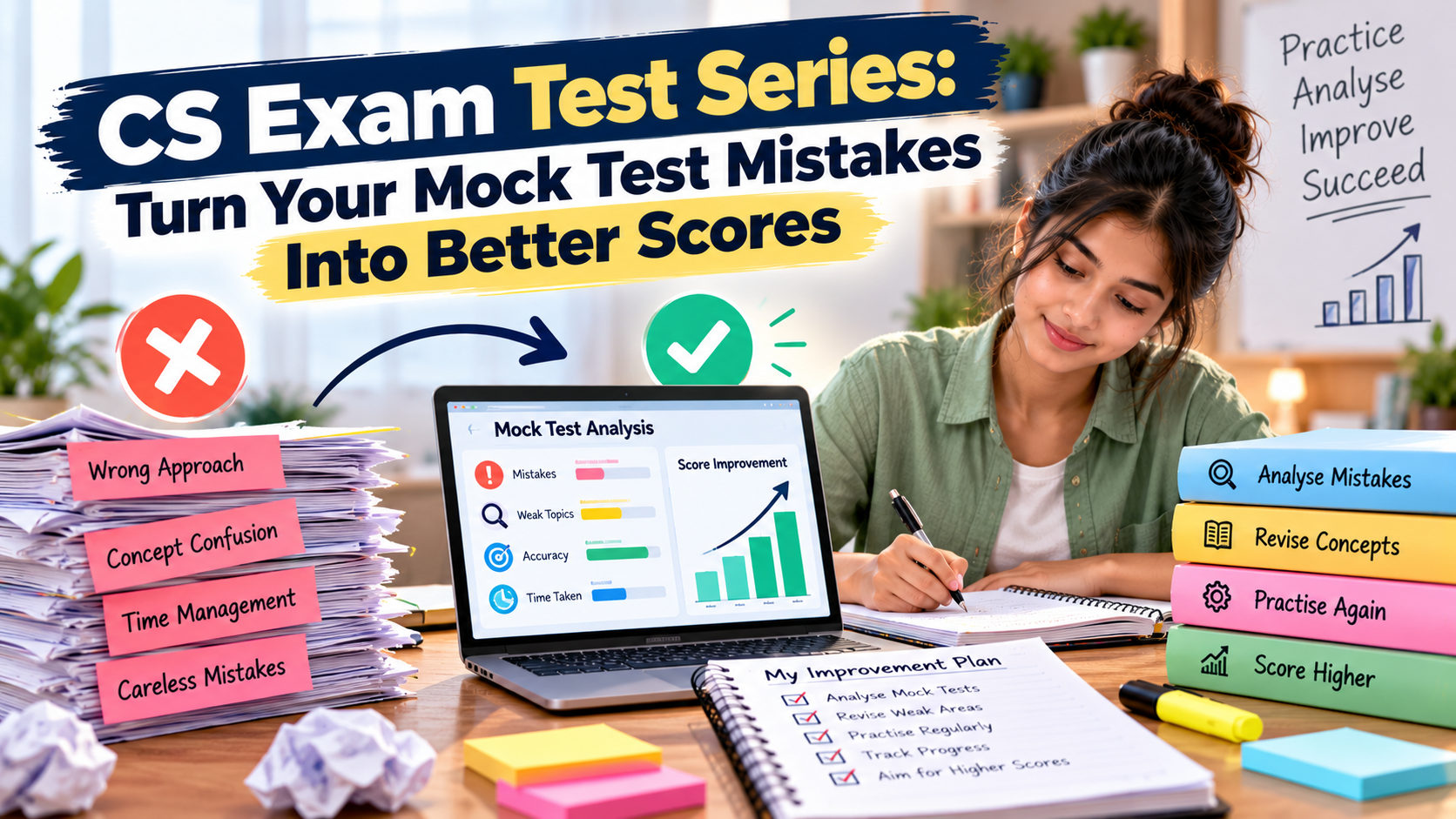
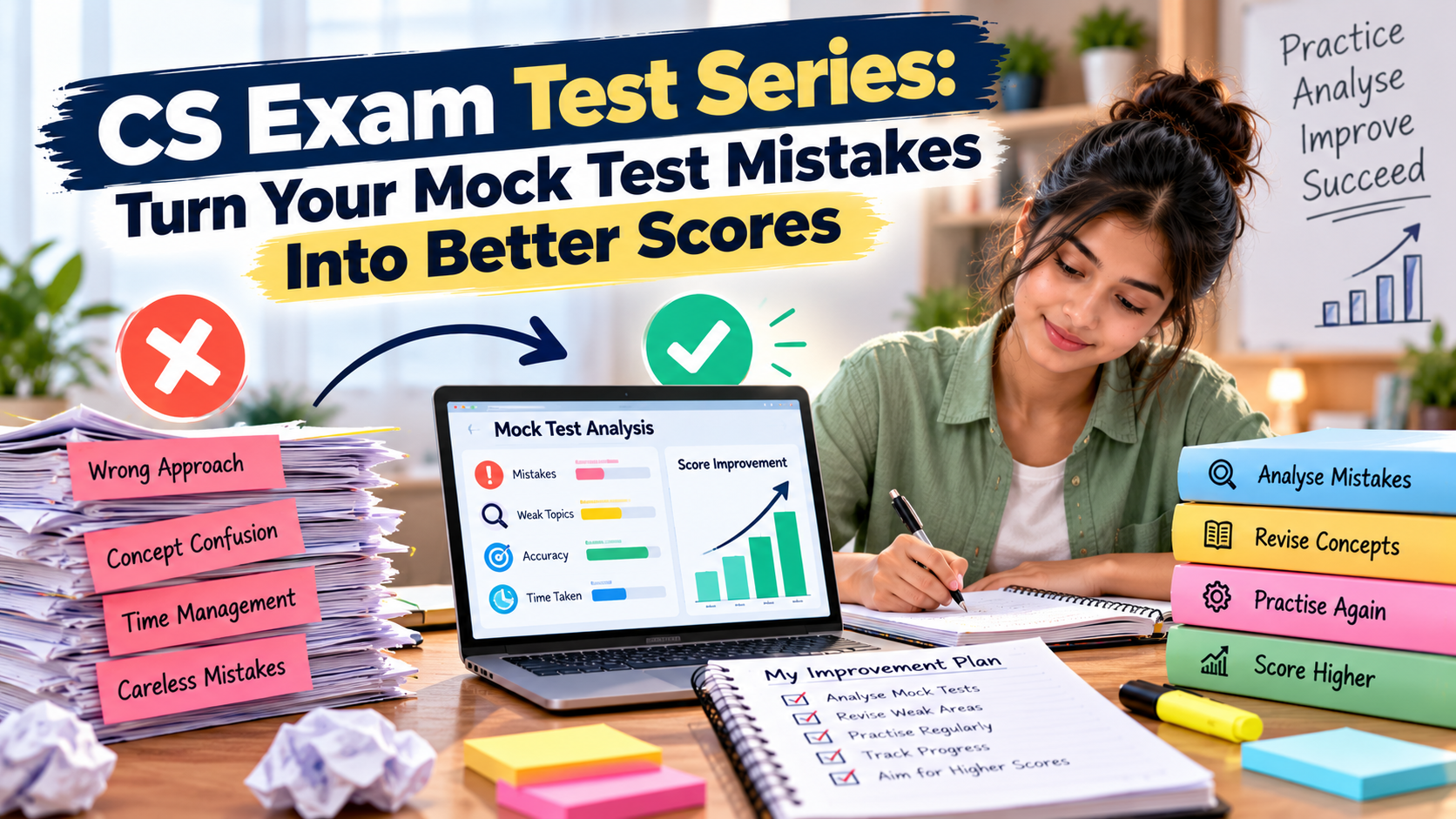
The important step comes after the test. If you check only the score and move on, the same mistakes may appear again. Treat every mock as feedback: identify the reason behind each lost mark, decide what to practise and check whether the correction works in the next test. A well-used CS Exam Test Series can support this practice-and-review routine.
Start With a Proper Review, Not Just the Score
After a mock test, take a short break and then review it with a clear head. Compare your answers with suggested answers, marking guidance or a reliable study reference. Do not focus only on questions you got completely wrong. An answer that reached the right conclusion but missed an important provision, explanation or step may also need attention.
For each question, note what was required, what you wrote, what was missing and how you can improve it next time. Keep the review practical. You do not need to rewrite the entire paper or make lengthy notes on every answer. Record the specific learning point that will help you avoid repeating the error.
Classify Your Mistakes to Find the Real Problem
Different mistakes need different solutions. A weak topic needs concept revision, while a time-management issue needs timed practice. Grouping errors helps you avoid treating every lost mark as a memory problem.
| Mistake type | What it may look like | What to do next |
|---|---|---|
| Concept gap | You cannot explain the rule or apply it to facts | Revise the concept, then solve fresh questions |
| Incomplete answer | A key condition, provision or conclusion is missing | Compare with a model answer and make a checklist |
| Misreading | You answer a related issue, not the requirement | Underline action words such as explain, discuss or advise |
| Poor presentation | Ideas are correct but hard to follow | Practise headings, numbered points and clear conclusions |
| Time pressure | Final answers are rushed or left incomplete | Use timed sections and limits per question |
| Recall error | You recognise a concept but cannot recall it alone | Use active recall and spaced revision |
| Technical error | A step, figure or application is incorrect | Practise the complete method and show key steps |
Build an Error Log You Can Actually Use
An error log is a simple record of mistakes and corrections. It should be short enough that you will review it regularly. A notebook, spreadsheet or digital document can work; the format matters less than using it consistently.
For each error, record the paper or subject, topic, question number, mistake category, reason, correct approach and date for a follow-up attempt. Add a status such as “not revised”, “practised once” or “improved in next mock”. This helps you see whether you are correcting the underlying issue or simply reading the solution and forgetting it.
Keep the wording specific. “Need to study Company Law” is too broad to guide your next session. “Forgot to state the condition that applies before giving the conclusion” gives you a clear action. Review the log before each new mock and select a few high-priority errors to target.
Use the Right Correction Method for Each Subject
CS papers do not all demand the same kind of practice. Adapt your response to the subject and the mistake instead of using one revision method for everything.
For law-based and theory-heavy papers
Return to the relevant provision or concept and make sure you understand its meaning, conditions and application. Practise explaining it in your own words without changing the legal meaning. For case-based questions, identify the facts that matter, connect them to the relevant rule, and write a reasoned conclusion. Avoid memorising a model answer word for word if you do not understand why it works.
For practical or application-oriented questions
Work through the solution step by step. Identify where the method went wrong: choosing the wrong approach, missing a step, making a calculation error or applying a concept incorrectly. Then solve a similar question without looking at the answer. This independent attempt checks whether the correction has stuck.
For objective tests and short-answer questions
Record why an option was incorrect, especially when two options looked similar. If you guessed correctly, mark it for review too; a lucky answer is not proof of strong recall. Revisit the concept and try a fresh set of questions after a gap.
Improve Answer Writing Before the Next Mock
Knowing the answer and communicating it clearly are two different skills. A technically correct response may still lose marks if it does not address the requirement, leaves out reasoning or is difficult to read. Use the review stage to improve both accuracy and presentation.
Before writing, identify the task in the question. Organise the answer around the issue, relevant rule or concept, application to the facts and conclusion where appropriate. Use headings or numbered points when they make the response easier to assess. Keep paragraphs focused and avoid adding unrelated information just to make an answer longer.
After reviewing a model answer, close it and write the answer again from memory. Compare the second attempt with the original and check whether you included the essential points. Repeating this exercise on selected questions is often more useful than copying long answers into your notes.
Create a Revision Plan Based on Your Mistakes
Your next study plan should reflect what the mock revealed. If a large share of errors comes from two topics, give those topics focused revision time before taking another full paper. If the knowledge is sound but answers are incomplete, reserve time for writing practice rather than rereading the whole chapter.
A practical weekly cycle can include one mock or timed sectional test, a review session, targeted revision, a fresh practice set and a short follow-up check. Adjust the frequency to your exam date, syllabus coverage and available study hours. Near the exam, give more attention to recurring errors and exam-style practice while keeping the rest of the syllabus in rotation.
| When | Suggested action | Purpose |
|---|---|---|
| Same day or next day | Review paper and classify errors | Understand why marks were lost |
| Within 2–3 days | Revise the concept and solve similar questions | Correct the weakness |
| After about a week | Reattempt selected questions without help | Check retention after a gap |
| Next mock | Track whether the error returns | Measure whether the correction works |
Use a CS Exam Test Series as a Feedback System
A test series is most helpful when it becomes part of a learning loop, not just a source of question papers. Choose practice that matches your current stage and the syllabus and exam pattern applicable to your attempt. Check whether the tests give you a useful way to assess answers, timing and topic-wise performance.
With CS Exams Test Series, make each attempt purposeful: decide what you want to test, sit the paper under realistic conditions, review the result and schedule a follow-up. If detailed feedback is available, use it to identify the gap between your response and a stronger answer. If feedback is limited, compare your work with appropriate suggested answers and your official study material.
Do not judge progress by one score alone. A mock can be unusually difficult, and marks can vary across papers. Look for patterns across several attempts: fewer repeated errors, more complete answers, better time allocation and stronger recall without notes.
Manage Time and Exam Pressure During Practice
Some students understand the subject but struggle when the clock is running. Practise with the time limit and conditions relevant to your examination. Keep your phone away, avoid checking notes during the attempt and plan how much time you can afford for each section.
If you repeatedly leave questions unfinished, review where the time went. Did you spend too long on a difficult question? Did you write more than the requirement asked for? Did you struggle to recall the structure of an answer? Use that diagnosis to set a realistic limit for the next attempt. Leave a little time, where possible, to check that you have answered every part.
Build up gradually if a full-length mock feels overwhelming. Start with a timed section, review it, and then increase the length of the practice. The aim is to make exam conditions familiar while still leaving enough time to learn from each attempt.
Common Mock Test Review Mistakes to Avoid
Avoid checking only the total marks. A score tells you the result of one attempt; it does not explain what to change. Review questions that were correct by guessing, too, and check whether you used a sound method.
Do not spend hours decorating an error notebook or copying every model answer. Keep only the details that will change future practice. Avoid taking another mock immediately just to feel productive if you have not addressed the weaknesses from the previous one. Finally, do not compare every score with another student’s result. Your most useful comparison is with your own earlier attempts and the quality of your answers.
How to Know Whether Your Strategy Is Working
After several tests, check the evidence. Are you making fewer errors in the same topics? Are you finishing more questions within the time limit? Are your answers more relevant and logically organised? Can you solve previously difficult questions without looking at the solution? If the answer is yes, your review process is helping.
If the same mistake keeps returning, change the method rather than simply adding more study hours. You may need to revisit the foundation of the concept, practise more varied questions, use spaced recall or get a teacher to clarify the issue. Improvement often comes from making a small correction and testing it again, not from restarting the entire study plan.
Conclusion: Make Every Mock Test Count
Mock tests become valuable when you use the results to guide what happens next. Classify mistakes, keep a concise error log, revise the exact weak areas and attempt similar questions again after a gap. Then use your next test to check whether the change worked.
A consistent routine supported by CS Exams Test Series can help you turn practice into measurable progress. The aim is not to avoid every mistake on the first attempt. It is to make sure each mistake teaches you something useful before the real examination.