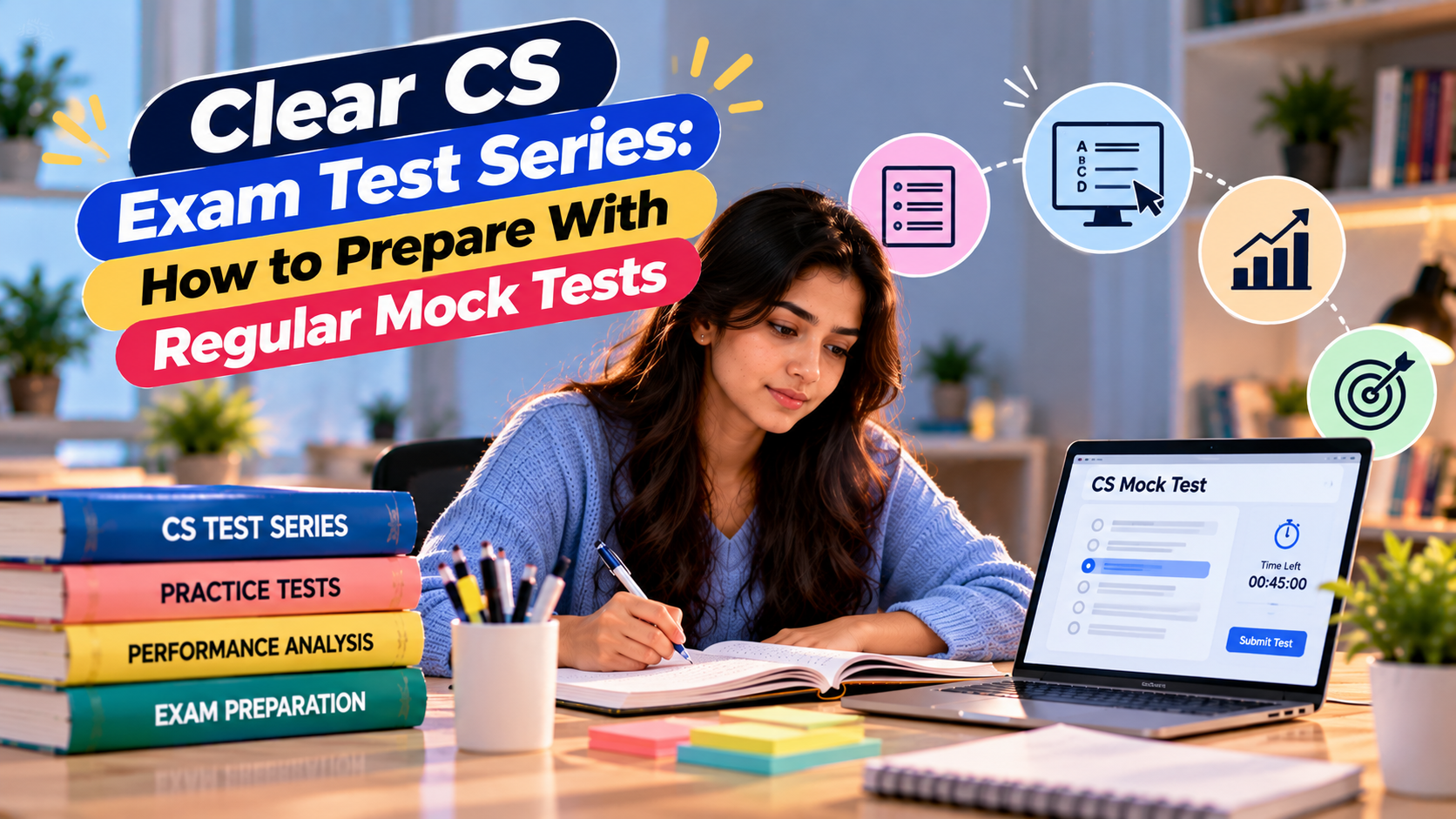
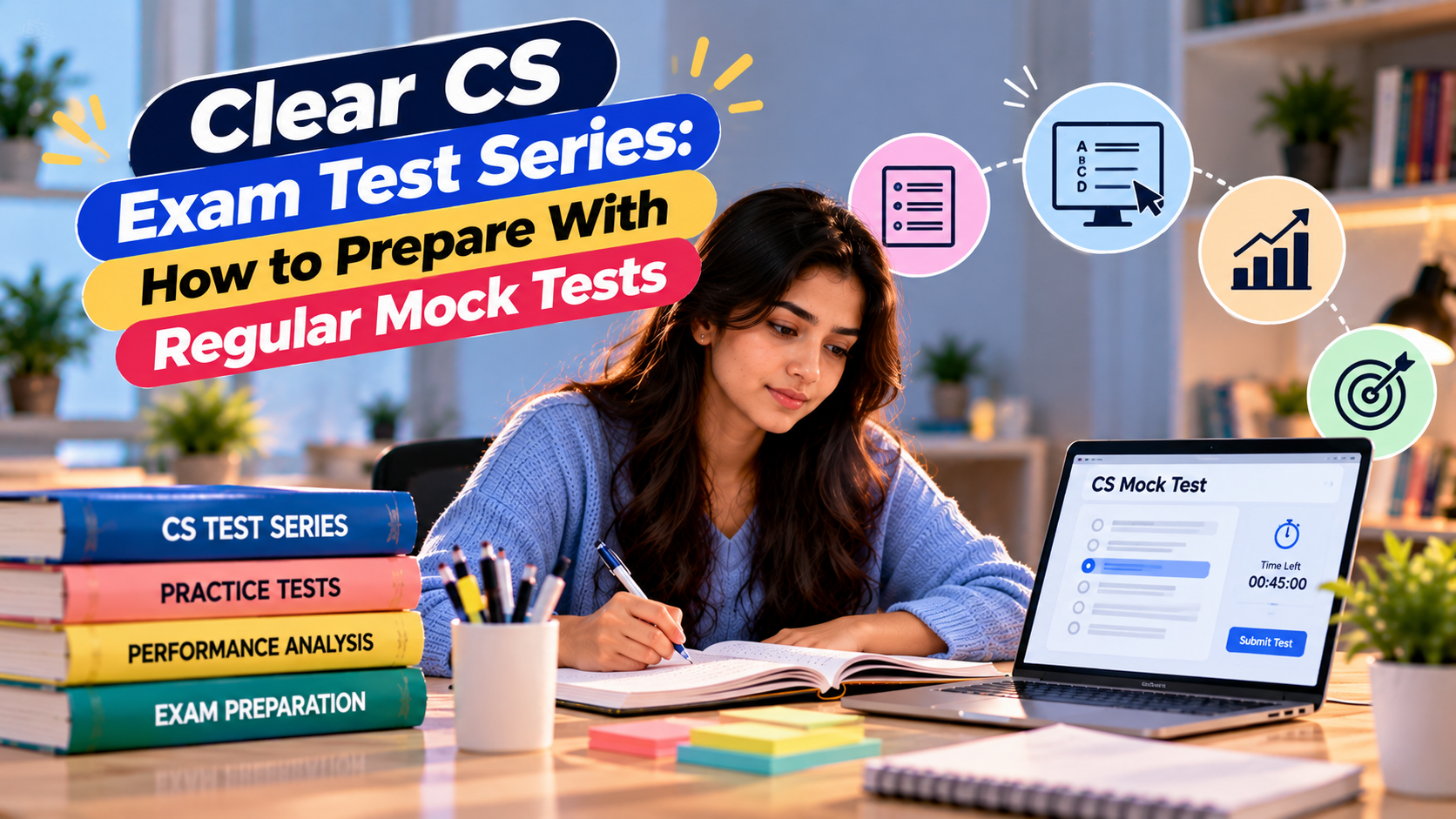
Preparing for Company Secretary (CS) examinations involves more than reading modules and remembering provisions. Students also need to understand how to apply concepts, structure answers, manage time and complete a paper within the exam duration. Regular mock tests help turn preparation into a measurable process.
A mock test is most useful when you treat it as both practice and feedback. Attempting papers without reviewing mistakes may not improve performance much. A planned routine—study a topic, attempt questions, analyse the result and revise weak areas—helps you recognise gaps before the actual examination. With a consistent approach and the right CS Exams Test Series resources, students can make practice more focused and productive.
Why Regular Mock Tests Matter for CS Exams
Reading helps you understand a topic, but answering a question requires you to recall the relevant information and present it in a suitable format. A mock test brings these skills together. It shows whether you can identify the issue in a question, select the relevant concept, organise your answer and finish within the available time.
Regular practice can also make exam conditions feel more familiar. Students who have never attempted a full-length paper may spend too long on early questions or discover too late that their writing speed is insufficient. Timed tests help reveal these issues while there is still time to work on them.
Mock tests are not a guarantee of a particular result, and one low score does not define your ability. Their value lies in the information they provide. When you review each attempt carefully, you can see which topics need more attention and whether your main difficulty is knowledge, application, presentation or time management.
Before You Start: Set Up Your Test Plan
Begin by identifying your CS course level, examination session and applicable syllabus. Check the latest ICSI announcements and study resources for your attempt, including any applicable amendments or changes. This step matters because a practice paper based on an outdated syllabus may not reflect what you need to prepare.
Next, make a subject-wise list of chapters and mark each one as not started, in progress, studied or ready for revision. Be honest with the labels. A chapter should not be considered complete simply because you have read it; you should also be able to answer relevant questions without relying heavily on your notes.
Finally, decide how much time you can realistically set aside for tests and analysis. A mock test takes more than the time spent writing it. You also need a review session to identify errors and revise the concepts behind them. A smaller number of thoroughly analysed tests is generally more useful than many tests attempted in a rush.
Choose the Right CS Exam Test Series
A suitable CS exam test series should support your current stage of preparation. If you are still learning the syllabus, chapter-wise or topic-wise tests can help you check understanding. When most topics have been covered, mixed tests and full-length papers can help you practise selecting the right approach without being told which chapter a question belongs to.
Check whether the questions match the applicable syllabus and examination pattern. Look for clear instructions, realistic time limits, balanced topic coverage and model answers or evaluation guidance that helps you understand how to improve. For theory-oriented papers, review whether the answer guidance highlights relevant provisions, key points and logical structure. For practical or case-based questions, check whether it explains the reasoning and application, not only the final conclusion.
CS Exams Test Series can be part of this practice routine when the papers and guidance suit your course and attempt. Before choosing any resource, confirm its relevance and use it alongside official ICSI material. A test series should support your preparation, not become a substitute for studying the syllabus.
Create a Realistic Mock Test Schedule
Your test frequency should reflect how much of the syllabus you have completed and how close the examination is. Taking a full-length test before learning the core topics may produce a score that tells you little beyond what you have not studied yet. On the other hand, delaying all testing until the final weeks leaves limited time to correct weaknesses.
During the learning stage, attempt short topic tests after completing a chapter or unit. Once you have covered a substantial part of a subject, add mixed tests that combine topics. After revising the subject, attempt a full-length paper under exam-like conditions. Adjust this sequence to your available time and the demands of your course.
| Preparation stage | Useful test format | Main objective |
|---|---|---|
| Learning a chapter | Short topic test | Check basic understanding and recall |
| Covering several chapters | Mixed or unit test | Practise choosing the correct concept |
| First revision | Subject-level mock | Find gaps across the syllabus |
| Near the examination | Full-length timed paper | Practise timing, selection and presentation |
| After every test | Error-review session | Convert mistakes into revision actions |
Keep your schedule flexible enough to allow for college, work or personal commitments. For example, you might reserve one session for a timed test and another for checking answers and revising the weakest topics. If a test reveals a major gap, adjust the next few study sessions instead of continuing blindly with the original plan.
How to Attempt a Mock Test Properly
For a full-length mock, recreate the basic conditions of the examination as closely as practical. Set a timer, keep your phone away and use only the materials permitted by the instructions. Avoid pausing the clock to look up a provision or check a formula. The purpose is to learn what you can produce independently within the time limit.
Read the instructions and scan the paper carefully before beginning. Identify the marks and requirements of each question, then allocate time accordingly. Do not spend too long trying to perfect one answer while leaving other questions incomplete. If you are stuck, note the question, move on when appropriate and return if time permits.
Pay attention to the command words in each question. A question asking you to explain requires a different response from one asking you to discuss, distinguish, advise or analyse a case. Keep your answer focused on the requirement, use headings where they improve clarity and support your reasoning with the relevant legal provision or concept when applicable.
Do not look at model answers while attempting the paper. Once you start checking answers midway, the test no longer gives you a reliable picture of your independent performance. Complete the attempt first, then use the answer guidance to evaluate what you wrote and what you missed.
Analyse Every Test Instead of Only Checking Marks
Your score is one useful measure, but it does not explain why you gained or lost marks. Review every question and classify the problem. Did you forget a key provision? Misunderstand the question? Know the concept but fail to apply it? Write an incomplete answer? Spend too much time on one section? Each problem needs a different response.
Create an error log with four simple fields: question or topic, type of mistake, reason and next action. For example, if you remembered a provision but omitted an important condition, your next action may be to revise the conditions and answer a similar question. If you understood the topic but ran out of time, practise timed answers rather than rereading the entire chapter.
Also compare your answer with the model answer or reliable evaluation guidance. Do not copy the model answer word for word and assume that memorising it will solve the problem. Identify the key elements that made the answer complete: issue, applicable rule, explanation, application to the facts and conclusion, where relevant. Use that structure to improve your own writing.
Reattempt selected incorrect questions after a short gap, without looking at the earlier solution. If you can now answer them correctly and explain the reasoning, the review has worked. If the same mistake appears again, return to the underlying concept and schedule another revision.
Use Different Strategies for Different Papers
CS papers do not all demand the same preparation method. Match your mock-test review to the type of knowledge and answer required.
Law and Theory-Based Papers
Practise identifying the exact legal issue and presenting the applicable provision, explanation and conclusion in a logical sequence. Focus on accuracy and relevance rather than writing everything you remember about a topic. During review, check whether you missed a condition, exception, important term or part of the question.
Case-Based Questions
Read the facts carefully and separate relevant details from background information. State the rule or principle, apply it to the facts and give a reasoned conclusion. When analysing a mock, ask whether your answer connected the rule to the case or merely repeated general theory.
Practical or Numerically Oriented Questions
Show the method and working clearly. A correct final figure may not demonstrate a sound process if the question requires calculations or explanation. Keep a list of recurring calculation errors, formula confusion and skipped steps, then practise similar questions until the method becomes reliable.
Mixed Papers and Integrated Topics
Use mixed tests to practise recognising which concepts apply when the question does not identify the chapter for you. Review why a particular approach was suitable and why an alternative approach was not. This strengthens application rather than relying on memorised question patterns.
Connect Mock Tests With Revision
Testing should be part of your revision plan, not a separate activity that competes with studying. Before a test, revise the topics you intend to assess. After the test, use your error log to choose what to revisit. This makes revision more targeted than rereading every chapter equally, regardless of your level of understanding.
Try a simple three-step cycle. First, review the weak topic using the applicable study material and your notes. Second, solve a small set of fresh questions without help. Third, return to the topic a few days later and test your recall again. This spacing gives you an opportunity to check whether the correction lasts beyond the same study session.
Keep a short revision sheet for recurring errors. Include key distinctions, conditions you forget, answer structures that work well and time-management lessons. Do not turn the sheet into another textbook. Its purpose is to remind you of high-value corrections before your next test.
Mistakes to Avoid During Mock Test Practice
Taking tests without reviewing them: An unanalysed score offers little direction. Reserve time after each attempt to understand mistakes and plan the next revision session.
Attempting only easy questions: Comfort-zone practice can hide gaps. Include a range of question types and use timed tests to practise making sensible decisions under pressure.
Memorising model answers blindly: Model answers should teach structure, relevant points and reasoning. Understand why the answer works so you can adapt the method to unfamiliar questions.
Changing resources after every low score: A low result may reflect incomplete preparation or weak exam technique, not necessarily a poor resource. Diagnose the cause before switching test series or notes.
Comparing every score with other students: External comparisons can distract from the information in your own performance. Track your progress against your earlier attempts and focus on repeat mistakes.
Ignoring syllabus updates: Confirm that practice material matches your examination session. Refer to official ICSI announcements and applicable study resources when checking changes.
How to Use Mock Tests in the Final Weeks
In the final weeks, avoid using every day for a full-length paper if that leaves no time to revise. Balance timed attempts with focused correction sessions. A practical cycle might be to attempt a paper, analyse it carefully, revise the weakest areas and then test those areas again before the next full paper.
Prioritise topics based on the syllabus, your preparation status and the mistakes revealed by practice. Do not assume that a topic can be ignored solely because it was difficult in one mock or did not appear in a recent paper. Maintain broad syllabus coverage while giving additional time to areas where your understanding is weak.
In the final days, use concise revision sheets and selected questions to reinforce important concepts. Protect enough time for rest and keep your routine manageable. The goal of the final practice phase is to enter the examination able to recall, apply and present what you have studied—not to exhaust yourself with an unrealistic number of tests.
Track Your Progress With a Simple Scorecard
Record more than the marks earned. A small scorecard helps you see whether the changes you make are improving your performance.
| Measure | What to record | What it tells you |
|---|---|---|
| Score | Marks or percentage | Overall performance trend |
| Completion | Questions attempted and left | Whether pacing needs work |
| Knowledge gaps | Topics or provisions forgotten | What to revise next |
| Application errors | Incorrect use of a concept | Where extra practice is needed |
| Presentation | Missing steps or unclear structure | How to make answers easier to evaluate |
| Repeat mistakes | Errors appearing in more than one test | Which issues need a focused correction plan |
Review the scorecard every week. Look for patterns instead of reacting to one test. If your scores remain steady but you complete more questions, time management may be improving. If the same knowledge gap continues to appear, schedule a deeper revision session. Use evidence from your own attempts to decide what to do next.
Conclusion
Regular mock tests can make CS exam preparation more structured when each attempt leads to a clear improvement plan. Choose papers that match your syllabus and preparation stage, attempt them under timed conditions, analyse errors and revisit weak topics before the next test. A CS Exams Test Series can support this routine when used alongside official ICSI material. Consistency, honest review and targeted revision matter more than simply counting how many tests you complete.