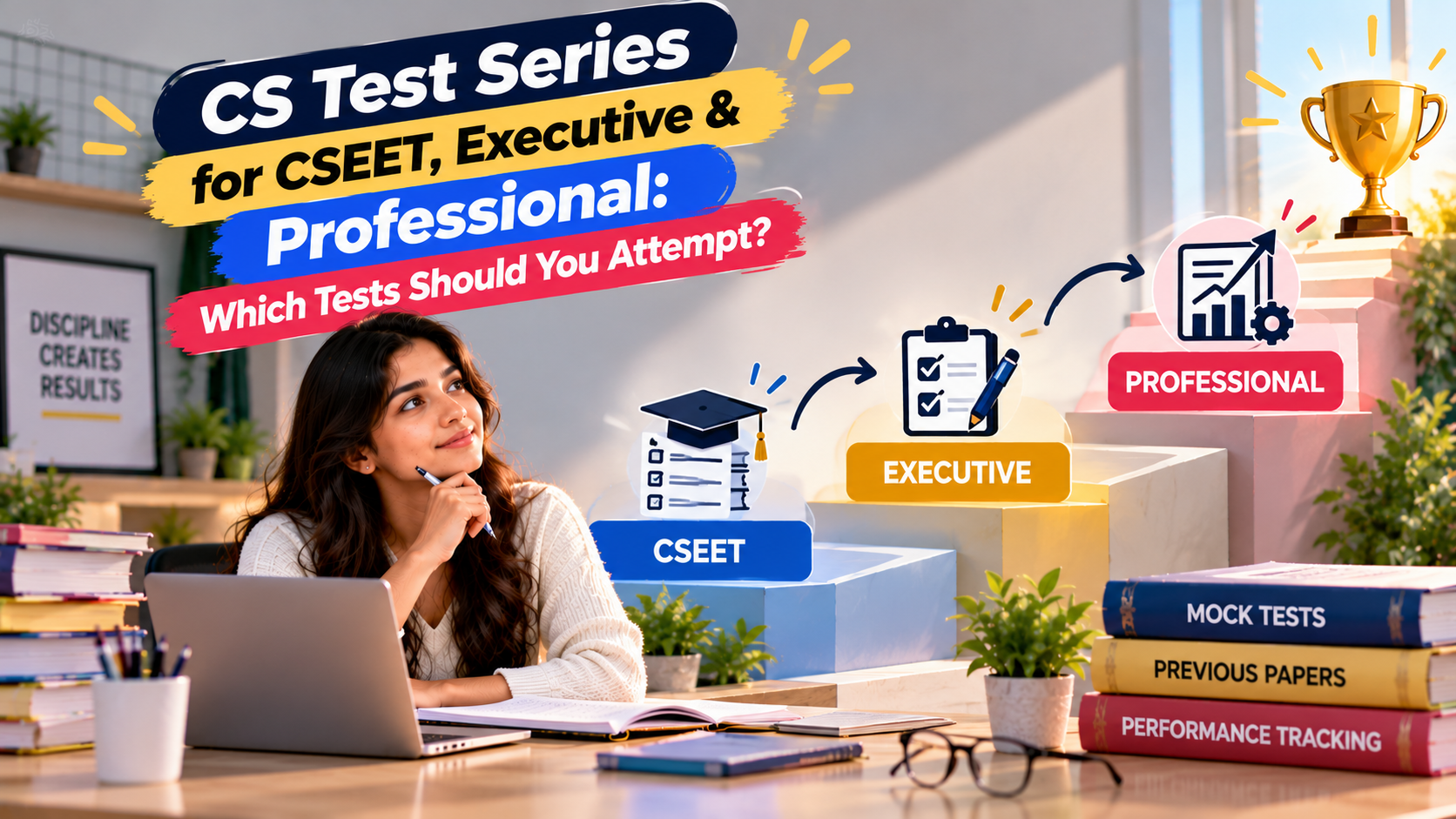
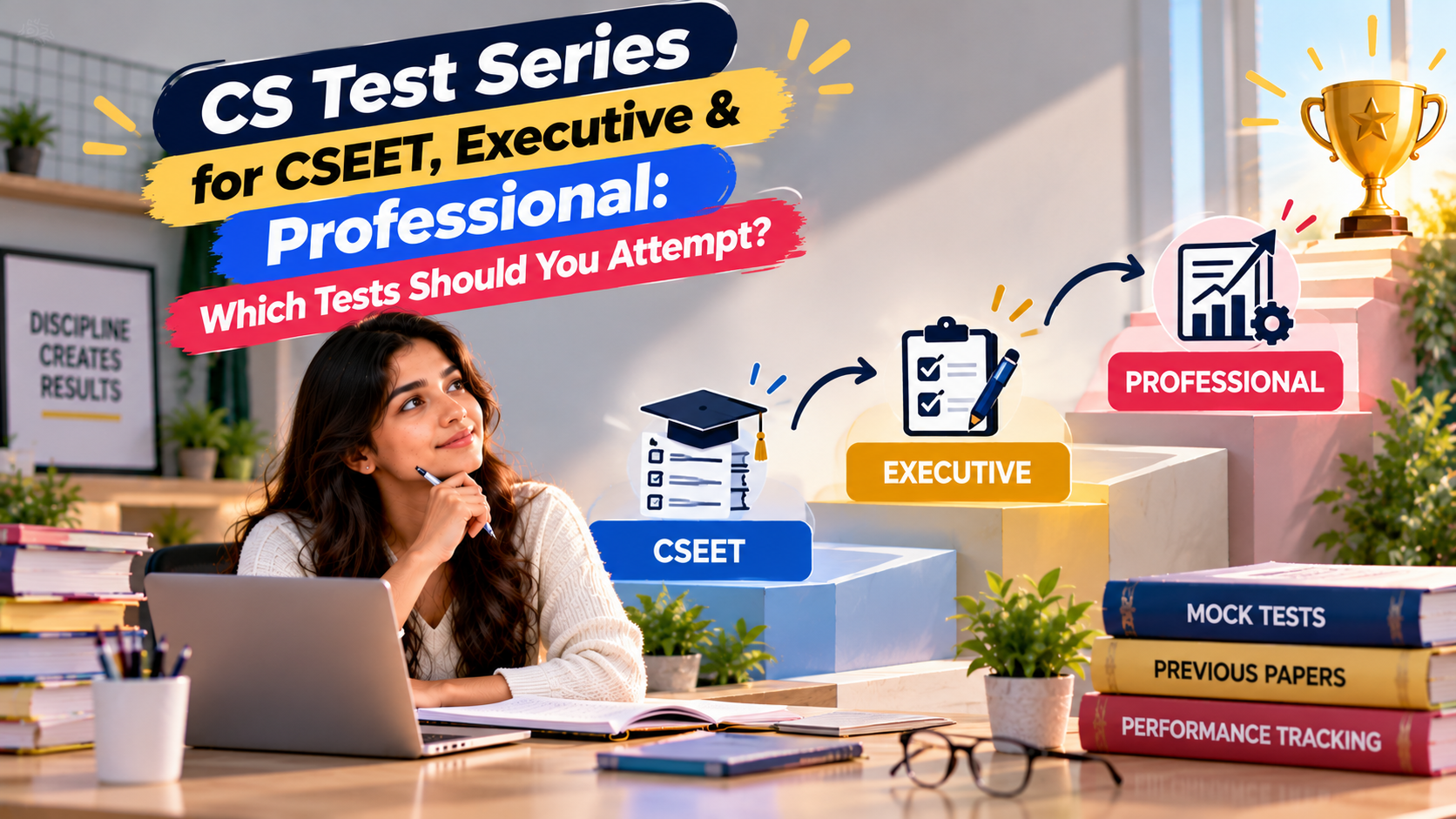
Company Secretary students do not all need the same kind of test practice. A CSEET candidate is building a foundation and learning the assessment style, a CS Executive student must understand subject-level concepts and apply them, and a CS Professional student needs to connect advanced topics and present well-reasoned answers.
Choosing a CS test series should begin with your current level and preparation stage—not simply the number of papers included. Topic tests, subject-wise tests, mixed practice and full-length mocks each serve a different purpose. The best plan combines these formats at the right time, reviews mistakes after every attempt and follows the applicable ICSI syllabus and examination instructions.
Why the Type of Test Matters
A test is useful when it helps answer a specific preparation question. Do you understand a recently studied chapter? Can you recall material from several chapters together? Can you finish within the allotted time? Are your answers relevant, accurate and clearly presented? Different formats measure different parts of your readiness.
Topic-wise tests are helpful during learning because they focus on a limited area. Subject-wise tests show whether you can handle a broader range of questions. Mixed tests require you to identify the relevant concept without being told which chapter it belongs to. Full-length mocks help you practise concentration, time allocation and the overall examination experience.
Before selecting a test, confirm the current syllabus, examination format and instructions through official ICSI resources. Do not assume that a paper designed for an earlier session will always match your upcoming examination.
Which Tests Should CSEET Students Attempt?
CSEET candidates should focus on understanding the concepts and question styles relevant to the current entrance assessment. Start by checking the latest official CSEET syllabus, exam structure and candidate instructions. Choose practice tests that reflect the current requirements rather than relying only on old sample papers.
1. Topic-Wise Practice Tests
Attempt short tests after studying a topic. They show whether you understood the lesson and can recall key facts without looking at your notes. If you repeatedly miss questions from the same area, revisit the concept before moving on. Keep a list of confusing terms and concepts for revision.
2. Section-Wise Tests
Once you have studied several topics, attempt a test covering a wider section. This helps you practise switching between concepts and reveals whether your understanding is limited to recently studied material. Review incorrect responses and understand why the correct answer is appropriate.
3. Timed Practice and Full-Length Mocks
As preparation progresses, practise within a time limit that matches the relevant official instructions. Timed practice helps you avoid spending too long on one question and shows whether you can maintain accuracy at a steady pace. Use full-length mocks after covering a substantial part of the syllabus, and check that the mock reflects the format applicable to your session.
Recommended CSEET sequence: topic tests, section-wise tests, timed mixed practice and full-length mocks. Review errors after every attempt. Building dependable fundamentals is more important than collecting a high number of test scores.
Which Tests Should CS Executive Students Attempt?
CS Executive preparation needs a detailed subject-wise plan. Students must understand concepts, recall key points and apply them in examination questions. Test selection should progress from checking individual topics to practising complete papers and reviewing answer presentation.
1. Chapter-Wise Tests
After studying a chapter, attempt questions on its main provisions, concepts and applications. Do not rely on reading the chapter twice as proof that you have learnt it. A short test shows whether you can recall key points and use them without prompting.
2. Subject-Wise Tests During Revision
After completing a meaningful portion of a subject, attempt a test covering multiple chapters. These tests reveal whether you can remember earlier topics while learning new ones. They also help you decide which rule, concept or method applies to each question.
3. Case-Based and Application Questions
Where relevant to the paper, practise applying a provision or concept to a set of facts. A strong answer addresses the issue, explains the applicable principle, connects it to the facts and reaches a reasoned conclusion. During review, check whether you applied the rule or only wrote general theory.
4. Full-Length Subject Mocks and Mixed Tests
When you have covered and revised most of a subject, attempt a full-length mock under timed conditions. Practise reading instructions, allocating time according to marks and completing the paper. Mixed tests can help you revisit several chapters and identify topics that need another revision session.
Recommended Executive sequence: chapter-wise tests during learning, subject-wise tests during revision, relevant case-based practice and timed full-length mocks. If you are preparing multiple papers, rotate them through the week instead of repeatedly practising only your strongest subject.
Which Tests Should CS Professional Students Attempt?
At the CS Professional level, test practice should focus on depth, integration and analysis. Students need to interpret a requirement, select relevant concepts and build a structured answer. The exact approach depends on the subjects and modules applicable to the examination session.
1. Focused Tests for Complex Topics
Use focused tests when a topic has several conditions, exceptions or connected concepts. A short test can locate the precise part you have not understood. Return to the official study material, clarify the concept and attempt new questions to check whether the issue has been resolved.
2. Integrated or Cross-Topic Questions
After revising individual topics, practise questions that require you to connect related concepts. Read the question carefully and identify which facts matter. Structure your response around the requirement instead of listing every point you remember. This helps you build a reasoned answer for unfamiliar questions.
3. Full-Length Mocks and Answer-Writing Tests
Full-length mocks help you sustain concentration and complete a paper within the prescribed time. Review the depth of your answers, relevance of your points, use of provisions or concepts and time spent on each section. For descriptive papers, practise writing complete answers, using headings where helpful and ensuring each paragraph supports the question requirement.
4. Weak-Area Retests
After a mock, select questions that exposed important gaps and revisit them after a short interval. Attempt a similar question without looking at the earlier solution. If the same error continues, return to the underlying concept before taking another full-length mock.
Recommended Professional sequence: targeted tests for difficult topics, integrated practice, full-length timed mocks and focused retests based on your error log. Treat each mock as evidence for deciding what to revise next, not as a prediction of your final result.
Compare Test Selection by Level
| Level | Start with | Build towards | Main focus |
|---|---|---|---|
| CSEET | Topic-wise practice | Timed mixed and exam-pattern mocks | Fundamentals, accuracy and familiarity |
| CS Executive | Chapter-wise tests | Subject mocks and application questions | Retention, provisions and subject application |
| CS Professional | Focused tests for complex topics | Integrated questions and full-length mocks | Analysis, structured answers and time management |
This is a general study framework, not a replacement for official exam instructions. If the assessment format differs for your session, adapt your practice accordingly.
How to Plan Your Test Schedule
Build your schedule around preparation stage, available study time and the number of papers you need to cover. The objective is a repeatable routine that includes learning, testing and correction—not filling every free hour with mock tests.
| When | Test activity | Follow-up |
|---|---|---|
| After a topic | Short topic test | Correct misunderstandings |
| After several topics | Mixed or chapter-group test | Review recall and application |
| During revision | Subject-level test | Update notes and error log |
| Near the exam | Full-length timed mock | Analyse timing and answer quality |
| After identifying a weakness | Focused retest | Check whether the correction worked |
Leave time for analysis after each test. If you attempt a timed paper in one session, reserve another session to compare answers with reliable guidance and revise weak topics. If the same problem appears repeatedly, reduce the number of new tests temporarily and focus on correcting the gap.
When preparing for several subjects, rotate papers across the week. You might test one subject, revise a second and review errors from an earlier paper on another day. Arrange this around your timetable and the time remaining before the examination.
How to Choose a Suitable CS Test Series
Check whether the series covers the correct course level and examination session. Papers should align with the applicable syllabus and use a suitable format. For CSEET, verify current assessment requirements; for Executive and Professional, confirm the papers and modules relevant to your attempt.
Review the quality of questions and answer guidance. Model answers should explain key points and reasoning rather than simply present a final response. For descriptive questions, useful guidance shows how to organise an answer. For application questions, it explains how the facts connect to the relevant concept.
Look for a sensible progression from short tests to full-length papers. Check the schedule, access details and evaluation process before committing, and choose a format you can realistically complete and review. CS Exams Test Series can be considered as part of your preparation toolkit when its papers and support fit your needs. Use it alongside official ICSI study resources, and verify syllabus coverage and session relevance before attempting the tests. No test series can guarantee a pass; its value depends on consistent practice and how you use feedback.
How to Review Each Test
Do not stop at calculating marks. Review every incorrect or incomplete response and classify the reason: forgotten concept, misunderstood requirement, incorrect application, incomplete answer, avoidable error or poor time allocation. Each category points to a different improvement task.
Keep an error log with four fields: topic or question, mistake, reason and next action. “Revise the chapter” is often too vague. A more useful action might be “learn the conditions and exceptions, then answer two case-based questions” or “practise writing a complete answer in eight minutes”. Specific actions are easier to complete and review.
Compare responses with relevant model answers or evaluation guidance after finishing the paper. Identify missing elements and rewrite selected answers in your own words. Reattempt important incorrect questions after a gap. If the same error continues, return to the underlying concept before attempting another full-length mock.
Common Test-Series Mistakes
Attempting full papers too early: A full paper may be discouraging if you have not covered the basics. Use short tests first and increase difficulty as preparation improves.
Taking tests without analysis: A score alone does not explain what to do next. Review errors and turn them into specific revision tasks.
Using outdated material: Check the applicable syllabus and official instructions before relying on a paper, especially if the assessment format has changed.
Memorising answers without understanding: Model answers help you learn structure and key points, but understanding the reasoning is essential for unfamiliar questions.
Ignoring time management: Practise with a timer as you approach the exam. Learn when to move on from a difficult question and how to distribute time sensibly.
Comparing scores without context: Compare your own attempts over time and look for improvement in accuracy, completion and answer quality. One result is only one piece of information.
Which Tests Should You Attempt Near the Exam?
In the final stage, prioritise full-length mocks and targeted tests based on weaknesses. Do not fill the entire revision period with papers; leave time to correct the gaps those papers reveal. A balanced sequence is to attempt a mock, review it, revise weak areas and use a short retest to confirm improvement.
Choose mock papers that match your examination session and follow the relevant time limits. Practise with the answer-writing approach you intend to use in the actual exam. Review whether you completed the paper, interpreted questions correctly and included necessary reasoning or key points.
During the last few days, focus on concise revision material, important concepts and recurring errors. Avoid major changes to your resource system at the last minute. The aim is to strengthen what you have studied and enter the examination with a clear approach to reading, answering and managing time.
Conclusion
The right CS test series depends on whether you are preparing for CSEET, CS Executive or CS Professional. CSEET students should progress from topic practice to timed mocks; Executive students should add subject-wise and application tests; Professional students should emphasise integrated questions, answer quality and full-length practice. Across all levels, review every attempt and use the findings to guide revision. Choose tests that match your current syllabus and use them with official ICSI resources for a structured preparation routine.