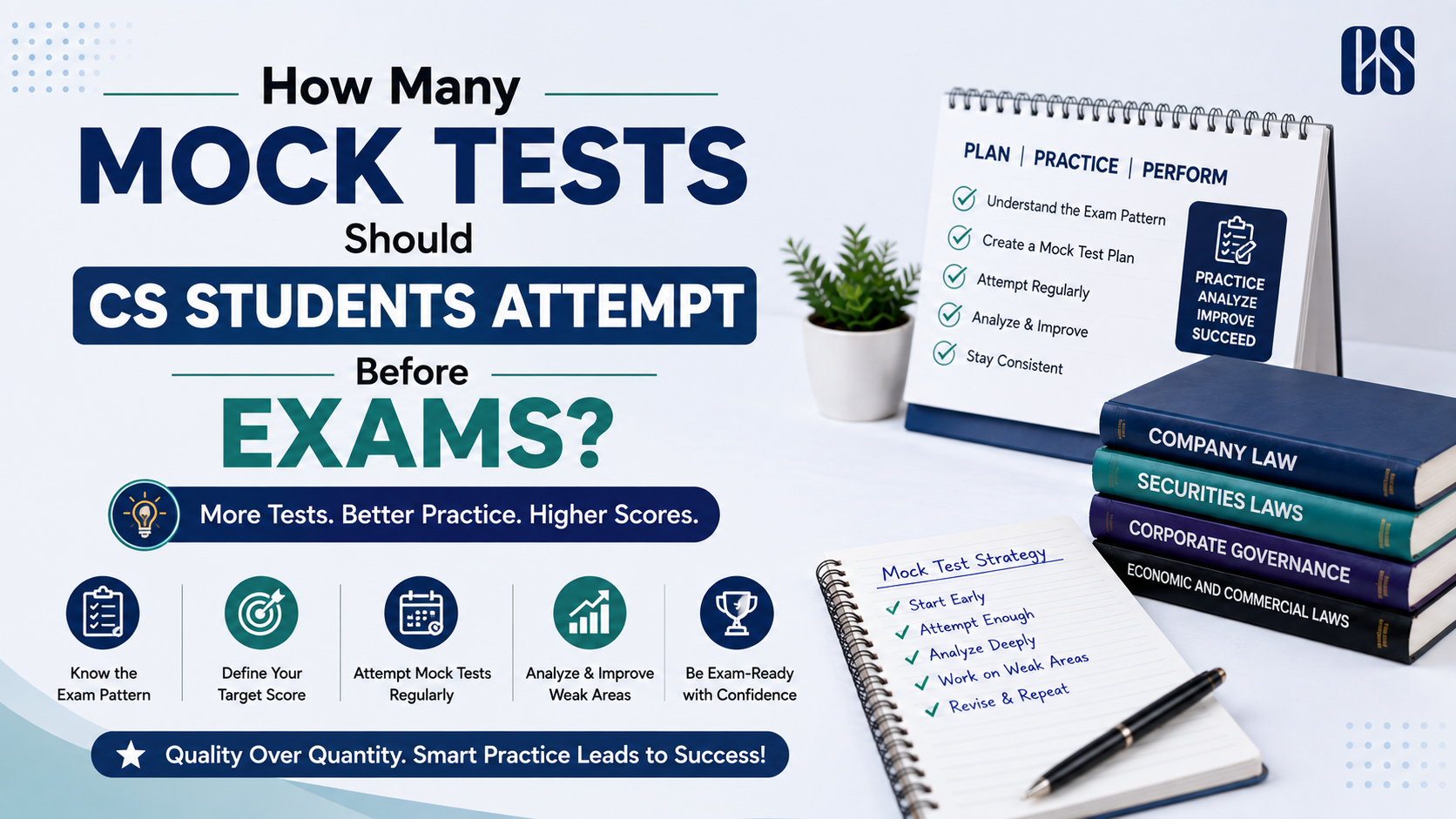
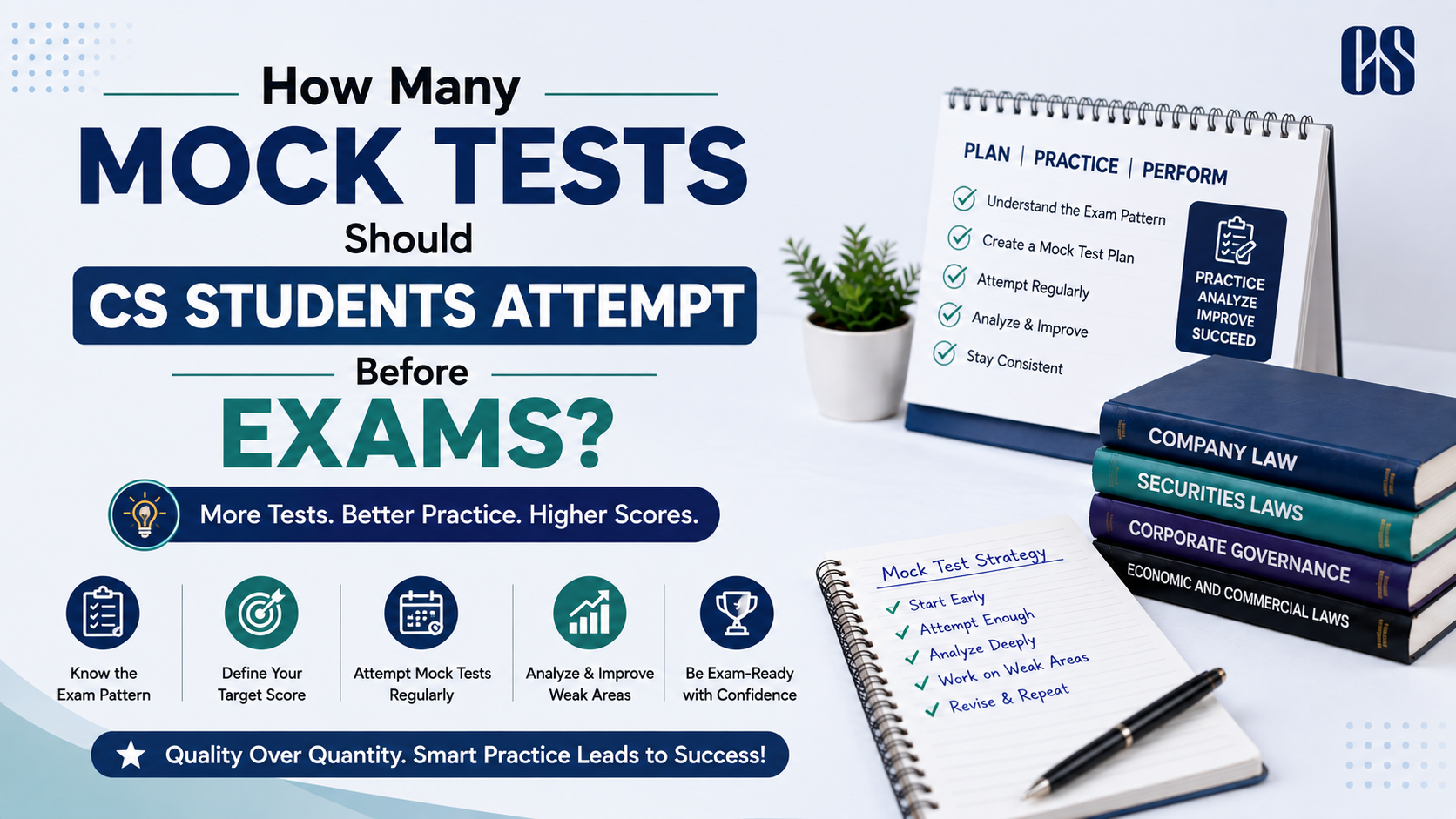
Preparing for a Company Secretary examination is not just about completing the syllabus. Many students study every chapter, revise their notes several times, and still struggle when they sit in the actual examination hall. The reason is often simple: they have not practised enough full-length questions under exam-like conditions.
This is where mock tests become extremely important.
But there is one question almost every serious CS aspirant eventually asks:
How many mock tests should I attempt before my CS exams?
There is no single number that works for every student. A student who has completed the syllabus early may need more mock tests than someone who is still finishing revision. Similarly, a CS Executive or Professional student may require a different strategy depending on the number of papers, preparation level, and time available.
As a practical target, most CS students should aim for at least 5–8 quality full-length mock tests per subject, while students targeting a strong score can benefit from 8–12 or more carefully analysed tests.
However, simply solving 10 mock papers does not guarantee better marks.
The real improvement comes from attempting the test, checking the answers, identifying mistakes, and making sure those mistakes are not repeated.
That is why a well-designed CS Exam Test Series can become much more valuable than randomly solving question papers.
How Many Mock Tests Are Enough for CS Exams?
If you want a simple answer, use this as a starting point:
|
Preparation Level |
Recommended Mock Tests per Subject |
Main Focus |
|
Basic Preparation |
3–5 |
Understanding paper pattern |
|
Average Preparation |
5–8 |
Time management + answer writing |
|
Strong Preparation |
8–10 |
Accuracy + presentation |
|
High-Score Target |
10–12+ |
Exam simulation + mistake elimination |
|
Last-Minute Preparation |
3–5 |
Revision + important question practice |
These numbers are not rigid rules. Quality matters more than quantity.
For example, attempting 12 tests without analysing them is usually less useful than attempting 6 tests and thoroughly reviewing every mistake.
A good mock test should help you answer questions such as:
- Did I complete the paper within the required time?
- Did I understand what the question actually asked?
- Was my answer structured properly?
- Did I use appropriate headings and provisions?
- Did I miss important points?
- Did I spend too much time on one question?
- Did I make avoidable presentation mistakes?
- Which topics repeatedly caused problems?
Once you start using mock tests to answer these questions, they become a preparation tool rather than just another practice activity.
Why Are Mock Tests Important for CS Students?
A CS examination demands more than theoretical knowledge. Students are expected to recall concepts, interpret questions, structure answers and present them effectively within a limited amount of time.
Mock tests bring all these skills together.
1. They Create Real Exam Pressure
Studying at home can feel comfortable. You can take breaks, check your notes and spend as much time as you want on a difficult topic.
The examination hall is completely different.
You have a fixed amount of time and a large number of questions to attempt.
Regular mock tests gradually make this environment familiar. After several full-length tests, sitting for three hours and continuously writing answers does not feel as overwhelming.
2. They Improve Time Management
One of the most common problems students face is running out of time.
A student may know the answer but still lose marks because the last few questions are rushed or incomplete.
Mock tests reveal your actual writing speed.
If you consistently need too much time for the first half of the paper, you can change your strategy before the real examination.
3. They Improve Answer Writing
Knowing an answer and writing a good examination answer are two different things.
CS students need to learn how to:
- Start answers directly
- Use relevant headings
- Present provisions clearly
- Explain concepts logically
- Apply concepts to practical situations
- Highlight important points
- Use suitable conclusions
- Avoid unnecessary repetition
This skill develops through practice.
4. They Expose Weak Areas
You may believe that a particular chapter is strong because you can read and understand it.
A mock test can reveal something different.
Perhaps you remember the concept but forget important provisions. Maybe you understand the theory but struggle with application-based questions.
That information is extremely valuable because it tells you exactly where your preparation needs improvement.
The Ideal Mock Test Strategy for CS Students
Instead of attempting mock tests randomly, divide your preparation into stages.
Stage 1: Start With Chapter-Wise Practice
Do not immediately jump into full-length tests if your syllabus is incomplete.
Begin with chapter-wise questions after completing individual topics.
This helps you check whether you actually understand the material.
For example, after completing a major topic, solve questions without looking at your notes. Mark the questions you cannot answer confidently and revise those areas.
This creates a strong foundation for full-length mock tests.
Stage 2: Attempt Subject-Wise Mock Tests
Once you have completed your first revision, start full-length subject-wise tests.
A practical target is:
2–3 tests during your first serious revision cycle.
The objective at this stage is not necessarily to score extremely high.
Instead, focus on:
- Understanding the question pattern
- Improving answer structure
- Finding weak chapters
- Learning how to manage time
- Becoming comfortable with writing continuously
Your marks may initially be lower than expected.
That is completely normal.
A mock test is supposed to expose weaknesses before the actual exam, when there is still time to fix them.
Stage 3: Increase the Number During Final Revision
After completing another revision, attempt more full-length papers.
At this point, aim for approximately:
3–5 additional mock tests per subject.
Now your focus should shift from simply completing the paper to improving your score.
After every test, record:
|
Area |
What to Check |
|
Knowledge |
Which topics did I forget? |
|
Accuracy |
Where did I write incorrect information? |
|
Time |
Which questions consumed too much time? |
|
Presentation |
Were my answers properly structured? |
|
Coverage |
Did I attempt every question? |
|
Revision |
Which topics require immediate revision? |
This simple process can make every subsequent mock test more effective.
Stage 4: Take Full Exam Simulations
The final stage should be treated like the real examination.
Choose a quiet environment.
Keep your phone away.
Use the same duration as the actual examination.
Do not refer to notes.
Do not pause the timer.
Attempt the complete paper in one sitting.
This is where your preparation starts becoming exam-ready.
Ideally, attempt your final full-length mocks during the last few weeks before the examination rather than leaving all practice for the final few days.
How Many Mock Tests Should CS Executive Students Attempt?
CS Executive students generally deal with subjects that require a combination of conceptual understanding, legal knowledge, practical application and written presentation.
A useful target is 6–10 full-length mock tests per subject.
Students who are already well prepared can push this number toward 10–12, provided they have enough time to analyse each test.
A possible plan could look like this:
|
Preparation Period |
Mock Test Target |
|
After Syllabus Completion |
1–2 tests |
|
First Revision |
2–3 tests |
|
Second Revision |
2–3 tests |
|
Final Revision |
2–4 tests |
|
Total |
7–12 tests |
Do not try to complete all these tests in a few days.
The objective is continuous improvement.
How Many Mock Tests Should CS Professional Students Attempt?
At the Professional level, students should focus heavily on answer quality, conceptual clarity, case-based application and time management.
A practical target is 6–10 full-length tests per paper, with additional practice for difficult or weak areas.
If a student has limited preparation time, completing 5 high-quality mocks with detailed analysis can still be more beneficial than rushing through 10–12 papers.
For Professional students especially, the question should not be:
“How many papers have I solved?”
Instead, ask:
“How many mistakes have I successfully eliminated?”
That is a much better measure of preparation.
Is Solving Previous Year Papers Enough?
Previous-year papers are extremely useful, but they should not be your only source of practice.
Previous papers help you understand:
- The style of questions
- Repeated concepts
- Question framing
- Difficulty level
- Application-based requirements
However, a structured CS Exam Test Series can provide additional practice through fresh questions and simulated examination papers.
The best strategy is to combine both.
A strong combination looks like this:
Previous-year papers + Mock Tests + Revision + Answer Analysis
This gives you exposure to both familiar and unfamiliar questions.
Mock Tests vs Revision: Which Is More Important?
This is not really an either-or choice.
Revision gives you knowledge.
Mock tests teach you how to use that knowledge under examination conditions.
Imagine that you have revised a chapter five times but have never written an answer from it.
You may feel confident.
But during the exam, you might discover that you cannot recall the relevant provision quickly or that your answer takes too long to write.
Mock tests reveal this gap.
Therefore, your final preparation should include both revision and testing.
A simple rule is:
Study → Revise → Test → Analyse → Improve → Retest
This cycle is much more effective than repeatedly reading the same material.
How to Analyse a CS Mock Test Properly
This is perhaps the most overlooked part of mock-test preparation.
Many students finish a paper, check their marks and immediately start another test.
Don't do that.
Spend enough time analysing the paper.
Step 1: Check Every Wrong Answer
Do not only look at the total score.
Identify exactly why the answer was wrong.
Was it:
- Lack of knowledge?
- Confusion between concepts?
- Careless mistake?
- Poor interpretation?
- Incomplete answer?
- Incorrect provision?
- Weak presentation?
Step 2: Identify Lost Marks
Create a small mistake tracker.
For example:
|
Test |
Topic |
Mistake |
Action |
|
Mock 1 |
Company Law |
Forgot provision |
Revise provision |
|
Mock 2 |
Tax |
Calculation error |
Practise questions |
|
Mock 3 |
Drafting |
Weak format |
Review answer structure |
|
Mock 4 |
Governance |
Incomplete explanation |
Revise concept |
After 5–6 tests, patterns will become obvious.
Step 3: Reattempt Difficult Questions
After revising the weak topic, attempt the question again.
This converts a mistake into learning.
What Is a Good Mock Test Score?
Do not become obsessed with achieving a specific score in your first mock.
Your first objective should be identifying weaknesses.
However, as the examination approaches, your mock scores should ideally show an upward trend.
For example:
Mock 1 → 48%
Mock 2 → 55%
Mock 3 → 61%
Mock 4 → 67%
Mock 5 → 72%
The exact numbers are less important than the direction.
If your score remains unchanged after several tests, analyse why.
You may be making the same mistakes repeatedly, or your revision strategy may need to change.
7 Mistakes CS Students Should Avoid While Taking Mock Tests
1. Attempting Tests Without Completing Basic Preparation
Mock tests cannot replace studying the syllabus.
2. Checking Answers During the Test
This destroys the purpose of an examination simulation.
3. Ignoring Time Limits
Always practise under realistic time conditions.
4. Focusing Only on Marks
Your mistakes are often more valuable than your score.
5. Skipping Analysis
A test without analysis is a missed learning opportunity.
6. Attempting Too Many Tests at the Last Minute
Ten tests in three days are not necessarily better than ten tests spread across several weeks.
7. Repeating the Same Mistakes
Maintain a mistake notebook and revise it regularly.
How to Create the Perfect CS Mock Test Schedule
Suppose you have four weeks remaining.
A simple schedule could be:
|
Week |
Main Goal |
Mock Tests |
|
Week 1 |
Revision + weak topics |
1–2 |
|
Week 2 |
Answer writing + practice |
2–3 |
|
Week 3 |
Full exam simulation |
2–3 |
|
Week 4 |
Final revision + confidence building |
2–3 |
This gives you approximately 7–11 tests, depending on your preparation level.
If you have less time, reduce the number but maintain quality.
If you have more time, increase practice gradually.
How CS Exam Test Series Can Improve Your Preparation
A structured test series gives your preparation a fixed direction.
Instead of constantly asking yourself, “What should I practise today?”, you have a defined testing schedule.
A good CS Exam Test Series should ideally provide:
- Full-length examination-style papers
- Subject-wise practice
- Relevant and updated questions
- Proper answer formats
- Detailed evaluation
- Performance analysis
- Time-bound tests
- Scope for repeated practice
- Identification of weak areas
The purpose is not simply to generate more question papers.
The purpose is to help students understand how they perform when it actually matters.
For a serious CS aspirant, this can make the final weeks of preparation much more structured.
So, What Is the Ideal Number of Mock Tests?
If you want one practical recommendation, aim for:
5–8 mock tests per subject as a minimum serious target.
If you are targeting a higher score and have sufficient preparation time:
8–12 mock tests per subject can be a strong target.
But remember:
8 analysed tests > 12 blindly attempted tests.
Your goal should not be to collect certificates, count papers or chase an impressive number.
Your goal is to enter the examination hall knowing:
- how to manage your time,
- how to structure your answers,
- how to handle unfamiliar questions,
- which topics are still weak,
- and how to avoid the mistakes you made during practice.
That confidence comes from repeated, purposeful practice.
Final Word: Test Yourself Before the Exam Tests You
Every CS student has a different preparation journey.
Some students finish the syllabus months before the examination. Others complete it much closer to the exam. Some are naturally fast writers, while others need more practice with answer presentation.
So there is no magic number of mock tests.
But there is a magic process:
Prepare well → revise thoroughly → attempt realistic mocks → analyse mistakes → improve → repeat.
For most students, 5–8 quality mock tests per subject is a practical baseline, while 8–12 tests can be beneficial for students aiming for stronger performance and who have enough time to analyse them properly.
Most importantly, never judge your preparation only by how many chapters you have read.
Judge it by how confidently you can write, manage time, apply concepts and complete the paper under exam conditions.
That is exactly where a reliable CS Exam Test Series can add real value to your preparation.
Your mock test is not the final exam.
It is your opportunity to make mistakes before the final exam, learn from them, and walk into the examination hall better prepared than you were yesterday.