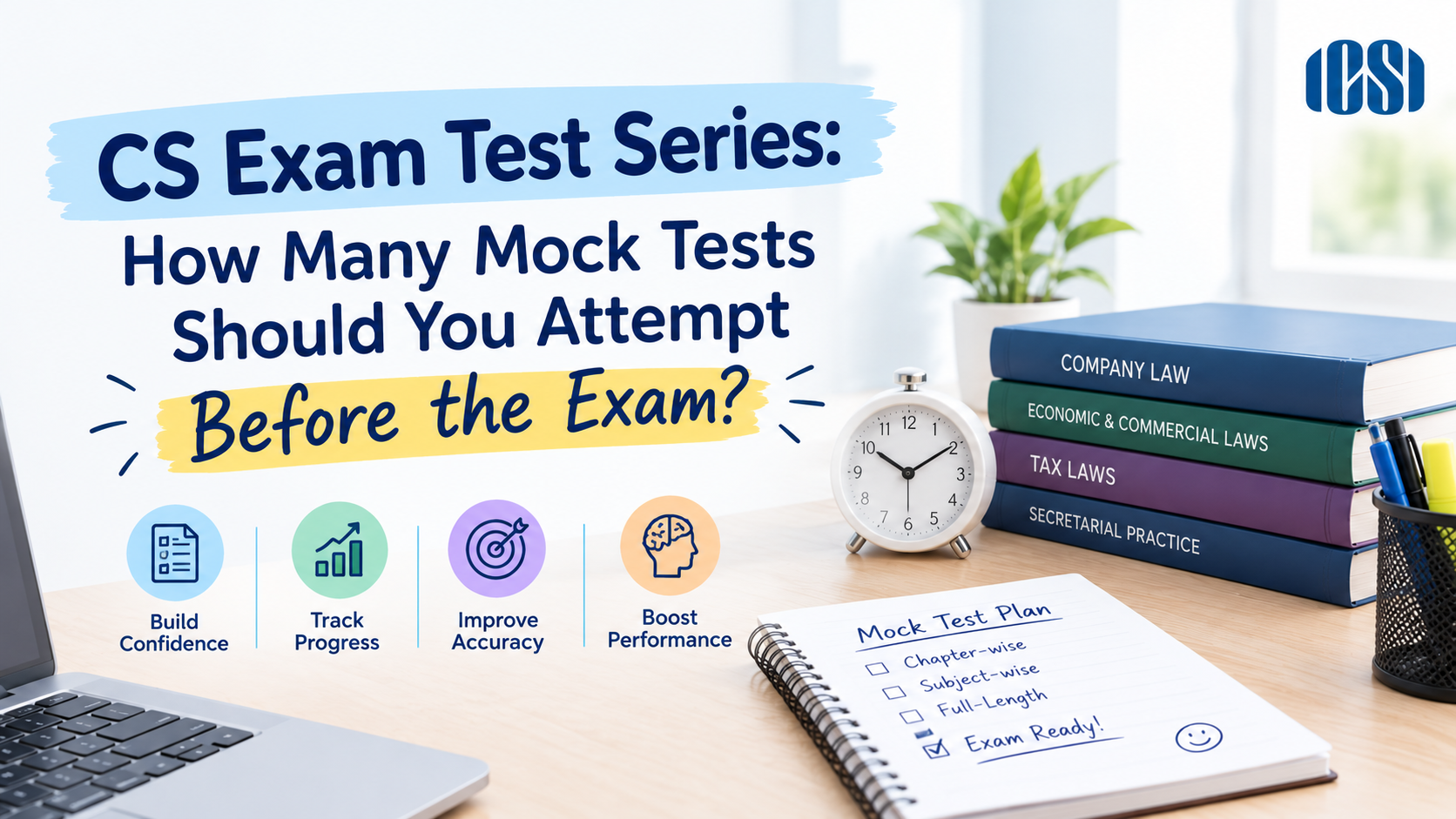
One of the most common questions during Company Secretary exam preparation is how many mock tests to attempt before the exam. Some students complete paper after paper, while others delay full-length practice until they feel completely ready. Neither approach is automatically best. The right plan depends on your syllabus coverage, course level, time available and ability to learn from each attempt.
This guide offers practical planning ranges for CSEET, CS Executive and CS Professional candidates, explains when to use different types of tests and shows how to analyse mock performance. Treat the suggested numbers as flexible guidance rather than official ICSI rules.
Is There an Ideal Number of CS Mock Tests?
There is no single number of mock tests that works for every CS student. The right target depends on your course level, how much of the syllabus you have covered, your available study time and whether you are improving after each attempt. Ten carefully reviewed tests may be more useful than twenty papers completed without analysis.
Think of mock tests as a way to practise and diagnose—not as a score-counting exercise. A useful test should help you identify what you know, what you have forgotten, where you lose time and which answer-writing habits need work. The goal is to enter the exam having practised the relevant format and corrected recurring mistakes.
A Practical Mock Test Target by Preparation Stage
The following ranges are planning suggestions, not official ICSI requirements or a guarantee of success. Adjust them to your syllabus, exam format and time remaining. Always verify the current examination pattern and syllabus using official ICSI information.
| Preparation stage | Suggested practice target | Main focus |
|---|---|---|
| CSEET | Around 3–5 full-format practice papers if time allows | Format familiarity, recall and accuracy |
| CS Executive | Around 2–3 full-length mocks per paper, plus topic tests | Application, coverage and answer structure |
| CS Professional | Around 2–3 full-length mocks per paper, plus targeted practice | Analysis, presentation and timing |
| Limited time remaining | Prioritise selected full papers and targeted weak-area tests | High-value revision and error correction |
How Many Mock Tests Should CSEET Students Attempt?
CSEET candidates can begin with short topic quizzes while learning and then attempt a few timed, complete practice papers once they have covered the relevant areas. As a practical starting point, aim for around three to five full-format practice attempts if your preparation window allows, alongside regular topic-level quizzes. This is a flexible target, not a rule.
Review each attempt carefully. Note whether errors came from a concept gap, a misread question, weak recall or rushed decision-making. Check that the practice material reflects the current CSEET syllabus and assessment format, since exam arrangements can change. Do not rely on old papers without checking their relevance.
How Many Mock Tests Should CS Executive Students Attempt?
CS Executive students often need a combination of chapter-wise, subject-wise and full-length practice because papers may require both detailed knowledge and application. During learning, use topic tests to confirm understanding. After covering a meaningful portion of a subject, attempt a subject-wise test to check whether you can move between chapters without prompts.
As a broad planning guide, try to complete two or three timed full-length mocks per paper before the exam if your schedule permits, while using shorter tests for weaker chapters. If you have more time, you may benefit from additional attempts—but only if you can review and learn from them. If you have limited time, prioritise syllabus coverage and targeted practice rather than rushing through a large number of papers.
How Many Mock Tests Should CS Professional Students Attempt?
At CS Professional level, the value of a mock often lies in practising advanced application, analysis and complete-paper writing. A useful starting target is two or three full-length attempts per paper, with additional focused practice for areas where your answers are incomplete or your timing is inconsistent. This should be adjusted to the time you have and the current exam structure.
After each paper, review whether you answered the exact question asked, supported your reasoning, covered relevant points and completed the paper within the available time. If you repeatedly lose marks because your answers lack structure, practise writing concise introductions, clear headings and direct conclusions rather than simply adding more mock tests.
Full-Length Mocks vs Chapter-Wise Tests: What Counts?
Not every test needs to be a full paper. Chapter-wise tests are useful for checking one topic shortly after studying it. Subject-wise tests help you assess a wider set of concepts within a paper. Full-length mocks practise the complete exam experience, including timing, concentration and question selection.
Count tests by their purpose, not just by their number. If a chapter test reveals a gap, revise the topic and reattempt a few questions. If a full-length paper reveals poor pacing, practise a time plan in the next mock. Mixing test types is usually more effective than using only full papers from the beginning.
When Should You Start Attempting Mock Tests?
Start chapter-wise testing as soon as you have studied a topic well enough to attempt questions without notes. You do not need to wait until the entire syllabus is complete. Early topic tests can expose misunderstandings while there is still time to correct them.
Introduce subject-wise tests once you have covered several connected chapters. Begin full-length mocks after you have completed a reasonable share of the syllabus and understand the applicable exam format. In the final revision phase, schedule papers under realistic time limits and avoid repeatedly postponing them because you are waiting to feel perfectly ready.
A Sample Mock Test Schedule for the Final Weeks
Use the following example as a flexible framework. The number of full papers should reflect the time available, your current readiness and how much analysis you can complete between attempts.
| Period | Suggested activity | Purpose |
|---|---|---|
| Weeks 4–3 before exam | Finish key topics and use chapter/subject tests | Find gaps while there is time to revise |
| Week 2 | Attempt a full-length mock for priority papers | Practise timing and paper strategy |
| Final week | Use selected mocks or timed sections; review error log | Consolidate learning without overload |
| Last 1–2 days | Light revision and review of key errors | Avoid unnecessary fatigue |
How to Analyse Every Mock Test Properly
Set aside time to review the test before attempting the next one. Start by grouping mistakes into concept gaps, forgotten facts or provisions, misread questions, incomplete answers, calculation errors and time-management problems. Each type needs a different correction.
Maintain a simple error log with the topic or question, the reason for the mistake, the correct approach and a date to retry it. Compare your answers with reliable model answers or official guidance where available. For descriptive papers, check structure, relevant provisions, application and conclusions. For objective tests, make sure you understand why the correct option is right.
Review trends across several attempts rather than focusing on one score. If you finish on time but lose marks on core concepts, return to the study material. If you know the content but leave questions unanswered, practise pacing and question selection. Reattempting weak questions after a short interval helps confirm that the correction has worked.
How to Know If You Need More Mock Tests
You may need more practice if you regularly run out of time, leave many questions unanswered, misinterpret command words or repeat the same mistakes. You may also need another full paper if you have not yet practised the complete exam format under realistic conditions.
However, more tests are not always the answer. If your errors come from unlearned chapters, pause full-length testing and revise those concepts. If you are exhausted and your review is becoming superficial, reduce the number of papers and improve the quality of analysis. The best next step is the one that addresses the reason your performance is limited.
Common Mistakes to Avoid When Planning Mock Tests
Do not choose a target number simply because another student attempted that many papers. Preparation time, prior knowledge and syllabus coverage vary. Avoid taking tests without a timer, checking only the final marks or ignoring questions you guessed correctly.
Another common mistake is using practice material that does not match the current syllabus. Confirm course level, syllabus version and exam format before relying on a paper. Finally, do not let mock tests replace concept study, official material and revision. They should measure and strengthen preparation—not become preparation's only activity.
How CS Exams Test Series Can Fit Your Plan
CS Exams Test Series can be considered as part of a structured practice routine, provided the selected package matches your course level and current syllabus. Check which papers and test formats are included, whether model answers or evaluation are available, how long access lasts and what the package costs.
Use the test series to create a repeatable cycle: learn a topic, practise questions, review mistakes, revise the gap and retest. Do not assume every plan includes personal evaluation or detailed feedback; confirm the features before enrolling. Pair practice papers with official ICSI study material and announcements.
Conclusion
The right number of CS mock tests is the number you can attempt under realistic conditions and analyse properly before the exam. Use topic tests throughout preparation, add subject-wise tests as coverage grows and schedule full-length mocks in the final phase. Focus on correcting recurring errors, improving time management and following the current ICSI syllabus rather than chasing a fixed test count.