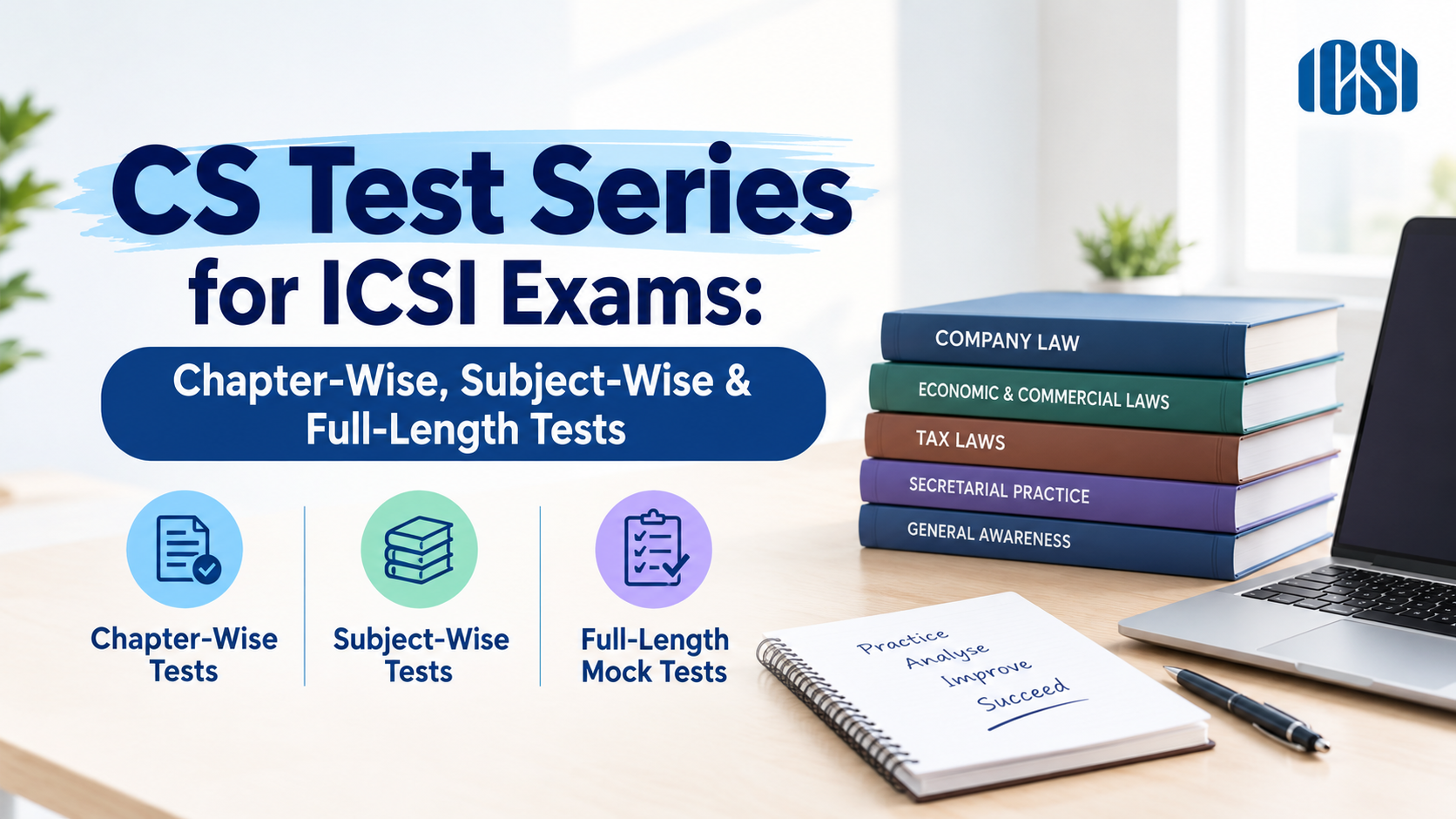
Preparing for ICSI exams involves more than completing chapters or reading notes repeatedly. Students also need to recall key information, apply concepts to questions and finish within the time available. A structured CS test series gives preparation a practical rhythm by combining topic practice, subject-level assessment and full-length mock tests.
This guide explains how each type of test works, when to use it and how to turn mock-test results into a realistic revision plan. CS Exams Test Series is included as an option to assess alongside official ICSI resources and your regular study routine.
Why a Structured CS Test Series Helps
Preparing for ICSI exams involves more than completing chapters or reading notes repeatedly. Students also need to recall key information, apply concepts to questions and finish within the time available. A structured CS test series gives preparation a practical rhythm by combining topic practice, subject-level assessment and full-length mock tests.
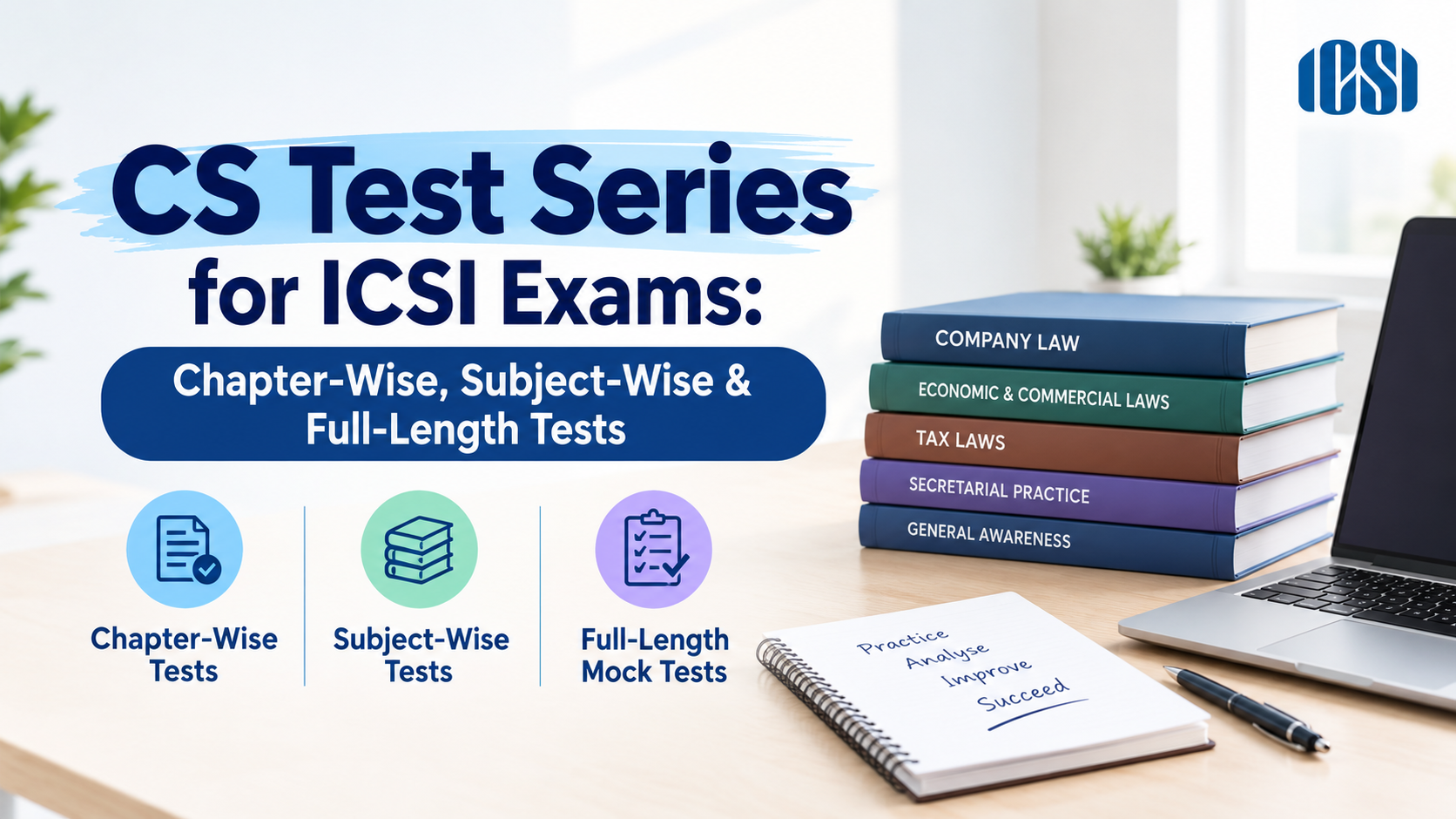
Each type of test serves a different purpose. Chapter-wise tests help you check one area soon after studying it. Subject-wise tests reveal whether you can connect concepts across a paper. Full-length tests help you practise time management and maintain concentration throughout an exam-style session. Using all three at the right stage can make revision more focused.
Understanding the Three Types of CS Tests
Chapter-wise, subject-wise and full-length tests are not competing choices. They work best as steps in a sequence. Start small when learning, broaden the scope as your understanding grows and use full papers to rehearse the complete exam experience.
Before choosing any package, confirm that its papers match the current ICSI syllabus and examination format for your course level. Syllabi and assessment arrangements can change, so use official ICSI notices and study material as the final reference.
Chapter-Wise CS Test Series: Build Strong Topic Foundations
Chapter-wise tests focus on a particular chapter or small group of connected topics. They are useful after a lecture, reading session or first round of revision because the content is still fresh. Instead of assuming that a topic is understood, a short test asks you to retrieve and apply it without looking at your notes.
These tests are especially useful for subjects with technical provisions, definitions, processes, calculations or exceptions. If you get an answer wrong, return to the exact section that caused difficulty. Write a brief note about the mistake and attempt a few related questions again after a short interval.
Do not treat chapter tests as a reason to memorise isolated answers. Ask yourself why the answer is correct, which rule or concept supports it and whether the same principle could appear in a differently worded question. This helps you build understanding that can transfer to unfamiliar questions.
Subject-Wise CS Test Series: Connect Concepts Across a Paper
Subject-wise tests cover a wider range of topics from one subject. They are most helpful after you have completed a meaningful portion of that subject and need to check whether you can move between chapters without prompts. This is closer to the challenge of an exam paper, where questions may test several different areas in sequence.
Use subject-wise tests to identify uneven preparation. You may be confident in some chapters but less comfortable with others, and an overall score can hide that difference. Review performance by topic wherever the test provider gives that information, or maintain your own error log by noting the question's subject area.
For descriptive answers, assess whether you address the question directly, organise points logically and support your conclusion with the relevant provisions or reasoning. For numerical questions, check the method and workings, not only the final answer. The purpose is to find the exact skill that needs improvement.
Full-Length CS Mock Tests: Practise the Complete Exam
Full-length tests help you practise concentration, question selection and time allocation across an entire paper. They are particularly valuable when you have covered enough of the syllabus to attempt a realistic paper. A full mock taken very early can still serve as a diagnostic exercise, but its score should be interpreted in light of incomplete syllabus coverage.
To get a meaningful result, set aside the complete test duration, follow the instructions and avoid checking notes unless the actual exam format permits them. Practise in a quiet environment and keep your phone away. If you pause frequently or extend the time, record that honestly so you do not mistake an untimed attempt for exam readiness.
After the paper, check unanswered questions, rushed answers and time spent on difficult sections. Full-length practice is not only about marks; it also helps you develop a workable order for attempting questions and leaving time to review your answers.
Which Test Type Should You Choose at Each Preparation Stage?
During early learning, prioritise chapter-wise tests because they provide quick feedback on individual topics. Once several chapters are complete, add subject-wise papers to check recall across a broader syllabus. As the examination approaches, schedule full-length mocks and keep targeted topic tests for persistent weak areas.
Students preparing for CSEET, CS Executive and CS Professional should select papers for their specific course level. The depth, question style and assessment format differ. Do not assume that a test created for one stage will be appropriate for another, and always confirm that the content reflects the current syllabus.
A Practical Comparison of Chapter-Wise, Subject-Wise and Full-Length Tests
The following table summarises when each test type is most useful. Adjust the sequence according to your course level, syllabus coverage and time remaining.
| Test type | Best time to use it | Main purpose |
|---|---|---|
| Chapter-wise | After completing a chapter or topic | Check immediate understanding and identify specific gaps |
| Subject-wise | After covering several chapters or revising a subject | Test recall and application across the subject |
| Full-length | After substantial syllabus coverage and during final practice | Rehearse timing, concentration and complete-paper strategy |
How to Use CS Mock Tests to Improve Performance
Review is where test practice becomes useful. After each attempt, classify mistakes into concept gaps, forgotten details, misread instructions, incomplete answers, calculation errors and time-management problems. Different mistakes require different fixes: reread and explain a concept, practise recall, slow down to interpret the question or rehearse a better time plan.
Maintain a simple error log with four details: the topic or question, why the mistake happened, the correct approach and the date you will retry it. Keep the log concise enough to review every week. Reattempting selected questions after a few days helps you check whether you have corrected the cause rather than merely remembered the answer.
Do not judge progress from one test alone. Compare attempts completed under similar conditions and look for repeated patterns. If your score is improving but you still run out of time, practise pacing. If you finish comfortably but lose marks on core concepts, return to the study material and revise those areas.
A Weekly Plan for Using a CS Test Series
A realistic schedule should include learning, testing, analysis and revision. The example below is a flexible template rather than a fixed rule. During early preparation, use more chapter tests; during final revision, make room for more full-length papers.
| Day | Suggested task | Purpose |
|---|---|---|
| Monday | Study a chapter and make concise notes | Build understanding |
| Tuesday | Attempt a chapter-wise test | Check topic-level recall |
| Wednesday | Correct errors and revise weak concepts | Fix gaps early |
| Thursday | Attempt subject-wise questions | Connect concepts across chapters |
| Friday | Practise descriptive or numerical answers | Improve presentation and method |
| Saturday | Attempt a full-length mock when appropriate | Practise exam conditions |
| Sunday | Review the test and reattempt errors | Turn feedback into a plan |
How to Choose a CS Test Series for ICSI Exams
Look beyond the number of papers advertised. Check whether the test series covers your course level and current syllabus, includes chapter-wise and subject-wise practice, offers full-length mocks where relevant, and explains the format and duration of each test. Clear model answers or evaluation guidance can also help you understand how to improve.
Confirm the package's access period, delivery method, fees and support terms before paying. If personal evaluation or detailed feedback matters to you, check whether it is included in the specific plan. Avoid assuming that every test package provides the same features.
CS Exams Test Series can be considered as one option for organising practice across different stages. Review the actual package details and choose based on the papers and features available, your current preparation needs and the time you can realistically devote to testing.
Common Mistakes to Avoid
One mistake is taking full-length mocks before learning enough of the syllabus and then treating a low score as a final judgement. Use early tests diagnostically and respond to the gaps they reveal. Another mistake is taking chapter tests repeatedly without moving to broader subject-level practice, which may leave you unprepared for switching between topics.
Students also lose value by checking only their marks, skipping answer analysis or never returning to difficult questions. Set aside review time when you schedule the test. Finally, verify the syllabus relevance of any test material and use official ICSI sources for current examination requirements.
Conclusion
A well-planned CS test series uses chapter-wise tests to strengthen individual topics, subject-wise tests to check broader understanding and full-length mocks to practise the complete paper. The best sequence depends on your course level, syllabus coverage and time remaining. Combine regular testing with honest analysis, targeted revision and official ICSI study resources to make your preparation more organised.