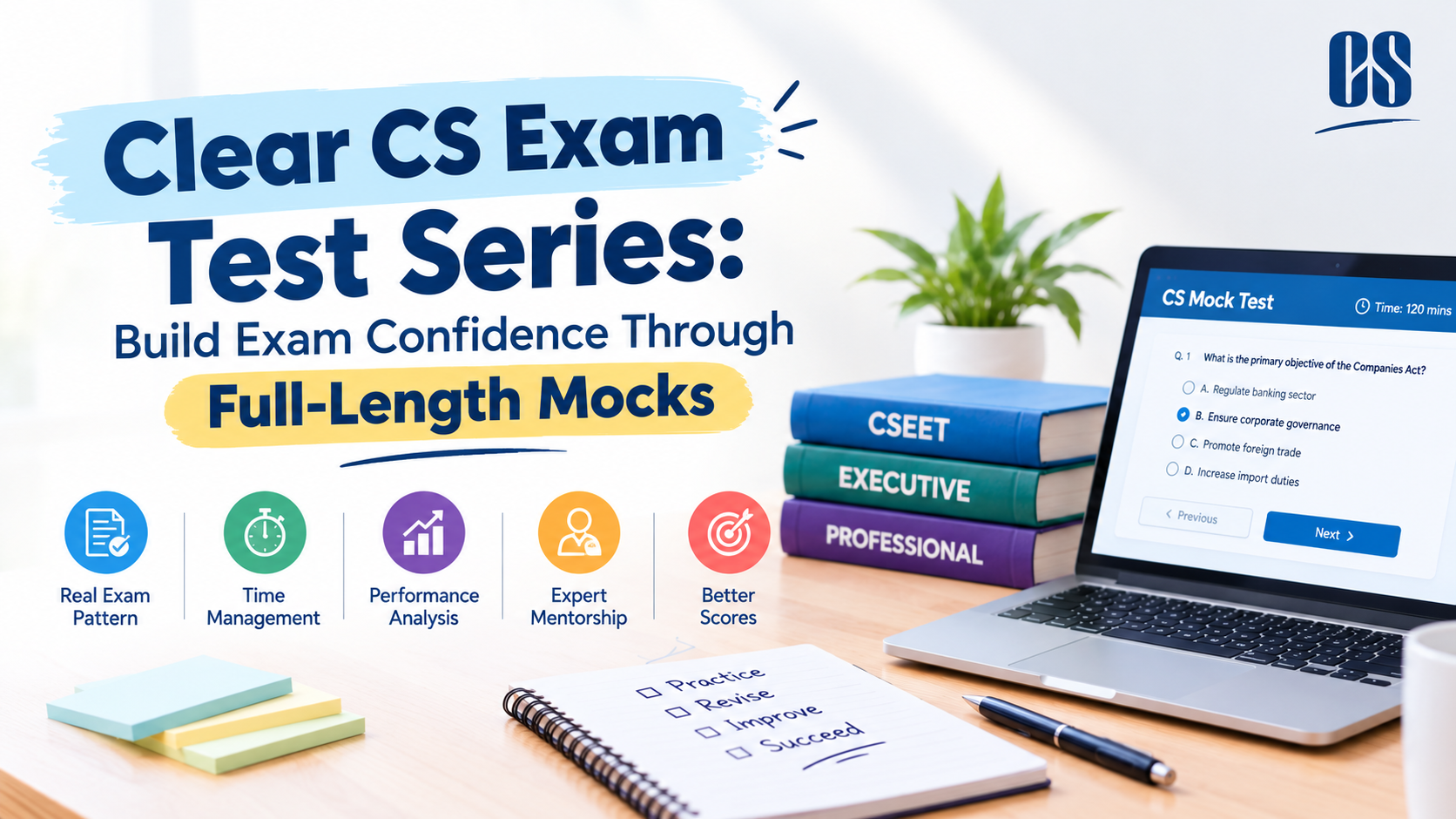
Preparing for a Company Secretary examination involves more than finishing chapters and revising notes. Students also need to practise applying concepts, writing clear answers and managing the time available for a complete paper. Full-length mock tests bring these skills together in conditions that resemble the examination.
This guide explains how to choose and use a CS exam test series, prepare for full-length mocks and turn the results into a practical revision plan. CS Exams Test Series is discussed as one possible part of a broader routine, alongside official ICSI resources and regular study.
Why Full-Length Mock Tests Matter
Studying a chapter and answering questions from it are different skills from completing an entire paper under time pressure. Full-length mock tests bring several exam demands together: recalling information, choosing the right approach, managing time and keeping your answers clear until the final question.
A mock test is most useful when you treat it as a rehearsal rather than a prediction of your result. It can show whether your revision is working, where you lose time and which topics need another look. CS Exams Test Series can fit into this process as a structured way to practise and review, alongside official ICSI resources.
What Does a Clear CS Exam Test Series Need to Offer?
A clear test series should make it easy to understand what you are practising, when to attempt it and how to use the result. Before enrolling, check the current syllabus coverage, test format, duration, marks, access period and whether answer keys, model answers or evaluation are included.
Do not assume that every package provides personal checking or detailed feedback. Read the feature list and terms carefully. The best choice is the one that fits your exam stage, preparation level and available study time—not necessarily the package with the largest number of tests.
Full-Length Mocks for CSEET, CS Executive and CS Professional
CSEET candidates can use timed practice to become familiar with the applicable assessment format and check how accurately they recall foundational concepts. Combine short topic quizzes with longer practice sessions, and verify the latest ICSI syllabus and examination pattern before selecting a test.
CS Executive students need to test both knowledge and application. Full-paper practice can reveal whether you can identify the issue in a question, state the relevant legal or technical principle, apply it to the facts and reach a clear conclusion. For numerical questions, show workings in a logical order.
At CS Professional level, full-length practice helps students connect detailed knowledge with analysis and presentation. Use questions relevant to the current syllabus and assess whether your answers address the command word, use appropriate reasoning and fit the time available. The needs of each level differ, so choose stage-specific papers.
| Stage | How to use full-length mocks | What to review |
|---|---|---|
| CSEET | Practise the current assessment format and foundational concepts | Accuracy, recall and question interpretation |
| CS Executive | Apply provisions and concepts across a full paper | Application, answer structure and time use |
| CS Professional | Practise advanced analysis and complete paper writing | Depth, reasoning, coverage and presentation |
How to Prepare Before Attempting a Full-Length Mock
Do not wait until you feel completely prepared to attempt your first mock. Once you have covered a reasonable portion of the syllabus, use a timed paper as a diagnostic exercise. Its purpose is to identify what needs work, not to label your preparation as a success or failure.
Before starting, choose a quiet place, keep only permitted materials nearby and set a timer for the prescribed duration. Avoid pausing the clock to check notes or search for answers. If the official format allows particular resources, follow those rules exactly. Try to reproduce the conditions you expect on exam day.
After the test, avoid rushing straight into another paper. Leave enough time to review the answers, record mistakes and plan the next revision session. A single carefully analysed mock can teach you more than several attempts that receive only a quick glance.
A Simple Full-Length Mock Test Routine
Use a repeatable routine so each mock leads to a practical next step. Start with a test date, identify the syllabus areas it covers and reserve a separate block for analysis. Adjust the frequency to your stage: early preparation may call for fewer full papers and more topic work, while the final revision period may require more timed practice.
- Choose a test that matches your stage and syllabus.
- Schedule the test and protect the full time block.
- Attempt it without notes unless the official format permits them.
- Mark questions you guessed or found difficult.
- Review answers and record the cause of each mistake.
- Schedule targeted revision and reattempt selected questions.
How to Analyse Your Mock Test Results
Start by checking more than the final score. Sort lost marks into clear categories: a concept was not understood, a fact or provision was forgotten, the question was misread, the answer was incomplete, a calculation went wrong or time ran out. Each category points to a different correction.
Create a simple error log with four columns: topic or question, reason for the mistake, correct approach and date to reattempt it. For descriptive answers, compare your structure with a reliable suggested answer or marking guide where available. For objective questions, explain to yourself why the correct option works and why your chosen option does not.
Look for patterns across several attempts. If accuracy is good but you leave questions unfinished, practise pacing. If you finish on time but lose marks on core concepts, return to study material and revise those areas. One mock score alone is not a reliable measure of final exam performance.
Time Management During a Full-Length Mock
Before answering, scan the paper and note any instructions. Divide the available time across questions according to their marks and complexity, leaving a small buffer for checking. Avoid spending too long on one difficult question while easier marks remain elsewhere.
If you get stuck, write down what you know, move on where the format permits, and return later. Practise the same approach in your mocks so it becomes familiar. After each attempt, compare your planned time with the time actually spent; this can reveal where your strategy needs adjustment.
How to Build Confidence Without Ignoring Weak Areas
Confidence grows when you can see evidence of progress. Instead of aiming for a perfect score immediately, set specific targets: complete the paper within the time limit, reduce unanswered questions, improve accuracy in one weak subject or write more complete answers.
At the same time, do not use a rising score as a reason to stop revising difficult topics. Review mistakes even when the overall result looks encouraging. Confidence based on understanding and repeated practice is more useful than confidence based on a single easy paper.
A Weekly Plan for Mock Tests and Revision
Balance practice with learning and recovery. The following sample plan can be adjusted around classes, work and the time remaining before the examination. The key is to reserve time for analysis rather than filling every day with another test.
| Day | Suggested activity | Goal |
|---|---|---|
| Monday | Revise a priority topic | Strengthen concepts before testing |
| Tuesday | Attempt a timed topic test | Check recall and accuracy |
| Wednesday | Correct errors and revisit material | Fix the cause of mistakes |
| Thursday | Practise written or numerical questions | Improve application and presentation |
| Friday | Attempt a full-length mock when appropriate | Rehearse exam conditions |
| Saturday | Analyse the paper and update an error log | Turn results into actions |
| Sunday | Reattempt weak questions and rest | Check progress and maintain balance |
Common Mistakes Students Make With Mock Tests
One common mistake is attempting a mock without following the time limit. This can make the score look stronger than the performance would be under exam conditions. Another is checking only the marks and ignoring the reasons behind errors.
Students may also attempt papers that do not match their current syllabus, or rely on one provider without checking the relevance of its content. Always confirm the applicable syllabus and use official ICSI information for examination requirements. Finally, avoid comparing your raw score with another student's score unless the paper difficulty and conditions are comparable.
How CS Exams Test Series Fits Into Your Preparation
CS Exams Test Series can be considered as part of a preparation routine built around timed practice, review and targeted revision. Before choosing a plan, check which course level and papers it covers, what mock formats are available, whether answer guidance or evaluation is included, and how long access lasts.
Use the tests to find gaps, not as a substitute for learning. Read the prescribed study material, follow official syllabus updates and keep concise notes of recurring errors. If a feature such as detailed evaluation is important to you, confirm that it is included in the specific package you plan to select.
Conclusion
A full-length mock test is valuable when it shows you what to do next. Choose papers that match your stage and syllabus, attempt them under realistic conditions and review every important mistake. With a steady cycle of practice and correction, CS Exams Test Series can support a more organised approach to exam preparation and help you build confidence through evidence of progress.