Attempting a mock test is an important part of CS exam preparation, but the real improvement often happens after the test is over. A score tells you how you performed on one paper; a careful review explains why you earned those marks, where you lost them, and what needs to change before the next attempt. Without this review, even a student who completes many mock tests may continue making the same mistakes.
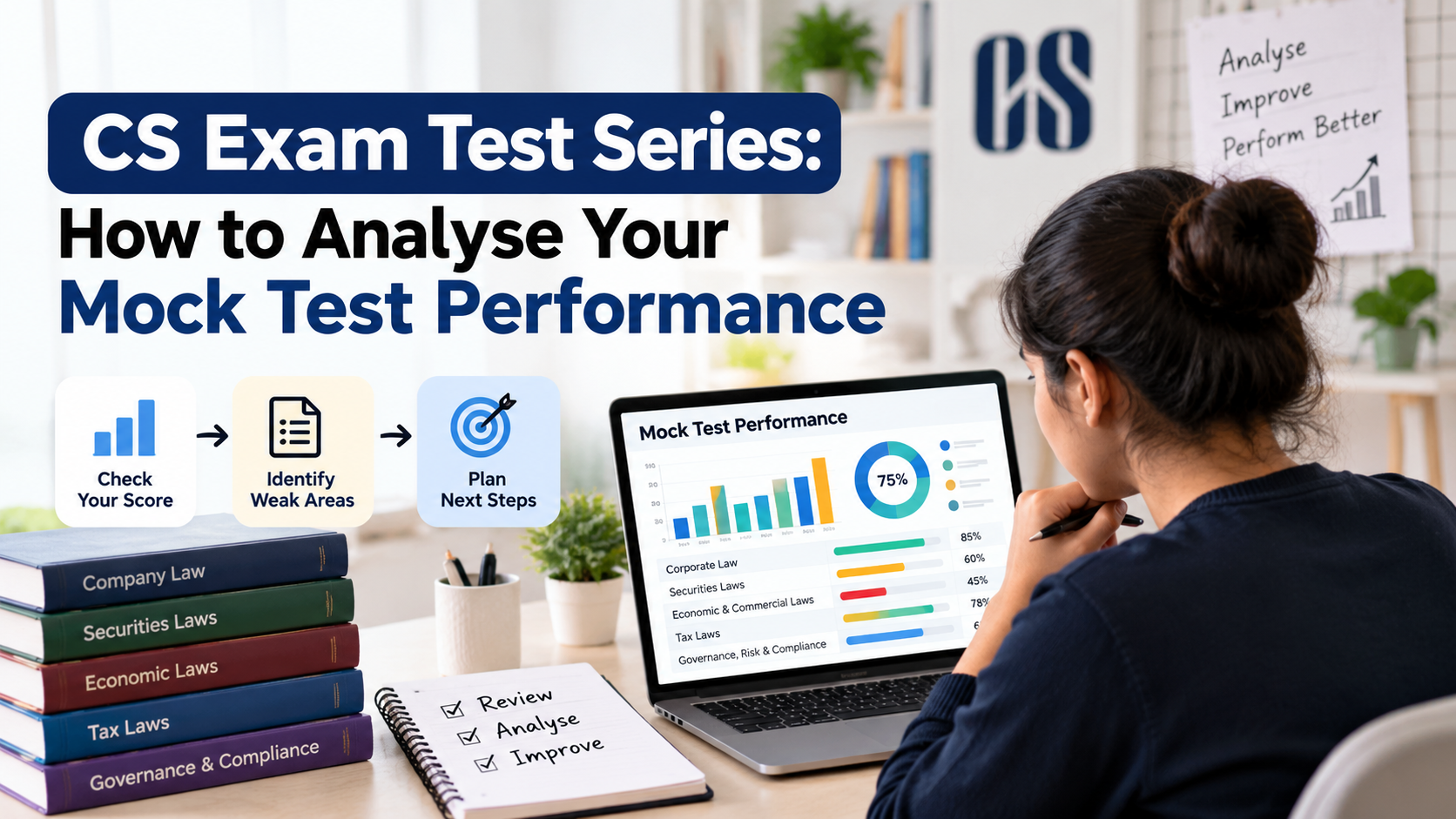
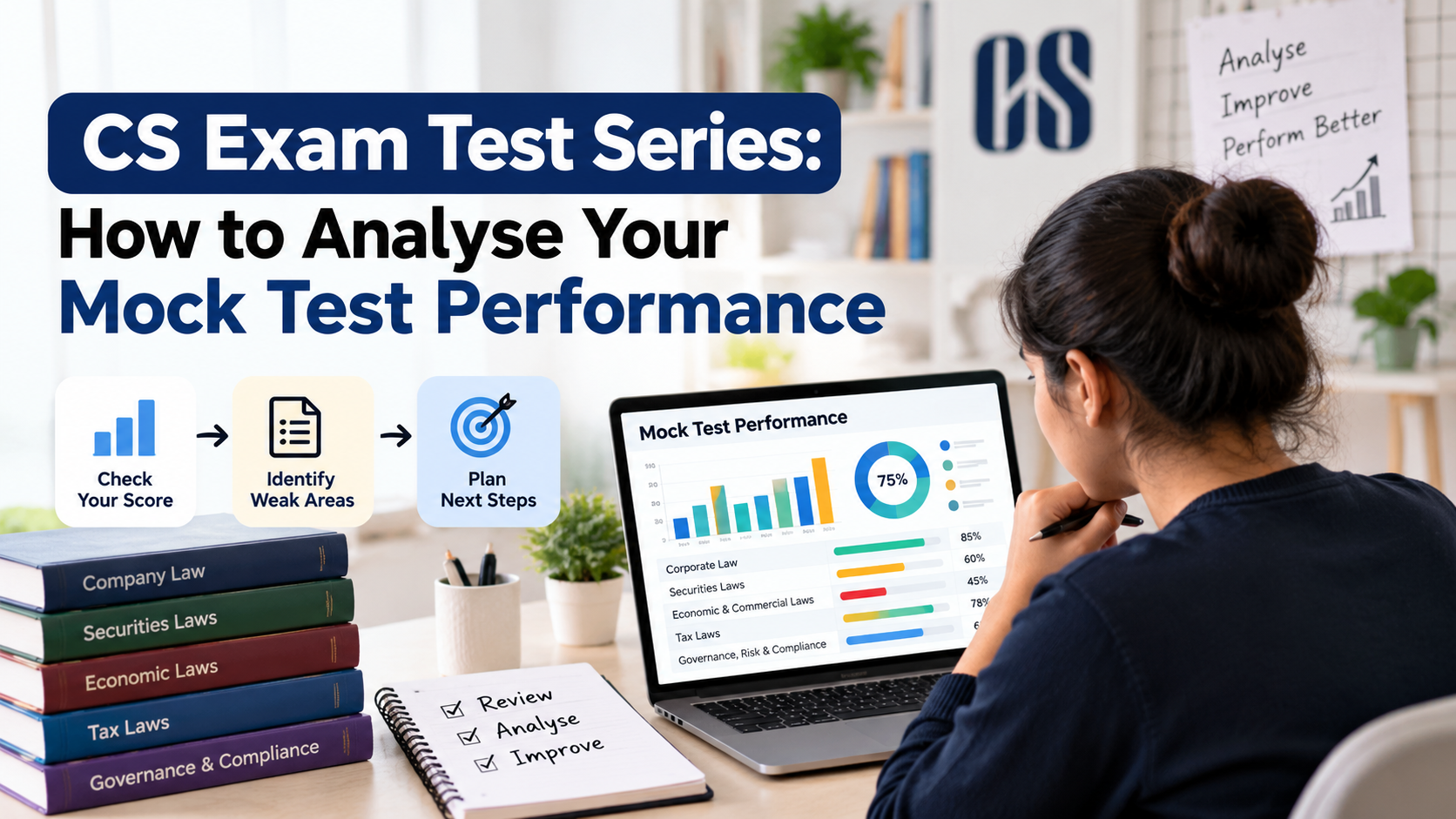
A useful CS Exam Test Series routine should include three steps: attempt the paper under realistic conditions, analyse the result honestly, and use the findings to plan targeted revision. This guide explains how to review marks, answer presentation, subject knowledge, and time management so that each mock test becomes a practical step towards better exam performance.
Why Mock Test Analysis Matters
A mock test is more than a practice paper. It is a way to check whether your preparation works when you must recall information, understand the question, organise an answer, and finish within a time limit. A low score can point to several different problems: a concept may be unclear, the answer may be incomplete, the question may have been misunderstood, or too much time may have been spent on one section.
Each problem needs a different response. Rereading an entire chapter will not necessarily fix poor time management. Writing more mock tests will not automatically correct a misunderstanding of a legal provision. Analysis helps you choose the right next step rather than studying harder in a direction that may not solve the problem.
Students using CS Exams Test Series should treat every attempt as a feedback cycle. Review what went well as well as what went wrong. Recognising strong areas helps you maintain them, while identifying repeated weaknesses gives your revision a clear purpose.
What to Collect Before Reviewing a Test
Keep the question paper, your attempted answers, the marks or evaluation you received, and reliable model answers or marking guidance where available. Also note the time taken and whether you completed the paper. If the test platform provides question-wise marks or evaluator comments, keep those details together with your attempt.
Review the paper using the syllabus and amendments applicable to your examination session. This matters particularly when you are revising law, compliance, taxation, or other areas where provisions can change. A question or model answer from an older source should not be accepted as current without checking its relevance.
Choose a calm time for the review. Avoid looking only at the final score immediately after the test and then moving on. Give the analysis enough attention to understand the reasons behind the result.
Look Beyond the Total Score
Your total marks are a starting point, not the complete diagnosis. Two students can receive the same score for very different reasons. One may know the concepts but write slowly; another may finish on time but lose marks because of gaps in knowledge. Their revision plans should therefore be different.
Break down the result by question, section, topic, or learning outcome wherever the information is available. Ask yourself:
- Which questions earned the strongest marks, and why?
- Which questions lost marks even though I had studied the topic?
- Did I leave any questions unanswered or incomplete?
- Did I spend too much time on a difficult question?
- Were lost marks caused by knowledge, interpretation, presentation, or time?
Compare scores across tests only when the tests are reasonably comparable in syllabus coverage and difficulty. A change in marks can be useful evidence, but it is not always a direct measure of improvement if one test covered familiar topics and another covered more difficult material.
Classify Your Mistakes
Do not write “careless mistake” beside every lost mark. That description is too broad to guide revision. Identify the specific reason for the error so you can take a useful corrective action.
| Mistake type | What it may look like | Corrective action |
|---|---|---|
| Conceptual gap | You cannot explain the underlying rule or concept. | Return to the relevant study material and explain the concept in your own words. |
| Recall error | You understand the topic but cannot recall a provision, step, or key point. | Use spaced revision and short closed-book recall practice. |
| Question interpretation | Your answer discusses the topic but does not answer what was asked. | Underline the command word and key facts before planning the response. |
| Application error | You know the rule but apply it incorrectly to the facts. | Practise scenario-based questions and write the link between rule and facts. |
| Presentation issue | The answer is unclear, unstructured, or difficult to follow. | Practise headings, logical order, concise explanations, and clear workings. |
| Time-management issue | You leave questions unfinished or rush at the end. | Set question-level time limits and practise full papers under timed conditions. |
| Accuracy error | A calculation, figure, citation, or detail is incorrect. | Use a checking step and practise the relevant process carefully. |
Some answers may involve more than one error. For example, a student might misunderstand a question and then run out of time while trying to correct the answer. Record the main cause first, then note any secondary cause that also needs attention.
Review Answer Writing and Presentation
In professional examinations, knowing the subject is essential, but the examiner must also be able to follow your response. During analysis, compare the structure of your answer with the requirements of the question and the available marking guidance. Do not assume that a long answer is automatically a strong answer.
Check whether you addressed every part of the question, included relevant provisions or concepts, explained the application where required, and reached a clear conclusion. For practical questions, review the steps and workings as well as the final result. For descriptive answers, look for a logical sequence and relevant points rather than repeated statements.
Try this simple review method for each answer:
- Requirement: Write in one sentence what the question actually asked.
- Coverage: Identify the key points or steps your answer should contain.
- Gap: Mark what was missing, inaccurate, or irrelevant in your response.
- Rewrite: Improve the answer in a concise form without copying it blindly.
Keep a few examples of your improved answers. Reviewing these examples before the next mock test can remind you how to organise similar responses. However, learn the reasoning behind the answer instead of memorising its wording.
Analyse Time Management
Finishing a paper is a skill that improves through planned practice. If you consistently leave the final questions unanswered, check where the time went. Did you spend too long planning one answer, rewrite sentences repeatedly, or attempt questions in an order that did not suit your preparation?
After a test, note the approximate time spent on each section or major question. Compare that with the marks available and the instructions for the actual examination. Use this comparison to set realistic time limits for future attempts. The aim is not to rush every answer; it is to allocate time sensibly and avoid spending a disproportionate amount on one difficult question.
Practise moving forward when you are stuck. If the exam instructions allow it, mark the question for review and return after completing the questions you can answer more confidently. Reserve a small amount of time to check that you have not missed a page, sub-question, or required part of an answer.
Find Subject-Wise and Topic-Wise Gaps
Overall marks can hide a weak topic. A student may perform well in familiar chapters but struggle when questions combine multiple concepts. After each mock test, group errors by subject and topic. This will help you see whether a problem is isolated or recurring.
Use a simple priority system:
- High priority: Important topics where you repeatedly lose marks or cannot explain the concept.
- Medium priority: Topics you understand but answer inconsistently or too slowly.
- Maintenance: Topics you usually answer accurately but still need to revise periodically.
Do not label a topic “unimportant” just because it did not appear in one mock test. Test coverage varies. Use the current syllabus, study material, and your own performance evidence to decide what needs attention. A mock test should guide your revision, not become the only source for deciding what to study.
Create a Mock Test Error Log
An error log turns feedback into a record you can use across the preparation period. Without one, students often recognise a mistake after a test but forget it by the next week. Keep the log short enough that you will update it after every attempt.
| Date and test | Topic or question | Error and reason | Next action |
|---|---|---|---|
| Test 1 | Topic A | Missed a key concept | Review notes and explain it from memory |
| Test 1 | Question 4 | Answer incomplete | Practise a structured answer |
| Test 2 | Topic B | Time exceeded | Attempt similar questions with a timer |
The entries above are examples; replace them with your actual errors. Add a status column if useful, such as “not revised,” “practised,” or “improved in next test.” When an error repeats, move it higher on your revision list. When you solve similar questions accurately in later attempts, mark the issue as improved but continue to revise it periodically.
Turn Analysis Into an Action Plan
Analysis is incomplete until it changes what you do next. At the end of each review, select a small number of actions rather than creating an unrealistic list of every topic you could revise. A practical plan might include revising one concept, rewriting two weak answers, and completing a short timed set on a recurring problem.
Use this sequence after each mock test:
- Review: Check marks, comments, and the questions you could not complete.
- Diagnose: Classify the main errors and identify their causes.
- Revise: Return to the relevant chapter or concept using reliable study material.
- Practise: Answer fresh questions that test the same skill.
- Verify: In the next test, check whether the same error has reduced.
Keep the action plan measurable. “Improve law” is too broad. “Revise the relevant provision and answer three scenario questions without notes” gives you a clear task and a way to check completion.
CS Exams Test Series can support this cycle by giving you regular practice opportunities. Choose tests that match your current preparation stage, review the feedback carefully, and use your error log to decide what to practise next. The benefit comes from applying the lessons, not from collecting a high number of completed tests.
How Often Should You Analyse Mock Tests?
Review every mock test while the attempt is still fresh in your mind. For a short topic test, the review may be brief. For a full-length paper, allow enough time to inspect the answers, identify recurring issues, and revise the relevant topics. Avoid scheduling so many tests that you have no time left to learn from them.
As the examination approaches, keep a balance between full-paper simulations and targeted revision. Early in preparation, topic-wise tests can help you check understanding. Later, full-length tests can help you practise timing and stamina. The exact frequency depends on your syllabus coverage, other commitments, and the time remaining.
Every week, review your error log as a whole. Look for patterns that may not be obvious from one paper, such as repeated omissions, weak recall, or slow writing. Adjust the next week's study plan based on these patterns.
Analysis Mistakes to Avoid
- Focusing only on marks: Use the score as one data point and investigate why marks were gained or lost.
- Blaming every error on carelessness: Name the specific cause and choose a matching corrective action.
- Reading model answers passively: Close the answer and rewrite the key points from memory after understanding them.
- Ignoring strong answers: Identify what worked well so you can repeat that approach.
- Revising everything equally: Prioritise recurring errors and syllabus-relevant weak areas.
- Taking the next test too quickly: Allow time to correct the weaknesses revealed by the previous attempt.
- Comparing every score directly: Consider test difficulty and coverage before interpreting a change in marks.
A Sample Weekly Mock Test Review Plan
This sample plan can be adapted to your schedule. It is intended to show how practice and analysis can fit together, not to prescribe the same workload for every student.
| Day | Activity | Purpose |
|---|---|---|
| Day 1 | Revise selected topics and complete a short practice set. | Refresh concepts before testing. |
| Day 2 | Attempt a topic-wise mock test. | Check recall and application. |
| Day 3 | Review answers and update the error log. | Identify the cause of lost marks. |
| Day 4 | Revise weak topics and rewrite selected answers. | Correct the most important gaps. |
| Day 5 | Practise similar questions under time limits. | Test whether the correction works. |
| Day 6 | Attempt a longer or mixed-topic test, if appropriate. | Practise switching between question types. |
| Day 7 | Review progress and plan the next cycle. | Keep revision focused and realistic. |
At the end of the week, write down one improvement, one weakness that remains, and one priority for the next cycle. This small habit helps you see progress beyond the marks shown on a single paper.
Conclusion
Analysing mock test performance is one of the most practical ways to make exam practice more effective. Look beyond the total score, classify errors, review answer presentation, check time management, and record subject-wise gaps. Then turn the findings into specific revision and practice tasks.
Use each CS Exam Test Series attempt as a feedback loop: practise, analyse, correct, and test again. When you consistently apply what each paper teaches you, your preparation becomes more focused and you are better equipped to recognise and address weaknesses before the actual ICSI examination.