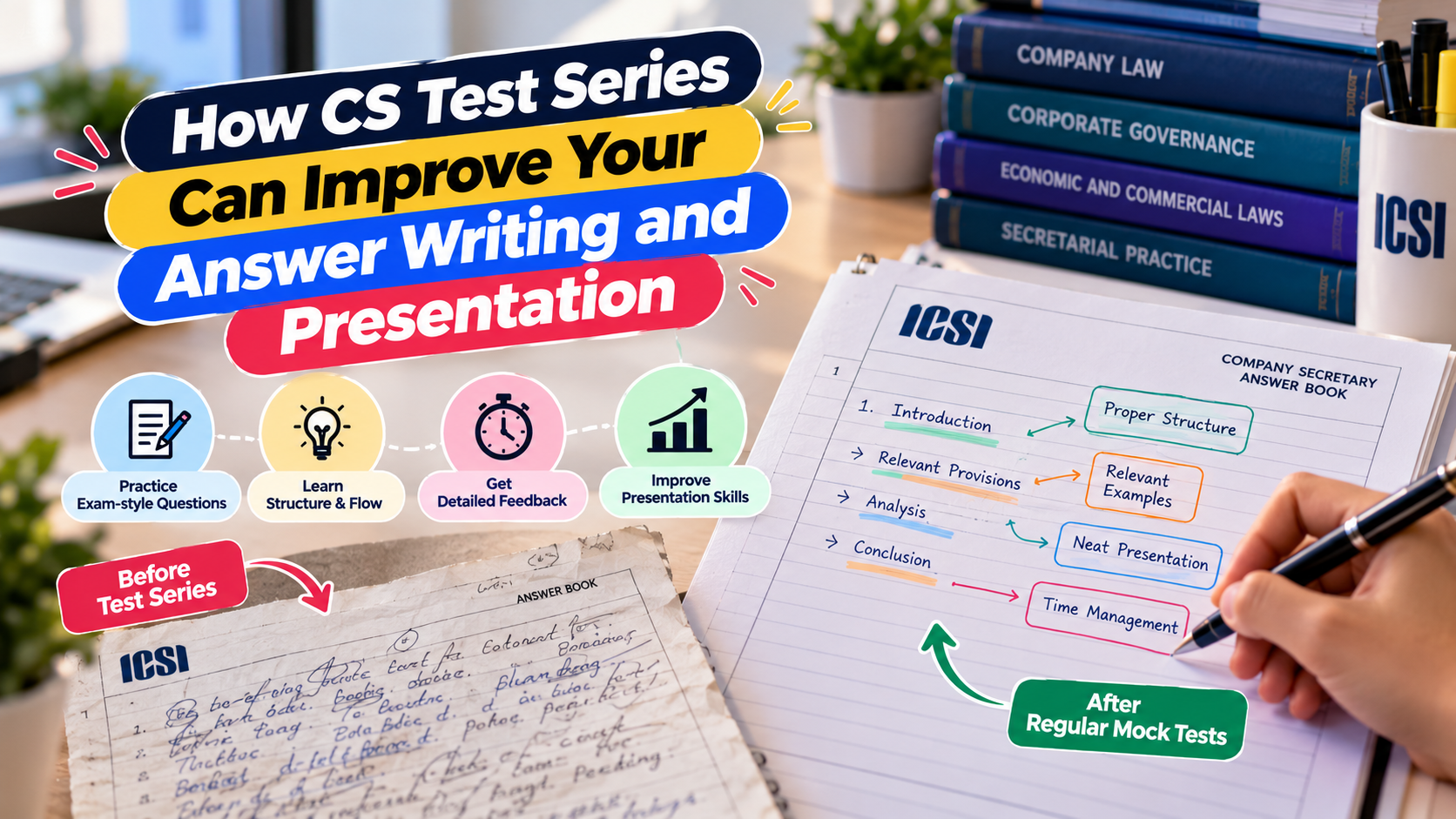
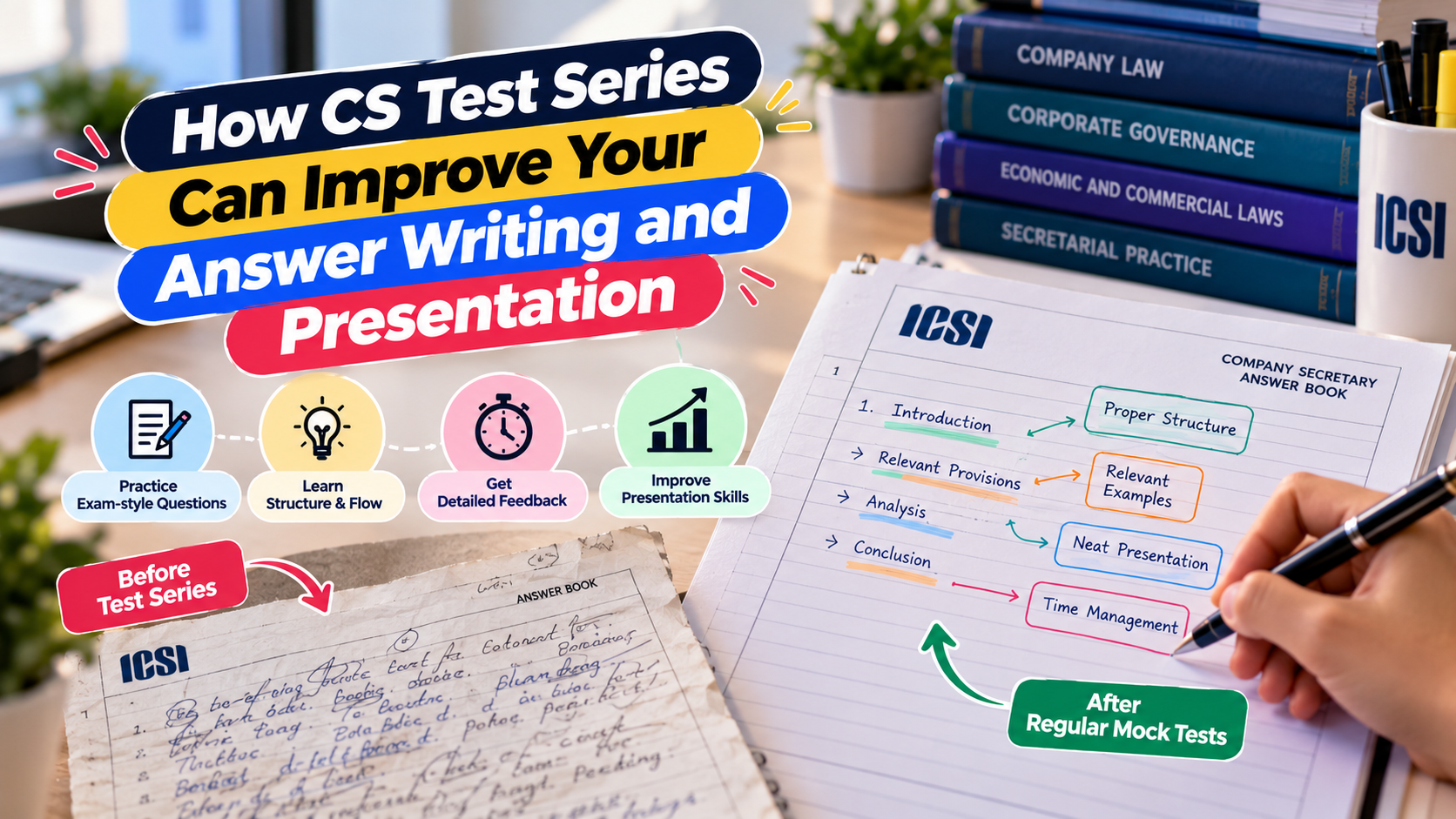
Knowing a concept and communicating it clearly in an examination are two different skills. A CS student may understand a provision or topic while studying, yet struggle to identify the exact requirement of a question, organise the answer or finish within the available time. These difficulties can affect the quality of an answer even when the student has put in considerable preparation.
A regular CS test series gives you a chance to practise these skills before the actual ICSI examination. It helps you move beyond reading model answers and learn how to build your own responses under timed conditions. The biggest improvement comes when you attempt a paper honestly, review the answer and use the feedback to make specific changes in your next attempt.
Why Answer Writing and Presentation Matter
Examination answers need to do more than show that you have read a chapter. They should respond to the question, include the relevant concepts and explain the reasoning in a logical order. In descriptive and application-based papers, an answer that is difficult to follow may not communicate your understanding as effectively as a clear, focused response.
Presentation does not mean decorating the page or adding headings everywhere. It means making the answer easy to read and evaluate. A suitable structure, clear paragraphs, relevant headings and properly shown workings can help the reader follow your reasoning. The right format depends on the question and the instructions for your paper.
A CS test series helps you practise this process repeatedly. Rather than waiting until the examination to discover that your answers are too long, incomplete or poorly organised, you can identify those issues during practice and work on them gradually.
Learn to Understand the Question Requirement
One common answer-writing problem is responding to the general topic instead of the exact question. Students may remember a provision or concept and write everything associated with it, even when the question asks for a distinction, an explanation, advice or an analysis of a particular situation.
During mock tests, underline or note the command word and identify what the question expects. For example, “distinguish” calls for clear differences, while “analyse” generally requires reasoning about the facts or issue. “Advise” may require a conclusion supported by the relevant rule or principle. Follow the instructions and marking expectations applicable to your examination.
After a test, compare the question with your answer. Ask yourself whether each paragraph contributed to the required response. If you wrote a long answer but missed one part of the requirement, note that as a question-reading error. In your next practice session, spend a few seconds planning the response before writing.
Build a Clear Answer Structure
A consistent structure helps you organise your thoughts under time pressure. The structure should fit the type of question rather than being applied mechanically to every answer.
For Conceptual or Descriptive Questions
Begin with a direct response to the question, then explain the key concept or relevant points in a logical sequence. Use headings or numbered points when they make the answer easier to follow. Finish with a brief conclusion if the question calls for one. Avoid lengthy introductions that delay the main answer.
For Legal or Case-Based Questions
A useful approach is to identify the issue, state the relevant provision or principle, apply it to the facts and provide a reasoned conclusion. The exact format depends on the question, but the important point is to connect the rule to the situation rather than simply reproducing a textbook explanation.
For Practical Questions
Show the required method, calculation or working in a logical sequence. Label important steps and make the final result easy to locate. If the question asks for an explanation as well as a calculation, include both rather than providing only the final figure.
Use a CS test series to try these structures across different questions. When you review the paper, note which answers were easy to follow and which became unclear. Adjust your structure based on the requirement, not on a fixed formula that may not suit every question.
Practise Applying Concepts to Case-Based Questions
Case-based questions test whether you can use your knowledge in a specific situation. Simply recalling a rule may not be enough if the question expects you to explain how that rule applies to the facts. This is why practice should include questions that require reasoning rather than only direct recall.
Read the facts carefully and separate relevant information from background details. Identify the issue, choose the applicable concept, explain how the facts relate to it and reach a conclusion that follows from your analysis. Avoid making assumptions that are not supported by the question.
When checking a mock answer, look for the connection between the rule and the facts. If your answer states a provision but does not explain its application, practise adding a sentence that makes the connection explicit. If you reached a conclusion without explaining the reasoning, revise the answer to show the steps that support it.
Write Relevant Answers Without Unnecessary Detail
Students sometimes equate a long answer with a strong answer. In practice, extra information can make it harder to see whether the question has been answered. The aim is not to write as little as possible, but to include the points that are necessary for a complete and relevant response.
Use mock-test review to identify repeated habits such as writing background information that was not asked for, repeating the same point in different words or adding unrelated provisions. Mark those sections in your practice answers and rewrite them more concisely while retaining the important reasoning.
Pay attention to the marks and scope of the question. A short requirement may need a focused response, while a complex case may require more explanation. Use the available time sensibly and ensure that every part of the question receives an appropriate response.
Improve Speed and Time Management
Good answer writing must work within the examination time limit. A student may prepare detailed answers at home but struggle to complete a paper when every response takes too long. Timed tests help you understand how much you can write clearly within the time available.
Before starting, read the instructions and make a quick plan for allocating time according to the marks and requirements. Do not spend an excessive amount of time perfecting one answer while leaving other questions incomplete. If you get stuck, move on when appropriate and return later if time permits.
After each mock, record which questions took longer than expected and why. You may have struggled to recall a concept, spent too long planning or written unnecessary detail. Each cause requires a different fix. Practise short timed answers for specific issues before attempting another full-length paper.
| Problem noticed | What to practise | What to check next time |
|---|---|---|
| Answer takes too long | Write focused answers to a time limit | Whether the response remains complete |
| Question requirement missed | Identify command words before writing | Whether every part is addressed |
| Unclear answer structure | Plan headings or logical steps briefly | Whether reasoning is easy to follow |
| Case application is weak | Practise connecting rules to facts | Whether the conclusion is supported |
| Paper remains incomplete | Practise allocating time across sections | Whether more questions are completed |
Use Test Feedback to Find Weaknesses
A mock score tells you something about performance, but it does not explain every problem. Review the answer itself and classify the mistake. Was the concept missing? Did you misread the question? Was the rule correct but the application weak? Did you omit a required point or run out of time? A clear diagnosis helps you choose a useful next step.
Maintain an answer-writing log with the question, the weakness, the reason and the action you will take. For example, if you often state a rule without applying it, practise a few case-based questions and make the application explicit. If your answers contain all the relevant points but are difficult to follow, work on paragraph order and headings.
Compare your work with reliable model answers or evaluation guidance after completing the paper. Look for the important elements rather than copying the model response word for word. Rewrite selected answers in your own words and attempt a similar question later to check whether the improvement transfers to a new problem.
CS Exams Test Series can support this practice when its questions and answer guidance match your course and examination session. Use feedback as a way to improve your own work, and verify syllabus and session relevance before relying on any test paper.
Adapt Your Writing to Different CS Papers
Law and Theory-Based Papers
Focus on accurate concepts, relevant provisions, conditions and exceptions where applicable. Organise the response so the main point is easy to identify. Avoid adding a list of unrelated provisions just to make the answer appear detailed. Check whether you have addressed the exact issue raised.
Case-Based or Application Questions
Connect the facts with the relevant rule or principle. Explain why the concept applies and support your conclusion with reasoning. During review, identify whether your answer moved logically from the issue to the rule, application and conclusion.
Practical or Numerical Questions
Show workings clearly and keep calculations in a logical order. Label steps where helpful and check arithmetic before moving on. If a question requires an interpretation or explanation, include it rather than presenting a number without context.
Questions With Multiple Parts
Break the question into its separate requirements and answer each part. A response can lose clarity when several issues are mixed into one long paragraph. Use short headings or numbered sections where appropriate, and check that no part has been left unanswered.
Build an Answer-Writing Practice Routine
Improvement comes from regular practice followed by correction. You do not need to write a complete mock every day. A balanced routine can combine short answer-writing exercises, topic tests, full-length mocks and time for reviewing the results.
| Practice session | Task | Purpose |
|---|---|---|
| After learning a topic | Write two or three answers without notes | Check recall and structure |
| During weekly revision | Attempt a topic or subject test | Practise applying concepts |
| At planned intervals | Complete a timed mock | Build timing and paper strategy |
| After each test | Review and rewrite selected answers | Correct recurring weaknesses |
| Before the next mock | Reattempt a similar question | Check whether improvement lasts |
Keep the routine realistic. If you are still learning the syllabus, focus on short answers and topic tests. As your preparation improves, introduce mixed questions and full-length papers. Leave enough time to study the underlying concepts, because writing practice cannot compensate for gaps in knowledge.
Presentation Mistakes to Avoid
Writing everything you remember: Keep the answer focused on the requirement and include only relevant supporting points.
Using headings without a clear purpose: Headings should organise the answer, not break every sentence into a separate section. Choose a format that improves readability.
Skipping the application: In case-based questions, explain how the relevant rule applies to the facts instead of stating the rule alone.
Ignoring question instructions: Identify what the question asks before planning the response. A well-written answer can still be incomplete if it addresses the wrong task.
Checking model answers during the test: Complete the attempt independently first. Use model answers afterwards to review your reasoning and presentation.
Reviewing only the score: Examine answer quality, relevance, completeness and timing. These details help you identify specific changes for the next attempt.
Measure Improvement Over Time
Track more than marks. A simple record can show whether your answers are becoming clearer and more complete even before your score changes significantly.
| Measure | What to record | Signs of progress |
|---|---|---|
| Relevance | How often you address every part of the question | Fewer missed requirements |
| Structure | Whether answers follow a logical sequence | Clearer, easier-to-follow responses |
| Application | How well you connect concepts to facts | More reasoned conclusions |
| Timing | Time spent and questions completed | Fewer incomplete answers |
| Repeat errors | Mistakes appearing in multiple tests | Fewer repeated weaknesses |
Review your record weekly and choose one or two priorities for the next practice cycle. Avoid trying to fix every aspect of answer writing at once. A focused target—such as improving case application or finishing answers on time—makes it easier to notice whether your practice is working.
Conclusion
A CS test series can improve answer writing and presentation by giving you repeated opportunities to practise, receive feedback and correct mistakes. Focus on understanding the question, organising relevant points, applying concepts to facts and managing time. Review every mock beyond the final score and use the findings to guide your next practice session. When combined with the applicable ICSI study material, consistent test practice can help you develop clearer, more complete and more exam-focused answers.