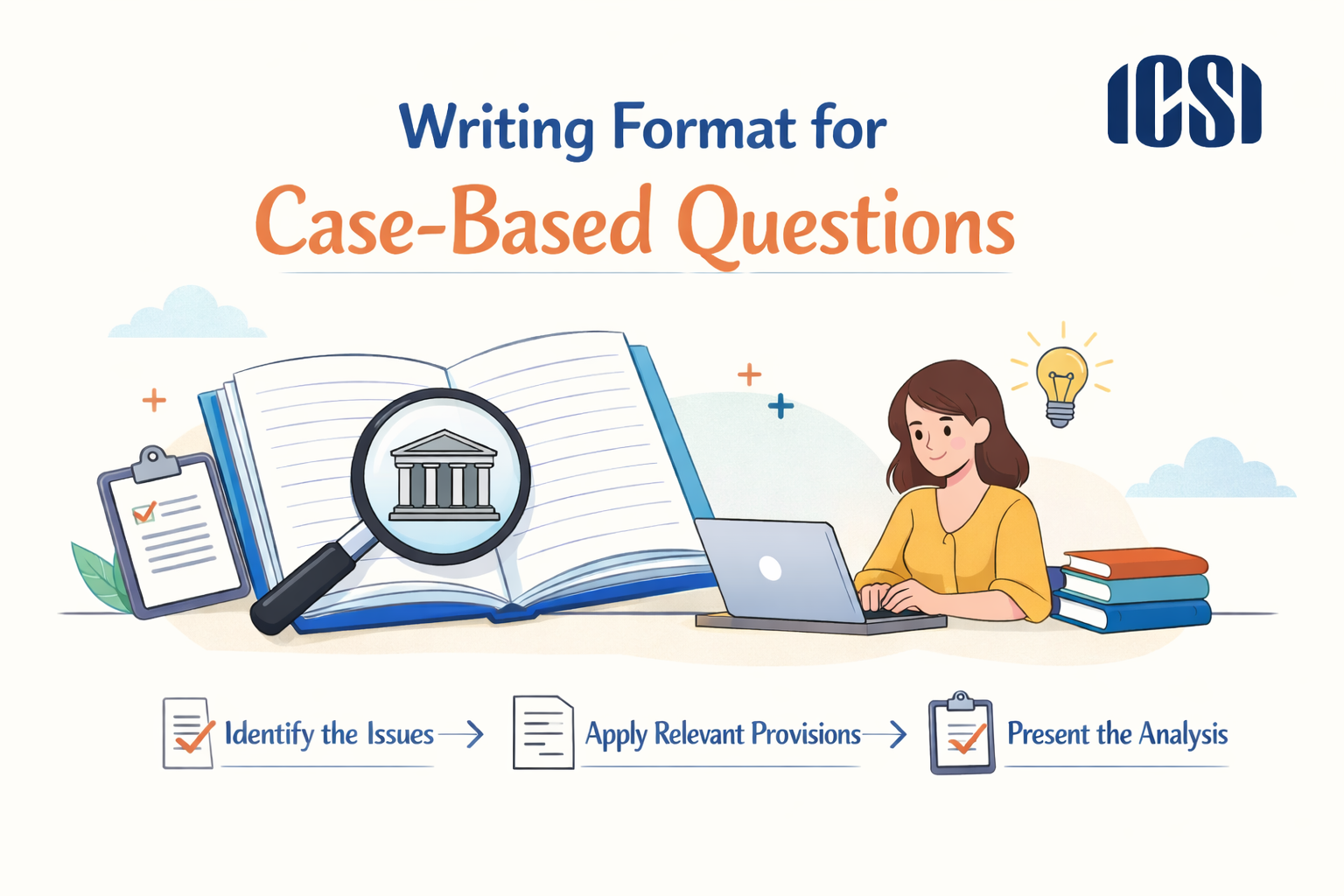
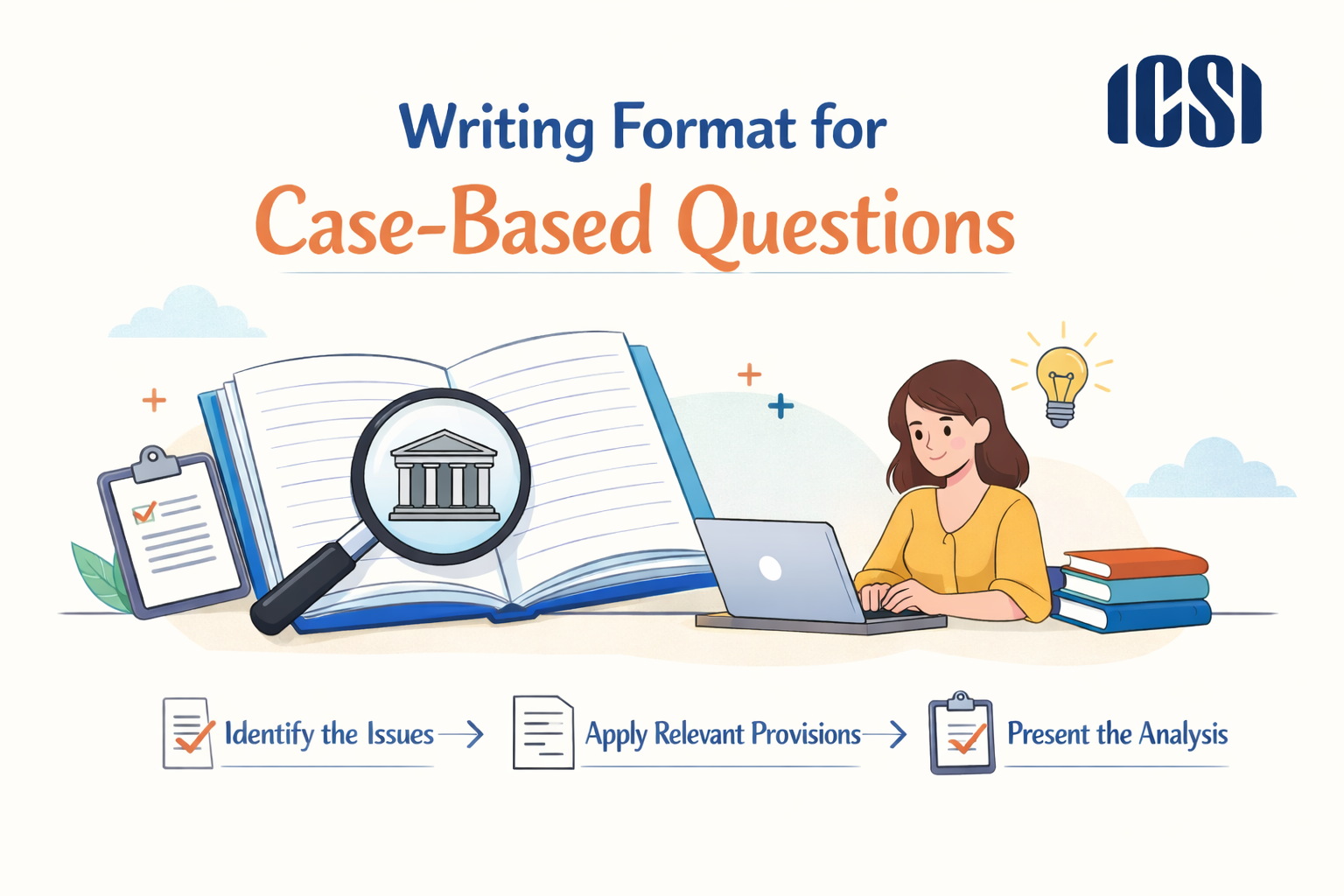
While preparing for the Company Secretary (CS) exam, candidates often focus on theoretical knowledge, law interpretations, and practical applications. However, one of the most challenging aspects comes in the case-based question. These questions not only test the understanding of the provisions but also require the ability to analyze, interpret, and implement them in practical scenarios. Unlike direct theory questions, case-based questions demand structured answers, logical reasoning, and clarity of thought.
The writing format for case-based questions on the CS exam plays a crucial role in scoring better marks. A well-structured answer not only helps to express knowledge effectively but also creates a positive effect on the examiner. Even if the material is correct, the poor presentation may lose scores. Therefore, knowing how to frame, organize, and answer is as important as ideological clarity.
This article will guide you through the correct written format for case-based questions in CS exams. From understanding the expectations of the examiner to learning a step-by-step answer format, we will detect effective strategies to maximize your score. By mastering this approach, you can turn the complex case landscapes into well-crafted answers that reflect both legal knowledge and analytical ability.
Understand the Case-Based Questions in CS Exams
Case-based questions are not only designed to assess the knowledge of your laws and principles but also your practical application skills. These questions typically present a real-life or imaginary scenario and expect you to analyze it based on the Companies Act, Securities Laws, or other applicable provisions.
In the CS exam, case-based questions may vary in length and complexity. Some can be small and direct, while others may include many issues. What remains stable requires clarity and structured presentation. The examiner wants to see if you can apply laws to logically given facts and reach a proper conclusion.
Why Use a Case-Based Format in CS Exams?
The main objective of the case-based answer format CS is to highlight whether the student understands the case question technique and can logically present the solution. Using the case-based answer format CS, below we have mentioned many benefits of the case-based answer format:
- Organized presentation: The answer should be systematically visible and easy to follow.
- Step-wise thinking: Each part of the answer is broken down into logical stages.
- Clarity of the application: shows how the theory applies to the given facts.
- Better scoring: the examiner prefers brief, structured answers over long essays. Writing in time avoids unnecessary details and helps manage time during the exam.
Step-by-Step Approach to Writing Case-Based Answers
Each answer should follow a logical sequence. The following step-by-step method can help:
Step 1: Read the case carefully—Start by reading the case study carefully. Identify major facts, legal issues, and hidden clues. Highlight important words like "Board Resolution," "shareholder approval," or "Registrar of Companies," as they point to specific provisions.
Step 2: Break the question—Various case-based questions have many parts. Break the question into sub-pranks to ensure that each point is addressed. Candidates reward full answers.
Step 3: Write the facts—To display understanding, summarize the facts in 2-3 lines. Avoid writing the entire question again; Pay attention to only important details.
Step 4: Explain the provisions- Refer to clearly relevant law or section. For example, if the case includes the respective party transactions in the case, explain the provision implemented under Section 188 of the Companies Act, 2013.
Step 5: Apply law—Explain how the law applies to facts. This is the most important part because it reflects analytical ability. Make sure your argument flows logically.
Step 6: Write conclusions—End with a clear, brief result. Do not leave the answer open; The examiner is expected to close.
Difference Between Theory- and Case-Based Answer Format
It is important to understand how the case-based questions differ from the principle-based questions. The table below reveals the difference:
| Aspect | Theory Questions | Case-Based Questions |
| Approach | Focus on the explanation of concepts | Focus on the application of the law |
| Structure | Continuous explanation | Structured with facts, law, and conclusion |
| Scoring | Based on knowledge retention | Based on analysis and interpretation |
Examples of Case-Based Answer Formats
To better understand the writing format for case-based questions in the CS exam, let's see a sample template:
Question (Fantasy): A company wants to enter the respective party transactions without the approval of the former board. Is this valid?
Answer:
- Case facts: The company is proposing a related party transaction without receiving approval from the board.
- Relevant provisions: According to Section 188 of the Companies Act, 2013, some related party transactions require prior approval of the board of directors.
- Application: In this case, since the company has sidelined the approval of the board, it is a violation of the Companies Act. Transactions can be considered zero on-board options.
- Conclusion: Therefore, the transaction is not valid until the approval of the board is received.
Tips for Effective Preparations
The way you present your answers has a direct impact on the digits. Keep in mind the following points:
- Use short paragraphs instead of long blocks of text.
- Highlight important legal provisions.
- Use subheads like "Fact," "Provision," "Application," and "Conclusion."
- Wherever possible, maintain cleanliness and underline the major conditions.
Benefits of Using the Case-Based Answer Format in CS Exams?
Below, we have mentioned the benefits of following the Case-based answer format (CS):
- Unnecessary principle is avoided: Writing directly at the point helps students to save time and avoid adding additional details that do not matter.
- Practical application shows: Using case-appreciation techniques reflects students' ability to apply concepts to real-life situations rather than just remembering.
- Answer keeps structured: A stepwise format makes the students' answers logical and easy, so that the candidates can be evaluated quickly.
- Increases confidence: Knowing the correct structure reduces confusion during the examination and helps students to present answers with clarity.
- Works in subjects: This approach is effective in law, commerce, management, and even social science, making it universally useful.
Common Mistakes to Avoid in Case-Based Answers in CS Exams?
Even when students know the provisions, they often lose scores due to presentation issues. Some common mistakes include:
- To copy the question instead of the abbreviation.
- To mention provisions without implementing them.
- Giving vague or incomplete conclusions.
- Writing long, unnecessary paragraphs without headings.
- By avoiding these mistakes, you can greatly improve your score.
Why Choose CS Exam Test Series for CS Preparation
When it comes to preparing for the hard CS exams, choosing the right test series can make all the difference. csexams.in has emerged as a trusted and result-oriented platform for CSEET, Executive, and Professional-level aspirants. Here's why it should be your first choice:
- Trusted by Thousands of CS Aspirants: The CS Exam has built a strong reputation among CS students for its consistent quality and excellent student feedback.
- ICSI Pattern-Based Question Papers: All tests are strictly based on the latest ICSI exam pattern and syllabus, ensuring real exam-like practice.
- Timely Evaluation with Expert Feedback: Get your answers evaluated within 48–72 hours along with detailed feedback, a marking scheme, and improvement tips.
- Personalized Mentorship & Study Planner: Get personalized mentorship, performance tracking, and a daily study plan customized to your syllabus completion pace.