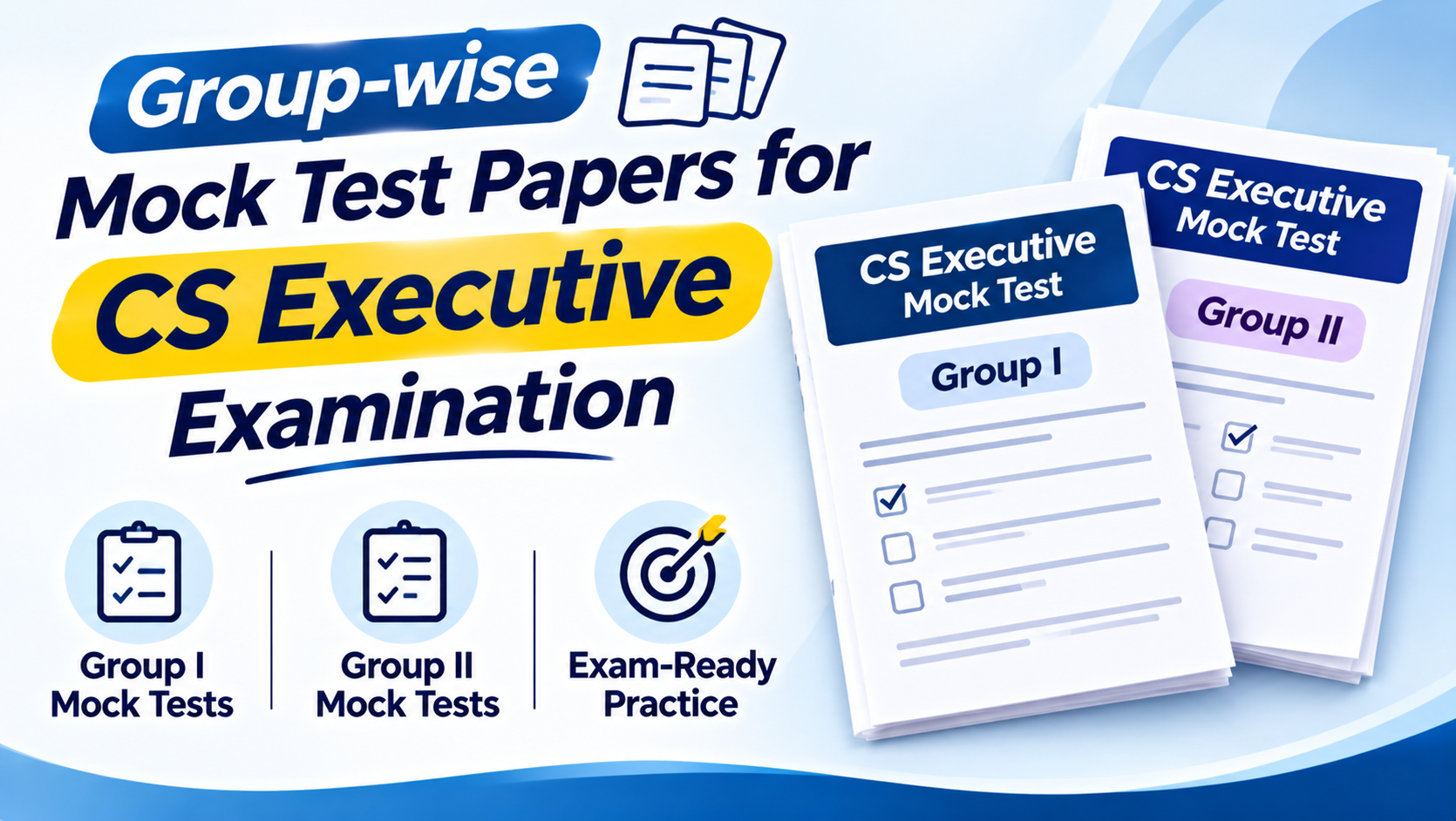
Students preparing for CS Executive may choose one group or both groups, depending on their preparation and examination plan. The mock test schedule should reflect that choice and ensure every paper receives sufficient practice.
Mock papers are most useful when aligned with the applicable syllabus and attempted at the right stage. Combine chapter-level tests with full-paper practice, then review performance across all the papers you intend to appear for.
Confirm your group and examination structure
Confirm the group or groups you plan to attempt and the applicable syllabus for your session. Check current ICSI information for paper names, structure, duration and updates.
Your test plan should reflect the actual papers you will write. Do not use an earlier group-wise schedule without checking whether its paper coverage remains relevant.
Why group-wise planning helps
A group-wise plan makes subject coverage visible. You can see which papers have been tested, which chapters need revision and where you are spending too much or too little time.
It reduces the risk of completing several tests in one subject while leaving another paper unpractised. Set weekly attention for every paper in your selected group or groups.
Plan mock tests for one group
Distribute tests across all papers in the selected group. Start with chapter-wise practice, then introduce mixed tests and full-length papers as syllabus coverage improves.
Do not spend all available time on the subject you find easiest. Use your tracker to identify difficult areas while maintaining regular revision across the remaining papers.
Plan mock tests for both groups
Students preparing for both groups need a broader calendar. Divide available time across all papers and rotate subjects to prevent long gaps. Include learning and testing rather than placing every mock in the final weeks.
If the workload becomes unrealistic, reassess the calendar. Meaningful preparation and review are more useful than attempting tests only to meet a numerical target.
Use chapter tests before full group papers
Chapter tests are useful soon after completing a topic. They identify concept gaps before you combine chapters or attempt a full paper. Keep a record of topics needing another round.
When several chapters are complete, use mixed tests to practise identifying the correct concept independently. This prepares you for a full-length paper.
Schedule full papers under exam conditions
Attempt full papers in one sitting and follow the applicable duration and conditions. Avoid checking notes during a closed-book simulation and practise completing every section within the time available.
Review attempted and unanswered questions. A paper may show that you know the content but need better time allocation, or that you spend too long on questions with limited marks.
Compare performance across papers
Track performance separately for every paper. Record marks, completion time, recurring errors, weak chapters and next actions. A combined score can hide a subject that needs more attention.
Review trends across several tests. If one paper remains weak, identify whether the issue is concept clarity, memory, application or writing speed.
Avoid an unbalanced timetable
Do not schedule tests only when you feel confident. Difficult papers need regular practice, but stronger subjects also need revision. Rotate papers and use fixed weekly slots.
Leave flexibility for classes, delays and difficult topics. An adjustable timetable is more useful than one that becomes impossible after a missed test.
Use test results to plan revision
Convert evaluation into specific tasks: revisit the chapter, clarify doubts, practise similar questions and schedule a retest. Do not simply record a score and move on.
Use your error log when planning the next cycle. Give more time to repeated weaknesses while continuing periodic revision of stronger topics.
How CS Exams Test Series can support group-wise practice
CS Exams Test Series can be considered as part of a group-wise practice plan. Check the current paper list, syllabus alignment, test format and evaluation features before choosing tests.
Follow a cycle of learning, chapter tests, mixed practice, full-length mocks and review. This keeps every selected paper visible and makes preparation decisions more evidence-based.
Quick Reference Table
| Preparation choice | Suggested test plan | Important check |
|---|---|---|
| One group | Tests across every paper in that group | Do not neglect any subject |
| Both groups | Weekly rotation across selected papers | Balance coverage and review |
| Early syllabus stage | Chapter-wise tests | Resolve concept gaps |
| Middle stage | Mixed and sectional tests | Identify topics independently |
| Revision stage | Full-length group-wise mocks | Use realistic timing |
| After each test | Paper-wise performance review | Set corrective tasks |
Conclusion
Consistent preparation depends on understanding the syllabus, practising questions and reviewing performance honestly. Keep your study plan aligned with current official ICSI information, and use CS Exams Test Series as one part of a wider routine of learning, revision and examination practice. Focus on correcting weaknesses from one attempt to the next rather than measuring progress only by the number of tests completed.