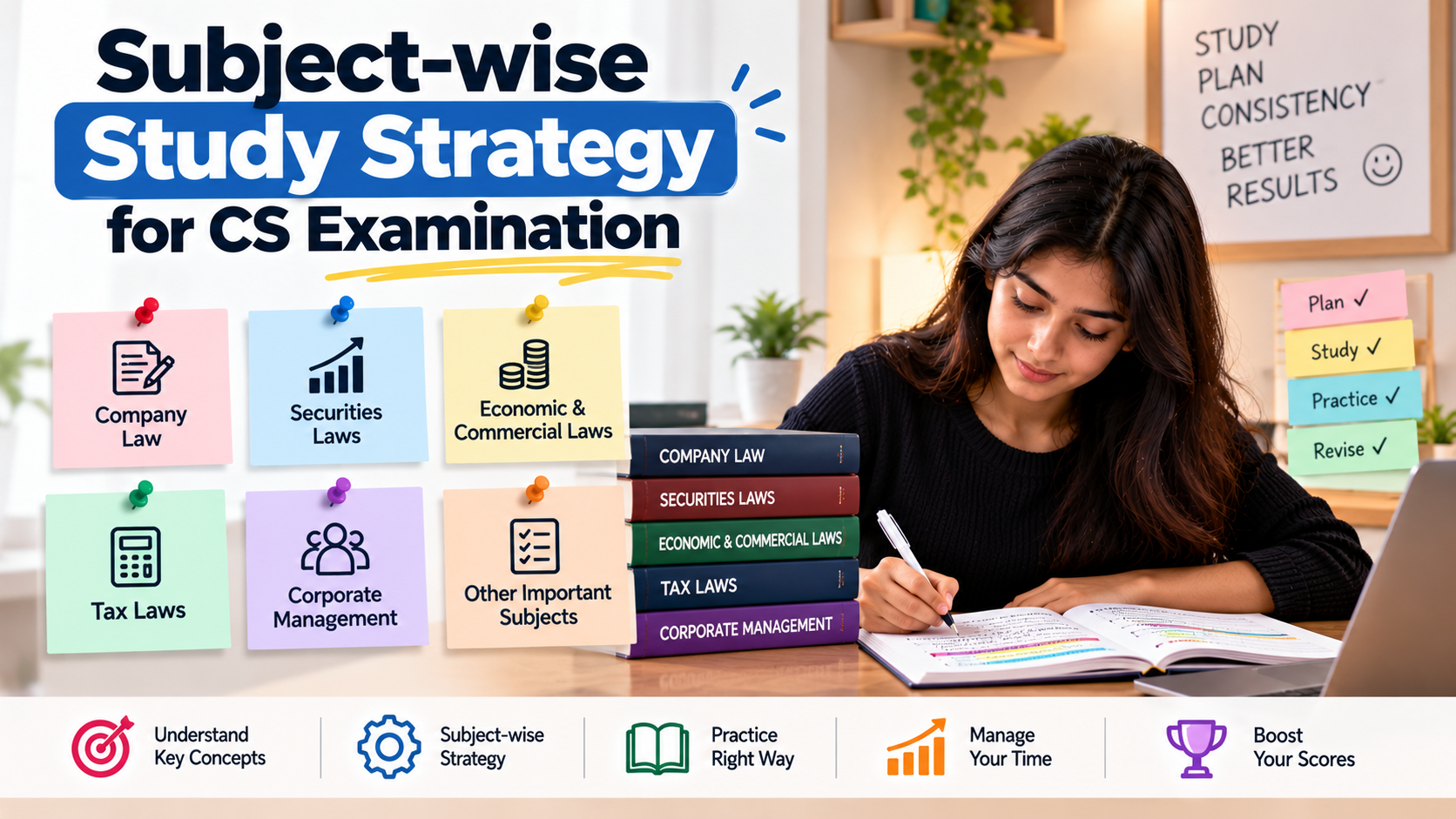
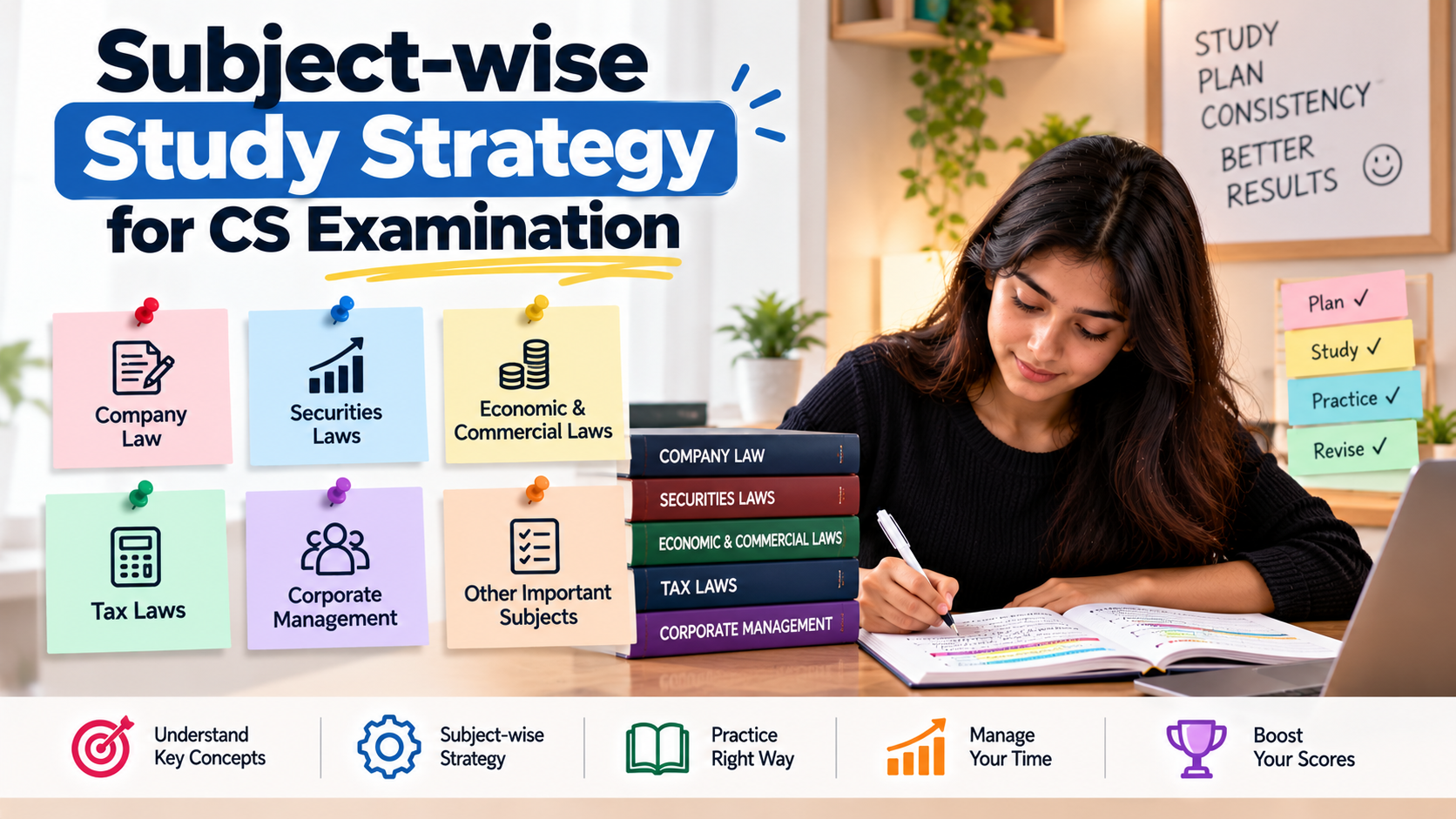
Preparing for CS examinations becomes more manageable when you begin with the current official syllabus, make a realistic plan and practise consistently. Use this guide as a practical framework, and verify programme-specific requirements and updates directly on the ICSI website.
CS Exams Test Series can be used as an additional practice resource alongside official ICSI study material. A good preparation routine balances learning, active recall, question practice and revision instead of relying on reading alone.
Quick Overview
| Area | Recommended approach |
|---|---|
| Syllabus | Use the current official ICSI syllabus and study material. |
| Study plan | Set realistic weekly targets and rotate subjects. |
| Practice | Attempt questions independently and analyse errors. |
| Revision | Use active recall and revisit weak topics at intervals. |
| Test support | Use CS Exams Test Series as a supplement to official resources. |
Diagnose each subject before planning
Rate each subject by familiarity, difficulty and the amount of practice it needs. A paper studied at university may still demand more precise answers or a different application method in a professional examination. Use sample questions or a short diagnostic exercise to test your starting point.
Track each paper and topic separately. Avoid labelling a whole subject easy or difficult; one paper may contain familiar units alongside topics that need substantial attention. Chapter-level planning gives a clearer picture of where study time should go.
Law subjects: connect rules with application
Read legal concepts to understand their purpose, conditions and exceptions. Keep a concise list of essential terminology and distinguish concepts that are easy to confuse. Use official material to verify provisions and check whether updates apply to your session.
Practise direct theory and case-based questions. In a case, identify the issue, state the rule, apply it to the facts and conclude clearly. In a theory answer, use headings when they improve clarity. After reviewing a guideline answer, note the missing reasoning step instead of copying the entire response.
Company law and governance: organise themes
Organise company law and governance chapters around themes named in your current syllabus, such as formation, management, meetings or compliance responsibilities. A theme-based map helps you see how related concepts connect. Keep notes linked to the official chapter or provision.
Use short recall questions: what condition triggers a requirement, who is responsible, or what consequence follows? For case material, practise applying the principle to facts rather than memorising a conclusion without context.
Accounting and finance: learn by solving
Numerical subjects need active practice. Study the concept and a worked example, then solve questions independently. Write each step clearly and label workings. If a calculation is wrong, identify the first step where your method diverged from the correct approach.
Maintain an error log for concept selection, formula choice, arithmetic, adjustments, interpretation and presentation. Review it weekly and solve similar questions. Gradually increase difficulty and time pressure instead of repeatedly doing only easy examples.
Tax and technical subjects: combine rules with questions
For tax or other technical papers, separate study into understanding the rule, remembering key conditions and applying it to a question. Create concise tables for distinctions and exceptions where useful, and check official study material and updates for your session.
After learning a rule, solve questions that require you to decide whether it applies. Explain the reason for your treatment and verify the method against a suitable solution. Use spaced recall to revisit details that are difficult to remember.
Business and management subjects: link concepts
Concept-based subjects are easier to revise when ideas are connected. Create small diagrams or comparison tables showing definitions, characteristics and practical examples. Follow the official syllabus headings rather than expanding into unrelated background information.
Test understanding by explaining a concept in plain language, giving an example and answering an application or comparison question. Keep business examples relevant and factual. Extra information does not improve an answer if it fails to address the question.
Communication and drafting: practise the output
Where the syllabus includes communication, drafting or professional writing, practise the formats and skills it names. Reading examples is useful, but you also need to produce your own responses. Pay attention to purpose, audience, structure, clarity and question instructions.
Review each attempt with a checklist: does it answer the task, follow the expected format, present points logically and use clear language? Time yourself occasionally so that good presentation remains possible within exam conditions.
Use a rotating weekly plan
Give each subject a place in the week, but avoid studying one paper exclusively for long periods without a specific reason. Rotation lets you revisit earlier material and keeps all papers active. Include new learning, question practice and recall in each week.
An example pattern might alternate a legal topic, numerical practice and a concept-heavy subject, with short sessions for revision across papers. Adjust the plan to your group and workload. At week’s end, move unfinished tasks forward deliberately.
Use past papers and mocks to refine the plan
Use official question papers and guideline answers where available. Attempt questions before reading solutions, then assess accuracy, relevance, completeness, structure and timing. Keep a list of topics where you repeatedly lose marks or struggle to finish.
Use full-paper mocks to practise stamina and time allocation once you have adequate coverage. The review after a mock is as important as the attempt. Choose specific changes for the next paper, such as clearer workings or more direct case application.
Make revision specific to each subject
Law notes may focus on provisions and application steps; numerical notes on methods and common errors; concept notes on diagrams and comparisons; communication notes on format checklists. Keep notes compact and linked to official sources.
Use active recall and spaced practice. Close the book and reproduce key points, solve a question or explain the concept aloud. Return to difficult topics after a gap. Revision should reveal what you can retrieve independently and help repair weaknesses.
Set priorities using evidence
Online advice often labels some chapters as high priority, but no unofficial list can guarantee the questions that will appear. Use the current ICSI syllabus as the boundary of your preparation. Then combine the syllabus with your own performance: topics that are difficult for you, areas where you repeatedly make errors and topics you have not revised recently deserve attention in the plan.
Review priorities every week. If your accuracy improves, maintain the skill through brief revision and give more time to weaker areas. If a topic remains weak, break it into smaller learning tasks. This evidence-based approach makes the timetable personal and avoids spending disproportionate time on a chapter just because it is popular in a discussion group.
Review errors systematically
Do not write only ‘wrong answer’ beside a question. Record the cause: concept not understood, detail forgotten, question misread, calculation error, weak structure or time pressure. Add the correct reasoning and set a date to attempt a similar question again. This makes the error log a practical tool instead of a list of disappointing scores.
At the end of each week, look for patterns. If several mistakes come from misreading questions, practise underlining command words and key facts. If you repeatedly forget distinctions, create a comparison table and test it through recall. A small change that addresses a repeated cause can improve several answers at once.
Combine independent practice with guidance
Classes, reference books and explanations can make a difficult concept easier to understand, but independent practice shows whether you can use it yourself. After watching a lesson or reading a worked solution, close the resource and attempt a question. If you cannot start, identify which step is missing and return to that part rather than replaying the entire explanation.
Use guideline answers as a standard for checking accuracy and completeness, not as text to memorise word for word. Compare your answer, note any missing element and then write a fresh response. This method supports understanding and helps you adapt when an examination question presents the same concept in a different way.