Preparing for CS examinations becomes more manageable when you begin with the current official syllabus, make a realistic plan and practise consistently. Use this guide as a practical framework, and verify programme-specific requirements and updates directly on the ICSI website.
CS Exams Test Series can be used as an additional practice resource alongside official ICSI study material. A good preparation routine balances learning, active recall, question practice and revision instead of relying on reading alone.
Quick Overview
| Area | Recommended approach |
|---|---|
| Syllabus | Use the current official ICSI syllabus and study material. |
| Study plan | Set realistic weekly targets and rotate subjects. |
| Practice | Attempt questions independently and analyse errors. |
| Revision | Use active recall and revisit weak topics at intervals. |
| Test support | Use CS Exams Test Series as a supplement to official resources. |
Why the applicable syllabus matters
A syllabus is more than a chapter list: it defines the areas to study and helps you distribute preparation time. Older articles and videos may describe a previous CSEET format. Before using them, check the session they cover and compare their paper names and assessment methods with the latest ICSI announcement.
Download the official syllabus and matching study material, then note the session and publication date. Check for official supplements or corrigenda. If different sources appear inconsistent, use the latest ICSI notice applicable to your session as the authority.
CSEET structure applicable from June 2026
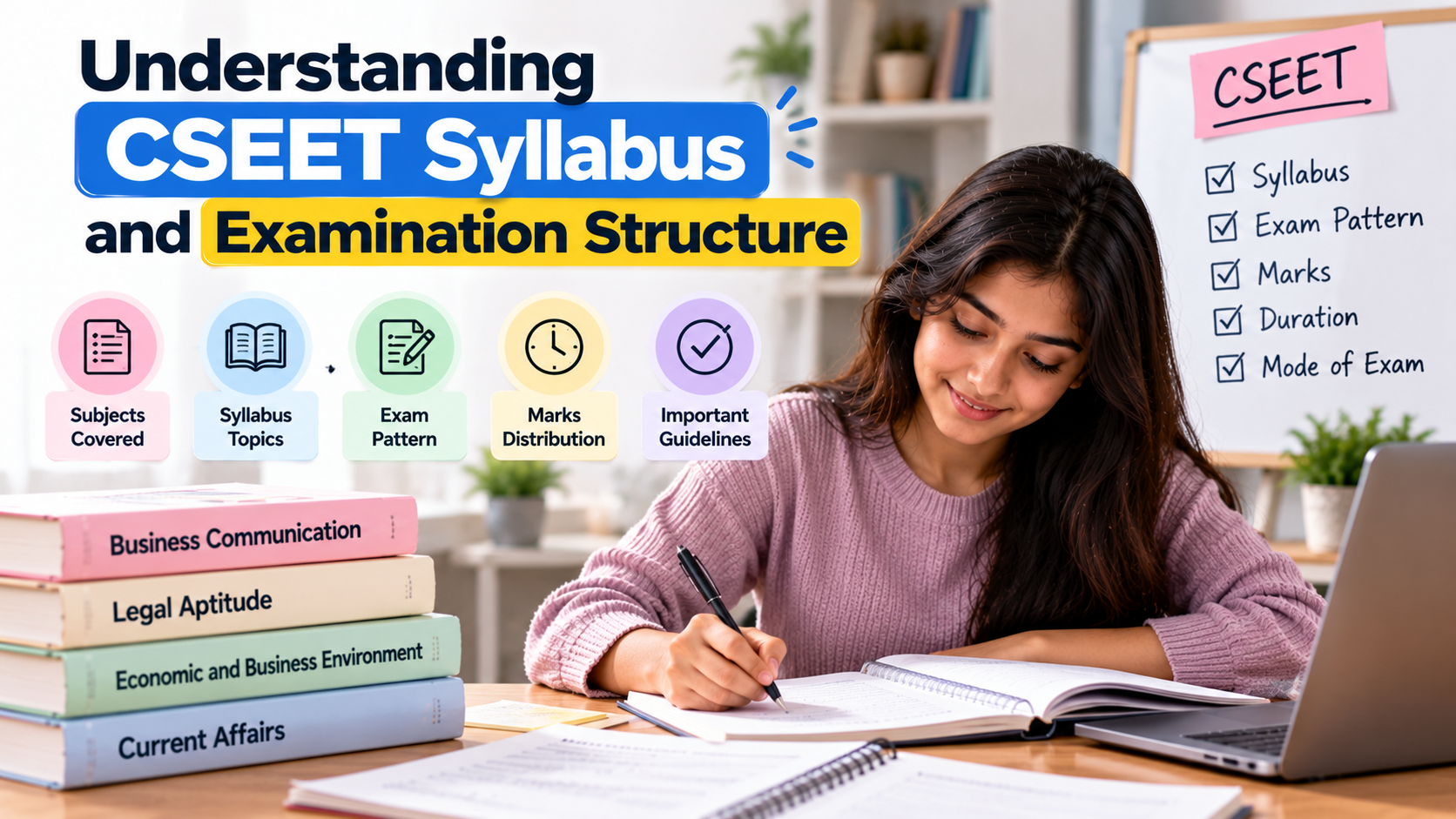
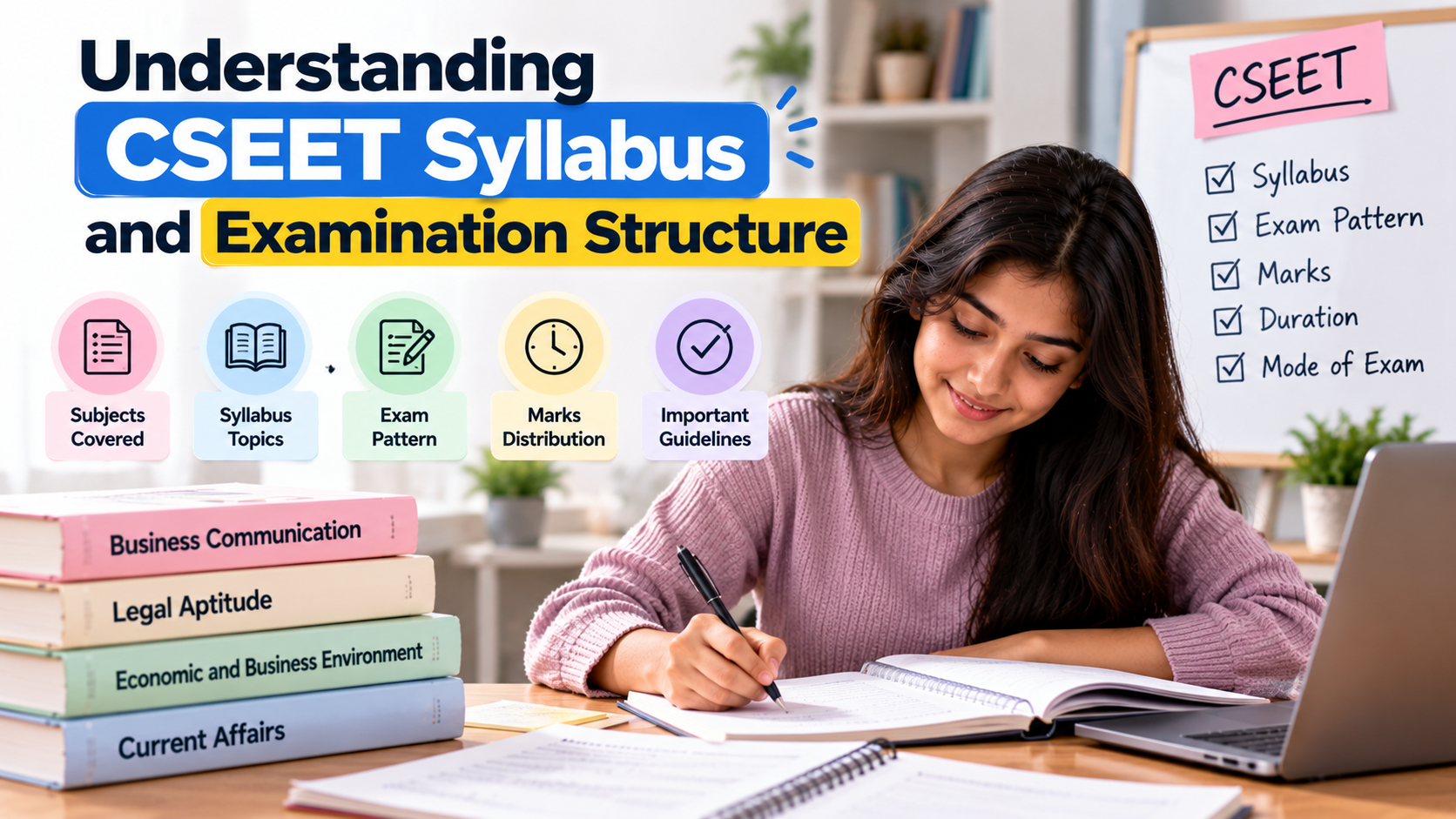
ICSI announced a restructured CSEET effective from the June 2026 session. The announced structure has four papers: Business Communication, Fundamentals of Accounting, Economic and Business Environment, and Business Laws and Management. The first three are subjective, while Business Laws and Management is OMR-based under the published structure.
The announcement lists 100 marks for each paper. It lists three hours for Business Communication, Fundamentals of Accounting and Economic and Business Environment, and two hours for Business Laws and Management. The last paper is divided into Business Laws for 60 marks and Business Management for 40 marks. Verify the current timetable and candidate instructions for your session.
Understand the skills each paper needs
Business Communication requires attention to language, comprehension and writing skills covered by the official syllabus. Practise producing clear responses rather than only memorising definitions. Fundamentals of Accounting needs concept clarity and repeated problem-solving: study an example, then solve a similar question without looking at the solution.
Economic and Business Environment benefits from understanding concepts and their business context. Business Laws and Management combines legal knowledge with management concepts, so organise notes around key terms, principles and distinctions. For all four papers, the syllabus and study material for your session should guide what you study.
Read the syllabus in three passes
First, scan all paper names, units and chapter headings to understand the workload. Second, label topics as familiar, partly understood or new. Third, break each unit into tasks. A theory task might be to read, summarise and answer five questions; an accounting task might be to learn a method and solve a set of problems.
A task-based tracker makes progress visible and helps you plan revision. Avoid treating every chapter as equally difficult. Estimate the time each one needs, then update your plan as you discover which areas require more practice.
Use methods suited to the exam format
Subjective papers require you to produce a clear answer, so practise writing within a time limit. Read the question carefully, identify its command word and organise your response before writing. Use headings or numbered points where they improve clarity, and make sure every part of the question is addressed.
For an OMR-based paper, practise reading options carefully and managing time. Follow the official instructions for marking responses and handling any changes on the answer sheet. Do not assume the same practice method suits every paper; adapt your preparation to the current assessment format.
Practise with sample papers
Use sample papers and official resources to understand how concepts may be assessed. Attempt questions independently before checking the available answers. Note whether each error came from a knowledge gap, misreading, weak recall, incomplete format or time pressure.
Repeat questions that exposed a weakness after a short gap. If a concept is unclear, revisit the relevant section; if you ran out of time, practise with a timer. Connect every test result to a change in your preparation rather than simply recording the score.
Make short revision notes
For theory, record definitions, key points, examples and distinctions. For accounting, record methods and common errors. For communication, maintain checklists for formats covered in the syllabus. For laws and management, use topic maps and short recall questions. Avoid turning revision notes into a second textbook.
Review notes actively: cover the page and explain the concept, write the main points from memory or solve a short question. Rereading can support learning, but it should not be the only revision method. Useful notes help you retrieve and apply the concept when the book is closed.
Use CS Exams Test Series alongside ICSI material
CS Exams Test Series can be an additional practice resource, but confirm that each test matches the restructured CSEET syllabus and format applicable to your session. Older tests based on a previous pattern may not represent the current exam accurately.
Use the result to build a paper-wise action list. If you know a topic but answer too slowly, practise timed responses. If accounting errors recur, redo similar questions and record why each mistake happened. Reassess the topic later to see whether the correction has lasted.
Check requirements before exam day
Confirm registration and enrolment status, timetable, venue or mode, reporting time, permitted materials and identification requirements through the official instructions for your session. Use the final days for revision and exam-style practice rather than chasing every new resource you find online.
Revisit difficult topics, solve selected questions and keep your sleep routine steady. A calm plan should follow the applicable syllabus, reflect the current paper pattern and provide repeated opportunities to practise independently.
Avoid confusion between old and new resources
Search results can contain older CSEET material alongside resources for the restructured format. Before studying from a book, video or test, check the publication date, paper names and assessment method. The restructured format announced from June 2026 differs from earlier arrangements, so an older practice set may not be suitable for judging readiness for the current examination.
Keep one folder containing the current syllabus, official study material, relevant sample papers and any applicable corrigendum. Label saved files with the session or publication date. If a coaching resource uses a different structure, compare it against ICSI’s official documents and use only the portions that remain relevant.
Make a paper-wise revision calendar
Plan revision dates when you first study a topic. Schedule a short recall check soon after learning, another practice session a few days later and a broader review at the end of the week. The exact spacing can change with your routine; the important point is to return to the material instead of assuming one reading will remain fresh until the examination.
Use the calendar to rotate the four papers and prevent one subject from disappearing for several weeks. Include short question sets, not just reading sessions. As the examination approaches, replace some first-study blocks with mixed practice and timed papers. Keep the schedule flexible enough to respond to test results and official exam dates.
What to do when a topic is difficult
If a topic remains difficult after repeated reading, change the method instead of repeating the same session. Break the concept into smaller parts, find a worked example in the official material, explain the principle in plain language and attempt a simple question. Only after the basic step is clear should you move to more complex applications.
Ask a teacher or study partner a focused question if you are still stuck. ‘I do not understand this chapter’ is harder to solve than ‘I can identify the rule but cannot apply it to this case’. A specific question helps you find the missing step. Record the clarification and test yourself again later.