In this article (11)
- Update (November 2026): New CSEET pattern and the February 2027 exam
- CSEET Syllabus 2026
- CSEET Syllabus & Subjects Highlights 2026
- ICSI CSEET Syllabus 2026
- CSEET Subjects for Paper 1: Business Communication
- CSEET Paper 2: Fundamentals of Accounting
- CSEET Subjects for Paper 3: Economic and Business Environment
- CSEET Paper 4: Business Laws and Management (OMR)
- ICSI CSEET Exam Pattern (from June 2026)
- Why Choose CS Exam Test Series for CS Preparation
- FAQs
Update (November 2026): New CSEET pattern and the February 2027 exam
ICSI has restructured the CSEET from the June 2026 session. It is now held three times a year, in February, June and October, offline at exam centres, with four papers of 100 marks each:
Latest update (18 Nov 2026): the next CSEET is on 1 to 4 February 2027 on the new ICSI pattern (three written papers and one OMR paper). Registration for the June 2027 CSEET is open till 28 February 2027.
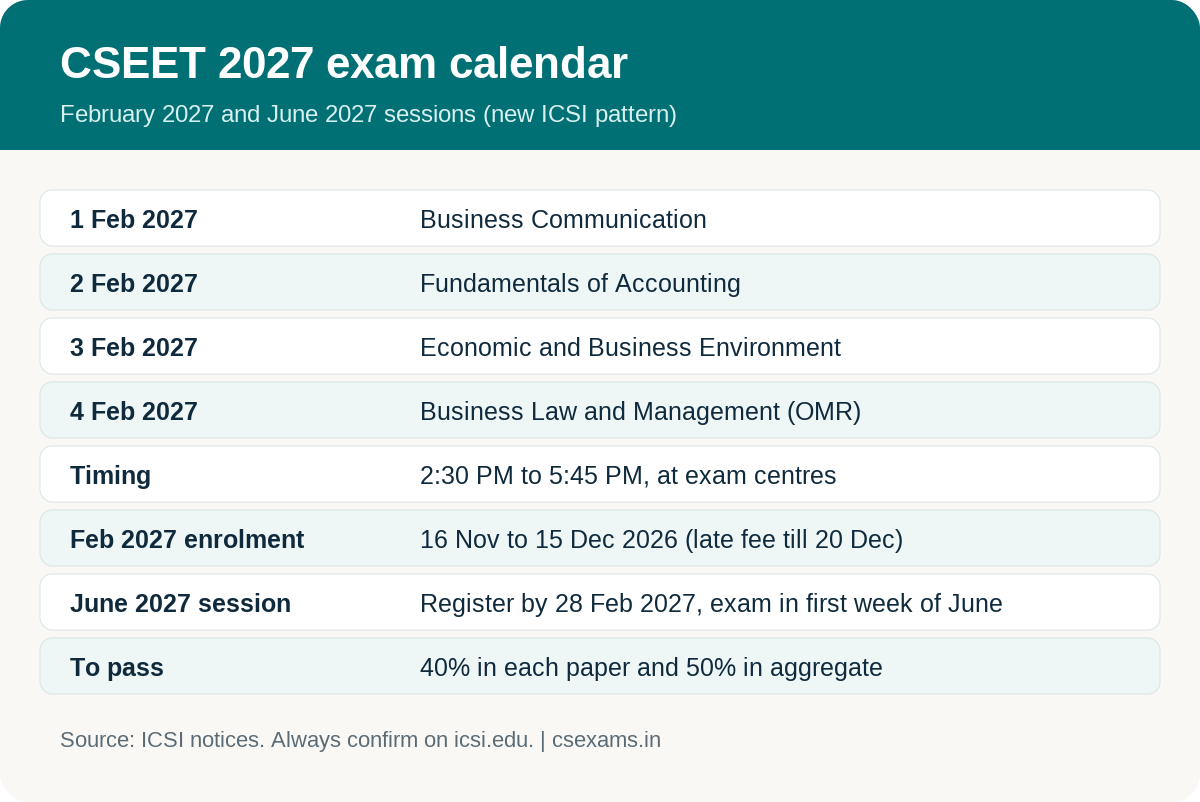
| CSEET 2027 | Details |
|---|---|
| CSEET Feb 2027 exam | 1, 2, 3 and 4 February 2027, 2:30 PM to 5:45 PM, at exam centres |
| Papers | Business Communication, Fundamentals of Accounting, Economic and Business Environment, Business Law and Management (OMR) |
| Feb 2027 enrolment | 16 Nov to 15 Dec 2026 (late fee 16 to 20 Dec 2026) |
| Admit card | Expected in the third week of January 2027 on icsi.edu |
| CSEET June 2027 | Registration till 28 Feb 2027, enrolment 16 Mar to 15 Apr 2027, exam in the first week of June 2027 |
| To pass | 40% in each paper and 50% in aggregate |
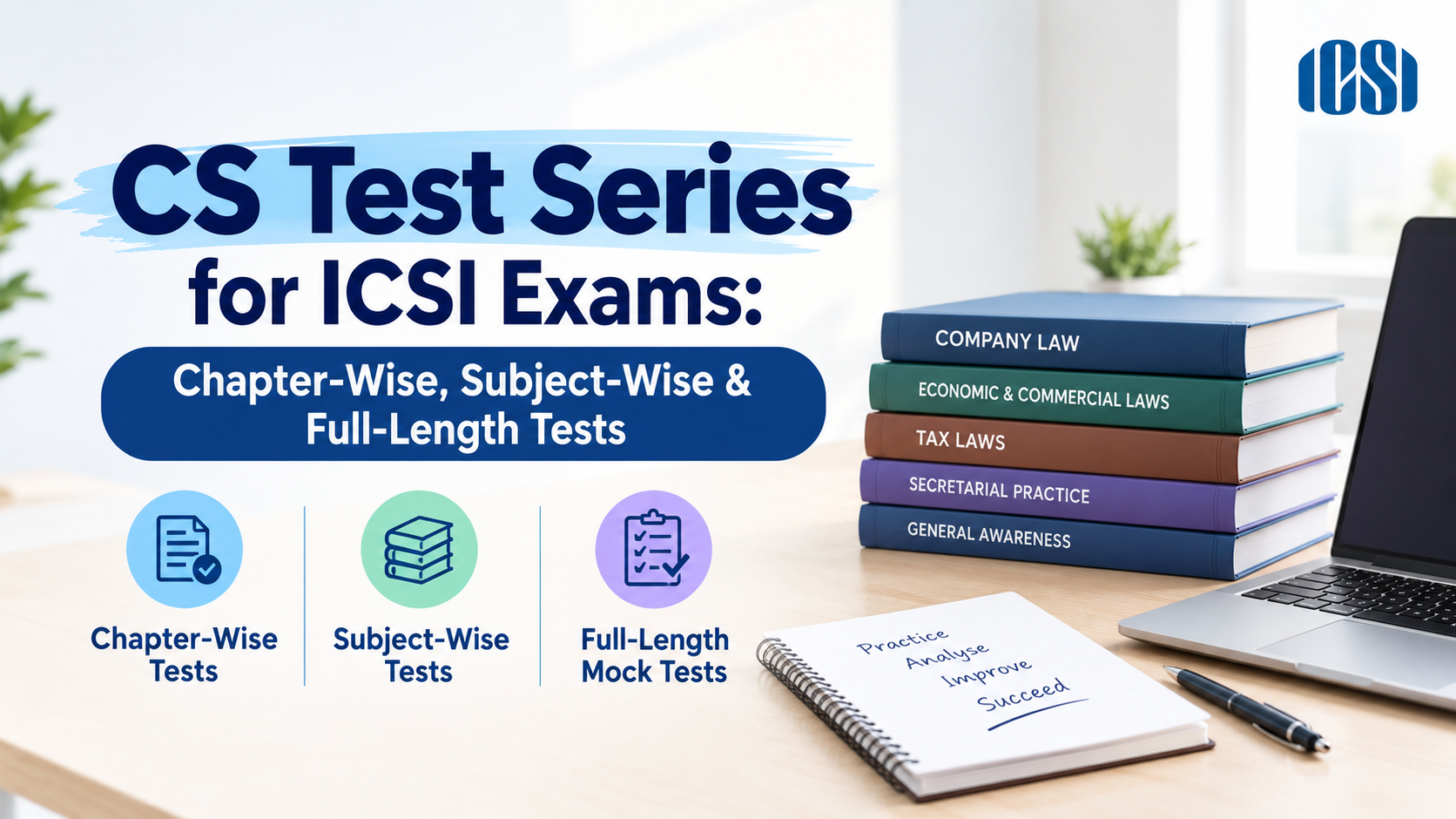
Practise on the new pattern with our CSEET test series for February 2027, with written answers checked by Company Secretaries.
Always confirm dates on the official ICSI website, icsi.edu.
| Date (Feb 2027) | Paper | Type and time |
| 1 Feb 2027 | Business Communication | Written, 3 hours |
| 2 Feb 2027 | Fundamentals of Accounting | Written, 3 hours |
| 3 Feb 2027 | Economic and Business Environment | Written, 3 hours |
| 4 Feb 2027 | Business Laws and Management (60 + 40 marks) | OMR (MCQ), 2 hours, no negative marking |
Papers start at 2:00 PM with 15 minutes of reading time. To pass you need at least 40% in each paper and 50% in aggregate, in one sitting. The old pattern (online, remote-proctored MCQ test with Legal Aptitude and Logical Reasoning and Current Affairs papers) ended with the January 2026 session. Dates as reported from the ICSI schedule; please confirm on icsi.edu.
CSEET Test Series for February 2027 on the new pattern: written papers checked by qualified Company Secretaries, plus OMR practice for Business Laws and Management.
A thorough summary of the subjects covered, including paper specifics, themes, and subtopics, is provided by the CSEET Syllabus 2026. The ICSI CSEET Subjects and Syllabus can be found here for a complete understanding.
Prepare to crack the ICSI CSEET 2026 exam. The Institute of Company Secretaries of India (ICSI) has released the detailed syllabus on its official portal, icsi.edu. Before heading into your study sessions, it is essential to understand the entire CSEET syllabus and the format of the exam.
The new syllabus for the CSEET 2026 Exam is a helpful guide that provides extensive information regarding the papers covered, themes, and subtopics under each paper. For initiating your preparation, let us see the entire ICSI CSEET Syllabus, paper-wise, in this article.
CSEET Syllabus 2026
The Institute of Company Secretaries of India (ICSI) has restructured the CSEET from the June 2026 session. The CSEET 2026 official syllabus is available on the ICSI website. Candidates must go through this syllabus before they prepare for it. The syllabus contains information about the papers, topics, and subtopics discussed.
To pass the CSEET exam, the candidates are required to achieve a minimum of 40% in each of the papers and an overall aggregate of 50% across all the papers. Passing the CSEET exam enables candidates to enroll for the CS Executive June 2026 exams.
CSEET Syllabus & Subjects Highlights 2026
Get familiar with the CSEET syllabus and subjects for 2026. Understand the exam pattern, weightage, and key topics to crack the Company Secretary Executive Entrance Test (CSEET) with confidence.
| ICSI CSEET Syllabus 2026 Overview | |
| Particulars | Details |
| Conducting Body | Institute of Company Secretaries of India (ICSI) |
| Name of Examination | CS Executive Entrance Test (CSEET) |
| Mode of Exam | Offline, at ICSI exam centres (3 written papers + 1 OMR paper) |
| Category | Syllabus |
| Number of subjects | Four |
| Duration of Exam | 3 hours for each written paper, 2 hours for the OMR paper (plus 15 minutes reading time) |
| Marks | 400 marks (4 papers of 100 marks each) |
| Language of Question Paper | English |
| Nature of questions | Three descriptive (written) papers and one OMR-based MCQ paper (Business Laws and Management) |
| Pre-Examination Requirement | No |
| ICSI Official Website | www.icsi.edu |
ICSI CSEET Syllabus 2026
The CSEET 2026 syllabus is divided into four papers, each with its own focus:
- Paper 1. Business Communication: Focusing on effective communication skills.
- Paper 2. Fundamentals of Accounting: Accounting basics to final accounts, partnership, LLP and company accounts (written).
- Paper 3. Economic and Business Environment: Focusing on the economic and business environment.
- Paper 4. Business Laws and Management: Business laws (60 marks) and management (40 marks), OMR-based. Now, let's go through the details of each paper step by step.
CSEET Subjects for Paper 1: Business Communication
In CSEET Syllabus 2026 Paper 1, the candidates present their understanding of English grammar basics and major aspects of business communication. The paper carries a total of 50 marks. Go through the CSEET Paper 1 Syllabus for an idea about the topics and subtopics that are included to prepare thoroughly.
| ICSI CSEET Syllabus: Paper 1- Business Communication | ||
| S.No. | Topics | Sub-Topics |
| 1. | Essentials of Good English |
|
| 2. | Communication |
|
| 3 | Business Correspondence |
|
| 4 | Common Business Terminologies |
|
CSEET Paper 2: Fundamentals of Accounting
Paper 2 is a written (descriptive) paper of 100 marks and 3 hours. It replaces the old Legal Aptitude and Logical Reasoning paper. Topics:
- Basics, Concepts and Principles of Accounting
- Accounting Process
- Bank Reconciliation Statement
- Depreciation and Amortisation
- Preparation of Final Accounts for Sole Proprietorship
- Partnership and LLP Accounts
- Introduction to Company Accounts
- Accounting for Non-Profit Organisations
Practise full journal-to-final-accounts questions in writing, with proper formats and working notes.
CSEET Subjects for Paper 3: Economic and Business Environment
ICSI CSEET Syllabus 2026 for Paper 3 is divided into two sections, Economics and Business Environment. The subject matter in this syllabus consists of concepts of micro- and macroeconomics in the context of the Indian economic system. The candidates will also be examined on their understanding of the key aspects of the business environment.
| ICSI CSEET Syllabus: Paper 3: Economic & Business Environment | ||
| S.No. | Topics | Sub-Topics |
| Part A: Economics | ||
| 1. | Basics of Demand and Supply and Forms of Market Competition |
Theory of Demand and Supply
|
| 2 | National Income Accounting and Related Concepts |
|
| 3 | Indian Union Budget |
|
| 4 | Indian Financial Markets |
|
| 5 | Indian Economy |
|
| Part B: Business Environment | ||
| 6 | Entrepreneurship Scenario |
|
| 7 | Business Environment |
|
| 8 | Key Government Institutions |
|
CSEET Paper 4: Business Laws and Management (OMR)
Paper 4 is an OMR-based MCQ paper of 100 marks and 2 hours, with no negative marking. It replaces the old Current Affairs and Quantitative Aptitude paper.
- Part A: Business Laws (60 marks): Introduction to Law; Elements of Company Law; Elements of Law of Contracts; Elements of Law relating to Partnership and Limited Liability Partnership
- Part B: Business Management (40 marks): Introduction to Management; Functions of Management; Principles of Management and Modern Approaches; Management Knowledge for Company Secretaries
Since there is no negative marking, attempt every question, and practise filling the OMR sheet within time.
ICSI CSEET Exam Pattern (from June 2026)
| Particulars | Details |
| Exam mode | Offline, at ICSI exam centres (3 written papers + 1 OMR paper) |
| Sessions | February, June and October |
| Papers | Business Communication; Fundamentals of Accounting; Economic and Business Environment; Business Laws and Management (OMR) |
| Marks | 100 per paper, 400 in all |
| Duration | 3 hours for each written paper, 2 hours for the OMR paper (plus 15 minutes reading time) |
| Negative marking | None in the OMR paper |
| Passing | 40% in each paper and 50% in aggregate, in one sitting |
| Language | English |
Why Choose CS Exam Test Series for CS Preparation
When it comes to preparing for the hard CS exams, choosing the right test series can make all the difference. csexams.in has emerged as a trusted and result-oriented platform for CSEET, Executive, and Professional-level aspirants. Here's why it should be your first choice:
- Trusted by Thousands of CS Aspirants: The CS Exam has built a strong reputation among CS students for its consistent quality and excellent student feedback.
- ICSI Pattern-Based Question Papers: All tests are strictly based on the latest ICSI exam pattern and syllabus, ensuring real exam-like practice.
- Timely Evaluation with Expert Feedback: Get your answers evaluated within 48–72 hours along with detailed feedback, a marking scheme, and improvement tips.
- Personalized Mentorship & Study Planner: Get personalized mentorship, performance tracking, and a daily study plan customized to your syllabus completion pace.
FAQs
What are the CSEET subjects now?
Business Communication, Fundamentals of Accounting, Economic and Business Environment, and Business Laws and Management (OMR).
What is the new CSEET exam pattern?
From the June 2026 session the CSEET has four papers of 100 marks each: Business Communication, Fundamentals of Accounting and Economic and Business Environment (written, 3 hours each) and Business Laws and Management (OMR, 2 hours, no negative marking). It is held offline at exam centres.
How many times a year is the CSEET held now?
Three times a year: February, June and October.
When is the next CSEET exam?
The February 2027 session: 1, 2, 3 and 4 February 2027 (as reported from the ICSI schedule; confirm on icsi.edu).
Is there negative marking in the CSEET?
No. The OMR paper (Business Laws and Management) has no negative marking, and the other three papers are written.
What are the passing marks for the CSEET?
At least 40% in each paper and 50% in aggregate, in one sitting. Marks cannot be carried forward.
Are Legal Aptitude, Logical Reasoning, Current Affairs and Quantitative Aptitude still CSEET papers?
No. Those papers belonged to the old pattern, which ended with the January 2026 session. Fundamentals of Accounting and Business Laws and Management have taken their place.
Is the CSEET still a remote-proctored online test?
No. From June 2026 the CSEET is written offline at ICSI exam centres.
Practise what you just read