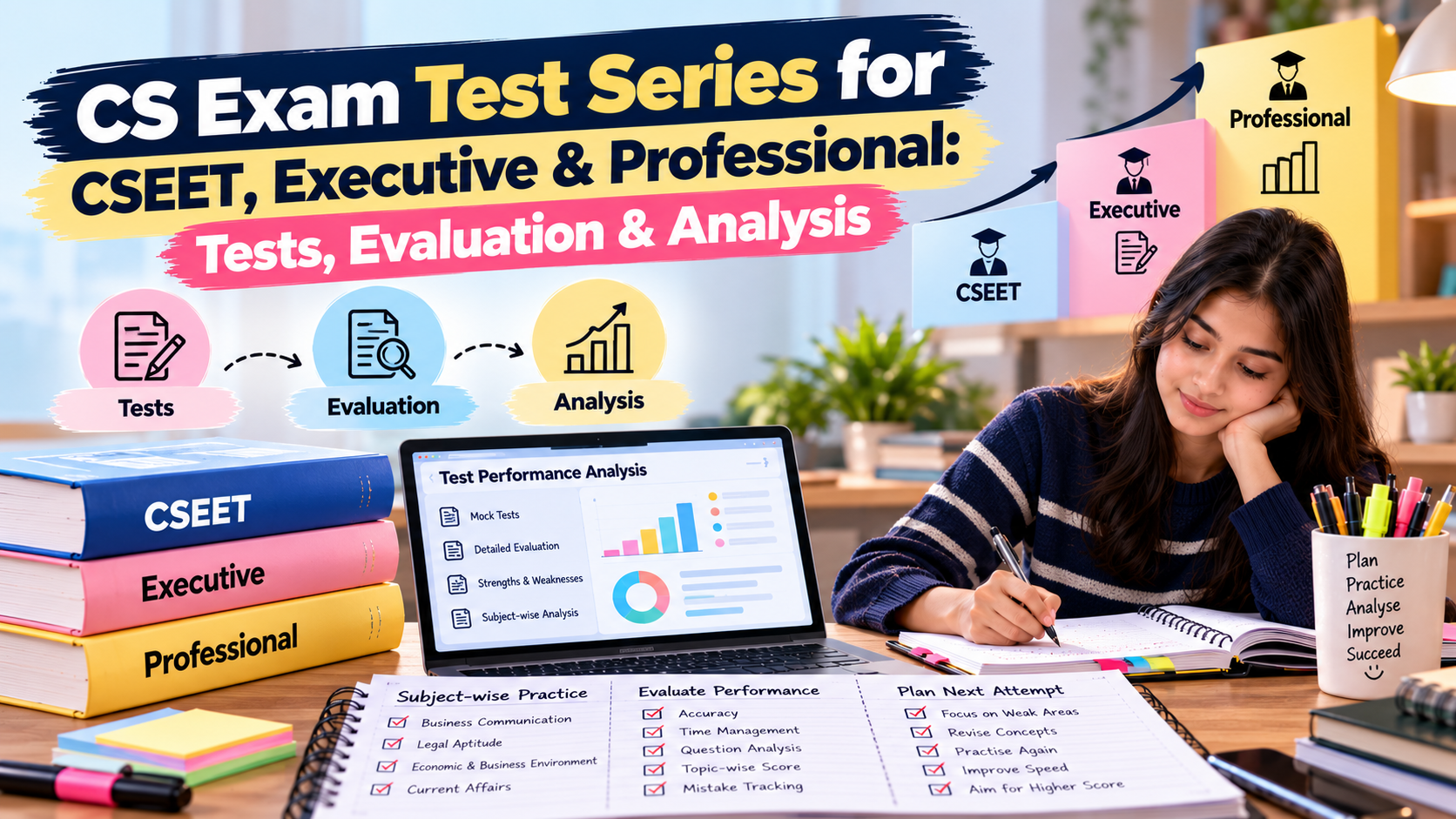
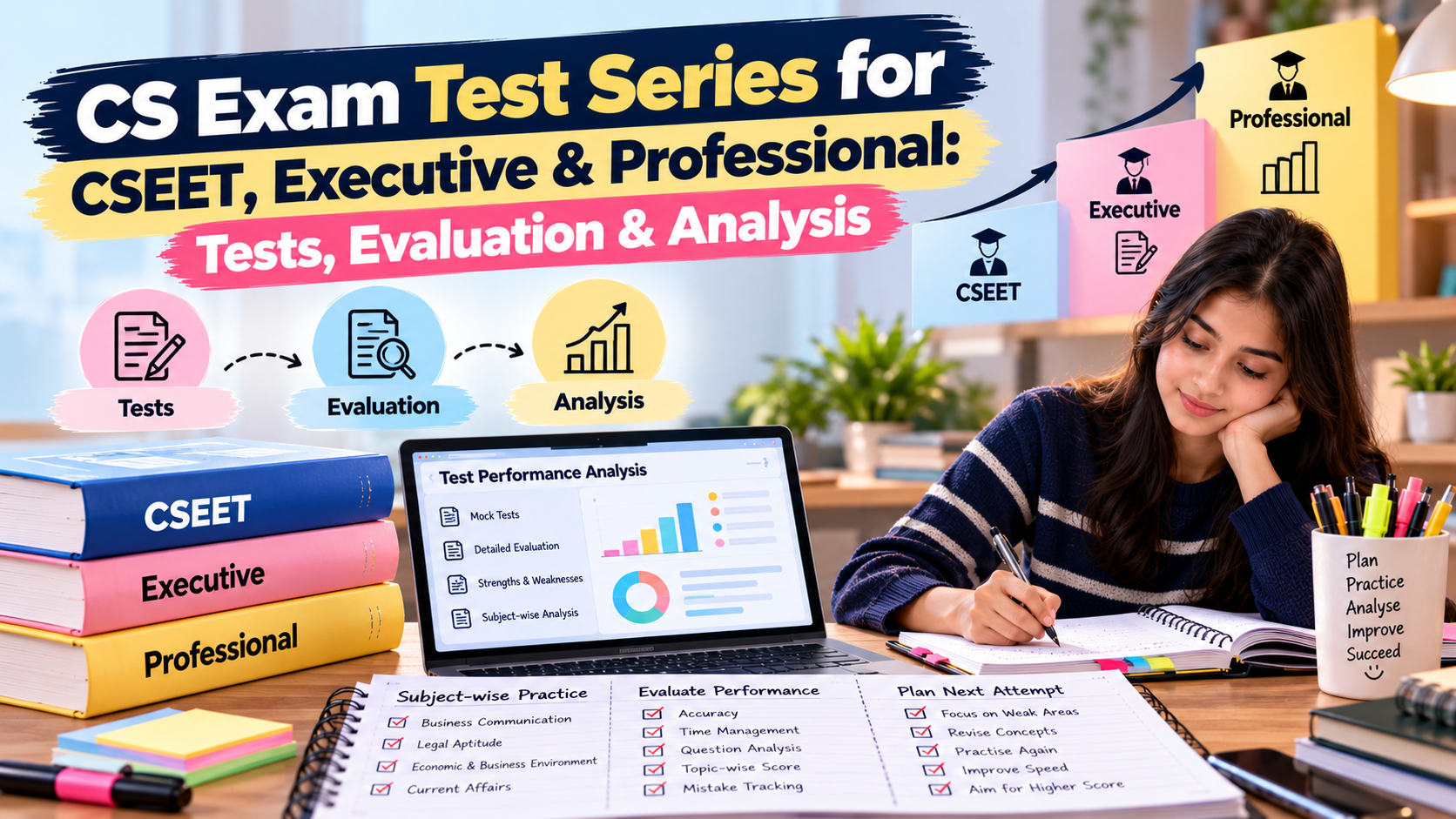
A study plan helps you cover the syllabus, but practice tests show whether you can use what you have learned. They help you check recall, understand question requirements, manage time and present answers clearly under exam conditions. For students preparing for CSEET, CS Executive or CS Professional, regular testing can make preparation more focused because each attempt reveals what needs attention next.
The value of a test series does not come from the number of papers alone. Useful practice includes a suitable mix of questions, a realistic time limit, dependable evaluation and a review process that turns results into action. CS Exams Test Series can be part of that routine when you use each test to identify a gap, work on it and check your progress in the next attempt.
How Test Needs Differ Across CSEET, Executive and Professional
Students at different stages of the CS course need different kinds of practice. CSEET preparation generally benefits from building a strong base, understanding the format of objective questions and improving speed and accuracy. CS Executive students need to strengthen subject knowledge and practise applying concepts to questions. CS Professional students often need to focus more on advanced application, integrated understanding and precise answer presentation, depending on the paper.
Before choosing a test plan, check the current ICSI syllabus, examination guidelines and applicable paper pattern for your attempt. Do not rely only on an old test package or a general description. Make sure the papers and practice material correspond to the syllabus and format you are preparing for.
What to Look for in a CS Test Series
A good test series should make practice purposeful and easy to review. Check the syllabus coverage, question quality, difficulty balance, exam-style format and clarity of evaluation. If you are preparing for a specific session, confirm that the material is aligned with the relevant syllabus and any applicable changes.
Also consider how easily you can access your scores and feedback. A useful result should help you understand more than whether you passed or failed a practice paper. Ideally, it should help you identify strong topics, weak topics, avoidable errors and areas where answer writing or time management needs work.
CSEET: Build Accuracy, Confidence and Consistency
For CSEET, start by understanding the question formats and the skills each paper tests. Short practice sets can help you check whether you understand a concept, while timed mock tests show how consistently you can apply it under pressure. Review incorrect answers and any correct answers that came from guessing.
Keep a record of repeated errors. If you frequently confuse similar concepts, revisit the difference and solve a fresh set of questions. If accuracy drops when you work quickly, practise at a steady pace before gradually tightening the time limit. Use the current official syllabus and instructions to decide which topics and formats deserve priority.
CS Executive: Strengthen Application and Answer Writing
At the Executive level, knowing a definition or provision is not always enough. You may need to explain a concept, distinguish between related ideas or apply a rule to a set of facts. A test series can help you practise these tasks under time limits and identify where your answer is incomplete or unclear.
After a test, compare selected answers with reliable suggested answers or evaluation guidance. Look for missing legal or technical points, weak reasoning, unsupported conclusions and unnecessary detail. Then rewrite a few answers using your own words. This helps you practise presenting the relevant rule or concept, applying it to the question and reaching a clear conclusion where required.
CS Professional: Practise Depth, Precision and Integration
Professional-level preparation often requires students to connect concepts and apply them to more complex situations. Test practice should therefore go beyond memorising notes. Depending on the paper, practise interpreting the requirement, selecting relevant concepts, building a logical response and supporting conclusions with appropriate reasoning.
Review whether your answer addresses every part of the question. A well-written response can still be incomplete if one requirement is overlooked. Use mock tests to identify whether you need to strengthen conceptual links, improve the structure of longer answers or manage the time spent on high-mark questions. Confirm that practice papers reflect the syllabus and format applicable to your examination.
Evaluation: Understand Why You Gained or Lost Marks
Evaluation is most useful when it explains how to improve. A score provides a starting point, but the comments, marking breakdown or self-review show what affected the result. Check whether you understood the question, included the necessary points, applied the concept correctly and presented the answer in a way that is easy to follow.
Where formal evaluator feedback is available, read it carefully and turn each repeated comment into a specific action. If the test does not provide detailed comments, compare your response with a trusted answer key or suggested answer and mark missing elements. Avoid treating a model answer as something to copy word for word; use it to understand the expected coverage and reasoning.
Performance Analysis: Track Patterns Instead of One Score
One mock test cannot give a complete picture of your preparation. Scores can vary because of question selection, difficulty, fatigue or how much of the syllabus you have covered. Track your performance across several attempts and look for patterns in accuracy, completeness, timing and repeated mistakes.
Create a simple performance tracker with the test date, subject, score, time used, strongest areas, weakest areas and next action. Keep the next action specific. For example, replace “revise tax” with “revise the treatment of the topic missed in Questions 3 and 5, then solve five new application questions.” This makes your analysis useful when you sit down to study.
A Simple Mistake-Review Table
Classifying mistakes makes it easier to choose the right correction. Use a table like the one below after each mock and update it when you retest the same topic.
| Mistake category | What to check | Follow-up action |
|---|---|---|
| Concept gap | Could you explain the concept without notes? | Revisit the source material and solve fresh questions |
| Incomplete response | Did you address every part of the requirement? | Make a short checklist of essential points |
| Application issue | Did you connect the concept to the facts? | Practise case-based questions and explain the reasoning |
| Presentation issue | Is the answer clear and logically ordered? | Rewrite selected answers with headings and concise paragraphs |
| Time management | Which questions took longer than planned? | Practise timed sections and set realistic limits |
| Recall issue | Did you rely on hints or guesswork? | Use active recall and revisit after a gap |
Create a Weekly Test, Evaluation and Revision Cycle
A sustainable cycle balances practice with correction. Taking tests every day is not automatically better if you do not have time to review them. Plan around your syllabus progress, other commitments and the time remaining before the exam.
One practical routine is to attempt a timed test or section, review the answers, revise the most important weaknesses, practise similar questions and then revisit those questions after a short gap. As the exam approaches, include full-length papers and practise the conditions you expect to face. Keep some time for revision across older topics so that recent study does not push earlier material out of memory.
| Stage | Action | Outcome |
|---|---|---|
| Attempt | Sit a timed mock or sectional test | Check performance under test conditions |
| Evaluate | Compare answers with marking guidance | Identify missing or incorrect points |
| Analyse | Record repeated errors and timing issues | Find the highest-priority weaknesses |
| Revise | Study the exact weak areas and practise similar questions | Correct the cause of the error |
| Retest | Reattempt selected questions or a fresh test | Check whether improvement lasts |
How to Use CS Exams Test Series Effectively
Use CS Exams Test Series with a clear purpose for each attempt. Before starting, decide whether you are checking concept understanding, question selection, answer presentation or time management. Sit the test without notes if it is intended to simulate exam conditions, and avoid pausing the clock to look up answers.
After completing it, review the paper before moving on. Note the main causes of lost marks, select a few priority corrections and add them to your study plan. In the next test, check whether the same issues appear again. If a weakness continues, change the revision method or ask a teacher to explain the concept instead of simply repeating the same practice.
Do not choose a test series based only on the number of papers advertised. Consider whether the questions match your current course stage, whether the evaluation is understandable, and whether you can realistically complete and review the tests. A smaller number of carefully reviewed tests can be more useful than a large pile of papers left unchecked.
Common Mistakes Students Make With Mock Tests
One common mistake is treating the score as the only result that matters. A low score can point to a fixable gap, while a high score can still hide guessed answers or weak timing. Another mistake is reading the solutions without attempting the questions again. Recognition feels like understanding, but independent recall is a stronger check.
Students also sometimes take full mocks before they have enough syllabus coverage to learn from them, or they delay all testing until the final weeks. Use sectional tests while learning and build towards cumulative papers as coverage grows. Finally, avoid copying another student's timetable without considering your own weak areas and available time. Let your test results guide your next steps.
How to Choose the Right Practice Plan for Your Stage
Begin with your current needs rather than choosing a test package simply because it is popular. If you are still building basic understanding, use topic-wise practice and short tests. If you have completed most of the syllabus, add mixed-topic tests to practise switching between concepts. If the examination is close, focus on realistic full-length practice and correcting repeated errors.
Check practical details before committing: syllabus alignment, access period, paper format, evaluation method, feedback availability and whether the schedule fits your preparation. Read the terms carefully and use official ICSI information to verify the examination requirements. A test series should support your study plan, not replace the official syllabus or your core learning resources.
Conclusion: Turn Practice Into Measurable Progress
A useful CS test series combines exam-style questions with thoughtful evaluation and follow-up revision. CSEET students can use it to build accuracy and confidence, Executive students can strengthen application and answer writing, and Professional students can practise depth, integration and precision.
With CS Exams Test Series, make every test part of a clear cycle: attempt, evaluate, analyse, revise and retest. Focus on trends across several attempts rather than one score, and let the errors you uncover decide what you study next.