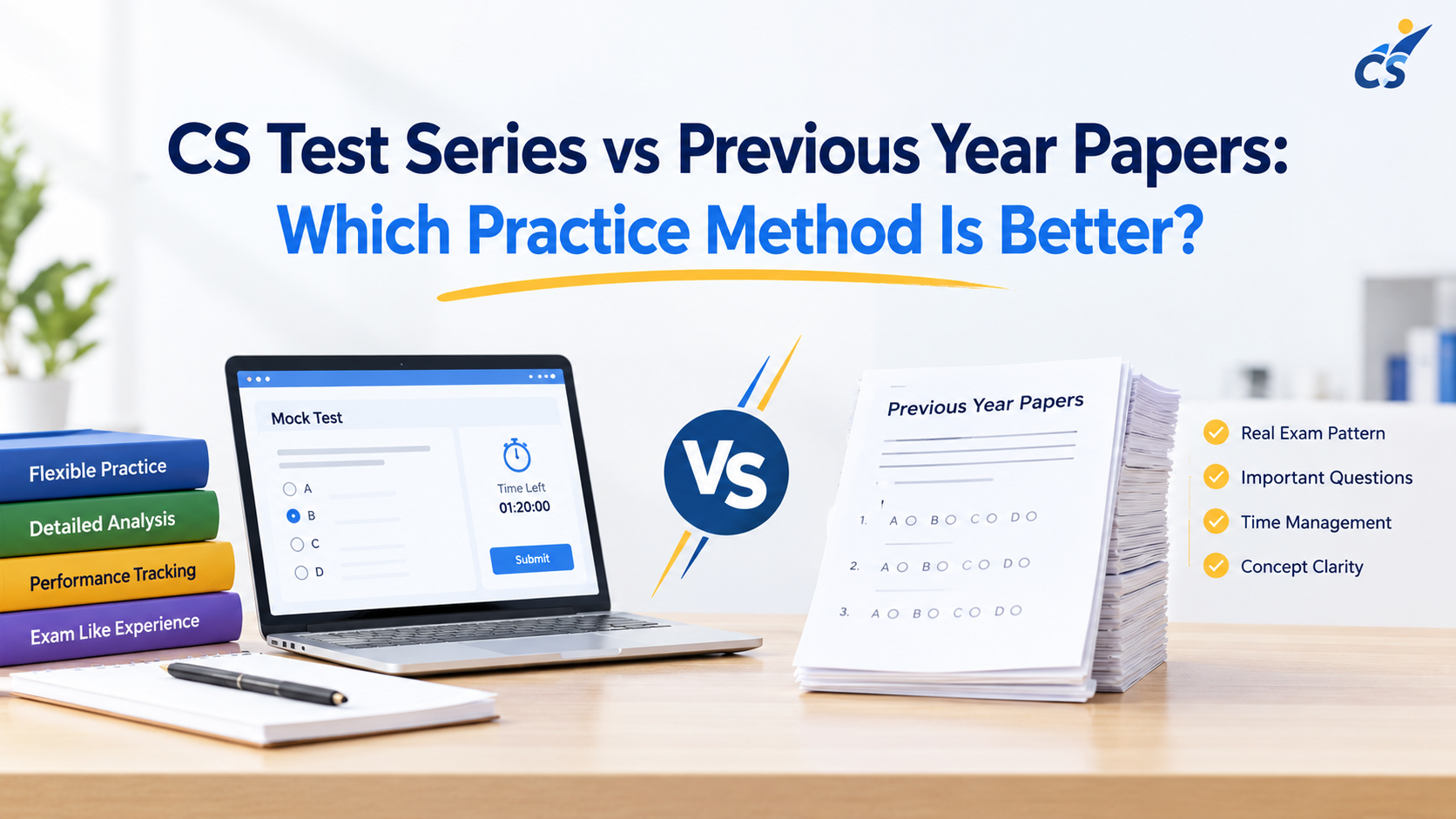
Preparing for a Company Secretary (CS) examination requires more than reading modules and remembering provisions. Students also need to understand how questions are framed, practise writing answers within a fixed time, and learn how to handle a paper when a question looks unfamiliar. Two useful tools for this purpose are a CS test series and previous year question papers. Both support exam preparation, but they serve different purposes.
Previous year papers help you understand the style and scope of questions asked in earlier examinations. A CS test series gives you a structured opportunity to practise, assess your performance, and improve before the actual exam. Instead of treating them as competing choices, understand when each method is most useful and how to combine them into one practical study routine.
What Is a CS Test Series?
A CS test series is a planned set of practice examinations designed to help students assess their preparation before the actual ICSI examination. Depending on the provider, tests may be chapter-wise, subject-wise, module-wise, or full-length papers. A well-designed series follows the relevant syllabus and exam format and gives students regular opportunities to practise writing answers under timed conditions.
The purpose is not simply to see how many marks you can score. It is to identify the reasons behind your score. You may know a concept but fail to explain it clearly, spend too long on one question, miss a key provision, or leave an answer incomplete. Reviewing these patterns after each test turns practice into an improvement process.
With CS Exams Test Series, students can approach practice in an organised way: attempt a test, review answers against the expected requirements, record mistakes, and revisit weak topics. The value comes from using feedback consistently rather than attempting many tests without reviewing them.
What Are Previous Year Papers?
Previous year papers are question papers from earlier CS examinations. They help students become familiar with the way the Institute of Company Secretaries of India (ICSI) frames questions, combines concepts, and tests application of the syllabus. Used alongside the current study material, they can also help you recognise areas that deserve careful revision.
Solving a past paper under exam-like conditions is more useful than only reading its questions and answers. A timed attempt shows whether you can recall concepts, structure your response, and complete the paper within the available time. Afterwards, compare your answers with reliable suggested answers or study resources, where available, and note gaps in your understanding.
A previous paper is a record of an earlier examination, not a promise of what will appear next. Syllabus changes, amendments, and changes in emphasis mean that you should check the applicability of each question before using it for the current attempt.
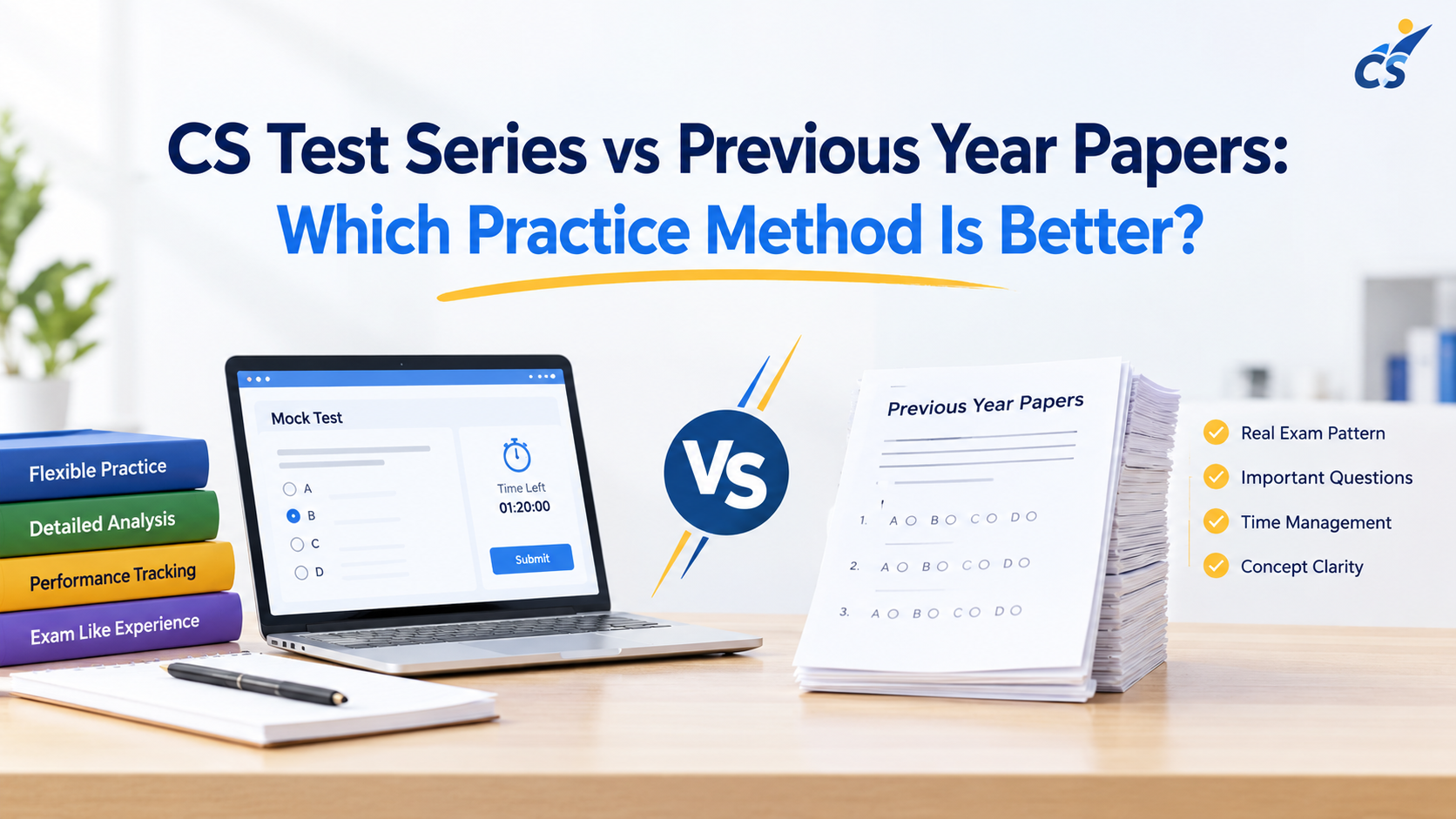
CS Test Series vs Previous Year Papers: Key Differences
The methods overlap because both involve answering questions, but their strengths are different.
| Factor | CS Test Series | Previous Year Papers |
|---|---|---|
| Main purpose | Build regular practice and assessment. | Understand past question patterns and exam style. |
| Coverage | May include chapter-wise, subject-wise, and full-length tests. | Reflects questions asked in specific past examinations. |
| Feedback | May offer checking, model answers, marks, or analysis. | Usually requires self-evaluation against reliable guidance. |
| Time management | Supports repeated practice with planned time limits. | Useful for realistic full-paper simulations. |
| Progress tracking | A sequence of tests can show improvement. | Progress must be recorded separately. |
| Best stage | Useful throughout preparation with the test type adjusted. | Especially useful after basic coverage and during revision. |
| Main caution | Quality and syllabus alignment vary by provider. | Past questions may not reflect current amendments or future papers. |
Previous year papers provide historical exam evidence, while a test series can provide a repeatable system for practice and feedback. Neither should replace studying the current syllabus and official materials.
Benefits of a CS Test Series
1. Creates a consistent practice routine
Students sometimes postpone answer writing until the syllabus is nearly complete, leaving little time to improve presentation and speed. A planned test schedule creates smaller checkpoints throughout preparation. Topic-wise tests can follow a chapter, while subject-wise and full-length tests can be introduced as coverage improves.
2. Highlights the gap between knowing and writing
Reading a provision and explaining it accurately in an exam answer are different skills. A test can reveal whether you missed a legal element, skipped a step in a practical answer, or wrote an explanation that does not address the question. These mistakes are easier to fix when identified early.
3. Builds time-management skills
Timed practice helps you estimate how much time different questions require. It also teaches you to move on when a question is taking too long and return to it later if appropriate. Repeated practice can reduce the risk of leaving marks unearned because the final questions were never attempted.
4. Supports measurable improvement
Record marks, unfinished questions, recurring errors, and topics needing revision. A lower score is not useful by itself; the useful part is understanding what caused it and what you will change before the next test.
5. Improves answer presentation
Structured answers, relevant headings, clear workings where required, and direct responses make your knowledge easier to evaluate. Practice helps you develop an exam-appropriate presentation style rather than relying on long, unstructured paragraphs.
Benefits of Previous Year Papers
1. Familiarity with actual exam style
Past papers show the wording, command terms, and level of detail used in earlier examinations. They can help you distinguish between questions that ask you to explain, discuss, calculate, analyse, or apply a provision. This familiarity can make the actual paper feel less unfamiliar.
2. Practice with real exam questions
A previous year paper contains questions that were actually asked. Attempting it gives you a concrete way to assess how well you can apply your preparation to an established exam format.
3. Helps identify revision priorities
Reviewing several papers may reveal concepts or formats that have appeared more than once. Use this information to check your understanding, but do not assume that a repeated topic must appear again or that topics absent from recent papers can be ignored.
4. Makes revision more targeted
Past papers can expose gaps that are not obvious from reading alone. If a question causes difficulty, return to the relevant chapter, clarify the concept, and try a fresh question on the same skill. This is more productive than memorising one answer.
5. Supports independent preparation
Students can attempt available papers at their own pace. To make self-practice effective, set a time limit, avoid checking notes during the attempt, and evaluate the answer honestly afterwards.
Limitations of Both Practice Methods
Neither method guarantees a good result without proper study and review. A test series may be less useful if its questions are poorly aligned with the current syllabus, evaluation is unclear, or the student focuses only on the score. Before choosing one, check coverage, format, model-answer quality, feedback, and relevance to your CS level and attempt.
Previous year papers also have limits. They cannot predict the exact next paper, and older questions may involve provisions or topics that have changed. Some students memorise past answers word for word instead of learning the underlying concepts. That approach can fail when the same idea is tested in a new situation.
There is another common problem: attempting a paper and moving on without analysing mistakes. Whether the paper comes from a test series or an earlier examination, practice has limited value if you never revisit the weak areas it reveals.
Which Method Should You Choose at Each Stage?
Your best choice depends on syllabus coverage and what you need to improve. A student who has just started studying may benefit more from short topic tests than from a full previous year paper. A student near the exam may need full-length timed practice and a detailed review of past papers.
| Preparation stage | Recommended focus | Why it helps |
|---|---|---|
| Early learning | Chapter-wise questions and short tests | Checks understanding without overwhelming you. |
| After a subject | Subject tests and selected past questions | Connects chapter knowledge with exam-style application. |
| First revision | Previous year papers and mixed-topic tests | Reveals gaps across the syllabus. |
| Final revision | Full-length timed papers and targeted correction | Builds stamina, timing, and confidence. |
If time is limited, do not attempt every available paper without review. Choose a manageable number of high-quality papers, complete them under realistic conditions, and reserve time to correct mistakes. One fully reviewed paper can teach you more than several papers attempted casually.
How to Use Both Methods Together
The most effective strategy is usually to combine both methods. Use previous year papers to understand the established exam style, and use a CS test series to practise regularly, assess progress, and work on specific weaknesses.
Step 1: Confirm the current syllabus
Start with the latest applicable syllabus, study material, and amendments for your examination session. Check whether each past-paper question is still relevant before including it in your practice plan.
Step 2: Practise topic-wise after learning
After finishing a topic, answer a small set of relevant questions. A chapter test or selected previous question can show whether you can recall the concept without looking at notes. Mark unclear questions and revise the relevant material.
Step 3: Attempt a past paper under exam conditions
Once you have covered a substantial part of the syllabus, choose an appropriate previous year paper. Set a timer, follow the paper instructions, and avoid using notes. Treat the attempt as a diagnostic exercise rather than a judgement of your final ability.
Step 4: Use test feedback to address weak areas
Use a subject-wise or full-length test to practise the areas that need improvement. If you lose marks because answers are incomplete, practise answer structure. If you run out of time, work on pacing and question selection. If your knowledge is weak, return to the study material before taking another test.
Step 5: Maintain an error log
After every attempt, record the topic, type of mistake, reason, and corrective action. Useful categories include conceptual error, missing provision, incorrect application, poor presentation, calculation or working error, time pressure, and incomplete answer. Review this log each week and retest the most frequent problems.
CS Exams Test Series can form part of this routine by providing planned opportunities to practise and evaluate your preparation. Choose a series that matches your level and current syllabus, and make review as important as the test itself.
Common Practice Mistakes to Avoid
- Memorising predicted questions: Use past papers to understand question styles, not to guess the entire next paper.
- Ignoring amendments: Confirm that notes and answers reflect updates applicable to your attempt.
- Checking answers too early: Finish the timed attempt before consulting notes or suggested answers.
- Tracking marks only: Record why marks were lost and what you will do differently.
- Taking too many tests: Balance testing with learning, revision, and correction.
- Using one question source only: Mix reliable past papers with well-aligned practice questions.
A Practical Weekly Practice Plan
Use this sample as a flexible framework, not a fixed timetable. Adjust it according to your CS level, subject load, commitments, and time remaining before the examination.
| Day | Practice activity | Review task |
|---|---|---|
| Day 1 | Revise one topic and answer topic-wise questions. | List unclear concepts and revisit the material. |
| Day 2 | Attempt a short test on the same topic. | Check accuracy, structure, and time taken. |
| Day 3 | Practise selected questions from a past paper. | Check relevance to the current syllabus. |
| Day 4 | Revise a second topic and solve mixed questions. | Update the error log. |
| Day 5 | Attempt a subject test or timed section. | Identify repeated errors and weak areas. |
| Day 6 | Complete a longer timed practice session. | Review answers and plan corrective revision. |
| Day 7 | Revise mistakes and difficult concepts. | Set priorities for the next week. |
At the end of each week, ask three questions: Which topics can I now answer confidently? Which mistakes occurred more than once? What specific action will I take next week? Your answers will make the next practice cycle more focused.
Final Verdict: Which Practice Method Is Better?
Neither a CS test series nor previous year papers is universally better. Previous year papers are valuable for understanding real exam questions and past patterns. A structured test series is useful for building regular practice, improving timing, and tracking performance. The right balance depends on your preparation stage and the weaknesses you need to address.
For most students, combining both methods is the more complete approach: study the current syllabus, practise topic-wise, solve relevant previous year papers, attempt timed tests, and review every mistake. With a consistent routine and suitable resources such as CS Exams Test Series, practice becomes a way to improve exam technique—not just a way to count completed papers.