If you are preparing for the CS Executive or CS Professional examination, you have probably heard one piece of advice again and again:
“Solve as many mock tests as possible.”
But here is the real question — which CS test series should you actually choose?
There are plenty of options available today. Some offer chapter-wise tests, some focus on full-length mocks, some provide evaluated answer sheets, while others highlight ranker guidance, performance reports or exam-oriented questions.
And honestly, this can make the decision confusing.
A student preparing for the CS examination does not simply need another question paper. You need a test series that helps you understand how to write an answer, how much to write, how to manage three hours, where you are losing marks, and whether your preparation is actually exam-ready.
This is especially important because CS examinations are not only about remembering provisions and concepts. Your ability to present answers clearly, apply concepts correctly, manage time and attempt the paper strategically can make a major difference.
The Institute of Company Secretaries of India (ICSI) conducts the CS Executive and Professional examinations, and students should always ensure that their practice material reflects the syllabus, examination pattern and applicable updates for their particular session.
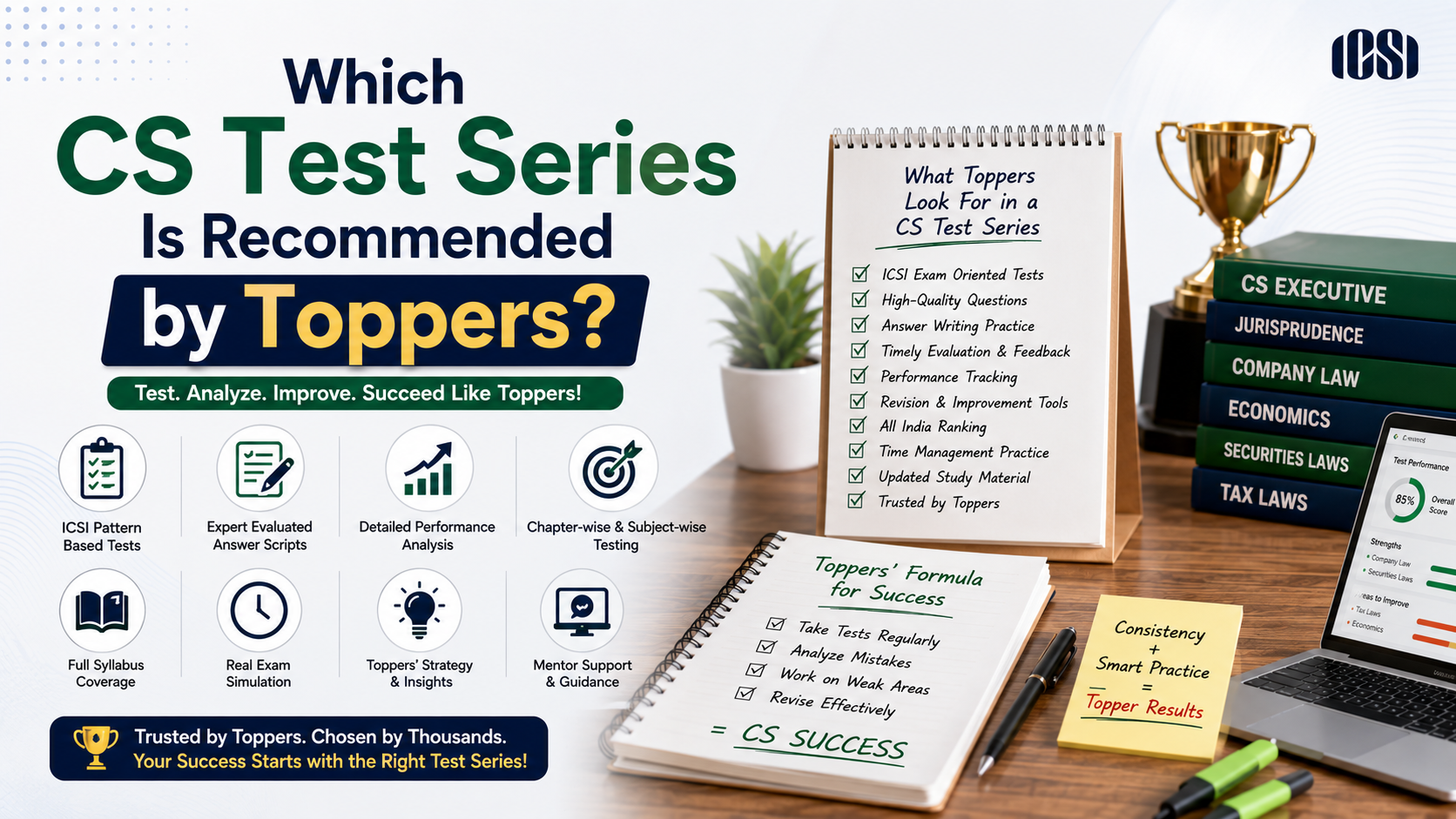
So, which CS test series is recommended by toppers?
The better way to answer this question is:
Toppers generally do not choose a test series simply because it is popular. They choose one that improves their actual exam performance.
What Makes a CS Test Series Worth Choosing?
Before looking at any particular test series, understand one thing:
A test series is useful only when it helps you improve.
You can attempt 20 tests and still make the same mistakes in every paper. Or you can attempt fewer but well-designed tests, analyse your mistakes properly and gradually improve your score.
That is why serious CS aspirants should evaluate a test series on the following factors:
|
Factor |
Why It Matters |
|
ICSI-oriented paper pattern |
Makes practice closer to the actual examination |
|
Chapter-wise tests |
Helps identify weak topics early |
|
Full-length mocks |
Builds examination stamina |
|
Time-bound practice |
Improves speed and time management |
|
Answer-sheet evaluation |
Shows where marks are being lost |
|
Suggested answers |
Helps improve answer structure |
|
Current amendments |
Keeps preparation relevant |
|
Performance analysis |
Tracks improvement over time |
|
Exam-oriented questions |
Helps practise application |
|
Feedback |
Tells you what to improve next |
These are the areas where a good CS Test Series can become much more than a collection of mock papers.
Do Toppers Really Use Test Series?
Yes, serious rank-focused students generally give considerable importance to writing practice and self-evaluation.
However, there is an important distinction.
Toppers don't usually depend on mock tests as a substitute for studying the syllabus.
Instead, they use tests to answer questions such as:
- Can I recall the concept without looking at my notes?
- Can I complete the paper within the available time?
- Am I writing answers according to the requirement of the question?
- Am I spending too much time on one question?
- Are my answers properly structured?
- Am I using headings, provisions, explanations and conclusions appropriately?
- Which subjects or chapters are consistently weak?
- Am I making the same mistakes repeatedly?
This is why test practice should be integrated into your preparation instead of being treated as something you will do only a few days before the examination.
What Kind of CS Test Series Do Toppers Prefer?
There is no single test series officially declared by ICSI as “the test series recommended by toppers.”
Different students may use different platforms, books, institute material and mock papers.
But if you study the preparation habits of high-performing students, one pattern becomes obvious:
They prefer structured practice over random practice.
A useful CS test series should ideally have multiple layers of testing.
1. Chapter-Wise Tests
These are useful immediately after completing individual chapters.
For example, suppose you have completed a chapter in Company Law.
Instead of simply reading it again, you can write a chapter test.
This immediately tells you whether you actually understood the topic or merely recognised it while reading.
2. Unit-Wise or Topic-Wise Tests
Once multiple chapters have been completed, unit-wise tests help you connect different concepts.
This is particularly useful for subjects where questions can combine multiple provisions or concepts.
3. Full-Syllabus Tests
Full-length tests are essential because the actual examination is not divided into comfortable study sessions.
You have to sit down, read the entire paper, decide your priorities and write continuously.
That experience cannot be completely replicated through casual practice.
4. Exam Simulation
A serious mock should feel like an examination.
Keep your phone away.
Set a timer.
Sit at a desk.
Use the permitted writing materials.
Follow the actual time limit.
Then evaluate your performance honestly.
That is when a mock test starts doing its real job.
CS Executive Test Series: What Should You Look For?
The CS Executive stage requires a combination of conceptual understanding, legal knowledge, practical application and answer-writing skills.
ICSI's current examination information and programme updates should always be checked for the relevant session before finalising your preparation strategy.
For CS Executive students, a good test series should ideally include:
- Subject-wise tests
- Chapter-wise practice
- Full-syllabus mocks
- Application-based questions
- Relevant amendments
- Time-bound papers
- Suggested answers
- Detailed evaluation
- Answer-writing feedback
- Performance tracking
The goal should not be simply to “finish tests.”
The goal should be:
Test → Analyse → Correct → Retest → Improve.
CS Professional Test Series: What Changes?
At the CS Professional level, simply solving a large number of questions is not necessarily the best strategy.
The quality of your practice becomes increasingly important.
Professional-level preparation should focus on:
- Advanced conceptual application
- Case-based questions
- Professional answer writing
- Amendments
- Interpretation
- Practical application
- Presentation
- Time management
- Full-length examination simulation
For example, if you are preparing a topic involving a legal provision, merely memorising the provision is not enough.
You should also practise how to apply that provision to a practical situation.
This is one of the reasons why an exam-oriented CS Professional Test Series can be valuable during the final stages of preparation.
Why Answer-Sheet Evaluation Matters So Much
This is one area where students often underestimate the value of a test series.
Imagine you have studied for 8–10 hours and feel confident about a particular subject.
You write a mock test.
Your score comes out lower than expected.
At first, you may think:
“The questions were difficult.”
But after proper evaluation, you may discover something else.
Perhaps:
- Your answers were too lengthy.
- You didn't highlight important points.
- You missed provisions.
- You didn't provide proper conclusions.
- You spent too much time on the first few questions.
- Your handwriting became difficult to read toward the end.
- You knew the answer but failed to address the exact requirement.
- You left questions incomplete because of poor time management.
This is the kind of feedback that reading a textbook cannot provide.
A test series with proper evaluation can turn these invisible weaknesses into visible problems.
And once a problem becomes visible, you can work on it.
Suggested Answers: Don't Just Check Your Marks
Many students make this mistake.
They receive their evaluated answer sheet, look at the score and immediately move on.
Don't do that.
Your evaluated copy should be treated like a mini audit of your preparation.
Compare your answer with the suggested answer and ask:
Did I understand the question correctly?
Sometimes students know the topic but answer a different question.
Did I include the important legal provisions?
For theory-heavy subjects, missing key provisions can affect the quality of an answer.
Was my answer properly structured?
A well-presented answer is easier to evaluate.
Did I explain the application?
Don't stop after writing a provision if the question requires application.
Did I give a conclusion?
Where appropriate, a clear conclusion can make your answer more complete.
The Toppers' Approach: Quality Over Quantity
One of the biggest myths surrounding mock tests is:
“The more tests you solve, the better your rank will be.”
Not necessarily.
Suppose Student A solves 25 tests but never analyses mistakes.
Student B solves 12 tests and carefully analyses every mistake.
Student B can potentially benefit more from those 12 tests.
The real equation is:
Practice + Evaluation + Correction = Improvement
Not:
Practice + Practice + Practice = Rank
This is why you should select a test series that provides enough practice while also giving you a way to understand your performance.
How CA Exam Test Series Can Help CS Aspirants
CA Exam Test Series focuses on an exam-oriented testing approach designed to help students practise before the actual examination.
While choosing any test series, CS aspirants should look for the same fundamentals that make test practice useful:
- Exam-oriented question papers
- Structured testing
- Chapter-wise or topic-wise practice
- Full-length mock examinations
- Time-bound preparation
- Suggested answers
- Performance analysis
- Answer-writing improvement
- Regular self-evaluation
The objective should be simple:
Make the mock test feel less like homework and more like the actual examination.
That mindset can change the way students use a test series.
CS Test Series Comparison: What Should You Choose?
Here is a simple comparison to help you decide.
|
Test Series Type |
Best For |
Main Benefit |
|
Chapter-Wise |
Students completing syllabus |
Finds weak chapters |
|
Unit-Wise |
Mid-stage preparation |
Tests multiple topics together |
|
Full-Syllabus |
Revision stage |
Builds exam confidence |
|
Mock Examination |
Final preparation |
Simulates real exam |
|
Evaluated Test Series |
Serious aspirants |
Identifies presentation mistakes |
|
Self-Test |
Quick revision |
Convenient practice |
Ideally, you should not depend on only one format.
A better strategy is to combine them according to your preparation stage.
When Should You Start a CS Test Series?
You don't have to wait until the entire syllabus is completed.
In fact, starting testing early can be more beneficial.
During First Reading
Use smaller chapter-wise tests.
Your objective is not necessarily to score very high.
Your objective is to discover gaps.
During First Revision
Increase the difficulty and move toward unit-wise tests.
Now you should be able to recall concepts faster.
During Second Revision
Start attempting full-syllabus papers.
Focus heavily on:
- Speed
- Accuracy
- Presentation
- Time management
- Question selection
Before the Examination
Treat mock tests like actual examinations.
No interruptions.
No notes.
No checking answers in between.
Just you, the question paper and the clock.
How Many CS Mock Tests Should You Attempt?
There is no universal number that guarantees success.
The ideal number depends on:
- Your preparation level
- Number of subjects
- Available time
- Whether you are writing one module or both
- Your previous performance
- Your speed
- Your answer-writing ability
Instead of setting an arbitrary target such as “I must solve 30 tests,” set an improvement target.
For example:
Test 1: 52 marks
Test 2: 58 marks
Test 3: 64 marks
Test 4: 68 marks
This tells you much more than simply counting the number of papers completed.
A Simple 4-Step Strategy to Use Any CS Test Series
You can follow this strategy regardless of which test series you select.
Step 1: Write the Test Seriously
Don't keep the test open beside your notes.
Treat it like the real examination.
Step 2: Get It Evaluated
If evaluation is available, use it.
If not, evaluate it honestly against the suggested answer.
Step 3: Maintain a Mistake Notebook
Write down recurring mistakes.
For example:
|
Mistake |
Frequency |
Solution |
|
Forgot provisions |
3 times |
Revise provision list |
|
Poor conclusion |
2 times |
Practise answer format |
|
Time shortage |
4 times |
Reduce time per question |
|
Missed keywords |
3 times |
Highlight key terms |
|
Lengthy answers |
2 times |
Practise concise writing |
This small notebook can become extremely valuable during the final revision.
Step 4: Retest the Weak Areas
This is the step students skip most often.
If a test tells you that you are weak in a chapter, don't simply note it.
Go back.
Revise.
Then test yourself again.
What Makes a CS Test Series “Topper-Friendly”?
Rather than asking only “Which test series do toppers use?”, ask:
“Does this test series support the habits that toppers follow?”
A topper-friendly test series should encourage:
Consistency
Tests should be scheduled instead of being attempted randomly.
Accountability
Your score should tell you whether you are actually improving.
Analysis
You should understand why you lost marks.
Exam Simulation
You should practise writing under real time pressure.
Feedback
You should know how to improve your answers.
Revision
Tests should become part of your revision strategy.
7 Mistakes Students Make While Choosing a CS Test Series
1. Choosing Only on Price
The cheapest option isn't automatically the best option.
2. Choosing Because a Friend Used It
Your friend's preparation level may be completely different from yours.
3. Looking Only at the Number of Tests
More tests do not automatically mean better preparation.
4. Ignoring Evaluation
If you never learn from your answers, you are wasting a major benefit of test practice.
5. Using Old or Irrelevant Material
Always check whether the material reflects the syllabus and updates applicable to your examination session.
6. Starting Too Late
If you begin testing only a few days before the exam, you have very little time to correct your mistakes.
7. Not Reviewing Performance
Your score is just a number until you understand what caused it.
How to Select the Best CS Test Series for You
Before enrolling in any test series, ask these questions:
- Is it relevant to my current syllabus?
- Does it follow the latest applicable examination pattern?
- Are the questions exam-oriented?
- Does it cover my complete syllabus?
- Are chapter-wise tests available?
- Are full-length mocks available?
- Will my answer sheet be evaluated?
- Will I receive useful feedback?
- Are suggested answers provided?
- Can I track my performance over time?
If the answer to most of these questions is yes, you are probably looking at a serious test series rather than just a collection of practice papers.
Final Verdict: Which CS Test Series Is Recommended by Toppers?
There isn't one officially declared “CS Test Series recommended by toppers.”
And honestly, you should be careful with anyone making an absolute claim like that without evidence.
The smarter approach is to select a test series based on what actually helps high-performing students:
ICSI-oriented preparation + quality questions + regular testing + realistic exam simulation + detailed evaluation + answer-writing improvement + performance analysis.
For students looking for an exam-focused option, CA Exam Test Series can be considered as part of their CS preparation strategy, especially when the goal is to practise under exam-like conditions and identify weaknesses before the actual examination.
But remember one thing:
A test series cannot replace studying.
It can, however, show you whether your studying is actually working.
You may know every provision in the book, but the real examination asks a different question:
Can you reproduce and apply that knowledge accurately, clearly and within the given time?
That is exactly why toppers take mock tests seriously.
So don't choose a CS test series simply because someone calls it “the best.”
Choose one that helps you become better with every test you write.
And if every mock makes your next mock better, you are using the test series the right way.