CA vs CS: Which Is Better After 12th Commerce? A Simple 2026 Guide
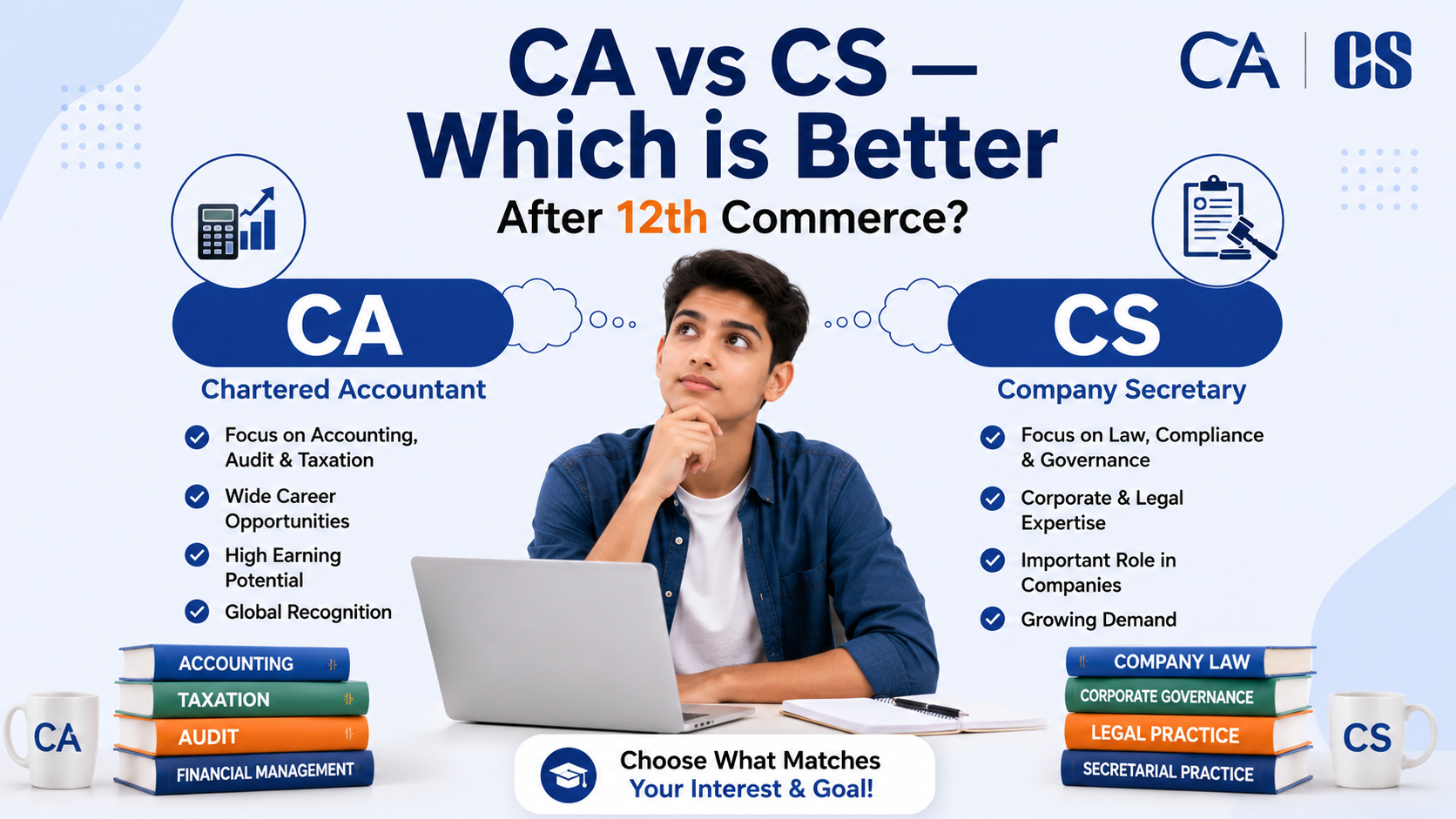
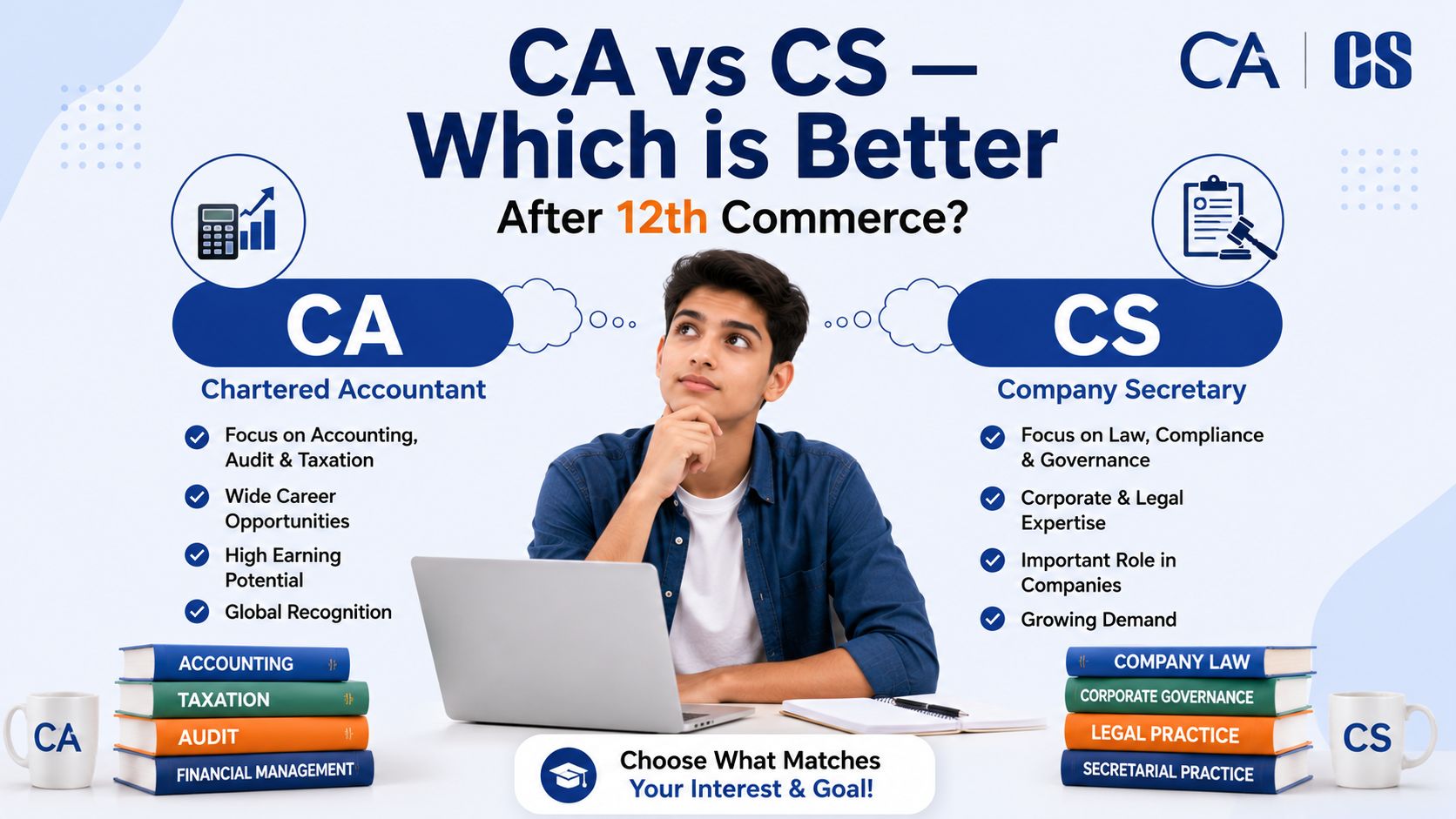
If you have just finished 12th commerce, you have probably asked yourself one big question: CA vs CS — which is better? The honest answer is that neither course is better for everyone. CA (Chartered Accountancy) suits students who love numbers, finance, and audit and want the highest earning potential. CS (Company Secretary) suits students who enjoy company law, governance, and compliance and prefer a more focused, stable career. This simple guide compares CA and CS on course structure, difficulty, salary, scope, and work-life balance, so you can confidently choose the right path after 12th commerce.
CA vs CS: The Quick Answer for 12th Commerce Students
In one line: choose CA if you want a broader, higher-paying finance career and are ready for a tougher, longer journey. Choose CS if you enjoy law and corporate compliance and want a shorter, more predictable path. Both are respected professional qualifications regulated by the Government of India, and both start right after 12th commerce. Your interest and mindset matter more than the label — a course you enjoy is a course you are far more likely to complete.
What Is CA (Chartered Accountancy)?
CA is conducted by the ICAI (Institute of Chartered Accountants of India). It trains you to become an expert in accounting, auditing, taxation, and financial advisory. A Chartered Accountant can conduct statutory audits, handle income tax and GST, advise businesses on finance, and even sign audit reports — something only a CA can do. The CA course has three levels — Foundation, Intermediate, and Final — along with a mandatory articleship (practical training) under a practising CA. CA is widely seen as the gold standard of commerce and is the most math-heavy and analytical of the professional courses. The CA qualification is also respected internationally, which can open doors to global finance roles for those who want to work with multinational firms.
What Is CS (Company Secretary)?
CS is conducted by the ICSI (Institute of Company Secretaries of India). While CA focuses on the financial side of business, CS focuses on the legal and governance side. A Company Secretary is an expert in company law, SEBI regulations, Companies Act compliance, secretarial practice, and board governance. In fact, a CS is recognised as Key Managerial Personnel under the Companies Act, and every listed company must appoint a qualified CS. The CS course has three stages — CSEET, CS Executive, and CS Professional — followed by mandatory practical training. CS is more theory- and law-oriented and less number-heavy than CA. With SEBI norms and corporate compliance rules becoming stricter every year, the demand for qualified Company Secretaries has been rising steadily, making it a future-proof profession.
CA vs CS: Course Structure and Duration
Here is how the two courses are structured after 12th commerce:
- CA path: CA Foundation (after 12th) → CA Intermediate → mandatory articleship of about two years under ICAI's current scheme → CA Final. Total time is roughly 4.5 to 5 years if cleared without delays.
- CS path: CSEET (after 12th) → CS Executive → CS Professional → around 21 months of practical training. Total time is roughly 3 to 4 years if cleared without delays.
Both allow direct entry for graduates: commerce graduates can skip the entry level and start higher up. Overall, CS is usually shorter because CA's longer articleship and Final level add extra time.
CA vs CS: Difficulty Level
Both are considered among India's toughest professional exams, but CA is generally harder than CS. CA has a vast, analytical syllabus, a demanding articleship, and notably low pass rates — the CA Final pass percentage is often only around 10% to 20%. CS is still challenging, but it is more theory- and law-based, and its pass rates are usually a little higher. If you are strong with numbers and analysis, CA will feel natural. If you are strong at reading, interpreting law, and writing, CS will suit you better.
CA vs CS: Salary and Earning Potential
Salary is often the deciding factor, and here CA has a clear edge. Fresher CA salaries typically range from ₹6–9 LPA, and can reach ₹12 LPA or more at Big 4 firms, with the average around ₹9 LPA. Fresher CS salaries are usually around ₹5–7 LPA on average, rising to ₹15 LPA or more with experience in large listed companies. CAs generally earn more at every stage, especially in leadership roles like CFO or partner. That said, an experienced CS in a big corporate governance role can also earn very well, so the gap narrows with skill and seniority. Remember that your final package depends heavily on your firm, city, skills, and performance — not on the qualification alone.
CA vs CS: Career Scope and Job Roles
Both open strong career doors, but in different directions:
- CA roles: auditor, tax consultant, financial analyst, internal auditor, finance manager, CFO, or independent practice. CAs have the broadest scope across finance, audit, and taxation.
- CS roles: company secretary, compliance officer, legal and governance advisor, or secretarial roles in listed companies, law firms, and PSUs. Every listed company legally needs a CS, which creates steady, protected demand.
In short, CA offers wider opportunities, while CS offers a focused, in-demand niche with less competition and strong statutory backing.
CA vs CS: Work-Life Balance
Work-life balance often tilts in favour of CS. CAs frequently face intense pressure during audit and tax seasons, with long hours and tight deadlines. CS professionals usually enjoy more predictable schedules built around defined compliance cycles and board calendars. If a steady routine matters to you, CS may feel more comfortable; if you are comfortable with high-pressure, high-reward work, CA will suit you.
Which Is Better After 12th Commerce — CA or CS?
There is no universal winner. The right choice depends on you. Choose CA if you:
- enjoy numbers, finance, audit, and taxation;
- want the highest salary and the widest career options;
- are ready for a longer, tougher course with lower pass rates.
- Choose CS if you:
- enjoy company law, governance, and compliance over number-crunching;
- want a shorter, more focused course with better work-life balance;
- like the idea of a stable, in-demand role in listed companies.
Still unsure? Talk to a mentor or a working CA and CS, and honestly assess your own strengths in numbers versus law. Your aptitude and interest should lead the decision — not peer pressure or salary alone.
Can You Pursue CA and CS Together?
Yes, you can. Many ambitious students pursue CA and CS together, because the two courses share subjects like law, accounting, and taxation. Doing both can make you a rare finance-plus-governance professional and boost your career options. However, it demands excellent time management and dedication, since both are heavy courses. A common strategy is to start with one course, build momentum, and add the second once you are comfortable. If you are unsure, it is perfectly fine to begin with a single course and decide later. There is no rush — even completing one qualification well will place you ahead of most commerce graduates, and you can always add the second later in your career.
Why CS Exams (csexams.in) Can Help You Prepare
Whichever path you choose, one habit decides your result more than anything else — regular test practice with expert feedback. If you lean towards CS, CS Exams (csexams.in) is one of India's most focused test platforms, built only for serious CS students. It offers precision testing, mentor feedback, and performance tracking for CSEET, CS Executive, and CS Professional. Here is why it helps:
- Real ICSI-level difficulty: papers match the actual exam standard, with 50–60% similar questions reported in the real ICSI exam.
- Over 90% positive results: a strong track record in the last CS attempt.
- Fast expert evaluation: answer sheets checked by Qualified CS professionals, with feedback often within 24 hours to 1–2 days.
- Toppers' sheets and doubt solving: compare your answers with top scorers and get your doubts cleared by experts.
And if you decide on CA instead, the same test-and-feedback approach applies — you can use a dedicated CA test series like caexams.in for ICAI-pattern papers and step-wise evaluated answer sheets. Either way, consistent evaluated practice is what turns preparation into results.
Final Verdict: CA or CS After 12th Commerce?
Both CA and CS are excellent careers after 12th commerce. CA gives you the highest salary, the widest scope, and the greatest prestige, but demands more time and effort. CS gives you a focused, in-demand, better-balanced career in corporate law and governance in less time. Do not choose based only on salary or difficulty — choose the field that genuinely interests you, because sustained effort is only possible when you enjoy the work. Pick your path, prepare consistently, and practise with regular tests, and you can succeed in either CA or CS.