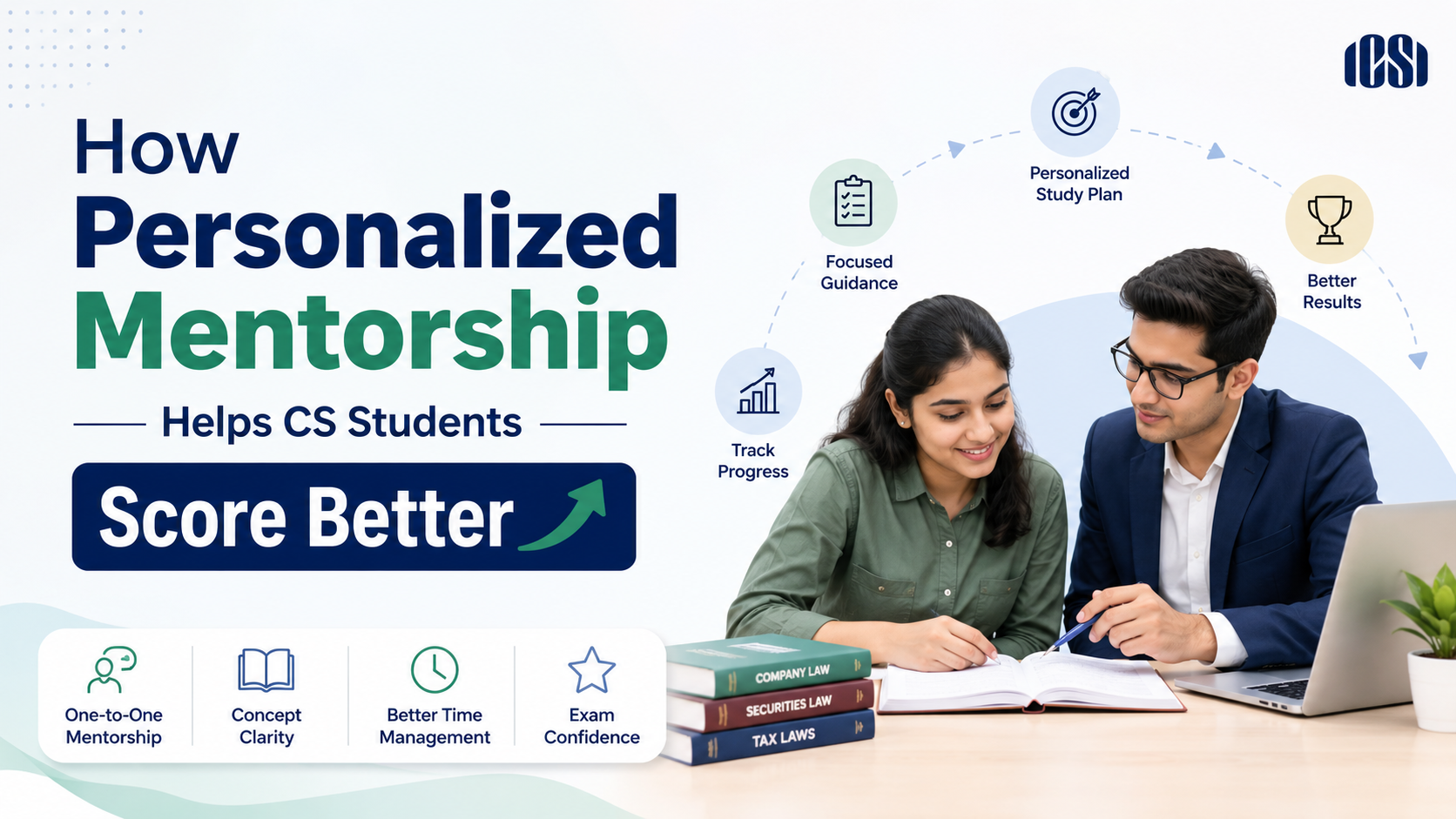
Preparing for the Company Secretary (CS) examination is not just about completing the syllabus. Every year, thousands of students dedicate months to studying, yet many struggle to achieve the results they expect. While hard work is essential, the right direction often makes the biggest difference. This is where personalized mentorship becomes a game changer.
Unlike traditional coaching, personalized mentorship focuses on the individual student. Instead of following the same study plan as everyone else, students receive guidance based on their strengths, weaknesses, learning pace, and exam goals. Whether someone is preparing for the CS Foundation, Executive, or Professional level, having an experienced mentor can significantly improve preparation quality and boost confidence.
In today's competitive environment, where every mark matters, students need more than books and lectures. They need someone who can identify mistakes early, create realistic study plans, monitor progress, and provide continuous motivation throughout the preparation journey.
This article explains how personalized mentorship helps CS students score better, why it is becoming increasingly important, and how the right mentor can transform exam preparation into a more focused and successful experience.
Why CS Students Often Struggle Despite Studying Hard
One of the biggest misconceptions among students is believing that studying longer automatically leads to better marks. In reality, many students spend several hours every day studying but still fail to perform well in examinations.
The problem usually lies in the preparation strategy rather than the effort itself.
Some common challenges include:
- Studying without a structured timetable
- Poor understanding of ICSI examination expectations
- Lack of answer-writing practice
- Weak revision planning
- Ignoring conceptual clarity
- Difficulty managing multiple subjects
- Exam anxiety and low confidence
- No expert available to solve doubts quickly
Without proper guidance, students often continue repeating the same mistakes for months. Personalized mentorship addresses these issues before they become major obstacles.
Traditional Study vs Personalized Mentorship
| Traditional Preparation | Personalized Mentorship |
| Same study plan for everyone | Customized study plan based on individual performance |
| Limited personal attention | One-to-one academic guidance |
| Generic doubt sessions | Focused doubt-solving sessions |
| Fixed pace for all students | Flexible learning according to student progress |
| Minimal performance tracking | Regular assessment and improvement reports |
| Students identify mistakes themselves | Mentor identifies mistakes immediately |
| Motivation depends on the student | Continuous encouragement and accountability |
This comparison clearly shows why many modern CS aspirants prefer mentorship programs alongside their regular studies.
What Is Personalized Mentorship for CS Students?
Personalized mentorship is an individualized learning approach where an experienced academic mentor guides students throughout their preparation journey instead of simply teaching subjects.
A mentor performs several important roles during preparation.
They help students:
- Understand the ICSI examination pattern
- Build an effective study schedule
- Prioritize important chapters
- Track weekly progress
- Improve answer-writing skills
- Analyse mock test performance
- Eliminate recurring mistakes
- Stay motivated during long preparation periods
- Manage exam stress effectively
Instead of giving generic advice, mentors make decisions based on the student's actual performance.
For example, if a student consistently loses marks in Company Law because of presentation rather than conceptual understanding, the mentor focuses specifically on answer presentation instead of asking the student to reread the entire textbook.
This personalized approach saves valuable time while producing better academic results.
How Personalized Mentorship Improves Academic Performance
Students often believe that scoring higher requires studying harder. In reality, scoring higher usually requires studying smarter.
Personalized mentorship improves academic performance in several measurable ways.
1. Creates a Study Plan That Matches Your Learning Style
Every student learns differently.
Some understand concepts quickly but struggle with revision.
Others remember information well but have difficulty writing answers under exam pressure.
Some students can dedicate eight hours daily, while working professionals may only have three hours available.
A single study plan cannot work equally well for everyone.
An experienced mentor develops a personalized roadmap after evaluating factors such as:
- Current preparation level
- Available study hours
- Previous examination attempts
- Strong subjects
- Weak subjects
- Learning speed
- Target examination
Because the plan is realistic and achievable, students remain consistent throughout the preparation period instead of feeling overwhelmed.
2. Helps Students Focus on High-Impact Topics
Many CS students spend excessive time studying chapters that contribute relatively fewer marks while ignoring areas that frequently appear in examinations.
Mentors understand examination trends and help students prioritize topics more effectively.
Instead of asking students to study everything with equal intensity, mentors guide them toward:
- Frequently tested concepts
- High-weightage chapters
- Practical application-based questions
- Common examiner expectations
- Important amendments
- Frequently repeated mistakes
This strategic preparation significantly improves scoring potential without increasing study hours.
3. Provides Continuous Accountability
One of the biggest challenges in self-study is maintaining consistency.
Most students begin preparation with enthusiasm but gradually lose momentum.
Missed study sessions become missed weeks, and eventually, the syllabus starts piling up.
Personalized mentorship solves this problem through regular accountability.
Knowing that someone will review progress every week encourages students to stay disciplined, complete assignments on time, and remain committed to their study goals.
This consistent progress often becomes the biggest difference between average performers and top scorers.
Why Students Performing Similar Efforts Get Different Results
An interesting observation among CS aspirants is that two students may study for almost the same number of hours every day, yet their examination scores differ significantly.
The reason usually isn't intelligence or dedication—it's preparation quality.
Consider the comparison below.
| Student Without Mentorship | Student With Personalized Mentorship |
| Studies randomly | Studies according to a structured roadmap |
| Revises only before exams | Follows scheduled revision cycles |
| Gives mock tests occasionally | Takes regular mock tests with detailed analysis |
| Unsure about progress | Receives continuous performance feedback |
| Repeats common mistakes | Corrects mistakes immediately |
| Faces exam stress alone | Gets expert guidance and motivation |
This is why mentorship often leads to consistent improvement over time rather than relying on last-minute preparation.
How Personalized Mentorship Strengthens Answer Writing Skills
One of the biggest reasons students lose marks in CS examinations is not because they lack knowledge—it is because they fail to present their answers in the way ICSI expects.
Many students know the concepts well but struggle to:
- Structure answers logically
- Quote legal provisions correctly
- Use appropriate legal terminology
- Manage time during the exam
- Write concise yet complete answers
- Present practical case study solutions
Personalized mentorship bridges this gap by providing continuous answer-writing practice and detailed feedback.
Instead of simply checking whether an answer is right or wrong, mentors evaluate:
- Content quality
- Presentation
- Legal language
- Structure
- Time taken
- Marks likely to be awarded
- Areas requiring improvement
After every evaluation, students receive specific suggestions instead of generic comments like "Improve presentation."
For example, a mentor may advise:
- Start every law answer with the relevant legal provision.
- Mention section numbers wherever applicable.
- Highlight important legal terms.
- Divide answers into proper headings.
- Conclude with a practical interpretation.
Over time, these improvements become habits, leading to consistently better scores.
Regular Mock Test Analysis Makes a Huge Difference
Taking mock tests is important.
Analysing them is even more important.
Many students attempt mock papers, check their scores, and immediately move to the next subject. This approach misses the real purpose of testing.
Personalized mentors conduct detailed performance analysis after every mock examination.
A typical analysis includes:
| Performance Area | Mentor's Focus |
| Accuracy | Identifies conceptual errors |
| Speed | Suggests time-saving techniques |
| Presentation | Improves answer structure |
| Weak Chapters | Plans targeted revision |
| Repeated Mistakes | Creates corrective action plan |
| Confidence Level | Builds exam temperament |
This continuous feedback loop allows students to improve steadily rather than repeating the same mistakes throughout their preparation.
Personalized Feedback Speeds Up Improvement
Generic feedback rarely changes performance.
Specific feedback does.
Imagine receiving comments such as:
"Study harder."
Now compare it with:
"Your concepts are correct, but you're losing marks because your answers lack proper legal language. Practice writing five descriptive answers every day."
The second feedback is actionable.
Personalized mentors provide practical guidance based on actual performance instead of assumptions.
Students know:
- What went wrong
- Why it happened
- How to fix it
- When to revise it
- How improvement will be measured
This targeted learning process dramatically accelerates academic growth.
Better Time Management Throughout Preparation
Most CS aspirants underestimate the amount of planning required to complete the syllabus on time.
Common problems include:
- Spending too much time on favourite subjects
- Ignoring difficult topics
- Delaying revision
- Last-minute preparation
- Missing mock tests
A mentor ensures every phase of preparation receives appropriate attention.
A balanced preparation plan usually includes:
| Preparation Phase | Suggested Focus |
| Initial Learning | Build conceptual clarity |
| Weekly Revision | Strengthen memory retention |
| Monthly Assessment | Measure progress |
| Mock Tests | Improve exam readiness |
| Final Revision | Focus on high-scoring topics |
| Last Week | Quick revision and confidence building |
This structured approach prevents unnecessary stress during the final weeks before the examination.
Mentorship Helps Students Stay Consistent
Consistency is often more valuable than studying for extremely long hours.
Many students start with high motivation but gradually lose focus because:
- The syllabus feels overwhelming.
- Results take months.
- There is no one monitoring progress.
- Self-doubt increases after difficult chapters.
A mentor acts as an accountability partner.
Regular discussions, progress reviews, and achievable weekly goals help students maintain momentum throughout their preparation.
Instead of asking,
"Can I finish the entire syllabus?"
Students begin asking,
"What's my target for this week?"
This shift in mindset leads to better discipline and long-term consistency.
Reduces Exam Stress and Builds Confidence
Stress is natural during professional examinations.
However, unmanaged stress often affects performance more than preparation itself.
Personalized mentorship provides emotional as well as academic support.
Mentors help students:
- Develop realistic expectations
- Handle setbacks positively
- Improve confidence after poor mock test scores
- Avoid unnecessary comparison with others
- Stay focused during revision
- Maintain a healthy study routine
Students who feel mentally prepared usually perform better under examination pressure.
Confidence isn't created overnight.
It develops through continuous preparation, regular feedback, and visible progress.
Personalized Mentorship Helps Different Types of Students
Every CS aspirant has unique challenges.
A personalized mentor adapts strategies according to individual circumstances.
| Student Type | How Mentorship Helps |
| Freshers | Builds a strong preparation foundation |
| Repeaters | Identifies previous mistakes and corrects them |
| Working Professionals | Creates flexible study schedules |
| College Students | Balances academics with CS preparation |
| Distance Learners | Provides structured guidance remotely |
| Average Students | Improves consistency and confidence |
| High Performers | Maximizes scoring potential |
This flexibility makes mentorship valuable regardless of the student's current level.
Common Mistakes That Personalized Mentorship Helps Students Avoid
Many students unknowingly repeat preparation mistakes that reduce their chances of success.
Some of the most common ones include:
- Studying without a proper timetable
- Ignoring answer-writing practice
- Revising only once before exams
- Skipping mock tests
- Memorizing instead of understanding concepts
- Not analysing mistakes
- Depending entirely on self-study
- Losing motivation midway
- Poor time allocation among subjects
- Focusing only on completing the syllabus instead of mastering it
A mentor identifies these issues early and ensures they are corrected before they become habits.
Real-Life Example: How Guidance Changes Results
Consider two students preparing for the CS Executive examination.
Both study approximately six hours daily.
Student A studies independently, follows random YouTube videos, and revises only before the exam.
Student B studies for the same number of hours but works under a mentor who tracks progress, reviews mock tests, and provides weekly feedback.
After three months:
- Student B has completed multiple revision cycles.
- Weak chapters have already been improved.
- Mock test scores have steadily increased.
- Exam confidence is significantly higher.
Although both students invested similar effort, the quality of preparation differs greatly.
This example illustrates why mentorship often produces better academic outcomes.
Why Personalized Mentorship Is Becoming Essential
Professional examinations are becoming increasingly competitive.
Success today depends not only on hard work but also on strategic preparation.
Personalized mentorship combines:
- Expert academic guidance
- Performance analysis
- Customized study planning
- Regular accountability
- Confidence building
- Continuous improvement
Together, these elements create an environment where students can perform to their full potential.
Rather than leaving success to chance, mentorship introduces a structured system that increases the probability of achieving better results.
Conclusion
Scoring well in the Company Secretary examination requires much more than completing textbooks or attending lectures. It requires a clear strategy, continuous improvement, disciplined execution, and the confidence to perform under pressure.
This is exactly where personalized mentorship creates a meaningful difference.
Instead of treating every student the same, mentorship recognizes that each aspirant has unique strengths, challenges, and learning patterns. With customized study plans, regular mock test analysis, expert feedback, and ongoing motivation, students are able to prepare more efficiently and avoid the common mistakes that often affect exam performance.
Whether you are preparing for the CS Foundation, CS Executive, or CS Professional examination, the right mentor can help transform your preparation from uncertain and stressful to structured and result-oriented.
Ultimately, personalized mentorship is not about studying more—it is about studying smarter, staying accountable, and maximizing every opportunity to improve. For students aiming to score better and build a successful career as a Company Secretary, investing in the right guidance can be one of the most valuable decisions in their preparation journey.