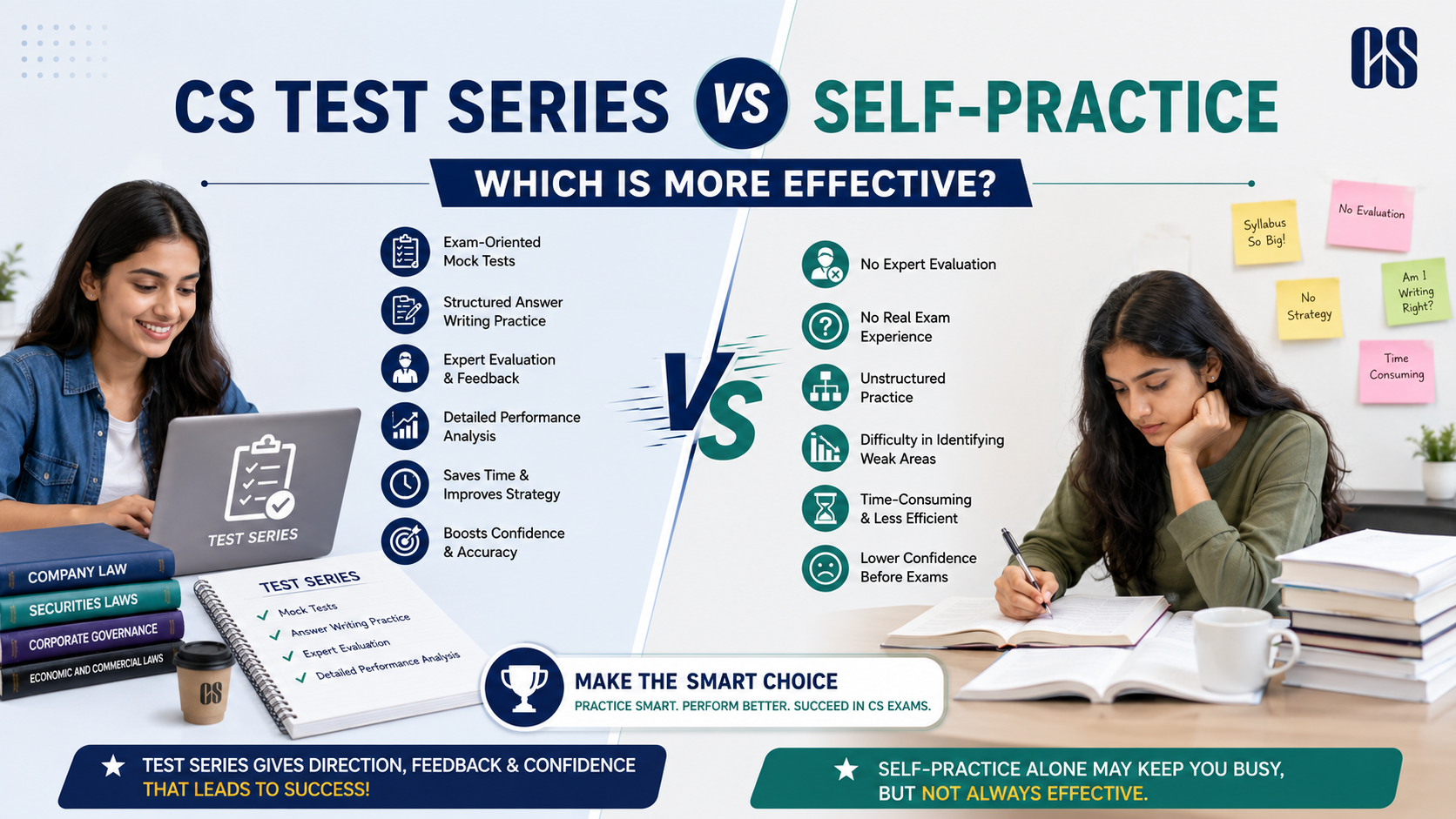
Preparing for a Company Secretary examination is not simply about studying more chapters or spending longer hours with your books. At some point, every CS student faces a more practical question:
Should I continue with self-practice, or should I join a CS Test Series?
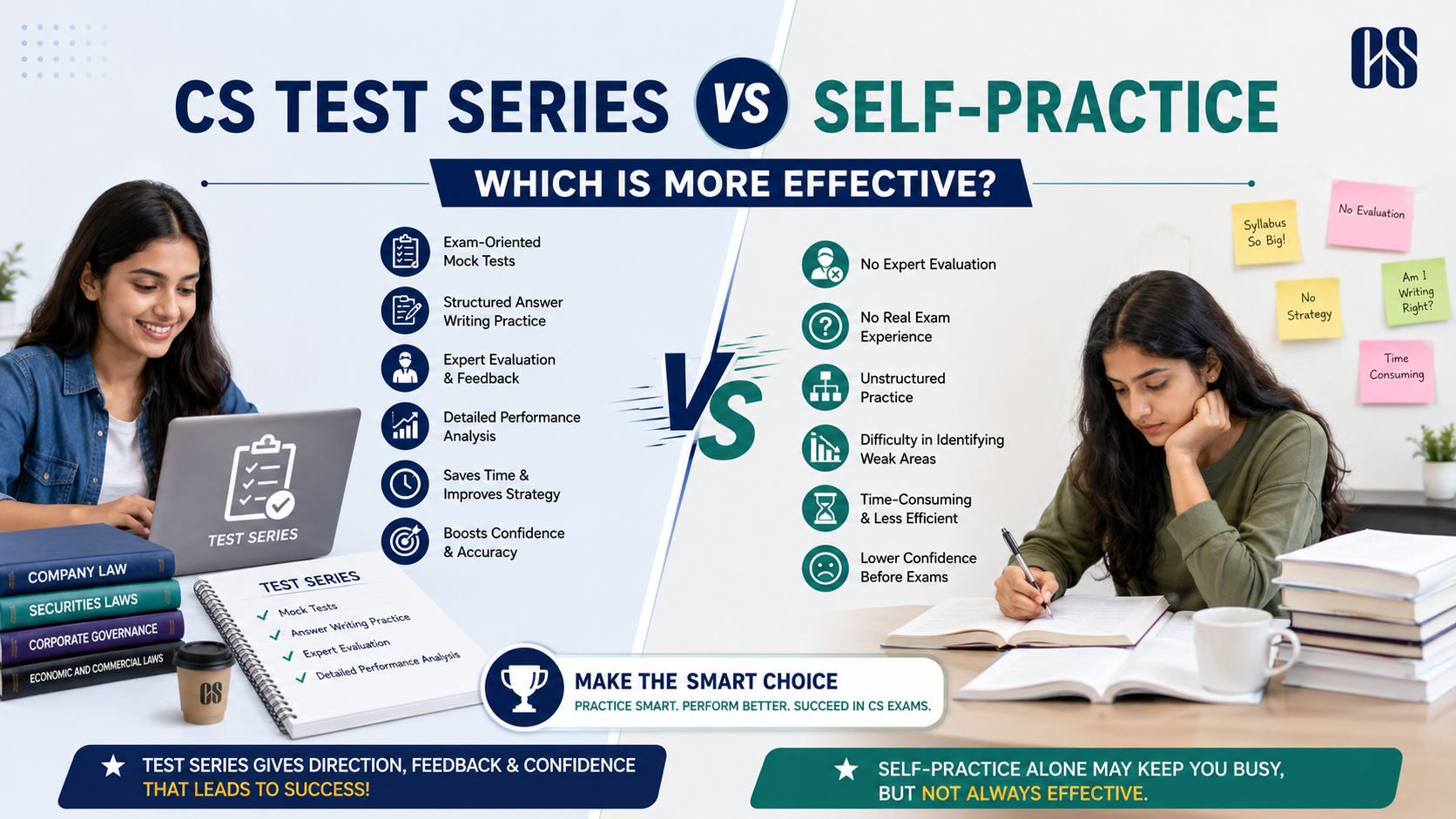
Both methods have an important role in exam preparation. Self-practice helps you understand concepts, revise provisions, remember important points, and solve questions independently. A well-designed CS Test Series, on the other hand, gives you an opportunity to test that preparation under exam-like conditions.
The real difference becomes visible when you sit for the actual examination.
You may know the answer but struggle to present it properly. You may understand Company Law but spend too much time on one question. You may remember a provision but forget how to structure a practical answer. Or you may complete your syllabus but have no clear idea about your actual exam readiness.
This is where testing becomes important.
The Institute of Company Secretaries of India (ICSI) provides official syllabus, examination resources, previous-session question papers and guideline answers, which students can use as important references during preparation.
So, is a CS Test Series better than self-practice?
Not exactly. The most effective approach is to use both—but for different purposes.
Let's understand why.
What Is Self-Practice for CS Exams?
Self-practice means preparing independently using study material, textbooks, revision notes, previous-year papers, question banks, amendments, and other resources.
For example, after completing a chapter on Company Law, you might:
- Revise the chapter
- Read important provisions
- Solve questions from your study material
- Attempt previous-year questions
- Write selected answers in your notebook
- Check your answers against suggested answers
- Revise mistakes
This is extremely useful, particularly during the initial and middle stages of preparation.
Self-practice gives you freedom.
You decide:
- What to study
- When to study
- Which chapter needs more attention
- How many questions to solve
- Which topics to revise
- How much time to spend on a subject
That flexibility is one of its biggest advantages.
However, flexibility can also become a weakness.
When there is no fixed test schedule, no external evaluation and no real pressure to complete a paper within a specific time, students often overestimate their preparation.
A chapter may feel easy when you are reading it.
But writing a complete answer from memory is a completely different experience.
What Is a CS Test Series?
A CS Test Series is a structured examination-practice programme designed to help students simulate the experience of writing their actual CS examination.
Depending on the programme, students may get:
- Chapter-wise tests
- Unit-wise tests
- Full-syllabus mock tests
- Subject-wise tests
- Exam-pattern papers
- Suggested answers
- Answer-sheet evaluation
- Performance analysis
- Answer-writing feedback
- Time-management practice
Several CS test platforms currently offer combinations of chapter-wise, unit-wise and full-syllabus tests, along with evaluated answer sheets and feedback.
The biggest difference is simple:
Self-practice asks, “Can I solve this question?”
A test series asks, “Can I perform in the examination?”
That distinction matters.
CS Test Series vs Self-Practice: The Quick Comparison
|
Factor |
Self-Practice |
CS Test Series |
|
Concept building |
Excellent |
Limited |
|
Revision |
Excellent |
Very Good |
|
Flexibility |
Very High |
Moderate to High |
|
Exam simulation |
Limited |
Excellent |
|
Time management |
Needs self-discipline |
Strongly developed |
|
Answer writing |
Depends on student |
Regularly tested |
|
External evaluation |
Usually unavailable |
Usually available |
|
Identification of mistakes |
Self-dependent |
Structured feedback |
|
Exam pressure practice |
Low |
High |
|
Performance tracking |
Difficult |
Easier |
|
Full-paper practice |
Irregular |
Structured |
|
Accountability |
Low |
Higher |
|
Best use |
Learning & revision |
Testing & improvement |
The table makes one thing clear: these two methods are not really competitors. They solve different problems.
Why Self-Practice Is Still Essential
Before discussing the benefits of a CS Test Series, let's be clear about something:
A test series cannot replace studying.
If your concepts are weak, writing ten mock tests will not magically make you exam-ready.
You first need to understand your subjects.
For CS students, this can involve reading ICSI study material, understanding legal provisions, learning definitions, reviewing amendments, studying practical applications and practising relevant questions.
ICSI's academic portal provides study materials, subject-wise resources, guideline answers and other academic resources that students can incorporate into their preparation.
Self-practice is especially useful in these situations.
1. Building Conceptual Clarity
You need enough time to understand why a provision exists, how it applies and how different concepts connect with each other.
2. Revising Difficult Chapters
Not every chapter requires the same amount of time. Self-study allows you to spend extra hours on difficult topics.
3. Learning at Your Own Speed
Some students understand a topic in one reading. Others need three or four revisions.
Self-practice gives you that flexibility.
4. Solving Previous-Year Questions
Previous-year papers can help you understand how concepts are tested and what kind of answers may be expected.
5. Developing Independent Thinking
Especially in practical and application-based questions, you need to learn how to analyse the situation instead of simply memorising an answer.
So yes—self-practice is the foundation.
But foundation alone does not complete the preparation.
Where Self-Practice Often Falls Short
This is where many CS students make the same mistake.
They study consistently, solve questions regularly and feel confident because they can answer questions while studying.
Then they sit for a three-hour mock or actual examination and discover several problems.
Problem 1: Poor Time Management
You may spend 25 minutes on a question that should have taken 15 minutes.
That difference seems small.
Multiply it across an entire paper and suddenly you have several unanswered marks.
Problem 2: Slow Answer Writing
Knowing an answer and writing it within the required time are different skills.
Problem 3: Lack of Presentation Practice
CS examinations often require structured, professional answers.
Students need to become comfortable with headings, provisions, explanations, applications, conclusions and appropriate presentation.
Problem 4: No Independent Evaluation
When you check your own answer, you already know what you intended to write.
That can make self-evaluation less objective.
Problem 5: False Confidence
This is perhaps the biggest issue.
You may feel:
“I have completed the syllabus, so I am ready.”
But syllabus completion and examination readiness are not the same thing.
Why a CS Test Series Can Make a Difference
A good CS Test Series creates a bridge between studying and performing.
It forces you to stop reading for a few hours and start writing.
That shift is extremely valuable.
1. It Builds Real Exam Discipline
When you sit for a full mock test with a timer running, you cannot pause after every question to check your notes.
You have to think, write and move forward.
That is exactly the habit you need in the actual examination.
2. It Improves Time Management
Suppose your paper has multiple questions and you have three hours.
During your first mock, you might discover that you are spending too much time on long answers.
During the second mock, you consciously improve.
By the fourth or fifth mock, your timing can become much more natural.
This is one of the most practical benefits of repeated testing.
3. It Improves Answer Writing
Answer writing is a skill.
And like any skill, it improves through repetition and feedback.
You learn how to:
- Start an answer
- Mention the relevant provision
- Explain the concept
- Apply it to the situation
- Reach a conclusion
- Use headings effectively
- Avoid unnecessary repetition
- Present information clearly
Some existing CS test programmes specifically provide answer-writing feedback and evaluated copies to help students understand where their presentation can improve.
4. It Reveals Your Weak Areas
Imagine you believe Company Law is your strongest subject.
You attempt a mock test and receive lower marks than expected.
After analysing the paper, you discover:
- You know the provisions but cannot recall them quickly.
- Your practical application is weak.
- Your answers are too lengthy.
- You are losing marks because of poor presentation.
This information is extremely valuable.
Now you know what to fix.
Without testing, you may never discover the problem.
CS Test Series vs Self-Practice: Which One Is Better for Answer Writing?
If the question is specifically about answer-writing improvement, a CS Test Series usually has the advantage.
Why?
Because self-practice can become selective.
You might write answers to questions you already feel comfortable with.
You might also stop after writing half an answer and think:
“That's enough. I understand the concept.”
In a test series, you have to complete the entire paper.
You experience:
Question → Thinking → Writing → Time Pressure → Completion → Evaluation → Feedback → Improvement
That complete cycle is difficult to recreate through casual self-practice.
For CS students, this matters because examination success is not based only on knowing the subject. You also need to communicate that knowledge effectively on paper.
Which Is Better for Time Management?
CS Test Series wins here as well.
Self-practice can help you estimate how long a question takes.
But a full mock test teaches you how to manage the entire paper.
For example:
You spend 20 minutes on Question 1.
Then another 20 minutes on Question 2.
Then you realise the remaining questions need to be completed much faster.
This experience teaches you something that a chapter-wise practice session cannot:
How to manage limited time across an entire examination.
With repeated mock tests, you can experiment with different strategies:
- Which question should you attempt first?
- How much time should be given to a long-answer question?
- When should you move to the next question?
- How much time should be kept for revision?
- How quickly can you write provisions and conclusions?
These decisions become easier with practice.
Which Is Better for Students Preparing for CS Executive and CS Professional?
Both self-study and testing are important at these levels.
The complexity and breadth of the syllabus make structured preparation particularly valuable.
For example, the current CS Executive Programme includes subjects such as Jurisprudence, Interpretation & General Laws; Company Law & Practice; Setting Up of Business, Industrial & Labour Laws; Corporate Accounting & Financial Management; Capital Market & Securities Laws; Economic, Commercial & Intellectual Property Laws; and Tax Laws and Practice.
With multiple subjects and extensive content to revise, students need a system that helps them measure progress rather than simply consume study material.
A structured test series can help you answer questions such as:
- Have I completed enough writing practice?
- Which subject is weakest?
- Am I finishing papers on time?
- Are my answers properly structured?
- Am I losing marks because of presentation?
- Can I maintain consistency throughout a full paper?
These are difficult questions to answer through reading alone.
Is a CS Test Series Useful for CSEET Students?
Yes, although the preparation style can be different.
CSEET students can use practice tests to become familiar with question formats, improve speed and identify topics that require additional revision.
For students moving toward the Executive and Professional levels, developing a regular testing habit early can also make the transition into descriptive and application-based preparation easier.
The key is not simply to take tests for the sake of taking tests.
The goal should be:
Attempt → Analyse → Correct → Reattempt → Improve.
How Many Mock Tests Should You Attempt?
There is no universal magic number.
A student who carefully analyses five mock tests may benefit more than someone who mechanically completes fifteen without reviewing mistakes.
However, a practical approach is to divide tests into three stages.
Stage 1: Chapter or Unit Tests
Use these after completing individual topics or units.
Purpose:
- Check understanding
- Identify weak concepts
- Practise answer writing
- Build confidence
Stage 2: Subject-Level Tests
Once a large portion of a subject is completed, start attempting longer papers.
Purpose:
- Improve retention
- Practise multiple chapters together
- Develop time management
- Identify recurring weaknesses
Stage 3: Full-Syllabus Mock Tests
These should become more important as the examination approaches.
Purpose:
- Simulate the real examination
- Test endurance
- Improve speed
- Practise complete-paper strategy
- Build confidence
The ideal number depends on your preparation level, available time and number of subjects.
Quality of analysis matters more than simply counting tests.
The Best Strategy: Combine Self-Practice With a CS Test Series
If you ask us which method we recommend, the answer is simple:
Don't choose one. Combine both.
Think of your preparation like this:
Self-Practice = Learning
CS Test Series = Testing
Analysis = Improvement
You need all three.
Here is a practical approach.
|
Preparation Phase |
Main Focus |
Recommended Activity |
|
Early Preparation |
Concept building |
Self-study + short practice |
|
Mid Preparation |
Revision + application |
Self-practice + chapter tests |
|
Syllabus Completion |
Performance measurement |
Subject tests + full mocks |
|
Final Revision |
Exam simulation |
Full-syllabus mock tests |
|
Last 10–15 Days |
Speed + confidence |
Mock tests + mistake revision |
This approach prevents one of the biggest preparation mistakes: spending almost all your time studying and too little time testing.
A Simple Weekly Plan for CS Students
You don't necessarily need to spend every day writing a full mock.
Instead, create a balanced schedule.
Monday to Thursday
Focus primarily on:
- New topics
- Concept revision
- Study material
- Amendments
- Question practice
Friday
Revise the week's important topics.
Make a list of concepts you found difficult.
Saturday
Attempt a chapter-wise or unit-wise test.
Keep your phone away.
Set a timer.
Write exactly as you would in the examination.
Sunday
Analyse your paper.
Do not just look at the marks.
Check:
- Which answers were weak?
- Where did you lose time?
- Which provisions did you forget?
- Were your answers too long?
- Did you write proper conclusions?
- Did you attempt all questions?
- Was your presentation clear?
This is where the real improvement happens.
How CS Exam Test Series Can Support Your Preparation
At CS Exam Test Series, the focus should not simply be on giving students another question paper.
The purpose of a test series should be to help students understand their actual examination performance.
A useful CS test programme should ideally provide:
Exam-Oriented Question Papers
Questions should reflect the type of thinking and application expected in the examination rather than simply testing random facts.
Structured Testing
Students should have access to chapter-wise, unit-wise and full-syllabus testing according to their preparation stage.
Answer Evaluation
A test becomes much more useful when students can understand why marks were awarded or lost.
Detailed Feedback
Marks tell you what happened.
Feedback helps explain why it happened.
Performance Tracking
Students should be able to identify whether their performance is improving over time.
Exam Simulation
Full-length tests should encourage students to replicate actual examination conditions.
At CS Exam Test Series, the goal is to make testing a meaningful part of preparation—not something students start doing only a few days before the examination.
What Should You Look for in the Best CS Test Series?
Not every test series is equally useful.
Before choosing one, check these factors.
1. Latest Syllabus Alignment
The test papers should match the syllabus applicable to your examination attempt.
ICSI regularly publishes academic material and examination-related resources, so students should always verify that their preparation resources are aligned with the applicable syllabus and updates.
2. Quality of Questions
A large number of tests is not automatically better.
Ten well-designed papers can be more useful than thirty repetitive papers.
3. Answer Evaluation
Look for meaningful evaluation rather than just a score.
4. Answer-Writing Feedback
This can be particularly valuable for descriptive papers.
5. Full-Syllabus Mocks
Chapter tests are useful, but full papers are essential for exam simulation.
6. Performance Analysis
You should be able to identify your strengths and weaknesses.
7. Flexibility
Students have different schedules. A flexible testing system can make consistent practice easier.
8. Suggested Answers
Suggested answers can help you compare your structure, coverage and presentation with an expected approach.
ICSI itself provides guideline answers for various examination sessions, making official guideline answers another useful reference for students.
The Biggest Mistake: Taking Tests Without Analysing Them
This deserves special attention.
Suppose you score 58 out of 100.
You feel disappointed.
Then you start another test.
That's not enough.
Instead, ask:
Why did I score 58?
Maybe:
- 10 marks were lost because of incomplete answers.
- 8 marks were lost due to weak presentation.
- 7 marks were lost because of forgotten provisions.
- 5 marks were lost because of poor time management.
- 12 marks were lost due to conceptual mistakes.
Now your score has become a diagnostic tool.
You know exactly what needs improvement.
That is why the most effective test-taking cycle is:
Test → Check → Analyse → Correct → Revise → Test Again
Not:
Test → See Marks → Forget → Next Test
So, CS Test Series or Self-Practice?
If we have to give a direct answer:
For learning concepts:
Self-practice is better.
For revision:
Both are useful.
For answer writing:
CS Test Series has a clear advantage.
For time management:
CS Test Series is more effective.
For identifying weaknesses:
A structured test series is generally better.
For exam simulation:
CS Test Series is better.
For complete preparation:
A combination of both is the strongest approach.
The goal should never be to replace self-study with mock tests.
Instead, use self-study to build knowledge and use testing to convert that knowledge into exam performance.
Final Verdict
The debate between CS Test Series vs Self-Practice should not really be about choosing one and ignoring the other.
Self-practice gives you the knowledge.
A CS Test Series tells you whether you can use that knowledge effectively under examination conditions.
You need both.
Think about it this way.
You can watch driving tutorials for weeks.
You can read the traffic rules.
You can understand how gears work.
But eventually, you have to sit in the driver's seat.
Self-practice is learning how to drive.
Mock tests are actually driving on the road.
And the more intelligently you practise, analyse your mistakes and improve, the more confident you become.
For CS students preparing for CSEET, CS Executive or CS Professional examinations, the ideal strategy is therefore simple:
Study deeply. Practise regularly. Attempt tests seriously. Analyse every mistake. Repeat.
Do not wait until the final week to discover that you are slow at writing answers.
Do not wait for the actual examination to find out that your three-hour strategy does not work.
Discover those problems during your preparation—when you still have time to fix them.
That is the real value of a CS Test Series.
And if your goal is not merely to complete the syllabus, but to walk into the examination hall knowing that you have already tested yourself under pressure, combining focused self-practice with a structured CS Exam Test Series can be one of the smartest decisions you make during your preparation.