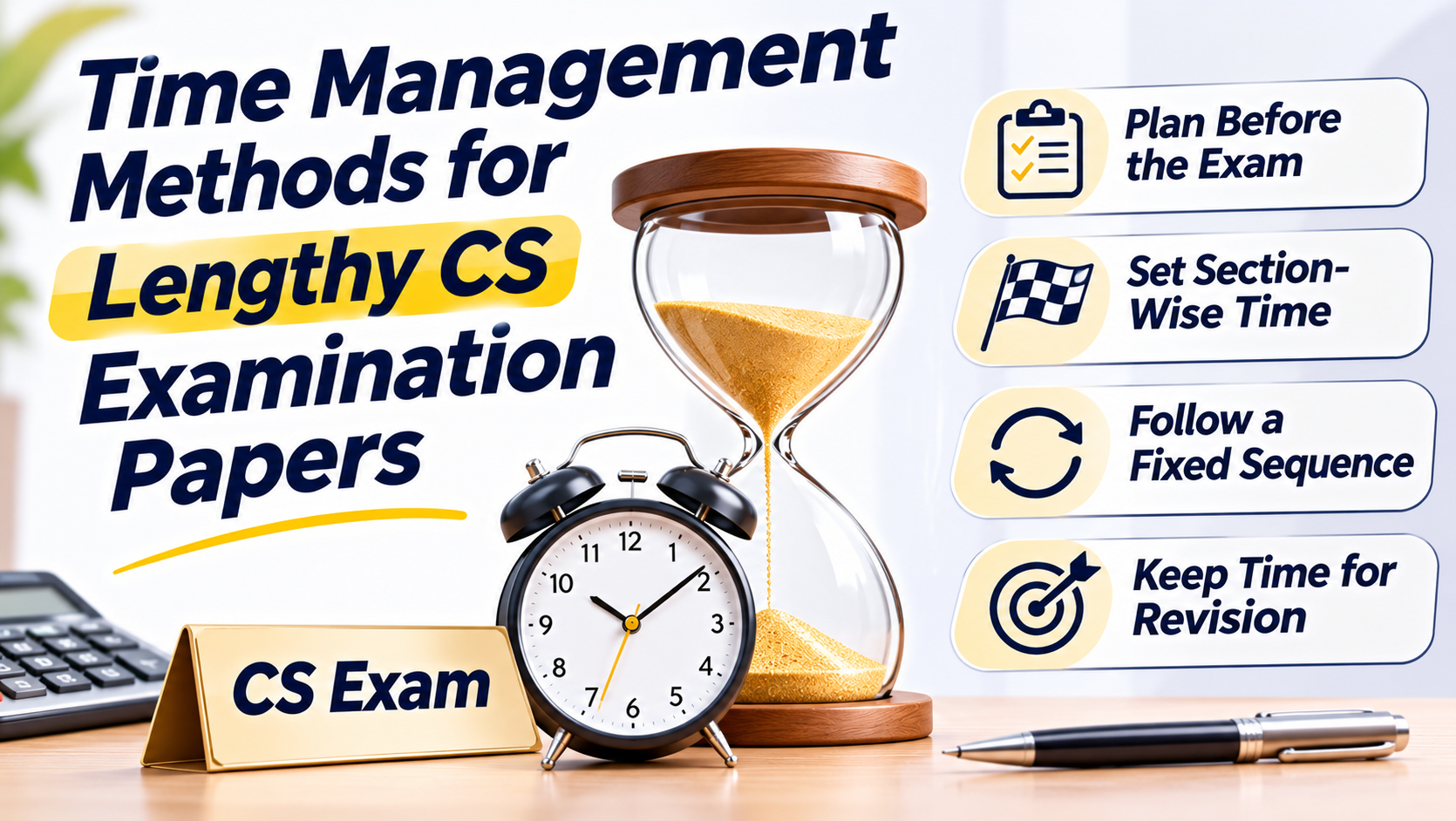
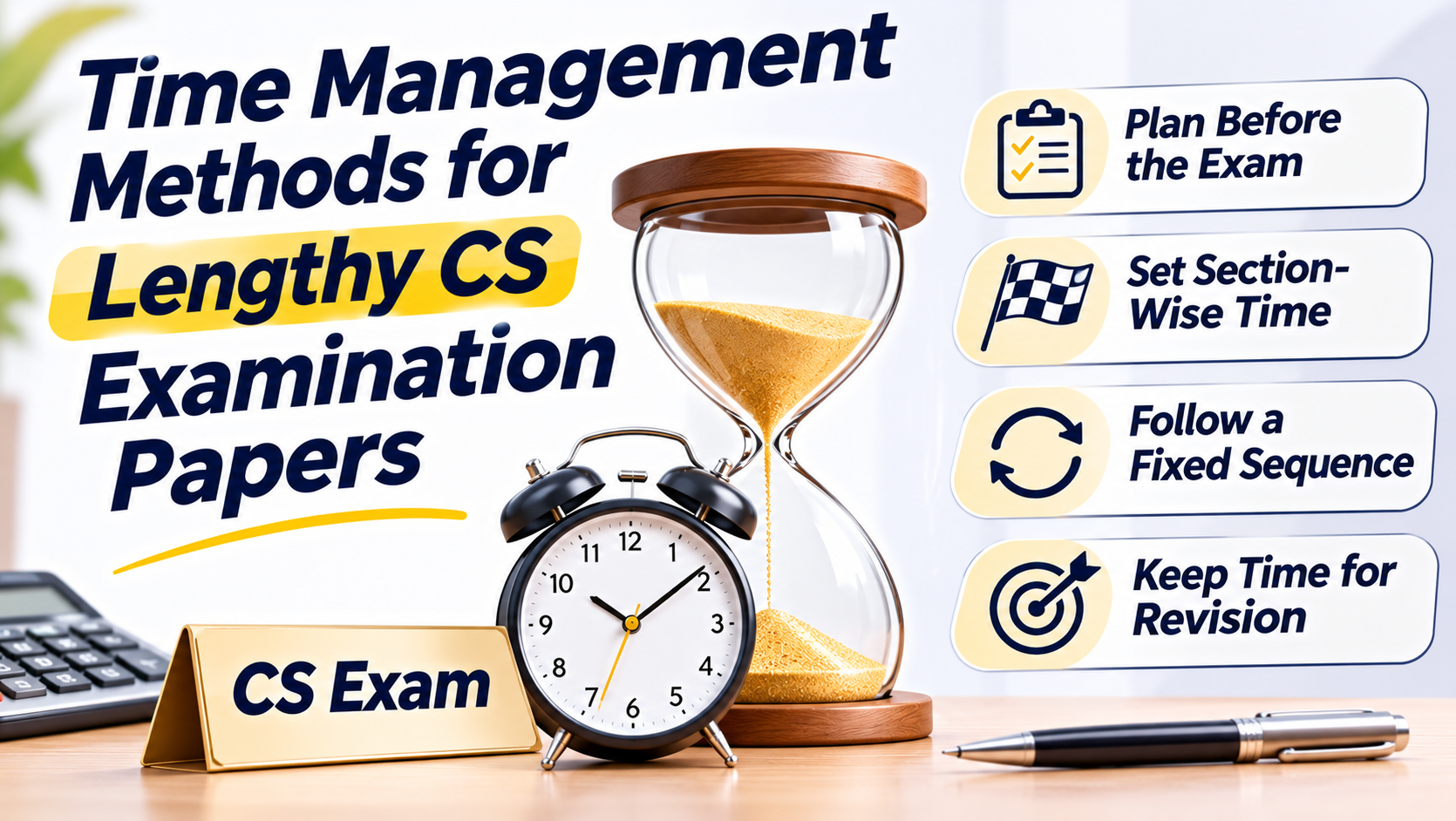
Lengthy Company Secretary examination papers can be challenging even when a student has prepared the syllabus well. A candidate may know the concepts but still struggle to complete the paper because too much time is spent on a few answers, question requirements are not identified quickly or the final review is left until the last minute. Effective time management is therefore an important part of examination preparation.
The aim is not to write as quickly as possible. It is to use the available time in a planned way, give appropriate attention to every question and present clear, relevant answers. A reliable method should include reading the paper, deciding the order of questions, planning answers, monitoring time and reserving a few minutes for review. This guide explains how CS students can practise these skills before the examination.
Why time management matters in lengthy CS papers
CS examination questions may require candidates to explain concepts, analyse situations, discuss provisions, compare alternatives or apply a rule to the facts given. Such answers need structure and accuracy. If a student spends too long on the first few questions, even well-prepared topics later in the paper may remain unanswered.
Time management helps maintain balance across the paper. It reduces the risk of writing an unusually long answer where a concise response would meet the requirement. It also creates space to read questions carefully and check whether every part has been addressed.
Good time management begins before examination day. Students need to practise writing under realistic conditions so that the time assigned to reading, planning and answering is based on their actual speed rather than guesswork.
Understand the paper before setting a time plan
Before attempting a paper, check its total marks, duration, question structure and instructions. The applicable examination instructions should always take priority. Note whether questions are compulsory, whether internal choices are available and whether any special directions apply to particular sections.
Use the marks assigned to a question as a guide to the depth and length of your response. A short question generally needs a focused answer, while a higher-mark question may require explanation, analysis and a conclusion. Marks are not a perfect word-count formula, but they help prevent over-answering.
During practice, calculate an approximate time budget for each section. Keep a small buffer for reading and review. Do not allocate every minute to writing because you may need time to understand a case-based question, make a brief answer plan or correct an omission.
Create a realistic time allocation strategy
Divide the available examination time into three broad parts: reading and planning, writing answers and final review. The exact split should depend on the paper pattern and your writing speed. As a starting point for practice, you might reserve around 5 to 10 percent for reading and planning, most of the time for writing, and the final 5 percent for checking. Adjust this after timed attempts.
Within the writing period, allocate time according to marks and complexity. If two questions carry similar marks, but one requires a detailed case analysis, it may need more planning time. Keep the allocation visible on your rough sheet or question paper where permitted.
Use a simple checkpoint system. For example, decide what question or section you should have reached at the halfway point. If you are behind, shorten unnecessary explanations and move forward rather than trying to recover lost time by rushing every remaining answer.
Do not treat the sample percentages as official examination rules. They are planning aids. Your final schedule must fit the current paper instructions and the time you have actually measured during mock examinations.
Read questions carefully and identify the requirement
Misreading a question wastes time because the answer may need to be rewritten. Before starting, identify the action word: explain, discuss, analyse, distinguish, advise, calculate or comment. Each instruction points to a different response.
Underline or note the key facts, relevant dates, parties, conditions and specific issue in a case-based question. Ask yourself what the examiner is actually asking. Avoid writing everything you know about the topic if only one aspect is required.
For multi-part questions, make a quick checklist of each part. Address them in a logical order and make sure no sub-question is missed. A short plan of three or four points can save time compared with beginning immediately and discovering halfway through that the answer has no clear direction.
Choose the order of questions strategically
If the examination allows a choice in the order of attempting questions, begin with a question you understand well and can answer accurately within the planned time. This can help you settle into the paper and build confidence.
Do not spend too long searching for the perfect first question. Make the decision quickly after reading the paper. If a question is unfamiliar or unusually lengthy, mark it for later and move to another permitted question.
Keep track of compulsory questions and internal choices. Never skip a compulsory part simply because another question appears easier. The best order is one that respects the instructions, protects time for every required answer and allows you to use your strongest preparation effectively.
Plan answers without overthinking
A short answer plan can improve both speed and clarity. For a theory question, note the main heading, essential points and a brief conclusion. For a case-based question, identify the issue, relevant rule or principle, application to the facts and conclusion where appropriate.
Keep planning proportionate to the marks and complexity. A one-mark or very short response does not need a lengthy outline. For a detailed answer, a few seconds spent organising the sequence may prevent repetition and missing points.
Practise writing plans separately during revision. Take a set of questions and spend a limited time identifying the requirement and listing the points you would cover. Then compare your plan with a suggested answer or reliable guidance. This develops the ability to organise thoughts quickly.
Improve writing speed while maintaining answer quality
Writing faster does not mean making handwriting difficult to read or removing important reasoning. Aim for a steady, legible pace. Use clear headings, short paragraphs and numbered points where they improve presentation.
Avoid repeating the same idea in different words. Once a point has been explained adequately, move to the next relevant point. Keep introductions brief and conclusions direct. The answer should address the requirement rather than display every detail you remember about the chapter.
Practise with a timer and review how much you write in a fixed period. Identify whether delays come from slow handwriting, excessive thinking, repeatedly checking notes or difficulty recalling the answer structure. Each cause needs a different correction.
Build speed gradually. First focus on accuracy and structure, then reduce the time for similar questions as you become more comfortable. Do not force a pace that causes careless errors or makes your answers unreadable.
Use headings, tables and point-wise presentation appropriately
Well-organised answers are easier to read and can help you keep track of the points you have covered. Use headings for major parts of a long answer and numbered points for separate requirements. A comparison table may be useful when the question asks you to distinguish between two concepts.
Do not use tables or bullet points automatically. Some questions require explanation in connected paragraphs, especially where analysis or application is important. Choose the format that communicates the answer clearly and follows the question's requirement.
Leave enough space between answers and make sub-parts easy to identify. Avoid decorative underlining, excessive highlighting or rewriting an answer only to improve its appearance. Presentation should support clarity without consuming unnecessary time.
Handle lengthy case-based and multi-part questions
Case-based questions can take longer because students must identify the relevant issue before applying a concept. Read the facts with a purpose. Separate information that is relevant to the question from background details that do not affect the answer.
Use a compact structure: identify the issue, state the relevant principle or provision, apply it to the facts and give a clear conclusion. The level of detail should match the marks and the exact instruction. Do not copy the entire case into your answer.
For questions with several sub-parts, allocate time to each part before writing. If one part is difficult, complete the parts you can answer and return to the difficult portion if time permits. This prevents one uncertain issue from consuming the time intended for the rest of the question.
Practise with timed mock examinations
Timed practice is the most reliable way to discover whether your time plan works. Attempt full-length papers in an environment similar to the examination. Follow the duration, question instructions and writing conditions as closely as possible.
After each attempt, record whether you completed the paper, which questions took longer than expected and where you lost time. Separate time-related issues from knowledge gaps. A student who does not know a provision needs revision; a student who knows it but writes an unnecessarily long answer needs answer-planning practice.
Use a time log for a few mock tests. Note the start and finish time for each question or section. Patterns will become visible: perhaps you spend too long on case studies, introductions or questions where you are uncertain. Use these findings to revise your strategy.
CS Exams Test Series can be considered as a structured practice option for attempting papers under timed conditions and reviewing performance. Check the current paper coverage and use feedback alongside the applicable ICSI study material. A test series supports practice; it does not replace syllabus learning or independent revision.
Manage unexpected delays during the examination
Even with preparation, a question may take longer than expected. The important thing is to recognise the delay early. Check your time at planned checkpoints instead of looking at the clock after every few lines.
If you are behind, avoid adding lengthy explanations that do not directly answer the requirement. Complete the essential points, write a concise conclusion where needed and move to the next question. Return to an unfinished part only after securing time for the remaining required answers.
If you cannot recall one detail, do not spend several minutes trying to retrieve it while the rest of the paper waits. Write the points you know accurately, move forward and revisit the gap if time remains. Never invent a provision or fact to fill space.
Reserve time for final review
Keep a small amount of time at the end to check that all required questions and sub-parts have been attempted. Confirm that question numbers are clear and that no page or answer has been left out accidentally.
Review calculations, dates, names, key terms and conclusions where relevant. Correct obvious errors, but avoid rewriting complete answers unless a serious mistake requires it. The review should focus on omissions and clarity, not cosmetic changes.
If you have no time left for a full review, use the final moments to check the answer sequence and compulsory requirements. This is another reason to protect a buffer rather than writing until the final second.
Build a personal time-management routine before the exam
Create a weekly practice routine that includes short timed answers, section-wise tests and occasional full-length mock papers. Begin with a comfortable pace and gradually work towards the actual examination duration.
After every practice session, write down one time-related improvement for the next attempt. It may be reducing the length of introductions, planning case-based answers faster, moving on from difficult questions or checking the clock at fixed intervals.
Keep the routine realistic. Include revision and rest alongside timed writing. Consistency over several weeks is more useful than attempting many full papers at the last moment without analysing the results.
Common time-management mistakes to avoid
One common mistake is spending too long on the first question because you want to make a strong start. Another is writing everything remembered about a topic instead of answering the exact requirement. Both habits reduce the time available for other questions.
Students may also ignore the marks, fail to track the clock, leave internal choices until too late or attempt mock tests without reviewing them. Simply completing a paper does not reveal how to improve.
Avoid changing your entire strategy on the day of the examination. Test your approach in advance and make adjustments based on repeated practice. A familiar plan is easier to follow under pressure than an untested technique.
Quick Time Management Reference Table
| Stage | What to do | Purpose |
|---|---|---|
| Initial reading | Check instructions, compulsory questions and choices | Avoid missing requirements |
| Planning | Allocate time by marks and complexity | Prevent over-investing in one answer |
| Answering | Use concise, structured and relevant responses | Maintain pace and clarity |
| Checkpoints | Compare progress with your time plan | Identify delays early |
| Final review | Check unanswered parts, numbering and key errors | Reduce avoidable omissions |
How CS Exams Test Series Can Support Your Practice
Regular timed practice helps you understand whether your preparation is translating into exam-ready performance. CS Exams Test Series can be considered as a structured practice option for attempting papers under timed conditions and reviewing performance. Check the current paper coverage and use feedback alongside the applicable ICSI study material. A test series supports practice; it does not replace syllabus learning, independent revision or answer-writing practice.