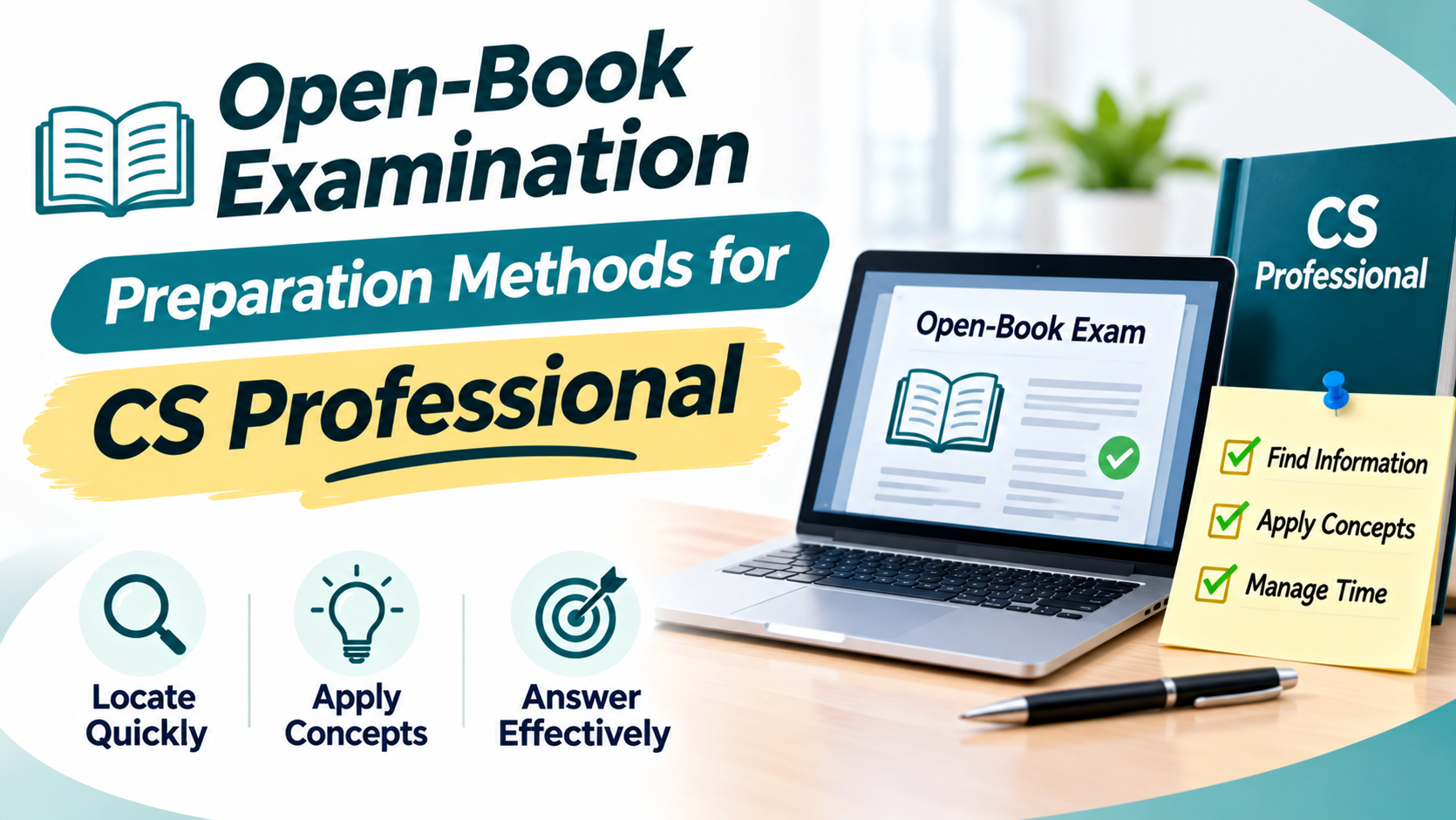
An open-book examination can appear easier because students are allowed to refer to permitted material. In practice, it tests whether candidates can understand a subject, locate relevant information quickly and apply it to a problem within a limited time. Searching through pages without a plan can waste valuable minutes.
Preparation should focus on concept clarity, organised reference material and application-based practice. This guide explains how CS Professional students can prepare efficiently while following the specific instructions issued for their examination.
Understand the examination rules
Start by reading the instructions for the particular paper and attempt. Confirm what material is permitted, whether annotations or tabs are allowed and whether there are restrictions on loose sheets, electronic devices or other aids. Rules may differ between examinations, so do not rely on assumptions.
Prepare only the material allowed under the official instructions. If a document or marking method is unclear, seek clarification through the appropriate official channel before the examination. An organised reference system is useful only when it complies with the rules.
Why open-book does not mean no preparation
An open-book paper still requires subject understanding and the ability to locate information quickly. If you begin learning a topic during the examination, searching for an explanation may take longer than the marks justify. You may also struggle to decide which information is relevant.
Treat reference material as a support tool, not a substitute for knowledge. Learn the main concepts, understand the structure of the subject and practise applying provisions to practical situations. Familiarity makes it easier to locate and use information.
Organise permitted reference material
Arrange material according to the syllabus, modules or topic sequence. Keep related provisions, rules, standards and illustrations together where permitted. A consistent arrangement helps you predict where information is located instead of searching randomly.
Use labels or tabs only if allowed. A simple contents sheet or index can support navigation where permitted. Avoid an elaborate colour system that takes more time to maintain than it saves.
| Preparation area | Recommended focus |
|---|---|
| Understanding | Build clarity on concepts and applicable provisions. |
| Application | Practise case studies and scenario-based questions. |
| Revision | Revisit key topics at planned intervals. |
| Presentation | Structure answers around the exact requirement. |
| Assessment | Attempt timed tests and analyse mistakes. |
Create an index and practise navigation
Prepare an index connecting common topics and question themes with the relevant page or section. Group recurring areas such as meetings, disclosures, governance, filings or professional obligations according to the prescribed subject. Check that the index matches the correct edition.
Practise finding information with a timer. Select a topic at random, locate the relevant passage and summarise the rule without copying it. This develops familiarity with your references and helps you recognise when a question needs more than one source.
Build concept clarity first
Read each topic to understand its purpose, conditions, exceptions and consequences. Create short summaries in your own words and note how related concepts connect. This helps you decide which material is relevant when a case study presents unfamiliar facts.
You do not need to memorise every page, but you should know the framework of the subject and where detailed information is located. Be able to explain the central principle without opening the book.
Practise application-based questions
Practise reading facts, identifying issues, selecting relevant provisions and reaching a reasoned conclusion. Include questions that combine more than one topic so you learn to navigate between related parts of the syllabus.
A response that copies several pages may still be weak if it does not explain how the information applies. Write in your own words and use references to support your analysis rather than replace it.
Develop a time strategy
Divide time according to marks and complexity, including a controlled period for locating references. Spending too long searching for a minor detail can leave insufficient time to explain the main issue. Practise deciding when you know enough to begin writing.
Do not look up every fact. Use references for precise requirements, exceptions, timelines or details that need verification. For concepts you understand, proceed with the answer. Timed practice will show how much checking is realistic.
Avoid common open-book mistakes
Common mistakes include carrying material that is not permitted, using an outdated edition, relying on page searching instead of understanding, over-highlighting, copying without application and spending too long on one question. Early preparation and practice reduce these risks.
Do not assume every answer needs numerous citations. Include the relevant legal or professional basis where it strengthens the response, but keep the focus on the requirement. Accurate analysis matters more than copied volume.
Prepare a final material-check routine
Before the examination, review the subject framework, key concepts, frequently tested areas and your index. Check that your reference material is complete, current for the relevant syllabus and arranged in the permitted manner. Avoid major changes at the last moment.
Practise a short navigation drill and one timed case study. Confirm examination-day instructions and permitted materials from official sources. A final check reduces uncertainty and helps you enter with a clear plan.
How CS Exams Test Series supports open-book readiness
An open-book plan should include timed tests that require selective information retrieval and application to facts. Reviewing the attempt reveals whether time was lost in navigation, whether the wrong provision was selected or whether the answer lacked analysis.
CS Exams Test Series can support this process through practice tests and performance review. Use mock attempts to improve speed and answer structure while ensuring that every material and method complies with current official examination instructions.