Preparing for Company Secretary examinations requires more than completing chapters. Students must understand concepts, remember important details and apply them accurately under time limits. A clear routine makes that work manageable.
A structured plan that combines learning, revision and practice helps students see where they are progressing and where they need to improve. CS Exams Test Series can support this process through planned examination-style practice and performance review.
Why self-assessment matters
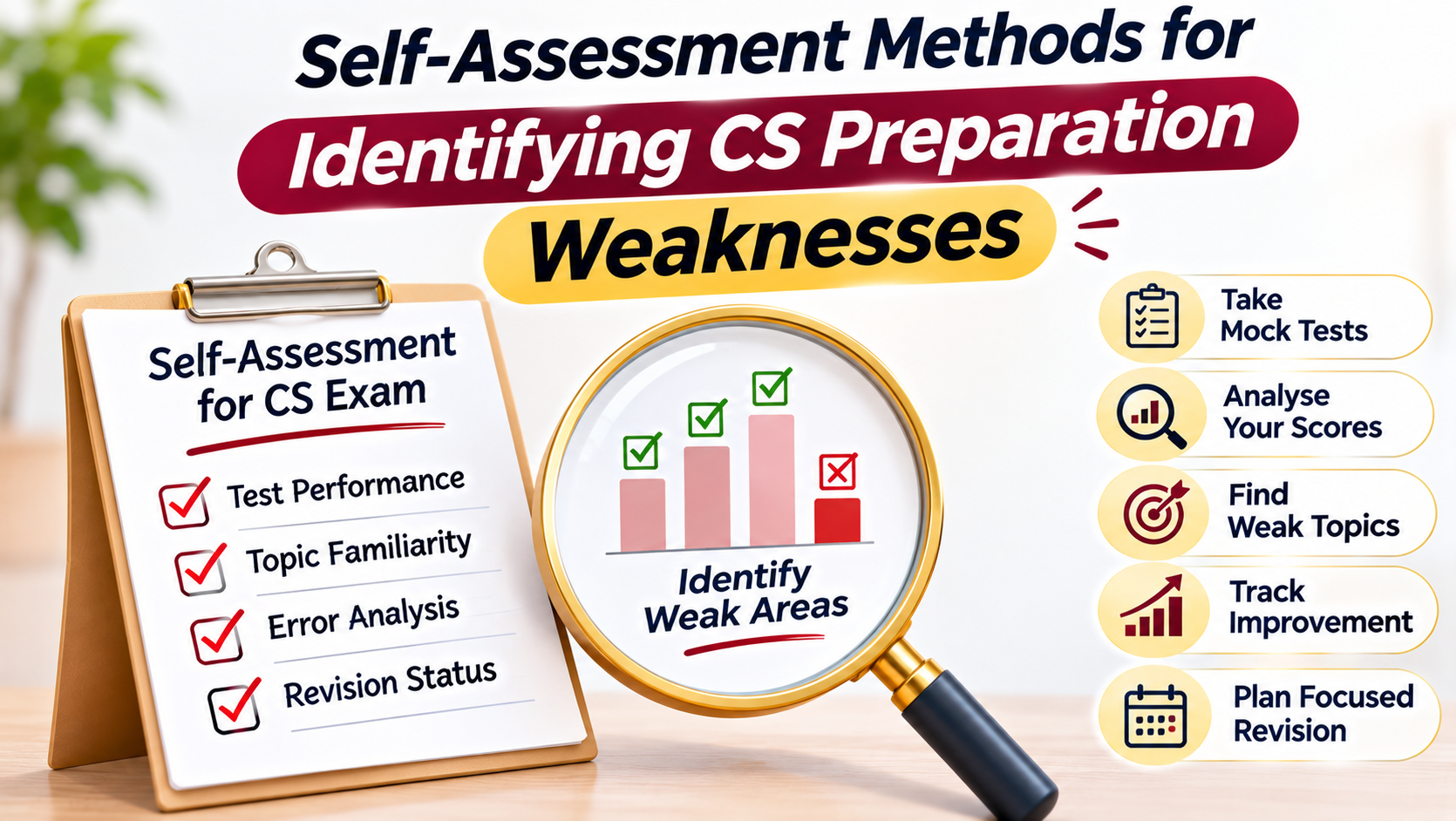
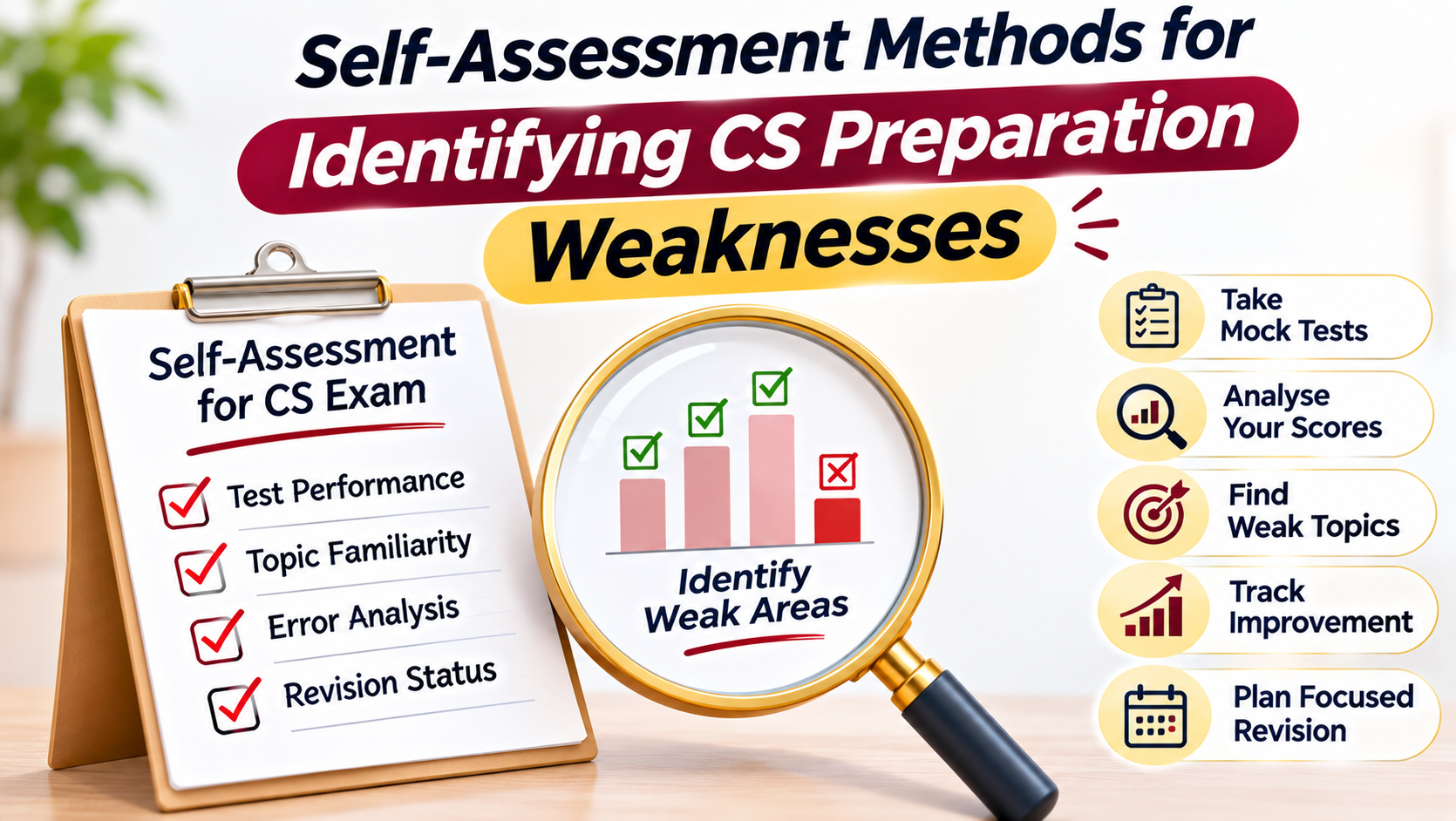
Hours studied and lectures completed show activity, not necessarily learning. A chapter may feel familiar but still be difficult to recall, apply or complete within examination time. Self-assessment uses evidence such as accuracy, answer quality, completion time and recurring errors to show what needs attention.
Create a chapter-wise preparation map
List chapters under each subject and mark whether they are not started, in progress, studied, revised or tested. Add separate ratings for understanding, recall and application. You may understand a concept but forget its conditions, or remember a rule but struggle to apply it. Separating these skills makes the weakness clearer.
Use closed-book recall checks
After studying a topic, close the material and write its main concepts, provisions or calculation steps. Compare the result with the study material and mark missing points. Repeat after a gap. If recall is strong immediately but weak later, schedule spaced revision rather than simply rereading the chapter.
Attempt chapter and sectional tests
Chapter tests assess a focused topic; sectional tests combine related chapters and require you to select the right concept. Begin with focused questions after learning and use broader tests as coverage increases. Record accuracy, time taken and the type of error. A lucky guess should not be treated as secure understanding.
Analyse mock tests beyond the score
A total score does not explain why marks were lost. Classify errors as concept not understood, fact forgotten, question misread, rule applied incorrectly, calculation error, incomplete answer, weak presentation or time shortage. Look for patterns across several tests and use recurring problems to change your study plan.
Review answer presentation separately
Knowledge and presentation are different skills. Check whether the answer responds directly, follows a logical structure and includes relevant reasoning. In case studies, confirm that you applied the rule to the facts. Compare selected answers with reliable guidance or seek teacher feedback, then practise the improvements.
Compare confidence with performance
A confidence-versus-performance check can reveal overestimation. High confidence with low results may indicate superficial familiarity; low confidence with strong results may mean you need more practice to trust your preparation. Low confidence and low performance identify a clear priority. Use evidence rather than anxiety to allocate time.
Maintain an error log
Record the topic, what went wrong, the correct approach and the next action. If a legal answer missed a condition, schedule recall and a case question. If a computation missed an adjustment, practise varied questions on that step. Review the log weekly and mark issues as corrected only after improvement appears again.
Use structured tests as checkpoints
Timed papers reveal whether you can complete work under realistic conditions. Feedback may highlight structure, relevance or application problems that are hard to notice when checking your own answers. The CS Exams Test Series can provide regular checkpoints; review the report and decide what to revise before attempting another test.
Turn findings into an action plan
At the end of each week, select a few priority weaknesses and assign a corrective task: revise a concept, prepare a comparison chart, solve a question set or write a timed answer. Keep time for stronger topics too. Reassess after the next practice cycle and update priorities using evidence.
Quick Reference Table
| Assessment method | What it reveals | Next action |
|---|---|---|
| Closed-book recall | Whether concepts can be retrieved | Schedule spaced revision |
| Chapter test | Understanding of a topic | Relearn and practise weak subtopics |
| Sectional test | Ability to connect chapters | Practise mixed application questions |
| Mock test analysis | Exam readiness and recurring errors | Create targeted improvement tasks |
| Answer review | Structure, relevance and clarity | Rewrite selected answers using feedback |