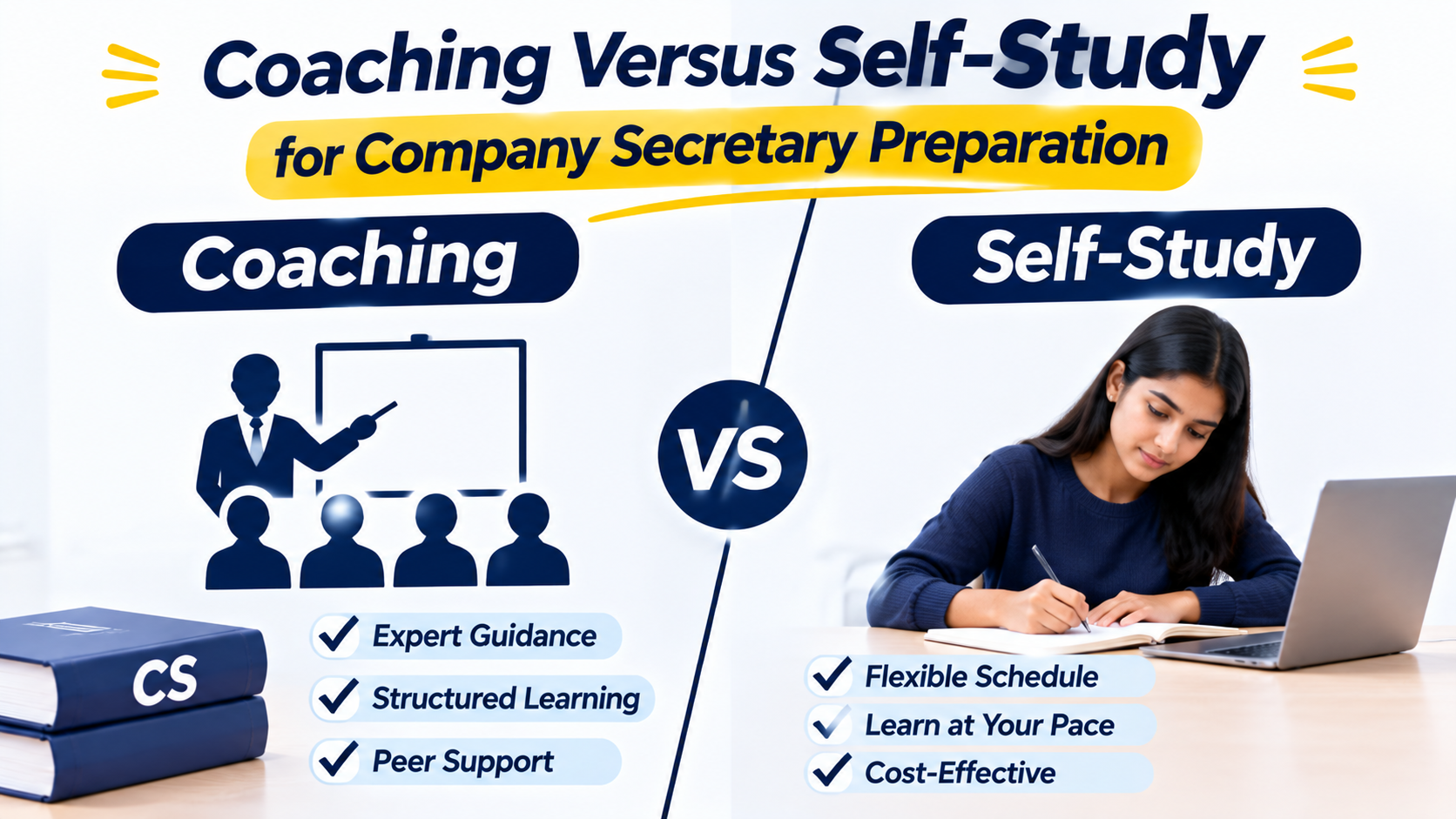
Students preparing for Company Secretary examinations often ask whether coaching is necessary or whether self-study is enough. Both approaches can work, but neither guarantees success on its own. The right choice depends on your understanding of the subjects, learning habits, available time, budget and access to reliable study resources.
Rather than treating coaching and self-study as competing options, compare what each one provides. You may benefit from structured classes for difficult papers and independent study for revision and practice. This guide will help you make a decision based on your actual needs.
Understand what coaching provides
Coaching can provide a planned sequence of classes, explanations, assignments and doubt-solving support. It may be useful when a subject is unfamiliar, when you need an external timetable or when you find it difficult to identify the right starting point.
Good teaching should help you understand concepts and learn how to apply them. Attending every class, however, does not automatically create exam readiness. You still need to read the prescribed material, revise independently, solve questions and review mistakes.
Before enrolling, check the course coverage, faculty approach, class schedule, access to recordings, doubt-resolution process and whether the material is updated for your examination session. Avoid choosing a course only because of promotional claims.
What self-study requires
Self-study gives you control over the pace, order and duration of preparation. You can spend longer on difficult topics, revisit explanations and organise revision around your own timetable. It may also reduce the cost of preparation.
The main challenge is maintaining direction. You must decide what to study, verify that the material is reliable, set deadlines and identify gaps without waiting for a teacher to point them out. This requires consistency and honest progress tracking.
Self-study works best when you use the official ICSI material as a foundation, plan weekly targets, practise questions and have a dependable way to resolve doubts. Do not rely on random notes or unverified summaries as your only source.
Compare the two approaches
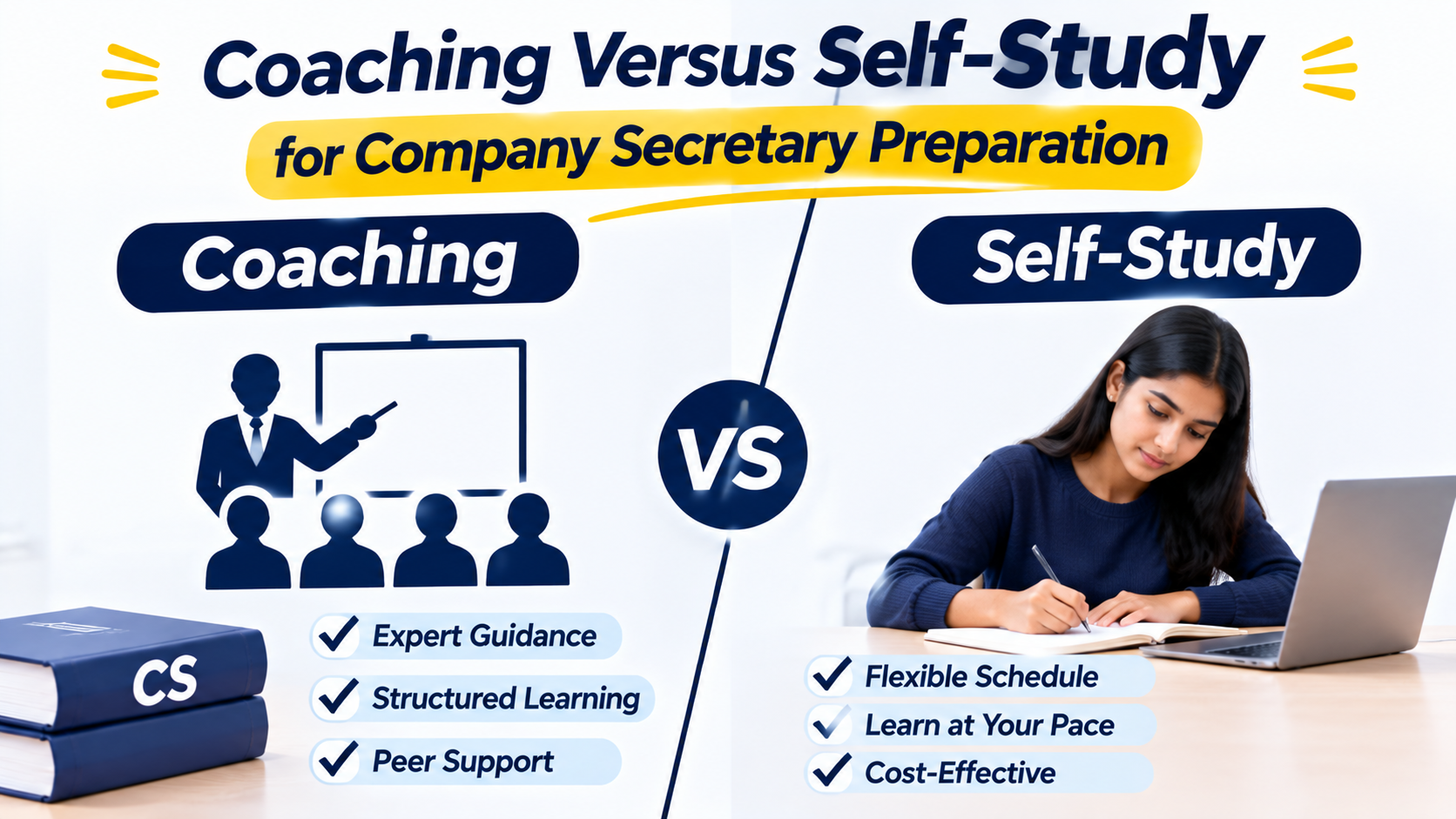
Coaching offers external structure and guided explanations, while self-study offers flexibility and independence. Coaching may make it easier to ask questions in a planned setting; self-study requires you to find a suitable route for resolving doubts.
Cost and travel time also matter. Online classes can reduce travel but still require scheduled attention. Self-study may appear inexpensive, but you should consider the time spent searching for explanations and organising material.
Neither approach removes the need for practice. A student who attends classes but does not solve questions may struggle, just as a self-study student may struggle if they never test their answers under examination conditions.
Consider your learning style and stage
Think about the subjects or topics that currently create difficulty. If you cannot understand the basic framework after using reliable material, guided teaching may help. If you understand the concepts but need more revision and writing practice, additional classes may not be the best use of your time.
Your stage of preparation matters. At the beginning, a structured course can help you map the syllabus. During the revision stage, independent recall, question practice and mock tests may deserve a larger share of your schedule.
Also consider your daily commitments. A full coaching timetable may not fit a student balancing work, family responsibilities or other studies. Choose a format you can attend consistently rather than one that looks impressive on paper.
When a blended approach works
A blended approach combines selected teaching support with independent learning. For example, you may attend classes for difficult subjects, use official material for detailed reading, prepare your own short notes and solve questions independently.
Set clear boundaries so that coaching does not consume all available study time. After a class, reserve a session to revise the topic and attempt questions without looking at the teacher's solution. This converts instruction into independent ability.
Use self-study to revisit topics at your own pace. If a doubt remains after reviewing the material, note the exact question and seek help rather than repeatedly watching the same explanation without a clear purpose.
Evaluate resources and costs
List the resources you already have: current ICSI study material, class notes, reference books, question papers, suggested answers and practice tests. Identify the specific gap that another resource is expected to fill.
Compare the total cost of coaching, including fees, travel, device or internet needs and the time commitment. For self-study, consider the cost of books, practice resources and any support you may need for doubt resolution.
Check that resources match the applicable syllabus and amendments. More material does not always mean better preparation. A smaller set of reliable resources used thoroughly is often easier to revise.
Create an independent study system
Whether or not you take coaching, maintain a weekly plan with learning targets, revision sessions and question practice. Divide each paper into chapters and mark your progress as not started, learning, practised or ready for revision.
After completing a topic, close your notes and explain the concept in your own words. Then solve a question and review the answer. Keep an error log so that you can identify repeated problems rather than simply counting completed chapters.
Schedule regular tests. CS Exams Test Series can be considered as a practice resource for timed attempts and performance review. Use the analysis to decide whether you need conceptual help, more writing practice or better time allocation.
Review progress before deciding
Do not make the coaching-versus-self-study decision once and assume it can never change. Review your progress after a few weeks. Are you meeting targets? Can you explain the topics? Are your answers improving? Are doubts being resolved in reasonable time?
If you are falling behind because concepts remain unclear, consider targeted guidance. If classes are taking time away from revision and practice, reduce unnecessary sessions and strengthen independent work. The goal is effective preparation, not maximum hours spent in a classroom.
Use evidence such as completed topics, question accuracy, mock-test analysis and revision consistency. This is more useful than comparing your method with friends or following a popular study routine without checking whether it suits you.
Common decision-making mistakes
Do not assume that coaching guarantees a result or that self-study is automatically more disciplined. Both require effort and a clear plan. Avoid enrolling in multiple courses because you fear missing something; too many sources can fragment your attention.
Do not choose a method only because it is cheaper or because someone else succeeded with it. Your needs may be different. Also avoid changing your entire approach after one difficult test. Identify the reason for the result before making a major adjustment.
Choose the support that solves a real problem, then protect enough time for independent revision and examination-style practice.
Quick Reference Table
| Factor | Coaching | Self-study |
| Structure | Scheduled classes and guided sequence | Student creates the timetable |
| Doubt support | May offer faculty or mentor support | Requires planned independent support |
| Flexibility | Depends on class schedule and format | High control over pace and timing |
| Cost | Usually involves course fees | Can be lower, depending on resources |
| Responsibility | Still requires independent revision | High responsibility for planning and tracking |
How CS Exams Test Series Can Support Your Practice
Consistent practice helps you check whether your preparation is translating into exam-ready performance. CS Exams Test Series can be considered as a structured practice option for attempting questions under timed conditions and reviewing performance. Check the current paper coverage and use any feedback alongside the latest official ICSI syllabus and study material. A test series supports preparation; it does not replace concept learning, independent revision or official resources.