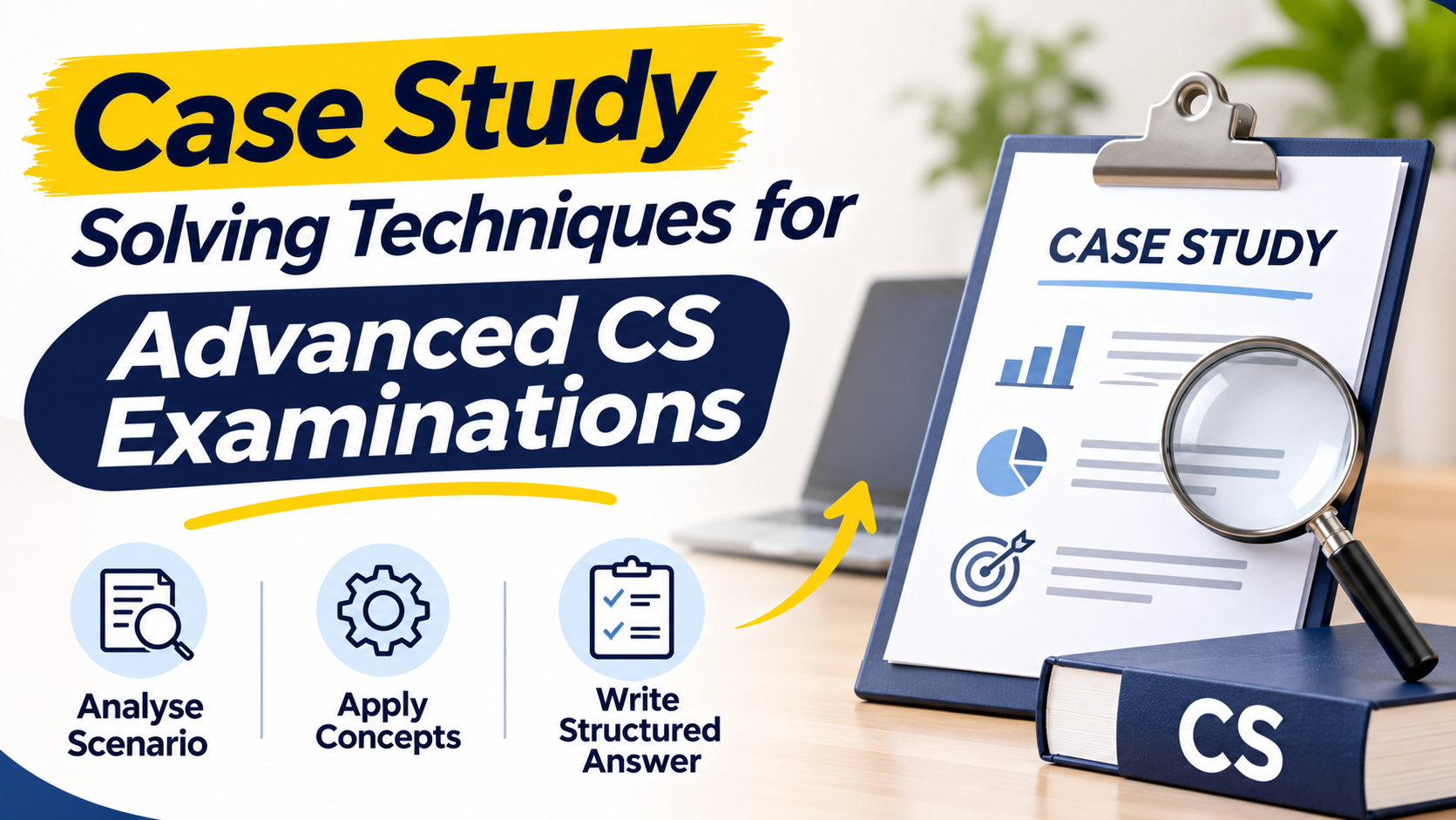
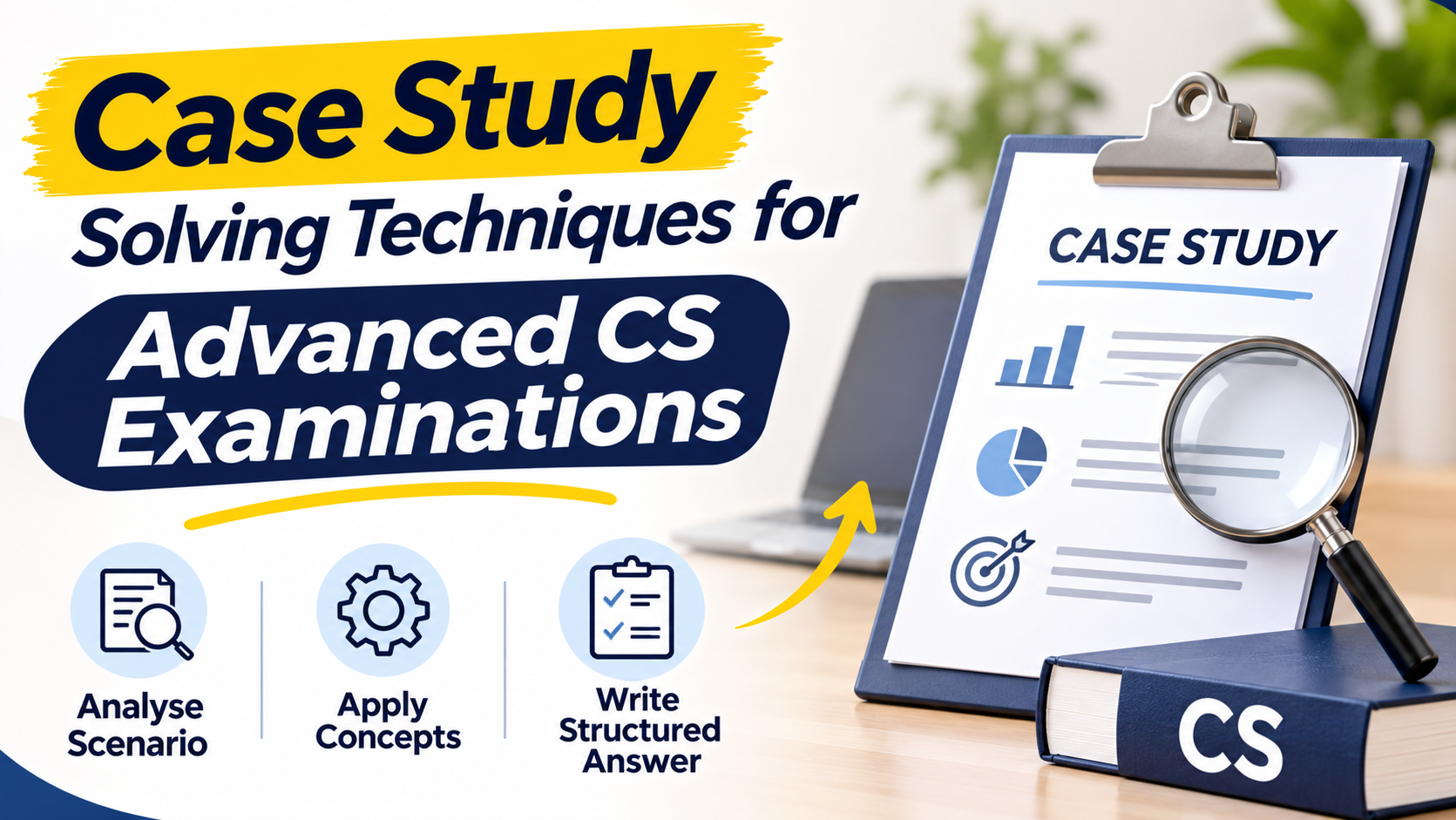
Advanced Company Secretary examinations test more than a candidate's ability to remember provisions and definitions. Many questions present a business situation and expect students to identify the relevant issue, apply the correct principle and reach a reasoned conclusion. Case study practice is therefore an important part of preparation.
A good answer needs accurate issue identification, relevant provisions, logical application and a clear conclusion. This guide explains a practical method for solving case-based questions and improving written responses.
Understand what the question is testing
Advanced CS case studies assess whether a candidate can identify a legal or professional issue, select the applicable principle and apply it to the facts. The facts are not background decoration; dates, roles, transactions, approvals and omissions may determine the result. Read the entire situation before deciding which provision applies.
A single case may combine governance, disclosure, procedural and compliance requirements. Separate the facts into individual issues rather than trying to answer everything through one broad provision. This makes the response focused and easier to evaluate.
Read the facts and identify the requirement
Read once for the overall situation and again for details that affect the outcome. Note dates, amounts, positions, shareholding, decisions, approvals and steps that were not taken. A small fact can change which rule applies or whether a condition has been met.
Pay attention to command words such as examine, advise, analyse, comment or determine. Break multi-part requirements into smaller tasks. If a question asks about validity, liability and remedial action, address all three rather than writing only about the law.
Select the relevant law and principle
Identify the applicable Act, rules, regulations, secretarial standards or other material prescribed for your attempt. Always use the current syllabus and relevant amendments. An outdated provision can weaken an otherwise well-presented answer.
Do not quote every rule that appears remotely connected. Select the principle that directly addresses the issue and include supporting requirements only where they affect the analysis. Mention a section number only when you remember it accurately.
| Preparation area | Recommended focus |
|---|---|
| Understanding | Build clarity on concepts and applicable provisions. |
| Application | Practise case studies and scenario-based questions. |
| Revision | Revisit key topics at planned intervals. |
| Presentation | Structure answers around the exact requirement. |
| Assessment | Attempt timed tests and analyse mistakes. |
Apply the provision to the facts
Explain how the relevant rule connects with the facts. Identify which condition has been met, which requirement appears to be missing and why that changes the outcome. The examiner should be able to see the link between the legal principle and the situation.
Avoid a textbook paragraph that could fit any question. Refer to the names, dates, roles or actions stated in the case wherever relevant. Do not invent facts; if an assumption is essential, state it clearly and keep it reasonable.
Structure the answer logically
A reliable structure is issue, applicable provision or principle, application to facts and conclusion. For multiple issues, repeat the sequence under separate headings. This makes the reasoning visible and reduces the chance of overlooking a sub-question.
Use short paragraphs, numbered points or a small table where it improves clarity. Start with the issue and move directly to analysis. Avoid lengthy introductions and unnecessary background.
Handle multiple provisions
Prepare a quick issue map before writing. Place each issue beside the rule that governs it, then decide whether the issues are independent or whether one finding affects another. This prevents unrelated provisions from being mixed together.
Explain relationships between provisions only when they affect the result. An approval requirement may need to be considered with disclosure or procedural timelines. Do not list rules without explaining why they matter.
Manage time and answer length
Allocate time according to marks and complexity. A short case does not need an essay, while a multi-issue problem needs separate analysis. Decide how much time to spend reading, planning and writing before beginning.
If one issue is taking too long, write the part you can support confidently and move to the next requirement. Keep a small buffer to check whether every part has been answered. Timed practice builds a realistic sense of answer length.
Practise with a repeatable method
Attempt past examination questions, study-material illustrations and fresh application-based questions without looking at the solution. Compare your response afterwards and identify whether you missed an issue, selected the wrong provision or failed to apply the facts.
Maintain an error log covering issue identification, legal knowledge, application, conclusion, presentation and time management. Revisit it before the next practice session. Correcting a specific weakness is more useful than simply attempting more questions.
Review answers and learn from feedback
After an attempt, check whether the answer addressed every command word and each sub-part. Compare the reasoning, not merely the final conclusion. Two answers may reach the same result, but one may explain the legal connection more clearly.
Rewrite weak answers in a shorter, more structured form. Note recurring provisions and factual patterns, but avoid memorising complete model answers. The aim is to develop a method that works when the facts change.
How CS Exams Test Series can strengthen case study practice
Case study performance improves through repeated attempts and careful review. Practise identifying issues quickly, applying provisions accurately and presenting a conclusion in a time-bound setting. Feedback is useful when it explains what was missing and how the response could be improved.
CS Exams Test Series can form part of a structured practice routine through examination-style tests and performance analysis. Use feedback alongside applicable ICSI study material, amendments and examination guidance. Official material relevant to your attempt remains the authority for syllabus and legal updates.