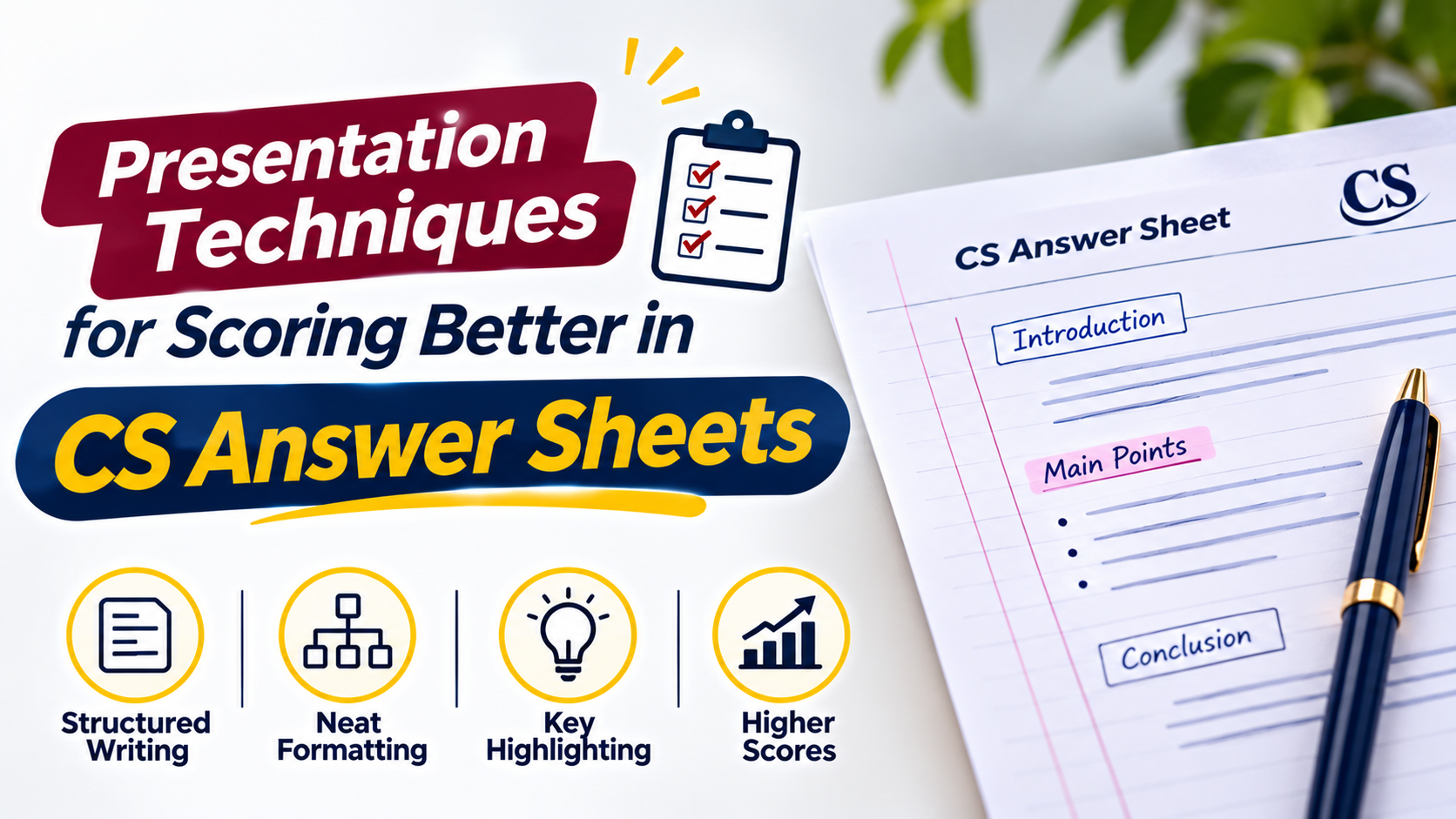
Knowing the subject is essential, but students also need to communicate that knowledge clearly in an examination. An answer can become difficult to follow when it ignores the question’s requirement, mixes unrelated points or hides the conclusion in a long paragraph. Good presentation helps make reasoning visible.
Presentation is not about decoration or writing more than necessary. It is about giving a complete, relevant and readable answer within the available time. Practise the techniques below with questions from the syllabus and review your work against suitable reference answers.
Understand the Question Requirement First
Before writing, identify the command word and exact task. Explain, discuss, distinguish, advise, calculate and comment do not all require the same structure. Underline the key issue and note whether the question asks for a definition, comparison, application, calculation or conclusion.
Use the marks and complexity of the question to decide how much detail is appropriate. A short question may need a precise response, while a case-based question may require you to identify the issue, state the principle, apply it to facts and conclude. Avoid writing everything you remember about the chapter.
Use a Clear Answer Structure
A well-structured answer usually begins by addressing the issue directly, develops relevant points in a logical order and ends with a conclusion when required. In case-based questions, connect the rule or principle to the facts rather than leaving the reader to make the connection.
Use headings for distinct parts of a longer answer and label sub-parts clearly. Keep each paragraph focused on one idea. Structure should make the answer easier to read; it should not add empty headings that do not contribute to the response.
Make Headings and Points Work for You
Headings can guide the reader through a multi-part answer. Use short, descriptive labels rather than vague titles. Numbered points are useful when a question asks for several elements, while paragraphs may be better when you need to explain reasoning or apply a concept in detail.
Do not turn every sentence into a bullet. Too many fragments can interrupt the explanation and make an answer feel disconnected. Choose the format that makes the logic easiest to follow and use it consistently.
Apply the Relevant Provision or Principle
When a question asks you to analyse a situation, avoid merely reproducing a rule. Identify the relevant principle, explain it accurately, connect it to the facts given and state the result that follows. This shows that you understand how to use knowledge rather than simply recall it.
Be careful not to introduce facts that the question does not provide or make unsupported assumptions. If a question requires a statutory reference or provision, learn the accurate detail from current study material and follow the expectations of the applicable syllabus.
Keep Language Precise and Professional
Use simple, direct language. Long introductions, repeated statements and unnecessary quotations can consume time without improving the answer. Define technical terms where needed, use them consistently and avoid informal wording that could make the meaning unclear.
Proofread the answer when time allows. Check whether sentences are complete, key terms are used correctly and the conclusion answers the question. Clear writing is more valuable than complicated wording that obscures the point.
Presentation Checklist for Practice Answers
| Check | Ask yourself | Improvement action |
|---|---|---|
| Relevance | Did I answer the exact requirement? | Underline command words before writing |
| Structure | Are ideas in a logical order? | Use concise headings and focused paragraphs |
| Application | Did I connect the rule to the facts? | Explain directly how it applies |
| Clarity | Is the language precise and readable? | Remove repetition and vague wording |
| Conclusion | Did I state the result where required? | Finish with a clear, supported conclusion |
| Timing | Did I complete the answer efficiently? | Practise with a realistic time limit |
Use this checklist after each written practice session. It can help you identify whether the problem is content, structure or execution.
Manage Time and Answer Length
Allocate time according to marks and the work required. Practise writing answers within a limit so that one question does not take the time needed for the rest of the paper. If a question has several parts, distribute time across them instead of spending too long on the opening section.
Answer length should be guided by the requirement, not by a target number of pages. A complete answer includes necessary points and application; repetition may reduce time available for other questions. Practise with a timer to learn how much detail you can write clearly.
Improve Readability Without Over-Decorating
Leave enough spacing between answers and make question numbers easy to identify. Keep handwriting or written formatting legible, use consistent headings and separate workings or sub-parts where appropriate. Follow the examination instructions about answer-book use and permitted tools.
Do not spend excessive time underlining every phrase or drawing elaborate boxes. Visual emphasis should be limited to what genuinely improves clarity and must comply with examination rules. Content accuracy and logical presentation remain the priority.
Learn From Suggested Answers and Feedback
Compare your answer with relevant suggested answers or trusted reference material. Check whether you addressed the requirement, included key principles, applied them to the facts and reached a supported conclusion. Do not assume your answer is wrong simply because the wording differs.
Use feedback to create a short improvement list. For example, you may need to include more application, reduce lengthy introductions, improve headings or manage time more effectively. Practise the same skill in the next answer and check whether it improves.
Practise With CS Exams Test Series
CS Exams Test Series can provide opportunities to practise writing under timed conditions and assess how clearly you present your knowledge. Choose tests that match the current syllabus and paper format. After each test, review both content and communication.
Make one or two presentation goals for each subsequent test, such as answering the requirement directly or completing every sub-part. Tracking these goals makes improvement more concrete than simply trying to make every answer look different.
Common Presentation Mistakes to Avoid
Common mistakes include copying the question at length, writing long introductions, using headings without explanation, failing to apply rules to facts and leaving conclusions unclear. Students may also sacrifice accuracy by writing too quickly or use too much time decorating the answer sheet.
Use a repeatable structure and practise it until it becomes natural. The best presentation style helps you deliver accurate, complete answers within the exam time and follows the instructions for your examination.