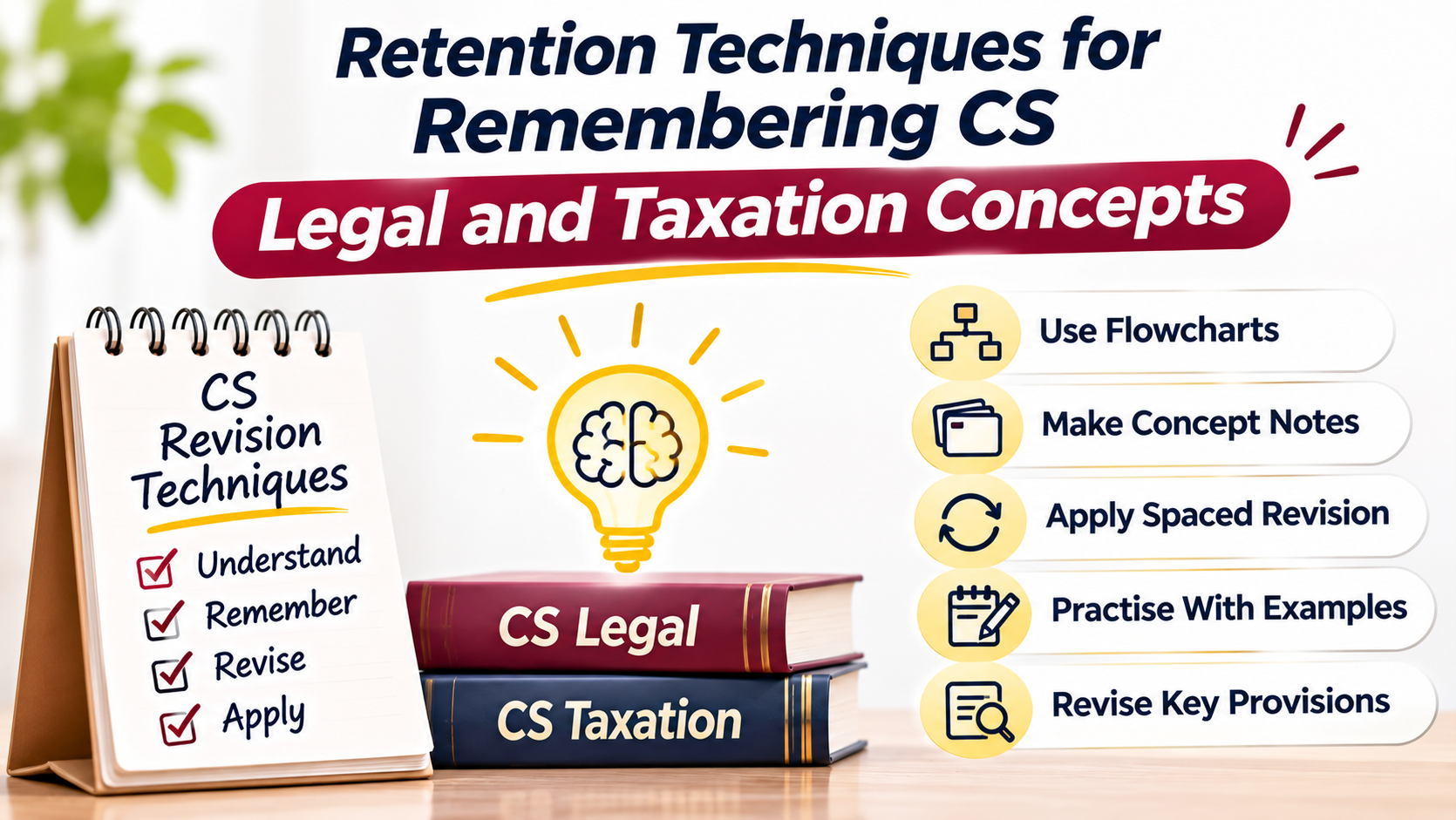
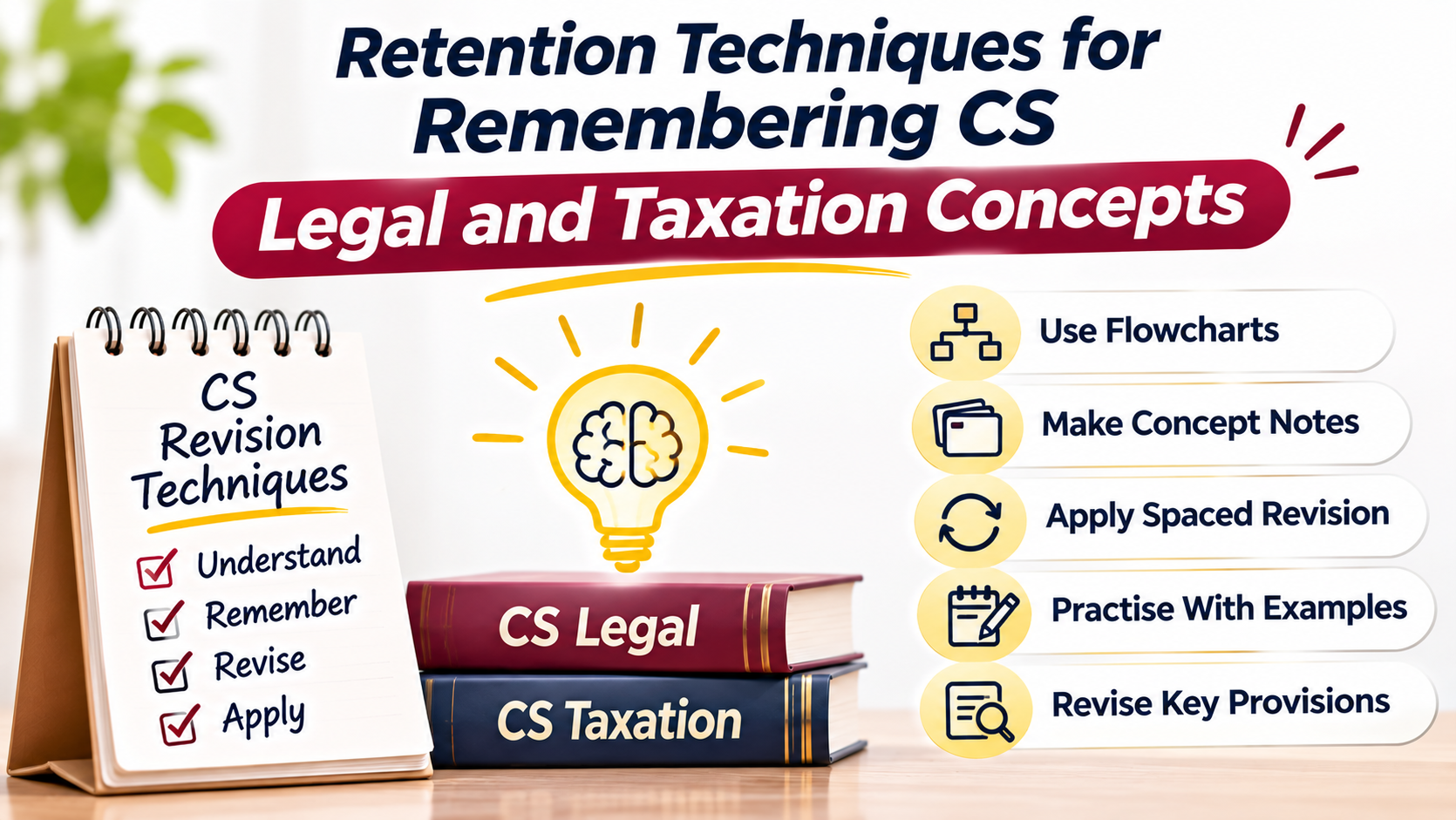
Preparing for Company Secretary examinations requires more than completing chapters. Students must understand concepts, remember important details and apply them accurately under time limits. A clear routine makes that work manageable.
A structured plan that combines learning, revision and practice helps students see where they are progressing and where they need to improve. CS Exams Test Series can support this process through planned examination-style practice and performance review.
Understand before memorising
Memorising a provision without understanding its purpose makes application difficult. Identify what the provision deals with, whom it affects, when it applies and what consequence follows. For taxation, understand the reason behind a treatment before memorising the steps. Work through a simple example, then change one fact to see how the result changes.
Use active recall
After studying a legal topic, close the book and write its essential conditions, process and consequences. For taxation, reproduce the calculation sequence or explain the treatment of an item without looking at the solution. Check your response and correct missing or inaccurate points. The effort of retrieval reveals what you genuinely know.
Apply spaced revision
Do not wait until the syllabus is complete to revisit a topic. Start with a short recall the next day, review again after several days and include the topic in weekly revision. Difficult material should return sooner. A tracker or calendar helps you record the next review date instead of relying on memory.
Prepare provision-based sheets for law
Create concise sheets that capture the core rule, conditions, exceptions, timelines and consequences where relevant. Keep terminology accurate and refer to current study material. For similar provisions, prepare comparison tables that show differences in applicability, authority, time limit or outcome. This is more effective than copying entire textbook pages.
Build concept chains for taxation
Map the facts, classification, applicable rule, calculation or treatment and final conclusion. Write the steps in sequence and explain why each adjustment is made. Practise variations by changing one fact or amount. Maintain an error list for missed adjustments, incorrect classification and arithmetic slips.
Use flashcards with a clear purpose
Flashcards are suitable for short facts, definitions, conditions and distinctions. Put one focused prompt on each card and attempt the answer before turning it over. Keep difficult cards for more frequent review. Cards should support understanding and question practice, not replace the detailed study needed for application.
Explain concepts in your own words
Explain a topic aloud as if teaching a classmate, without reading directly from notes. If you cannot explain why a condition matters or how a rule applies, return to the source. Keep technical terms accurate: your own words should make the concept clearer without changing its legal or technical meaning.
Practise questions after revision
Attempt questions soon after revising a topic. Begin with straightforward questions and progress to case-based or mixed questions. Review the solution and identify whether the issue was forgotten knowledge, misreading or incorrect application. Repeating questions without analysing errors can reinforce the same mistake.
Use tests to measure retention
A timed test checks whether you can retrieve information after a gap and apply it under examination conditions. Sectional tests help during preparation; full-length papers later test mixed-topic recall. The CS Exams Test Series can provide structured practice. Classify errors into forgotten facts, weak concepts, wrong application and poor presentation.
Protect memory with a sustainable routine
Sleep, breaks and a manageable workload support concentration. Avoid sacrificing rest to complete unrealistic targets. Keep revision notes short enough to revisit and prioritise difficult concepts, confused provisions and previous test errors. A focused system leaves more time for application and answer writing.
Quick Reference Table
| Technique | Best use | How to practise |
|---|---|---|
| Active recall | Rules and concepts | Reproduce key points without notes |
| Spaced revision | Long-term retention | Schedule reviews at increasing intervals |
| Comparison charts | Similar provisions | List conditions, timelines and differences |
| Step maps | Taxation computations | Write each stage and explain treatment |
| Timed questions | Application and recall | Attempt without notes, then analyse errors |