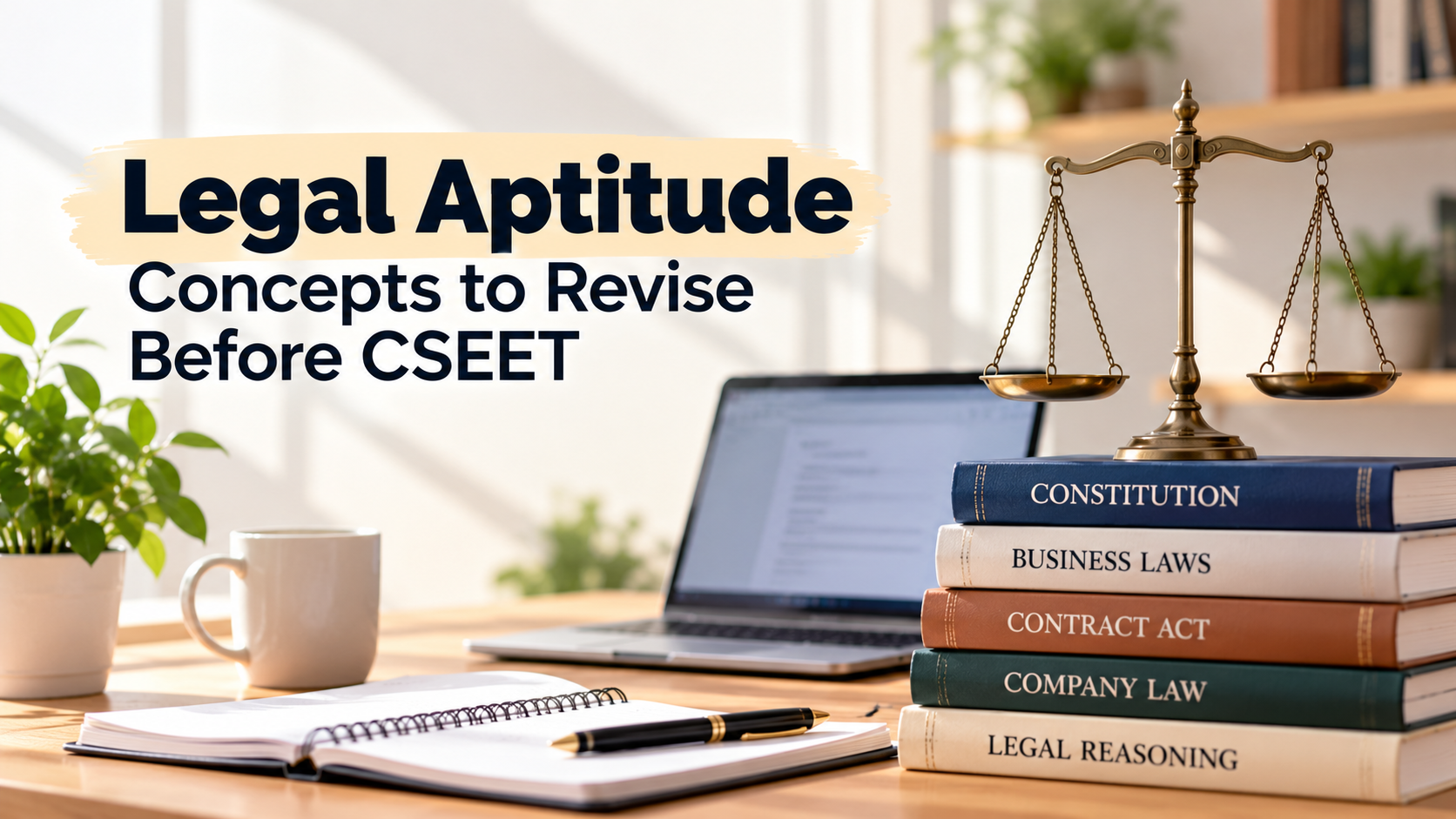
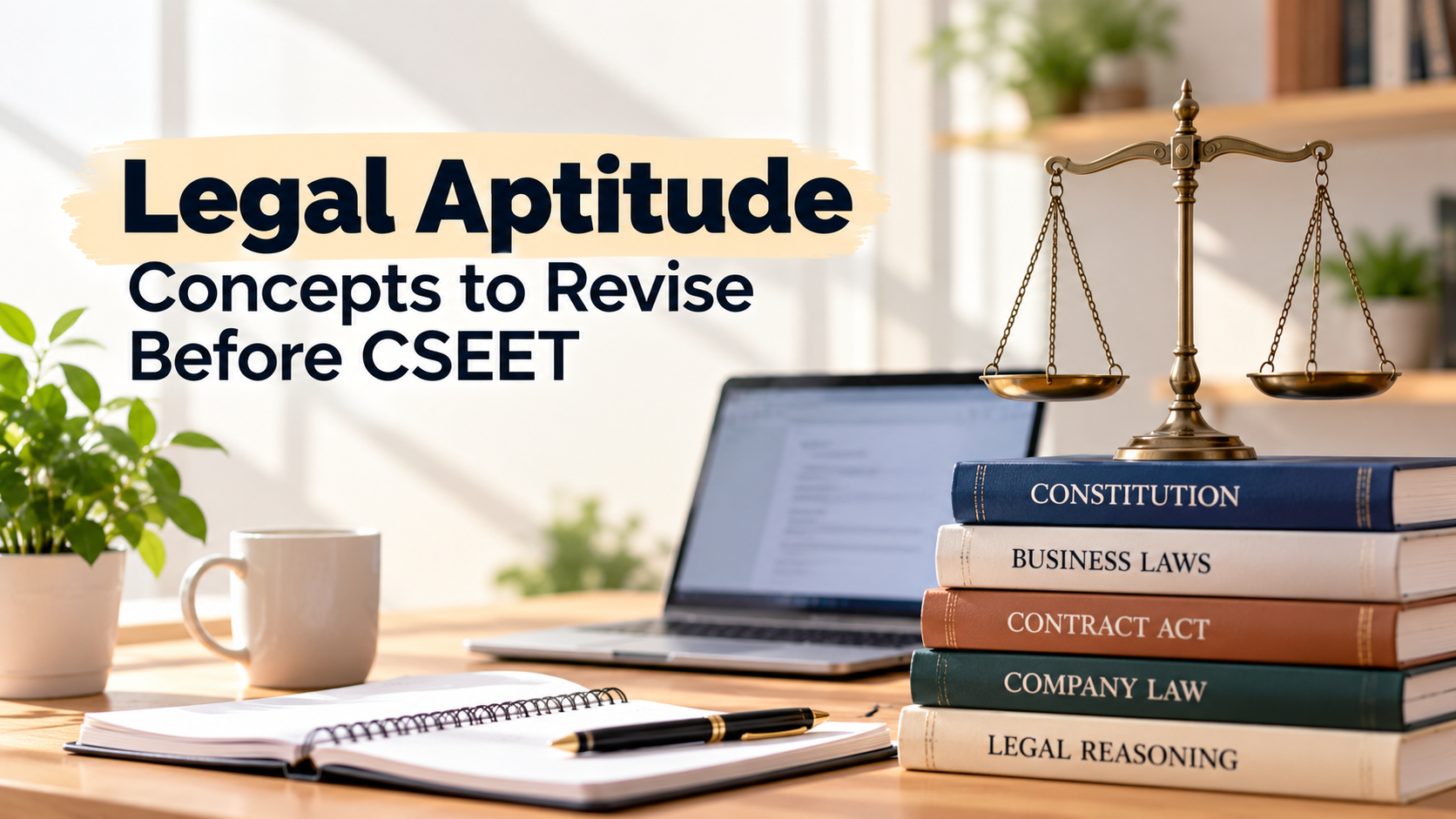
Legal aptitude can feel unfamiliar when you begin preparing for the Company Secretary Executive Entrance Test (CSEET). The subject requires you to understand legal ideas, recognise important terms and apply rules to short situations rather than simply memorise definitions. A clear revision plan makes these concepts easier to recall under exam pressure.
One important point comes first: ICSI introduced a restructured CSEET syllabus from the June 2026 session onwards. Earlier resources may describe a separate Legal Aptitude and Logical Reasoning paper, so always match your preparation to the session-specific syllabus and study material.
Start with the correct syllabus
Before revising legal aptitude, confirm which CSEET syllabus applies to your examination session. ICSI introduced a restructured CSEET syllabus from the June 2026 session onwards. Earlier resources refer to a separate Legal Aptitude and Logical Reasoning paper, while the restructured syllabus has a different paper structure, including Business Laws and Management. This change makes syllabus checking the first revision task, not an administrative detail.
Download the current syllabus and study material from ICSI. Compare your notes with the official topic list and mark any material that appears to belong to an older pattern. Do not discard useful explanations automatically, but do not assume every older topic or question remains examinable. Use official sample papers and announcements to understand the structure relevant to your session.
Understand legal terminology in context
Legal terminology becomes easier when you connect a word with a meaning and a practical example. For every prescribed term, write a one-line explanation in plain English. Where relevant, add a small example showing how the term might appear in a question. This approach is more useful than copying a paragraph and repeatedly reading it without testing your understanding.
Make flashcards for terms you confuse. Put the term on one side and the meaning, distinction or example on the other. Test yourself without looking at the answer. If two terms are similar, create a comparison card explaining the difference. Keep the cards short so that you can review them during a spare 10-minute period.
Revise constitutional and legal foundations
If constitutional foundations appear in your applicable syllabus, revise the purpose of the Constitution, the broad roles of fundamental rights, directive principles and fundamental duties. Learn how the concepts differ and how they fit into the larger framework. Avoid expanding into details that are not prescribed simply because they appear in a general online article.
Use a comparison table when concepts are easily confused. Write the concept, its purpose, its key features as stated in the study material and one point that distinguishes it from a similar concept. Check each note against the official material so that a simplified explanation does not change the legal meaning.
Learn institutions and legal processes
Study the institutions, authorities and processes explicitly named in your course material. Focus on what each body does, how its role differs from another body and the basic relationship between them. A simple flowchart can help you remember a process better than a long block of text.
Do not try to memorise every legal institution or procedural detail in one sitting. First understand the broad idea, then practise questions to identify the facts you actually need to remember. If a question exposes a gap, return to the relevant section of the prescribed study material and add only the necessary detail to your revision sheet.
Practise applying rules to short situations
Application questions reward careful reading and logical use of the prescribed rule. Read the facts, identify the issue, recall the relevant principle and then decide which option follows from the information given. Do not select an answer merely because it sounds reasonable in everyday life; the question may be testing a specific legal concept.
After checking your answer, record why you were wrong. Common reasons include confusing two terms, overlooking a word such as 'not', applying a rule too broadly or choosing an answer from memory without reading the facts. An error log turns practice into a targeted revision plan and prevents repeated mistakes.
Use spaced revision and active recall
Return to a topic several times instead of studying it once and leaving it untouched until the final week. A practical pattern is a short review on the day of study, another recall attempt the next day, a review later in the week and a final check the following week. Shorten the intervals for topics you keep forgetting.
Close your notes and explain the concept aloud, write key points from memory or answer a few questions before checking the book. This active recall shows what you can retrieve independently. Re-reading can make a topic feel familiar even when you cannot explain it without looking, so use self-testing to judge progress.
Create compact revision sheets
Prepare one-page summaries for major topics. Include essential definitions, distinctions, important exceptions that appear in the prescribed material and a few questions you previously answered incorrectly. Avoid turning a summary into a miniature textbook by copying entire paragraphs.
Use consistent labels such as 'definition', 'difference', 'example' and 'mistake'. Keep the sheet readable and update it when you discover a recurring error. The goal is to retrieve the main idea quickly during revision, not to replace the official study material.
Practise with a syllabus-matched test series
After revising a topic, attempt a short quiz. Once several topics are complete, use mixed questions to test whether you can identify the right concept without being told the chapter. CS Exams Test Series can be an additional practice resource when the questions match your applicable syllabus; official ICSI material remains the reference for scope and terminology.
Analyse more than the score. Note accuracy, time spent, questions guessed and topics that caused repeated errors. Revisit the underlying concept before taking another test. A mock test is most valuable when its results change what you study next.
Avoid common revision mistakes
Do not rely on old syllabus summaries without checking them, postpone question practice until the last week or memorise definitions without understanding them. Avoid collecting too many sets of notes; multiple versions of the same material can waste time and create confusion. Choose one primary source and a concise set of revision notes.
Do not repeatedly change an answer simply because another option looks unfamiliar. Re-read the question and use the prescribed concept to justify your choice. If you cannot explain why an answer is correct, mark the topic for review rather than treating a lucky guess as mastery.
A simple seven-day revision cycle
On Day 1, confirm the syllabus and revise one topic. On Day 2, test yourself with flashcards and a short quiz. On Day 3, revise a second topic and revisit mistakes from Day 2. On Day 4, attempt mixed questions. On Day 5, revise definitions and comparisons from memory.
On Day 6, complete a timed practice set and review every incorrect or guessed answer. On Day 7, use your error log and one-page sheets for final recall. This is a flexible example, not a fixed rule. Adapt it to your available time and the exact topics prescribed for your session.
Quick Reference Table
| Revision area | Action |
|---|---|
| Syllabus | Confirm the session-specific ICSI syllabus and paper structure |
| Terminology | Write a plain-English meaning and an example |
| Concept clarity | Compare similar ideas and explain them without notes |
| Practice | Attempt topic-wise and mixed questions |
| Error analysis | Record why each answer was incorrect |
| Final review | Use concise sheets and spaced recall |
How CS Exams Test Series Can Support Your Preparation
CS Exams Test Series can be used as an additional practice resource to test understanding, identify weak areas and build a regular preparation routine. Choose resources that match your applicable syllabus and session. For syllabus details, examination instructions and official rules, refer to the Institute of Company Secretaries of India (ICSI).