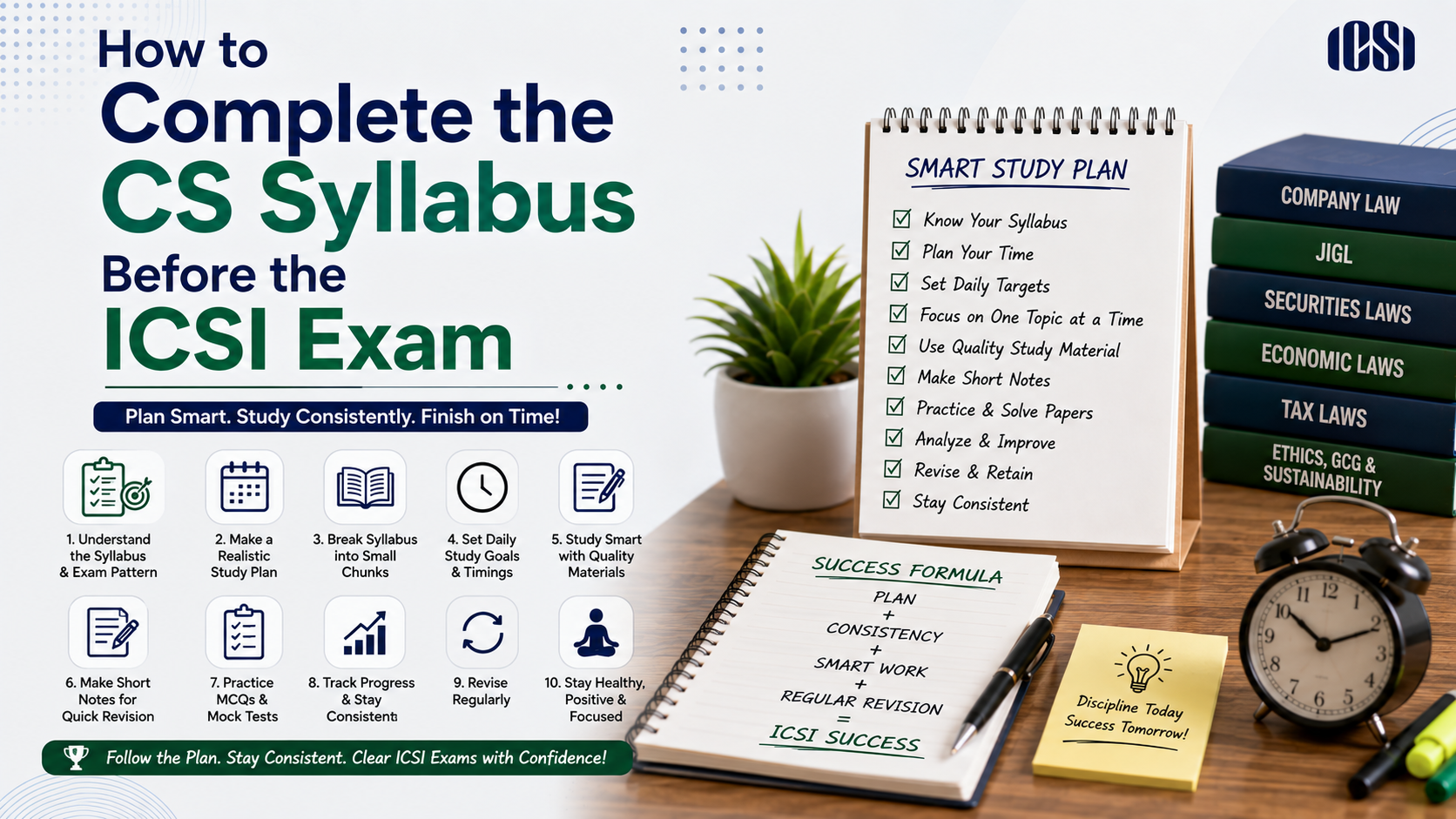
There is a particular kind of stress that almost every CS student experiences before an ICSI examination.
You open your books and suddenly realise that several chapters are still untouched. Some topics were studied months ago but are now difficult to recall. A few chapters are only half-completed. Then you look at the calendar and think, “Is it even possible to complete the CS syllabus before the exam?”
The good news is: yes, it is possible.
But there is one important condition.
You cannot try to complete the entire CS syllabus simply by studying for longer hours. What matters more is how you divide the syllabus, how you prioritise subjects, how often you revise, and when you start practising exam-oriented questions.
This is especially important for CS Executive and CS Professional students because the syllabus contains a combination of law, conceptual subjects, practical areas, amendments, case-based questions and subjects requiring repeated revision.
ICSI's current Syllabus 2022 structure includes seven papers in the CS Executive Programme, while the Professional Programme has Group 1 and Group 2 papers along with elective papers. Students should always check the latest ICSI study material and session-specific updates before finalising their preparation plan.
So, instead of asking “How many hours should I study?”, ask:
“How can I make every hour of my preparation count?”
That is what this guide is about.
First, Understand What “Completing the Syllabus” Actually Means
One of the biggest mistakes students make is considering a chapter completed simply because they have read it once.
Reading is not the same as preparation.
For an ICSI examination, a chapter should ideally pass through these four stages:
|
Stage |
What It Means |
|
1. Understanding |
You understand the concept and provisions |
|
2. Learning |
You can recall important points without constantly looking at the book |
|
3. Revision |
You revisit the topic multiple times |
|
4. Application |
You can write an answer or solve a question under exam conditions |
Therefore, if you have 100% of the syllabus “read” but only 40% properly revised and practised, you are not actually 100% prepared.
A better target is:
Complete → Revise → Practise → Analyse → Revise Again
This simple change in mindset can completely change your preparation.
Calculate Exactly How Much Syllabus Is Left
Before creating a timetable, take a blank sheet of paper.
Write down every subject and divide each subject into chapters or major topics.
Then classify each topic into three categories:
- A – Strong: Already studied and reasonably confident
- B – Average: Studied but needs revision
- C – Weak/Untouched: Not studied properly or completely new
For example:
|
Subject |
Strong |
Average |
Weak/Untouched |
|
Company Law & Practice |
30% |
40% |
30% |
|
JIGL |
40% |
30% |
30% |
|
Tax Laws & Practice |
20% |
35% |
45% |
|
Securities Laws |
35% |
40% |
25% |
This exercise gives you something extremely valuable: clarity.
Without knowing what is left, students often spend three days revising a subject they already know while another subject remains untouched.
Know How Many Days You Really Have
Suppose you have 60 days before your examination.
Do not consider all 60 days as syllabus-completion days.
A smarter division would be:
|
Preparation Phase |
Approx. Time |
Main Objective |
|
Phase 1 |
25 days |
Complete major portions |
|
Phase 2 |
15 days |
Finish remaining syllabus + first revision |
|
Phase 3 |
10 days |
Second revision + question practice |
|
Phase 4 |
10 days |
Mock tests + final revision |
The exact number of days can change depending on your situation.
If you have only 30 days, the same principle applies—you simply compress the phases.
The important thing is to keep revision and testing time separate from syllabus completion time.
This is where many students go wrong.
They study until the last week and then discover they have no time left to revise.
Don't Give Every Subject Equal Time
This sounds strange, but it is one of the most important CS preparation strategies.
Suppose Subject A is already 80% prepared while Subject B is only 30% prepared.
Studying both for exactly three hours every day may feel fair, but it isn't necessarily efficient.
Instead, allocate time based on:
- Your current preparation level
- Difficulty of the subject
- Amount of syllabus remaining
- Your confidence level
- Time required for revision
- Your ability to score in the subject
A useful approach is:
More weakness = More preparation time
But don't completely abandon strong subjects.
Strong subjects should receive shorter but regular revision sessions.
Use the 60–30–10 Rule
If you are struggling to create a daily schedule, try this simple framework.
60% – New Syllabus
Use around 60% of your study time to complete chapters that are pending.
30% – Revision
Use 30% of your time to revise previously studied topics.
10% – Practice
Use the remaining 10% for questions, answer writing, MCQs, case studies or mock-test practice depending on the subject.
For example, if you study for 10 focused hours:
|
Activity |
Time |
|
New syllabus |
6 hours |
|
Revision |
3 hours |
|
Question practice |
1 hour |
As the examination gets closer, change the ratio.
During the final weeks, your schedule should gradually move towards:
30% New Learning + 40% Revision + 30% Practice
And when your syllabus is substantially complete:
20% Revision + 50% Practice + 30% Mock Tests/Analysis
Follow a Daily Study Structure
A good timetable doesn't necessarily mean studying from 6 AM to 2 AM.
In fact, extreme schedules often collapse after a few days.
Instead, create focused study blocks.
A practical day may look like this:
|
Time Block |
Activity |
|
Morning |
Difficult/new topic |
|
Late Morning |
Second subject |
|
Afternoon |
Revision |
|
Evening |
New chapter |
|
Night |
Questions + recall |
|
Before Sleep |
Quick revision of key points |
You can modify these timings according to your college, job, coaching or personal routine.
The important part is consistency.
Three highly focused hours are often more productive than six distracted hours.
Complete One Chapter With a Fixed Process
Do not spend unlimited time trying to make every chapter “perfect.”
Use a fixed process.
First Reading
Understand the basic concept.
Don't worry about memorising every line.
Second Pass
Identify:
- Definitions
- Sections
- Provisions
- Exceptions
- Important lists
- Procedures
- Penalties
- Case laws
- Practical illustrations
Active Recall
Close the book and ask yourself:
“What did I just study?”
Try explaining the topic in your own words.
If you cannot explain it, you probably need another short reading.
Question Practice
Solve relevant questions.
This tells you whether you actually understand the topic or only recognise it when reading.
Mark Important Areas
Use a simple system:
- Very important
- Needs revision
- Frequently forgotten
- Needs answer-writing practice
This makes your second revision significantly faster.
Don't Ignore ICSI Study Material
One of the most common mistakes students make is collecting too many resources.
One teacher's notes.
Another teacher's summary.
A YouTube PDF.
Telegram notes.
A friend's handwritten notes.
An old scanner.
And eventually, the student has five sources but doesn't know which one to revise.
Your preparation should have a primary source.
For syllabus coverage and applicable study material, students should keep the latest ICSI material and session-specific updates as their foundation. ICSI also provides examination-related resources, guideline answers, previous question papers and academic updates through its official academic and examination portals.
Additional notes can be useful, but they should simplify your preparation—not make it more complicated.
Keep Amendments and Updates Separate
For law-heavy CS subjects, amendments and updates can become extremely important.
Do not wait until the last two days to discover what has changed.
Create a separate Amendment & Update Notebook.
Divide it into:
|
Area |
What to Record |
|
New provisions |
Newly introduced provisions |
|
Amendments |
Changes to existing provisions |
|
Notifications |
Important notifications |
|
Circulars |
Relevant circulars |
|
Case laws |
Important recent decisions |
|
Tax updates |
Applicable changes |
|
Important dates |
Dates you repeatedly forget |
ICSI publishes session-specific supplements and updates for its examinations, so students should verify the material applicable to their particular session rather than relying blindly on older notes.
Spend a small amount of time regularly reviewing these updates instead of trying to learn everything at the end.
Use Revision Cycles Instead of One Big Revision
This is perhaps the biggest difference between students who remember the syllabus and students who forget it.
Don't revise everything only once.
Use multiple short revision cycles.
Revision 1 – Within 24–48 Hours
Quickly revisit what you studied.
Revision 2 – After 7 Days
Test your recall.
Revision 3 – After 15–20 Days
Revise important provisions, concepts and questions.
Revision 4 – Before the Exam
Focus on high-value topics, weak areas, amendments and questions.
This approach reduces the amount of re-learning required.
Start Solving Questions Before You Finish the Syllabus
Many students say:
“I'll start solving papers after completing the syllabus.”
It sounds logical.
It is actually risky.
Start question practice while completing the syllabus.
For example, after finishing a chapter:
- Read the concept.
- Revise it.
- Solve 5–10 questions.
- Check your mistakes.
- Revisit weak areas.
This creates an immediate feedback loop.
You discover your weaknesses before the final month instead of during the final mock test.
Add CS Mock Tests to Your Preparation
A mock test isn't just a test.
It is a diagnostic tool.
A good CS mock test can help you understand:
- Whether you can complete the paper on time
- Whether you understand question requirements
- Whether your answers are structured properly
- Which chapters you are forgetting
- Whether you are making avoidable mistakes
- Whether your writing speed is sufficient
This is why CS Exam Test Series can become an important part of the final preparation phase.
Instead of waiting for the actual examination to discover your weaknesses, use mock examinations to identify those weaknesses earlier.
A useful mock-test cycle is:
Attempt → Evaluate → Identify Mistakes → Correct → Reattempt
Don't make the mistake of simply checking your marks and moving on.
The real value of a test lies in the analysis after the test.
A 30-Day CS Syllabus Completion Plan
If your examination is only one month away, don't panic.
You need an aggressive but realistic strategy.
|
Days |
Target |
|
Day 1–10 |
Complete high-priority pending chapters |
|
Day 11–20 |
Finish remaining major topics |
|
Day 21–23 |
Complete first rapid revision |
|
Day 24–26 |
Solve important questions + previous papers |
|
Day 27–29 |
Mock tests + mistake analysis |
|
Day 30 |
Final revision of important topics |
During these 30 days, avoid spending several hours making beautiful notes.
Your priority should be:
Coverage + Recall + Practice
A 60-Day CS Preparation Plan
If you have around two months, you have more flexibility.
|
Week |
Main Focus |
|
Week 1 |
Syllabus mapping + difficult subjects |
|
Week 2 |
New syllabus + daily revision |
|
Week 3 |
New syllabus + question practice |
|
Week 4 |
Major syllabus completion |
|
Week 5 |
Remaining topics + first revision |
|
Week 6 |
First full revision |
|
Week 7 |
Mock tests + weak areas |
|
Week 8 |
Final revision + exam practice |
This structure prevents the common problem of completing the syllabus but entering the examination without enough practice.
What If You Have Very Little Time Left?
Suppose only 10–15 days remain.
At this point, your strategy should change completely.
Don't try to study every single topic in equal depth.
Instead:
Prioritise
Start with:
- Topics you already understand
- Frequently tested concepts
- High-weightage areas
- Important provisions
- Important amendments
- Previous exam questions
- Topics repeatedly appearing in your practice material
Avoid
- Starting five new resources
- Watching random videos for hours
- Making lengthy notes
- Re-reading chapters passively
- Spending an entire day on one difficult topic
Your goal is no longer perfect preparation.
Your goal is maximum effective coverage.
Common Mistakes That Stop Students From Completing the CS Syllabus
1. Making Unrealistic Timetables
A 16-hour timetable looks impressive on paper.
But if you consistently follow only six hours of it, it is useless.
Make a timetable you can actually follow.
2. Studying Only Favourite Subjects
Students naturally prefer subjects they understand.
But difficult subjects remain pending.
Give your weakest subject a fixed daily slot.
3. Reading Without Recall
If your study method is simply highlighting and reading, retention will suffer.
Close the book and recall.
4. Ignoring Answer Writing
Knowing the answer and writing the answer are two different skills.
Practise writing.
5. Leaving Mock Tests for the End
Mock tests should begin before the final few days.
6. Using Too Many Resources
More material does not automatically mean better preparation.
7. Ignoring Revision
The syllabus is not complete until you can recall it.
How to Know Whether Your CS Syllabus Is Actually Complete
Use this checklist for every chapter.
|
Question |
Yes/No |
|
Have I understood the chapter? |
|
|
Can I recall the major concepts? |
|
|
Have I marked important provisions? |
|
|
Have I revised it at least once? |
|
|
Have I solved questions from it? |
|
|
Can I write an answer without looking at the material? |
|
|
Have I checked relevant amendments/updates? |
|
|
Have I tested myself on the chapter? |
If you answer “No” to several questions, that chapter is not truly complete.
The Final 7 Days Before the ICSI Exam
The final week should not be treated like another normal study week.
Your priorities should be:
1. Revision
Revise short notes, marked portions and weak chapters.
2. Practice
Attempt selected questions and mock papers.
3. Mistake Correction
Review mistakes from previous tests.
4. Amendments
Quickly revise applicable updates.
5. Time Management
Practise writing within the examination time.
6. Sleep
Do not destroy your sleep schedule in the final days.
A tired brain does not suddenly become more productive because you studied until 4 AM.
A Simple Formula to Complete the CS Syllabus Successfully
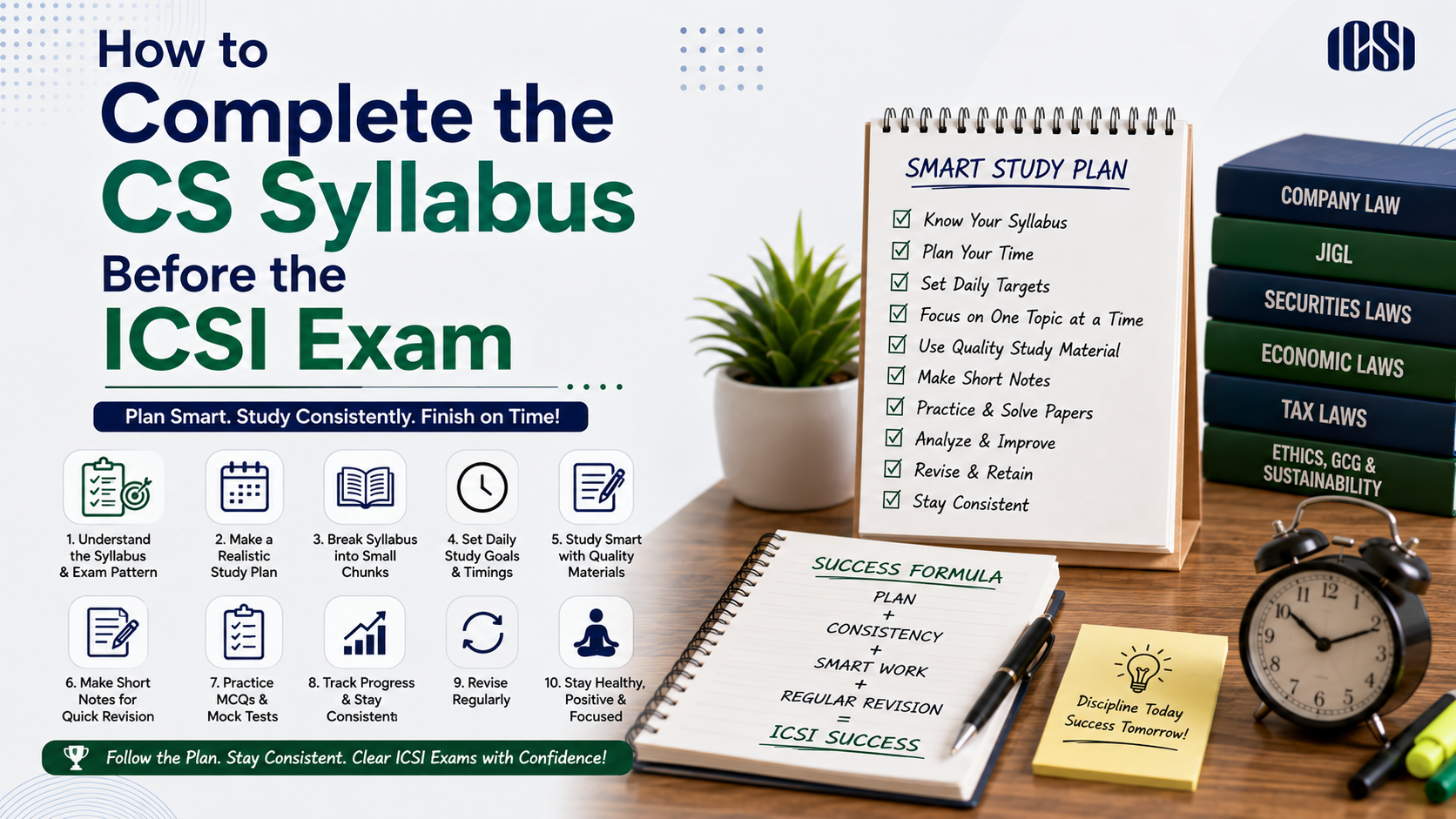
If you want to remember the entire strategy, remember this:
MAP → PRIORITISE → STUDY → RECALL → REVISE → PRACTISE → TEST → ANALYSE
MAP
Know exactly what is pending.
PRIORITISE
Start with important and weak areas.
STUDY
Understand the concept.
RECALL
Test yourself without the book.
REVISE
Repeat the topic at planned intervals.
PRACTISE
Solve questions and write answers.
TEST
Attempt full-length mock exams.
ANALYSE
Find mistakes and improve.
This is far more effective than simply counting how many chapters you have read.
Final Thoughts: You Don't Need to Study Everything in One Day
Completing the CS syllabus before the ICSI examination can look overwhelming, especially when you are already behind schedule.
But remember one thing:
You do not have to finish everything today. You only need to finish today's target today.
If you have 50 chapters remaining, don't think about all 50.
Think about the next chapter.
Then the next one.
Then revise what you studied.
Then practise.
Then repeat.
The students who succeed are not always the ones who start with the most confidence. Very often, they are the students who build a realistic plan, follow it consistently and keep testing themselves.
And when you combine ICSI study material + structured revision + answer writing + previous questions + mock tests + proper analysis, your preparation becomes much more exam-oriented.
For students preparing for CS Executive and CS Professional examinations, CS Exam Test Series can help make the final stage of preparation more practical by giving you an opportunity to simulate the examination environment, practise writing answers and identify your weak areas before the actual ICSI examination.
The objective is not simply to say:
“I have completed my syllabus.”
The real objective is to reach the examination hall thinking:
“I have studied it, revised it, practised it and tested myself on it.”
That is the kind of preparation that builds confidence.