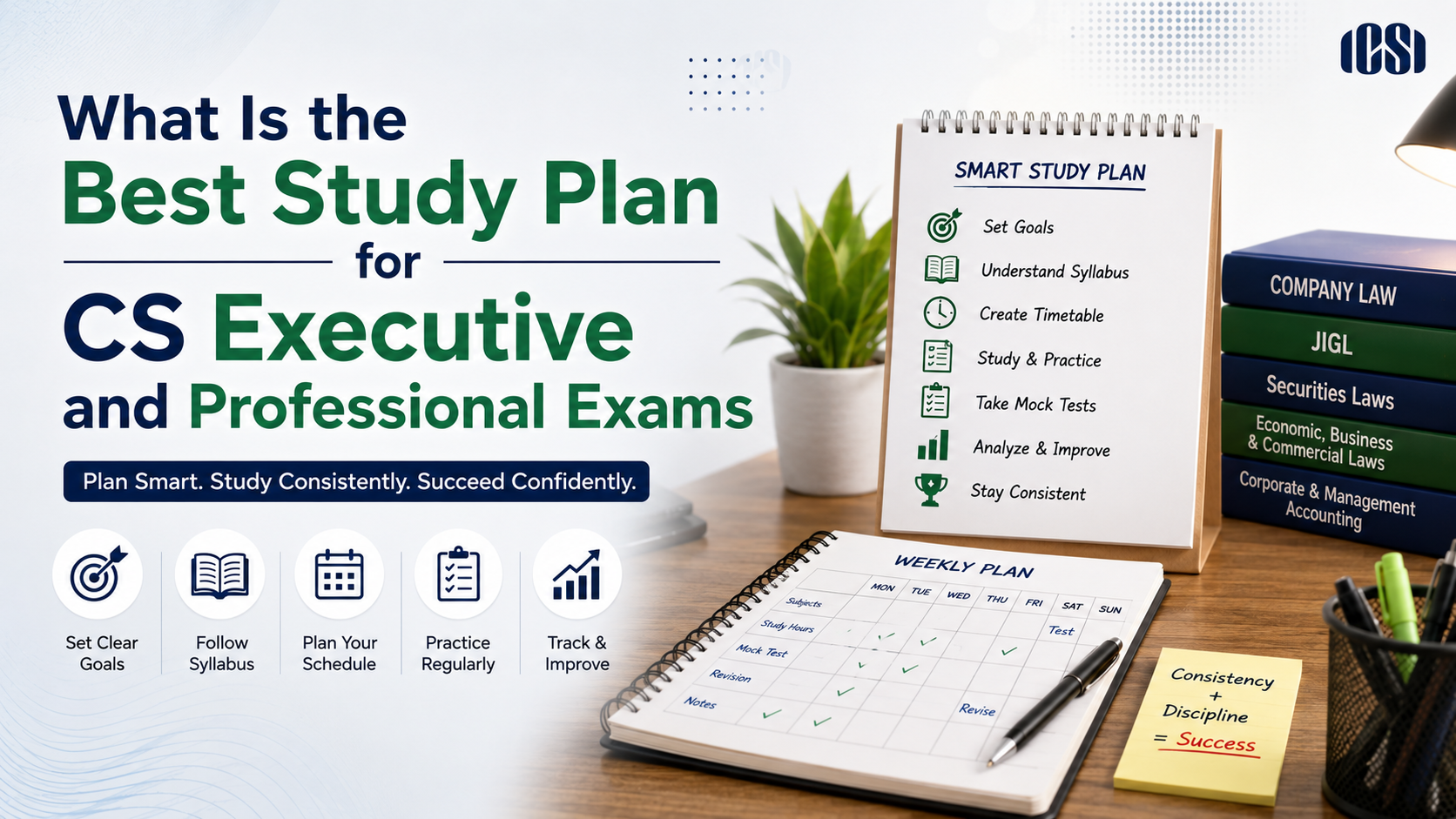
Preparing for the CS Executive and CS Professional examinations is not just about studying harder-it is about studying smarter. Every year, thousands of Company Secretary aspirants begin their preparation with enthusiasm, but many struggle because they do not follow a structured study plan.
The syllabus is extensive, the concepts are detailed, and the expectations of the Institute of Company Secretaries of India (ICSI) continue to evolve. In such a competitive environment, random preparation often leads to stress, poor time management, and disappointing results.
The good news is that a well-planned study strategy can completely change your preparation journey.
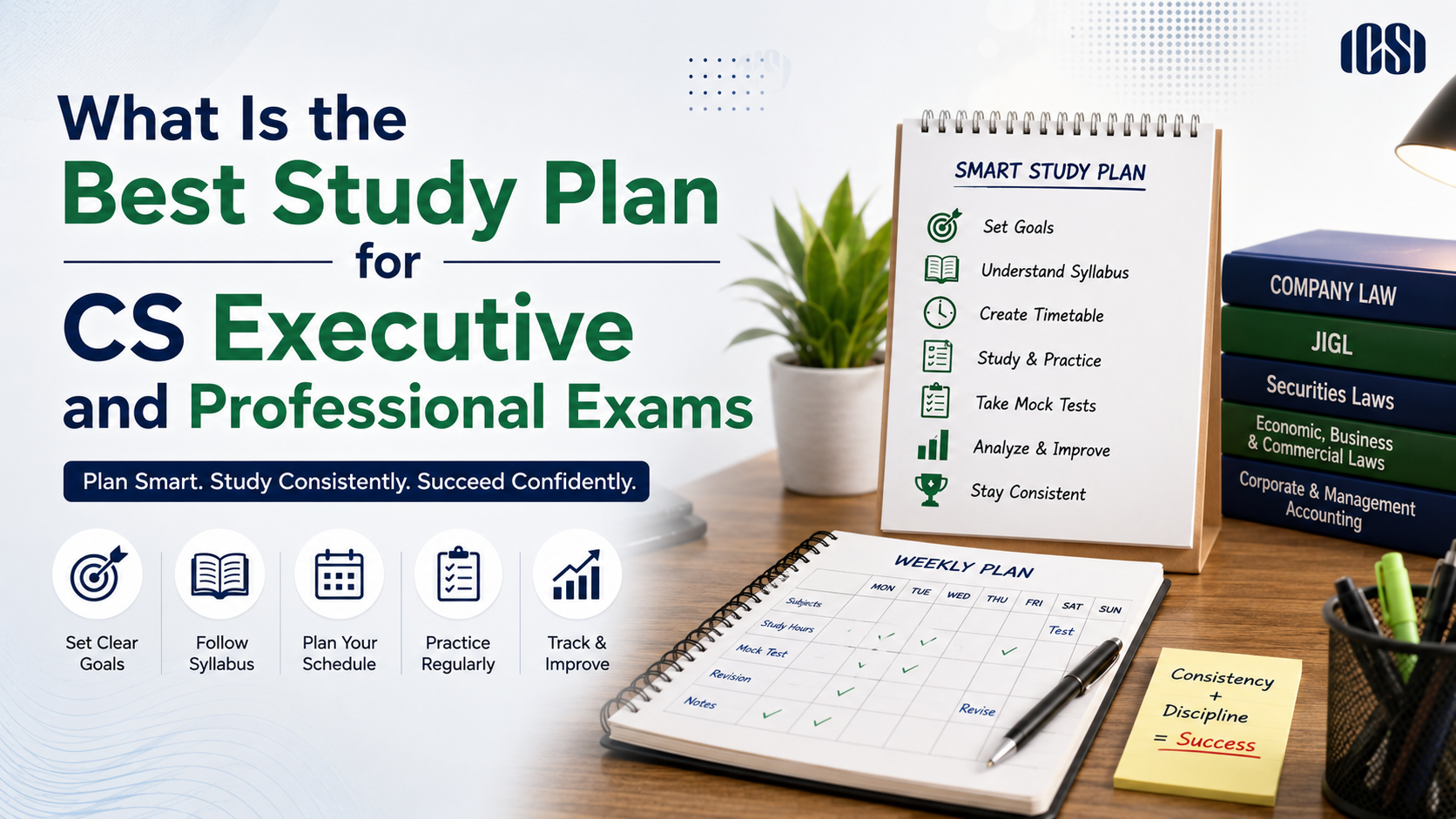
Whether you are a CS Executive student preparing for your first professional-level examination or a CS Professional aspirant aiming for a rank, this comprehensive guide will help you create an effective study plan that maximizes productivity, improves retention, and boosts confidence before the exam.
Why Is a Study Plan Important for CS Exams?
Most students underestimate the importance of planning. They focus on completing the syllabus without creating a roadmap.
A study plan helps you:
- Complete the syllabus on time
- Allocate sufficient revision time
- Track daily progress
- Reduce last-minute stress
- Improve answer-writing skills
- Identify weak subjects early
- Build consistency in preparation
Students who follow a structured study schedule often perform better because they know exactly what to study each day.
Understanding the CS Executive and Professional Syllabus
Before creating a study plan, you must understand the size and complexity of the syllabus.
|
Level |
Nature of Subjects |
Difficulty Level |
|
CS Executive |
Legal, Taxation, Corporate Laws, Accounting |
Moderate to High |
|
CS Professional |
Advanced Laws, Governance, Secretarial Practice, Electives |
High |
The CS Professional level requires deeper conceptual understanding and practical application compared to the Executive level.
Therefore, your study strategy should differ based on the stage you are preparing for.
The Ideal Timeline for CS Executive and Professional Preparation
One of the biggest mistakes students make is starting too late.
The ideal preparation timeline looks like this:
|
Time Before Exam |
Focus Area |
|
6 Months |
Concept Building |
|
4 Months |
Syllabus Completion |
|
3 Months |
First Revision |
|
2 Months |
Mock Tests |
|
1 Month |
Final Revision |
|
Last 15 Days |
Exam-Oriented Preparation |
Starting at least six months before the examination gives you enough time to study without pressure.
The Best Daily Study Plan for CS Executive Students
A CS Executive student should ideally study between 5 to 8 hours daily, depending on whether they are pursuing studies full-time or along with work.
Suggested Daily Schedule
|
Time |
Activity |
|
6:00 AM – 8:00 AM |
Core Subject Study |
|
8:00 AM – 9:00 AM |
Break & Routine Activities |
|
10:00 AM – 1:00 PM |
Concept Learning |
|
2:00 PM – 4:00 PM |
Practical Subjects |
|
5:00 PM – 6:00 PM |
Revision |
|
7:00 PM – 9:00 PM |
MCQs & Writing Practice |
This schedule ensures a balance between learning, revision, and practice.
The Best Daily Study Plan for CS Professional Students
CS Professional subjects require more analytical thinking and answer-writing practice.
A recommended schedule:
|
Time |
Activity |
|
Morning |
Advanced Law Subjects |
|
Afternoon |
Governance & Compliance |
|
Evening |
Revision & Case Studies |
|
Night |
Answer Writing Practice |
Students preparing for CS Professional should dedicate at least one hour daily to writing descriptive answers.
This habit significantly improves presentation and examination performance.
How to Divide Subjects Effectively
Many students spend too much time on favorite subjects while ignoring difficult ones.
A better approach is to classify subjects into three categories.
Category 1: Strong Subjects
Examples:
- Company Law
- Corporate Accounting
- Governance Subjects
Study Time Allocation: 25%
Category 2: Moderate Subjects
Examples:
- Tax Laws
- Economic Laws
Study Time Allocation: 35%
Category 3: Weak Subjects
Examples:
- Drafting
- Secretarial Audit
- Advanced Compliance Papers
Study Time Allocation: 40%
Weak subjects deserve more attention because they can significantly impact overall marks.
The 3-Phase Study Strategy That Top Scorers Follow
Many successful CS rank holders follow a three-phase preparation model.
Phase 1: Learning
Duration: First 60%
Focus on:
- Reading study material
- Understanding concepts
- Making notes
- Highlighting important provisions
Do not worry about speed during this stage.
Your only goal should be understanding.
Phase 2: Practice
Duration: Next 25%
Focus on:
- Solving past year papers
- Writing descriptive answers
- Attempting module-wise tests
- Practicing MCQs
This stage converts knowledge into exam performance.
Phase 3: Revision
Duration: Final 15%
Focus on:
- Quick notes
- Charts
- Important case laws
- Amendments
- Mock tests
Avoid starting new topics during this phase.
Importance of Revision in CS Executive and Professional Exams
Revision is often more important than studying new concepts.
Many students complete the syllabus once but fail to revise adequately.
A good revision strategy is:
|
Revision Number |
Timing |
|
Revision 1 |
Within 7 Days |
|
Revision 2 |
Within 30 Days |
|
Revision 3 |
Before Mock Tests |
|
Revision 4 |
Before Exam |
This method improves memory retention significantly.
How Mock Tests Improve CS Exam Scores
Mock tests are among the most effective preparation tools available today.
Benefits include:
- Time management improvement
- Better answer presentation
- Reduced exam anxiety
- Identification of weak areas
- Real examination experience
Students who regularly solve mock tests generally perform better than those who rely solely on reading.
This is where a structured CS Exam Test Series becomes valuable.
A professionally designed test series provides exam-pattern questions, performance analysis, and expert feedback that helps students understand their preparation level.
The Role of CS Exam Test Series in Preparation
Many students study extensively but never test themselves.
This creates a false sense of confidence.
A quality CS Exam Test Series helps students:
- Experience real exam conditions
- Evaluate preparation objectively
- Improve answer-writing techniques
- Build confidence before the examination
- Identify topics needing revision
Regular testing ensures that your preparation remains exam-oriented rather than theory-oriented.
Subject-Wise Preparation Tips
Company Law
- Focus on sections and provisions
- Prepare summary charts
- Revise amendments regularly
Tax Laws
- Practice numerical questions daily
- Maintain formula notes
- Solve practical case studies
Securities Laws
- Create flowcharts
- Memorize compliance timelines
Governance and Ethics
- Focus on concepts
- Learn practical applications
Drafting and Pleadings
- Practice formats repeatedly
- Write answers in proper structure
Common Mistakes CS Students Must Avoid
Many students fail despite studying hard because of avoidable mistakes.
1. Ignoring Revision
Without revision, retention drops rapidly.
2. Avoiding Mock Tests
Knowledge without practice rarely converts into marks.
3. Studying Randomly
Lack of planning leads to incomplete preparation.
4. Focusing Only on Theory
Application-based questions require practical understanding.
5. Last-Minute Preparation
CS exams require consistent effort over several months.
A 90-Day Study Plan Before the Examination
Days 1–30
- Complete pending syllabus
- Prepare short notes
- Understand difficult concepts
Days 31–60
- Start revision
- Solve previous year questions
- Attempt subject-wise tests
Days 61–75
- Full-length mock tests
- Improve weak areas
Days 76–90
- Final revision
- Focus on amendments
- Revise notes and charts
This structured approach helps maximize exam readiness.
Exam Day Preparation Tips
A strong study plan also includes exam-day strategies.
Before the exam:
- Sleep properly
- Avoid new topics
- Revise summary notes
- Reach the center early
- Stay calm and confident
Remember that success in CS examinations is not determined by the number of hours studied but by the quality of preparation.
Final Thoughts
The best study plan for CS Executive and Professional exams is one that combines consistency, smart scheduling, regular revision, and continuous testing.
There is no shortcut to success in professional examinations, but there is definitely a smarter path.
Start early, create a realistic timetable, revise multiple times, and regularly assess your performance through mock tests.
Most importantly, stay disciplined even on days when motivation is low.
A structured approach followed consistently for a few months can make a remarkable difference in your results.
If you truly want to improve your chances of success, combine your preparation with a reliable CS Exam Test Series that simulates real examination conditions and helps you identify areas for improvement before the actual exam.
Your preparation should not be based on assumptions—it should be based on performance, analysis, and continuous improvement.
Success in CS Executive and Professional exams is achievable for every dedicated student who follows the right strategy and remains committed throughout the journey.