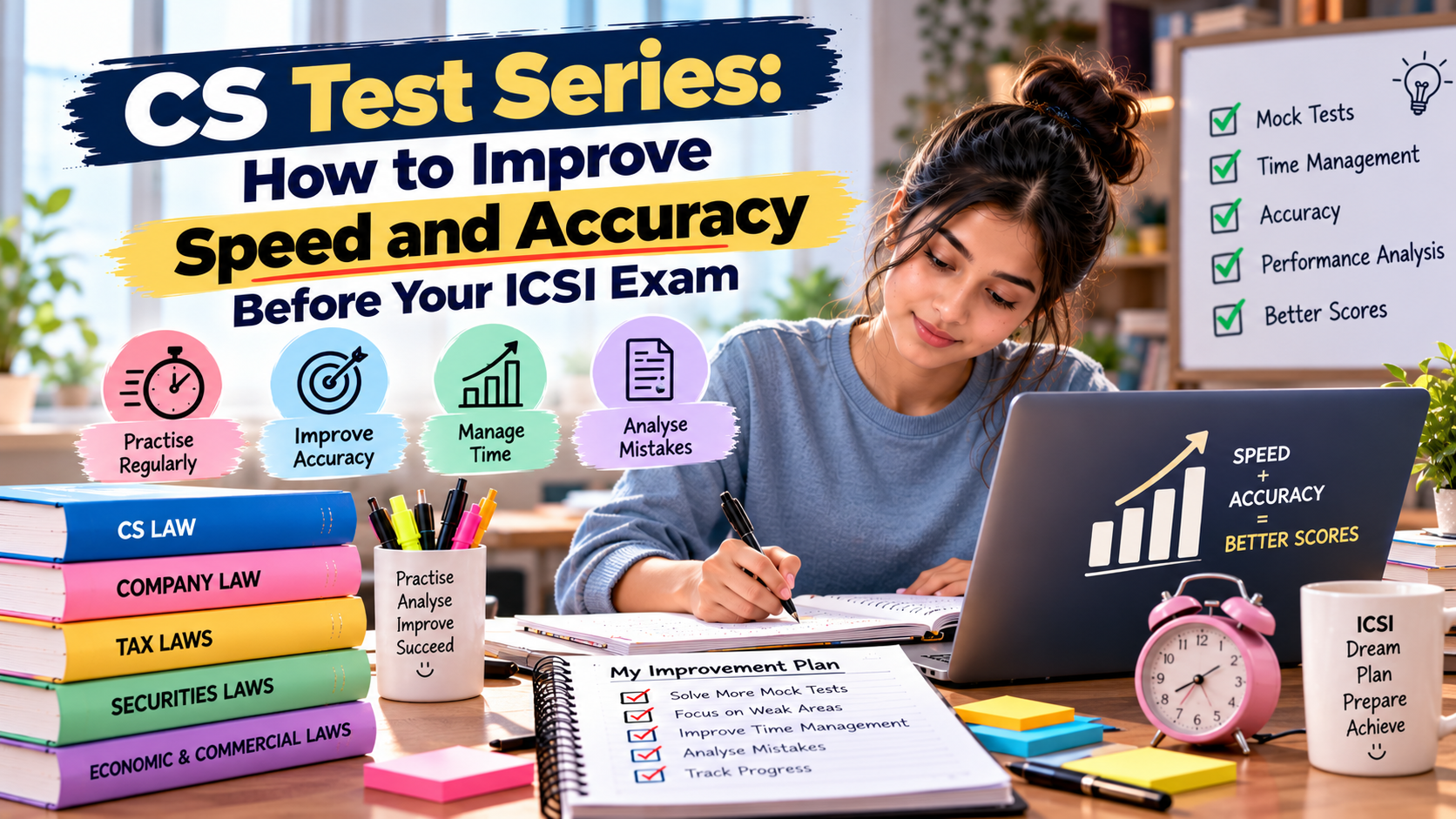
Preparing for an ICSI examination is not only about knowing the syllabus. You also need to understand what a question is asking, recall the relevant concept and present the answer within the time available. Working quickly without checking your understanding can lead to avoidable errors, while being very careful with every line may leave too little time for the rest of the paper.
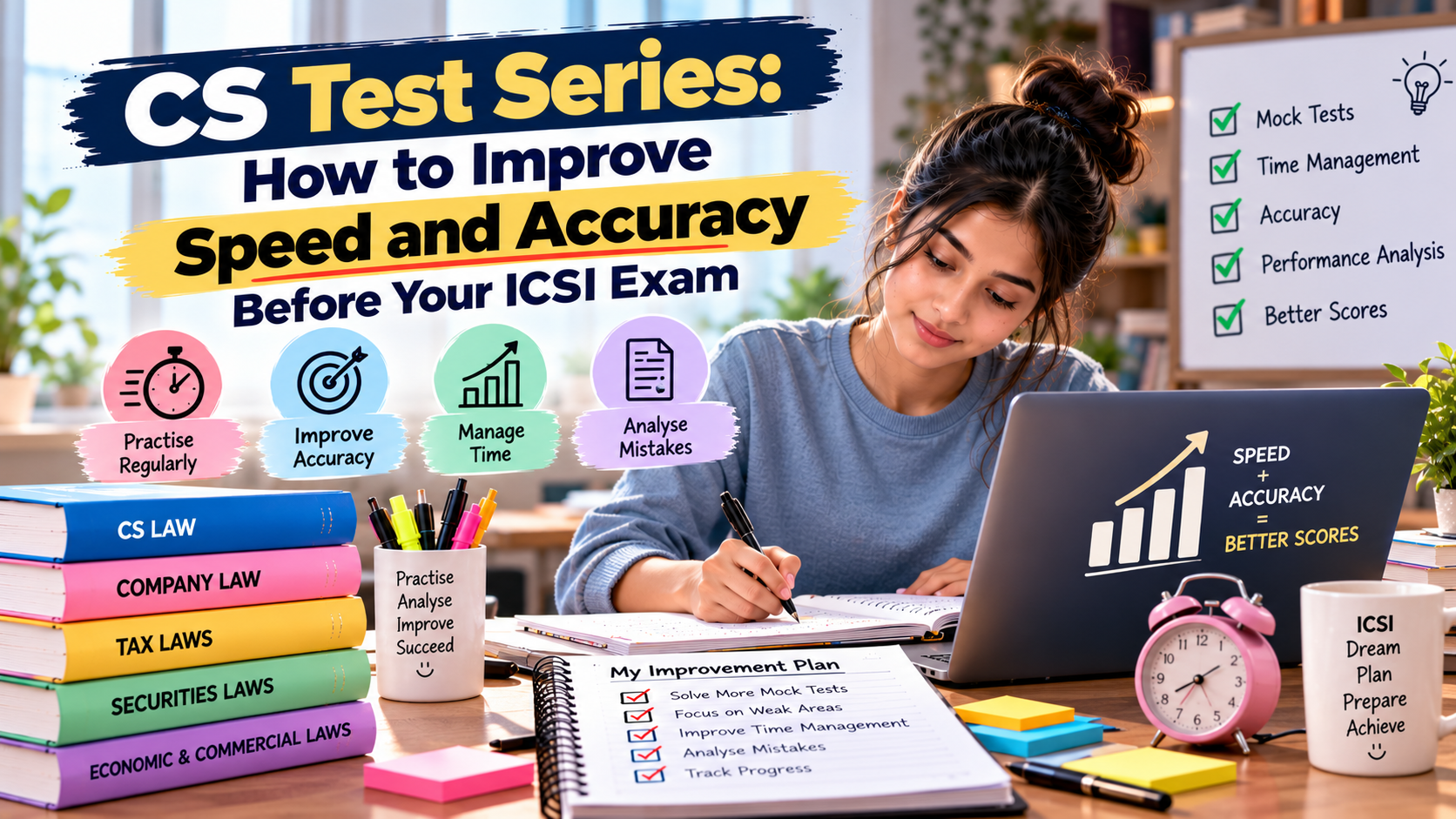
The goal is to build a balanced approach: answer accurately, use time sensibly and leave a short window for checking. A CS Test Series can help you practise these skills in exam-like conditions. The real benefit comes when you review each attempt, identify where time or marks were lost, and use that information to improve the next one.
Find Out What Is Slowing You Down
Before trying to write faster, identify what is actually costing you time. Some students spend too long recalling provisions or definitions. Others repeatedly reread the question, write more than the requirement asks for, or struggle to organise an answer before starting. In objective tests, students may change correct answers because they are unsure; in written papers, they may spend too much time on the opening questions.
Use one timed practice paper to observe your habits. Note which questions took longer than expected, where you hesitated, and whether errors came from weak understanding, misreading, poor planning or rushed work. This diagnosis is more useful than simply deciding to study faster.
Practise Under Realistic Time Limits
Timed practice teaches you to make decisions while the clock is running. Choose a test that matches the syllabus and examination format applicable to your attempt. Put away notes and distractions, use a timer, and attempt the paper in one sitting if it is intended to simulate exam conditions.
Start with a manageable section if a full paper feels difficult. Once you can complete it with reasonable accuracy, increase the length or use a full-length mock. Do not shorten the time limit too aggressively at the beginning. Speed should develop alongside understanding, not at the cost of it.
Use a Time Budget Before You Start
At the beginning of a paper, take a brief moment to understand the sections and marks distribution. Allocate time according to the requirements and marks available, while keeping a small buffer for review. Your exact approach should follow the instructions and pattern for your current ICSI examination.
During practice, compare the time you planned with the time you actually used. If one question consumes much more time than expected, learn to move forward and return to it if time permits. Avoid spending a disproportionate amount of time perfecting one response while leaving other questions incomplete.
Read the Question Carefully Before Answering
Many avoidable mistakes begin before the answer itself. Read the complete question and identify its instruction words. “Explain”, “distinguish”, “discuss”, “calculate” and “advise” do not ask for identical responses. Underline or mentally note the key requirement, the facts provided and each part that needs to be addressed.
For a case-based question, separate the important facts from background details. Identify the relevant rule or concept, apply it to those facts and give a clear conclusion where appropriate. This simple structure can prevent you from writing a long answer that does not actually answer the question.
Improve Recall With Active Practice
If you repeatedly pause because you cannot recall a concept, rereading the chapter may not be enough. Use active recall: close your notes and try to explain the rule, list the key points or outline the answer from memory. Then check what you missed and repeat the exercise after a gap.
Make short revision prompts for difficult topics. For law-based papers, focus on the meaning and conditions of provisions and how they apply. For practical or application-oriented questions, practise the method step by step. For objective questions, explain why the correct option works and why the other options do not. Use current official study material and syllabus guidance as your core reference.
Build an Answer Structure That Saves Time
Written answers become faster when you do not have to invent a structure from scratch every time. For a question that requires application, a useful pattern is to identify the issue, state the relevant rule or concept, apply it to the facts and conclude. For a theory question, use a brief opening line followed by clear points or short paragraphs that directly address the requirement.
Keep the structure flexible. Not every question needs four separate headings, and not every answer needs a lengthy introduction. Write enough to cover the relevant points clearly, but avoid repetition and unrelated information. Good presentation helps the examiner follow your reasoning and helps you manage the time available.
Use Accuracy Checks Without Losing Time
Accuracy improves when you learn which checks catch the most common errors. In a written answer, check that you have addressed every part of the question, used the relevant concept correctly and included a conclusion when needed. In a practical answer, review the key steps, figures, units or assumptions that apply. In an objective test, check that you selected the option matching your reasoning rather than a familiar-sounding phrase.
Do not reread every line several times. Use a short, consistent checklist and reserve a few minutes at the end where the exam format permits. The purpose of checking is to catch meaningful errors, not to make every answer feel perfect.
Analyse Your CS Test Series Results
A test score tells you how an attempt went, but a performance review tells you what to do next. After each CS Test Series paper, note the score, time used, questions left incomplete and the main types of mistakes. Separate knowledge gaps from errors caused by rushing or poor time allocation.
Track the same measures over several attempts. If you finish faster but make more mistakes, your pace may be too aggressive. If accuracy is strong but you leave questions unanswered, practise time allocation and concise responses. If the same topic keeps causing errors, revise it and attempt fresh questions before the next full mock.
A Simple Speed and Accuracy Tracker
Use a small table after each test. Keep the entries brief and focus on actions you can complete before the next attempt.
| Measure | What to record | How to respond |
|---|---|---|
| Completion | Questions attempted and left unfinished | Practise section timing and move on from stuck questions |
| Accuracy | Correct answers and avoidable errors | Slow down at error-prone steps and review concepts |
| Recall | Topics where you hesitated or checked notes | Use active recall and spaced revision |
| Presentation | Missing points or unclear answer structure | Practise concise, organised answers |
| Time use | Actual time compared with your plan | Adjust question-level time limits |
A Weekly Practice Routine Before the Exam
A balanced week should include timed practice, careful review, targeted revision and a follow-up test. The amount of each depends on how much syllabus remains and how close the examination is. Avoid filling every available hour with mock tests if you have no time left to learn from them.
One practical sequence is to complete a timed section or mock, review it on the same day or the next day, revise the two or three most important weaknesses, and solve a fresh set of related questions. Revisit difficult questions after a few days. As the exam approaches, add full-length practice that reflects the current examination conditions and keep a short revision cycle for older topics.
| Step | Action | Purpose |
|---|---|---|
| 1. Attempt | Take a timed section or mock | Practise under realistic conditions |
| 2. Review | Check answers and note errors | Understand why marks were lost |
| 3. Prioritise | Select two or three weak areas | Keep revision focused |
| 4. Correct | Revise and solve fresh questions | Build reliable understanding |
| 5. Retest | Try related questions after a gap | Check retention and progress |
How CS Test Series Practice Can Help
A CS Test Series gives you a repeatable setting to practise timing, question selection and answer presentation. Choose a series that reflects the syllabus and paper format for your examination stage, and check how results and evaluation are provided. The number of papers matters less than whether you can complete and review them properly.
Before each test, set one or two targets—for example, to finish a section on time or reduce incomplete answers. After the test, compare the result with those targets. If you receive evaluator comments, turn them into specific tasks. If not, compare your work with reliable suggested answers and official study material. This keeps each mock connected to a clear improvement goal.
Common Habits That Reduce Speed or Accuracy
Trying to write every detail is a common reason students run out of time. Focus on the question requirement and the relevant points. Another problem is practising without a timer and expecting exam speed to appear automatically. Make timed practice a regular part of preparation rather than leaving it until the final days.
Do not guess that faster always means better. Rushing through a question without understanding it can cost more marks than taking a few seconds to plan. Also avoid changing an answer in an objective test without a clear reason, copying model answers without understanding them, or ignoring repeated mistakes because the overall score looks acceptable.
Final Checklist for Your Next Mock Test
Before the test, check that you have selected a paper aligned with your current syllabus, set up a quiet place and decided on a time budget. During the test, read requirements carefully, keep answers focused and move on when a question is consuming too much time. After the test, identify the main errors and decide how to correct them.
Improving speed and accuracy is a gradual process. Focus on steady progress across several attempts rather than expecting a dramatic change after one mock. When you practise under realistic conditions and act on feedback, you build a clearer understanding of your pace, your weak areas and the methods that help you perform more consistently.
Conclusion: Practise Smart, Then Practise Again
Better exam performance comes from combining knowledge with deliberate practice. Use timed tests to build pace, question analysis to reduce avoidable errors and targeted revision to strengthen weak areas. Keep checking whether your changes improve both completion and accuracy.
A consistent CS Test Series routine can help you prepare with more purpose before your ICSI exam. Attempt, review, correct and retest—this cycle makes practice useful and keeps your preparation focused on measurable improvement.