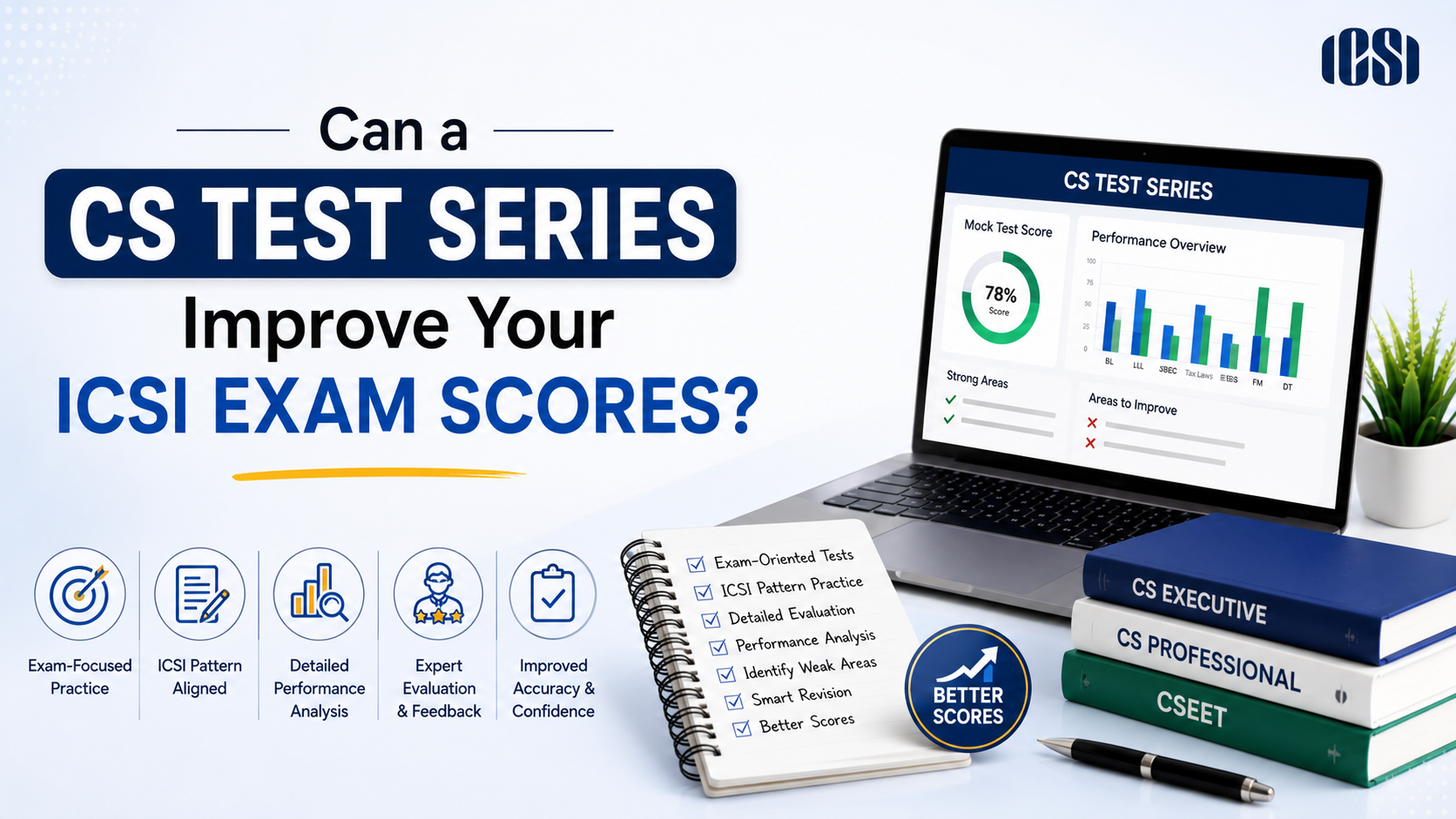
Preparing for an ICSI examination is not only about completing the syllabus. Many CS students study for months, revise multiple times, watch lectures, make notes and still struggle to convert their preparation into marks.
The reason is simple: knowing the subject and writing the exam are two different skills.
You may understand Company Law but still lose marks because your answer is poorly structured. You may know the provisions but spend too much time on one question. You may complete the syllabus but discover during the actual examination that you are not comfortable writing answers within the given time.
This is where a CS Test Series can make a meaningful difference.
A good test series does not magically increase your marks. Instead, it gives you repeated opportunities to practise the exact skills that matter in the examination — answer writing, time management, question selection, presentation, revision, accuracy and self-analysis.
So, can a CS Test Series improve your ICSI exam scores?
Yes — if you use it as a preparation and improvement tool rather than simply treating it as another set of question papers.
Why Do CS Students Lose Marks Even After Studying the Syllabus?
One of the biggest misconceptions among CS aspirants is:
“If I have completed the syllabus, my preparation is complete.”
Unfortunately, that is not how professional examinations work.
ICSI examinations require students to demonstrate their understanding through written answers. Depending on the paper and examination stage, students may need to explain concepts, apply legal provisions, analyse situations, present arguments and structure answers appropriately.
The Institute itself provides previous-session question papers and guideline answers, making answer practice and comparison an important part of preparation.
Consider a simple example.
A student may know the answer to a Company Law question but write:
- an unnecessarily long introduction,
- no clear provision,
- poor application to the situation,
- no conclusion,
- and spend 25 minutes on a question worth 10 marks.
The knowledge is there.
The marks, however, may not reflect that knowledge.
This is why exam-oriented practice matters.
What Is a CS Test Series?
A CS Test Series is a structured set of practice examinations designed to help students prepare for the actual CS examination environment.
Depending on the provider, a test series may include:
- Chapter-wise tests
- Topic-wise tests
- Subject-wise tests
- Full-length mock examinations
- Revision tests
- Previous-year-question-based tests
- Exam-pattern papers
- Model answers
- Evaluated answer sheets
- Performance reports
- Time-management guidance
- Personalized feedback
The best CS Test Series should not simply give you more questions.
It should help you answer a more important question:
“What exactly is stopping me from scoring higher?”
That could be a knowledge gap, weak presentation, poor time management, incomplete answers, lack of revision or simply insufficient writing practice.
How Can a CS Test Series Improve Your ICSI Exam Scores?
A well-designed test series can influence your marks in several ways.
Let's look at the most important ones.
1. It Converts Passive Study Into Active Practice
Reading study material feels productive, but reading alone does not tell you whether you can reproduce the information under examination pressure.
A test forces you to recall the concept without looking at your notes.
This is called active recall, and it is one of the most useful ways to identify whether you actually remember what you studied.
For example, you might read a chapter on Company Law three times and feel confident about it.
Then a test asks you to explain a specific provision.
Suddenly, you realise:
“I know this topic, but I cannot frame the answer properly.”
That discovery is valuable.
You can now work on the weakness before the actual examination.
2. It Improves Answer-Writing Skills
For CS students, answer writing is not something that should be postponed until the final week.
It needs practice.
A good CS Test Series allows you to practise:
- How to start an answer
- How to present legal provisions
- How to apply provisions to case studies
- How to structure long answers
- How to use headings and subheadings
- How to write conclusions
- How to avoid unnecessary content
- How to manage lengthy questions
This becomes particularly important for theory-heavy papers.
The difference between a 5-mark answer and an 8-mark answer is sometimes not the amount of knowledge but how effectively that knowledge is presented.
3. It Improves Time Management
Time management is one of the most common problems students face in professional examinations.
You may know every answer and still leave questions incomplete because you spent too much time on earlier questions.
A full-length mock test gives you an opportunity to practise the three-hour examination environment.
You learn:
- How quickly you write
- How much time you need for different questions
- Whether you spend too much time on difficult questions
- How much time you need for revision
- Whether you can complete the paper comfortably
For example:
|
Situation |
Without Mock Practice |
With Regular Mock Practice |
|
Starting the paper |
Takes time to settle |
Faster and more confident |
|
Time allocation |
Often random |
Planned |
|
Difficult question |
May consume too much time |
Better control |
|
Answer completion |
Questions may remain |
Better completion rate |
|
Revision time |
Often unavailable |
Can be planned |
|
Exam pressure |
Feels unfamiliar |
Becomes familiar |
The goal is not merely to finish the paper.
The goal is to finish it with enough time to review your answers.
4. It Helps You Identify Your Weak Subjects
Students often believe they know their strengths and weaknesses.
But assumptions can be misleading.
A performance report from multiple tests can reveal patterns.
Suppose your results look like this:
|
Subject |
Test 1 |
Test 2 |
Test 3 |
Average |
|
Company Law |
61% |
66% |
69% |
65% |
|
JIGL |
52% |
55% |
58% |
55% |
|
Tax Laws |
43% |
48% |
51% |
47% |
|
CSEET Business Communication |
72% |
75% |
78% |
75% |
The data tells you something your feelings may not.
You may have thought Company Law was your weakest subject because it feels difficult.
But your test performance shows that Tax Laws actually needs more attention.
This is why performance analysis is as important as attempting the test.
5. It Shows Whether Your Revision Is Actually Working
Revision should improve your performance.
If your scores remain unchanged after repeated revision, something needs to change in your preparation strategy.
For example:
Test 1: 48%
Revision: 1 week
Test 2: 55%
Revision: 1 week
Test 3: 63%
That upward trend indicates that your revision strategy is working.
But if your scores are:
Test 1: 51%
Test 2: 50%
Test 3: 52%
simply studying more may not solve the problem.
You need to identify why your performance is stagnant.
6. It Builds Examination Confidence
Confidence does not come only from motivation.
It comes from familiarity.
The first time you sit for a three-hour mock examination, it may feel uncomfortable.
Your handwriting speed may feel slow.
You may struggle to remember provisions.
You may panic when you see a difficult question.
But after attempting several tests, the examination environment becomes less unfamiliar.
You start thinking:
“I have handled this situation before.”
That psychological advantage can be extremely useful on examination day.
Does a CS Test Series Work for CSEET, Executive and Professional?
Yes, but the approach should be different for each stage.
ICSI has also restructured CSEET from the June 2026 session, with an enhanced assessment framework focusing on conceptual understanding, analytical abilities, communication skills and professional aptitude.
CSEET
For CSEET students, tests can help build:
- Conceptual clarity
- Speed
- Accuracy
- Subject familiarity
- Examination confidence
- Regular revision habits
With the restructured CSEET, students should ensure that their test practice matches the applicable current syllabus and examination format.
CS Executive
At the Executive level, the syllabus becomes significantly more detailed.
The current ICSI Executive Programme includes subjects such as JIGL, Company Law & Practice, Setting Up of Business, Industrial & Labour Laws, Corporate Accounting & Financial Management, Capital Market & Securities Laws, Economic, Commercial & Intellectual Property Laws and Tax Laws & Practice.
A test series can help Executive students manage:
- Large syllabus volume
- Multiple subjects
- Theory-heavy answers
- Numerical questions
- Case-based questions
- Revision pressure
- Time management
CS Professional
At the Professional level, students need an even more strategic approach.
The papers require deeper understanding, professional application and stronger answer presentation.
The current Professional Programme includes papers such as ESG, Drafting, Pleadings & Appearances, Compliance Management, Audit & Due Diligence, Strategic Management & Corporate Finance and Corporate Restructuring, Valuation & Insolvency, along with elective papers.
For these students, mock tests can become particularly valuable for developing professional answer-writing discipline.
How Many Tests Should You Attempt Before the ICSI Exam?
There is no magic number that guarantees success.
Quality matters more than quantity.
A practical approach could look like this:
|
Preparation Stage |
Suggested Tests |
|
After completing a chapter |
1 chapter/topic test |
|
After completing a subject |
1–2 subject tests |
|
First revision |
1 full/major mock |
|
Second revision |
1–2 full mocks |
|
Final preparation |
2–3 full-length mocks |
|
Last few days |
Revision + selective practice |
Instead of saying, “I will attempt 20 tests,” set a better target:
“I will attempt enough tests to identify and fix my recurring mistakes.”
One carefully analysed mock can be more valuable than five tests that you attempt and forget.
How to Analyse Your CS Mock Test Properly
This is where many students make a mistake.
They finish a test, check their marks and move on.
Don't do that.
After every test, create a simple mistake log.
Your mistake log can contain:
|
Mistake Type |
Example |
Action |
|
Conceptual |
Forgot provision |
Revise concept |
|
Memory |
Forgot section/details |
Add to revision list |
|
Presentation |
No headings |
Improve structure |
|
Time |
Last question incomplete |
Improve time allocation |
|
Careless |
Misread question |
Slow down while reading |
|
Application |
Wrong provision applied |
Practise case studies |
After 4–5 tests, you will begin seeing patterns.
For example:
Repeated mistake: Answers are too lengthy.
Your solution:
Practise writing the same answer in 30–40% fewer words while retaining the important points.
Another example:
Repeated mistake: You leave 10 marks unanswered.
Your solution:
Practise completing the paper within a fixed time during every mock.
This is how a test series becomes a score-improvement system.
What Should You Look for in the Best CS Test Series?
Not every test series provides the same value.
Before choosing one, check the following.
1. Does It Follow the Latest ICSI Syllabus?
This should be your first check.
ICSI regularly updates academic material, supplements and examination-related resources. For example, the Institute publishes session-specific supplements for Executive and Professional Programme papers.
Your test series should therefore be aligned with the syllabus applicable to your attempt.
2. Does It Follow the Actual Exam Pattern?
A mock test should feel like an examination, not just a worksheet.
Look for:
- Appropriate marks
- Relevant question types
- Proper difficulty level
- Time-bound papers
- Current syllabus coverage
3. Is Answer Evaluation Available?
This is one of the most important features.
If you only receive a question paper and answer key, you may still not know:
“Why did I lose these marks?”
Evaluation and feedback can make practice much more meaningful.
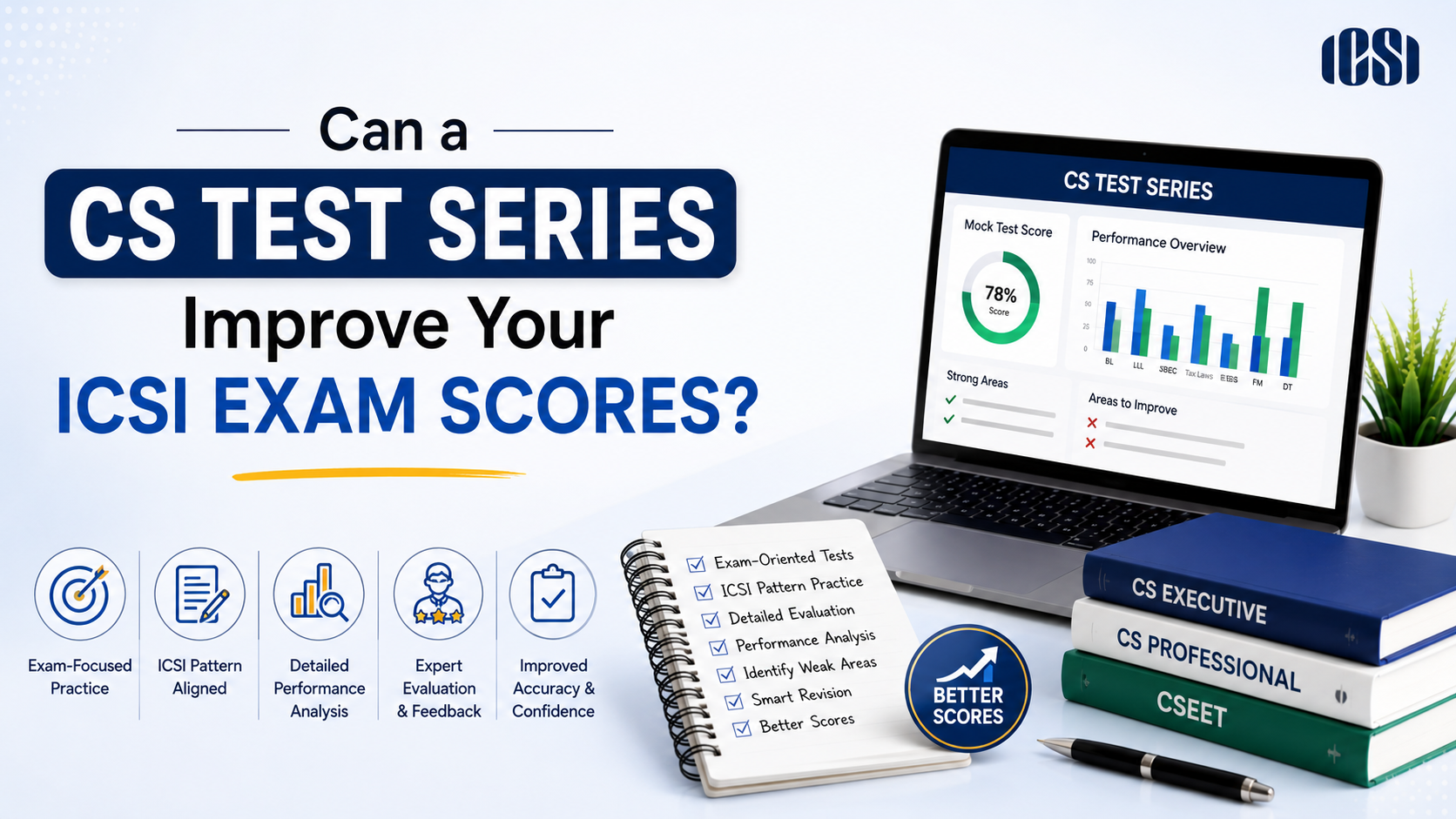
4. Does It Provide Performance Analysis?
Look for reports showing:
- Score
- Accuracy
- Question-wise performance
- Subject-wise performance
- Time performance
- Weak areas
- Improvement areas
5. Does It Include Full-Length Mock Tests?
Chapter tests are useful during learning.
But full-length tests are essential before the examination because they replicate the pressure of completing an entire paper.
6. Are the Tests Based on Current Content?
For subjects affected by amendments, updates and new provisions, old questions alone may not be enough.
Students should combine previous-year questions with current study material and applicable supplements.
ICSI itself provides current session materials and previous-year question papers through its academic and examination portals.
CS Test Series vs Self-Study: Which Is Better?
The real answer is:
You should not have to choose between them.
Self-study gives you knowledge.
Test practice tells you whether you can convert that knowledge into marks.
Think of it like this:
|
Self-Study |
Test Series |
|
Builds knowledge |
Tests knowledge |
|
Helps understand concepts |
Tests recall and application |
|
Covers syllabus |
Identifies gaps |
|
Helps revision |
Measures revision effectiveness |
|
Builds theoretical understanding |
Builds exam readiness |
|
Flexible |
Time-bound |
|
Mostly input-based |
Output-based |
The strongest preparation strategy combines both.
A Simple Strategy to Use a CS Test Series Effectively
If you have enrolled in a test series, don't simply attempt every test randomly.
Follow this process.
Step 1: Study the Topic
Complete the relevant ICSI study material and your preferred notes.
Step 2: Revise
Before taking the test, revise the important provisions, concepts, formulas and keywords.
Step 3: Attempt the Test Under Exam Conditions
Keep your phone away.
Set the timer.
Use the appropriate writing material.
Avoid checking notes.
Treat the test seriously.
Step 4: Get Your Answers Evaluated
If evaluation is available, study the feedback carefully.
Step 5: Compare With the Model Answer
Don't copy the model answer.
Instead, understand:
- What points you missed
- What concepts you misunderstood
- Whether your answer was properly structured
- Whether your conclusion was appropriate
Step 6: Update Your Mistake Book
Maintain one notebook or digital document called:
“My CS Exam Mistakes.”
Write down only mistakes that you are likely to repeat.
Step 7: Re-Test Weak Areas
After revision, attempt another test.
Your goal should be visible improvement.
Can a CS Test Series Guarantee Higher Marks?
No.
And students should be careful about anyone promising guaranteed marks simply because they purchased a test series.
A test series is a preparation tool.
Your final performance depends on several factors:
- Quality of your study
- Conceptual understanding
- Revision
- Answer writing
- Test practice
- Time management
- Exam-day performance
- Consistency
- Ability to learn from mistakes
A test series can create the environment for improvement, but you have to use that environment properly.
What Makes a CS Test Series Actually Worth Buying?
Before spending money, ask yourself five questions:
- Is it based on the latest applicable ICSI syllabus?
- Does it provide exam-oriented papers?
- Will my answers be evaluated?
- Will I receive meaningful performance feedback?
- Can it help me identify exactly where I am losing marks?
If the answer to all five is yes, the test series can become a valuable part of your preparation.
Don't buy a test series just because it has 20 or 30 tests.
Buy it because it helps you improve from Test 1 to Test 2, Test 2 to Test 3 and ultimately perform better in the actual ICSI examination.
Final Verdict: Can a CS Test Series Improve Your ICSI Exam Scores?
Yes — a properly designed and properly used CS Test Series can improve your ICSI exam performance.
But the biggest benefit is not simply “more practice.”
It is better practice.
A good test series helps you discover whether:
- You actually remember what you studied
- You can write answers within the required time
- You understand how to structure your answers
- You are making repeated mistakes
- Your revision is improving your scores
- You are weak in a particular subject or topic
- You can handle a complete paper under examination pressure
The students who benefit the most are not necessarily those who attempt the highest number of tests.
They are the students who attempt, analyse, improve and re-attempt.
So if your ICSI examination is approaching, don't wait until the last few days to discover how well you can perform under exam conditions.
Start testing yourself early.
Because the real question is not:
“Have I studied enough?”
It is:
“Can I convert what I have studied into marks?”
And that is exactly where a well-planned CS Test Series can make a difference.