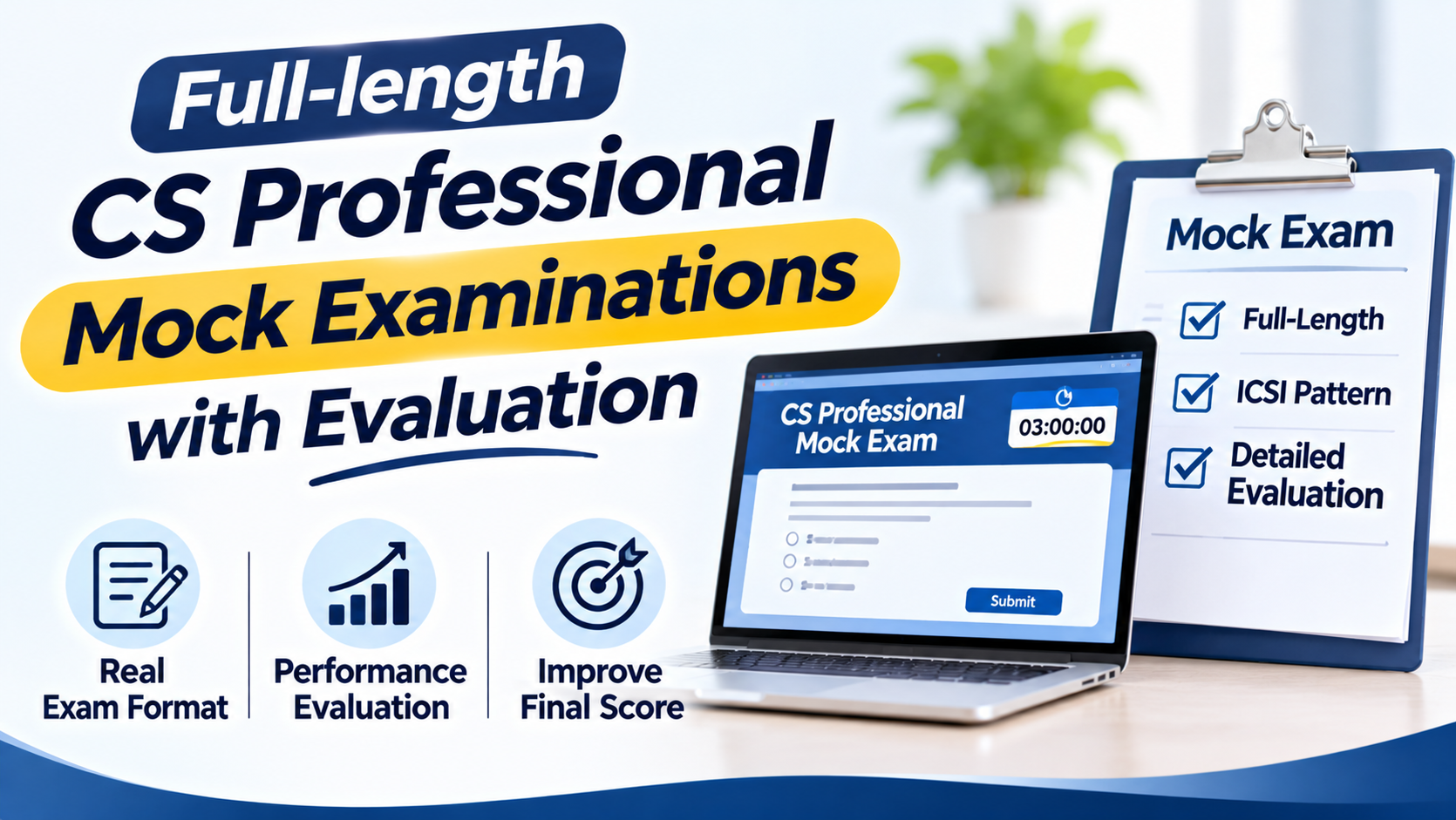
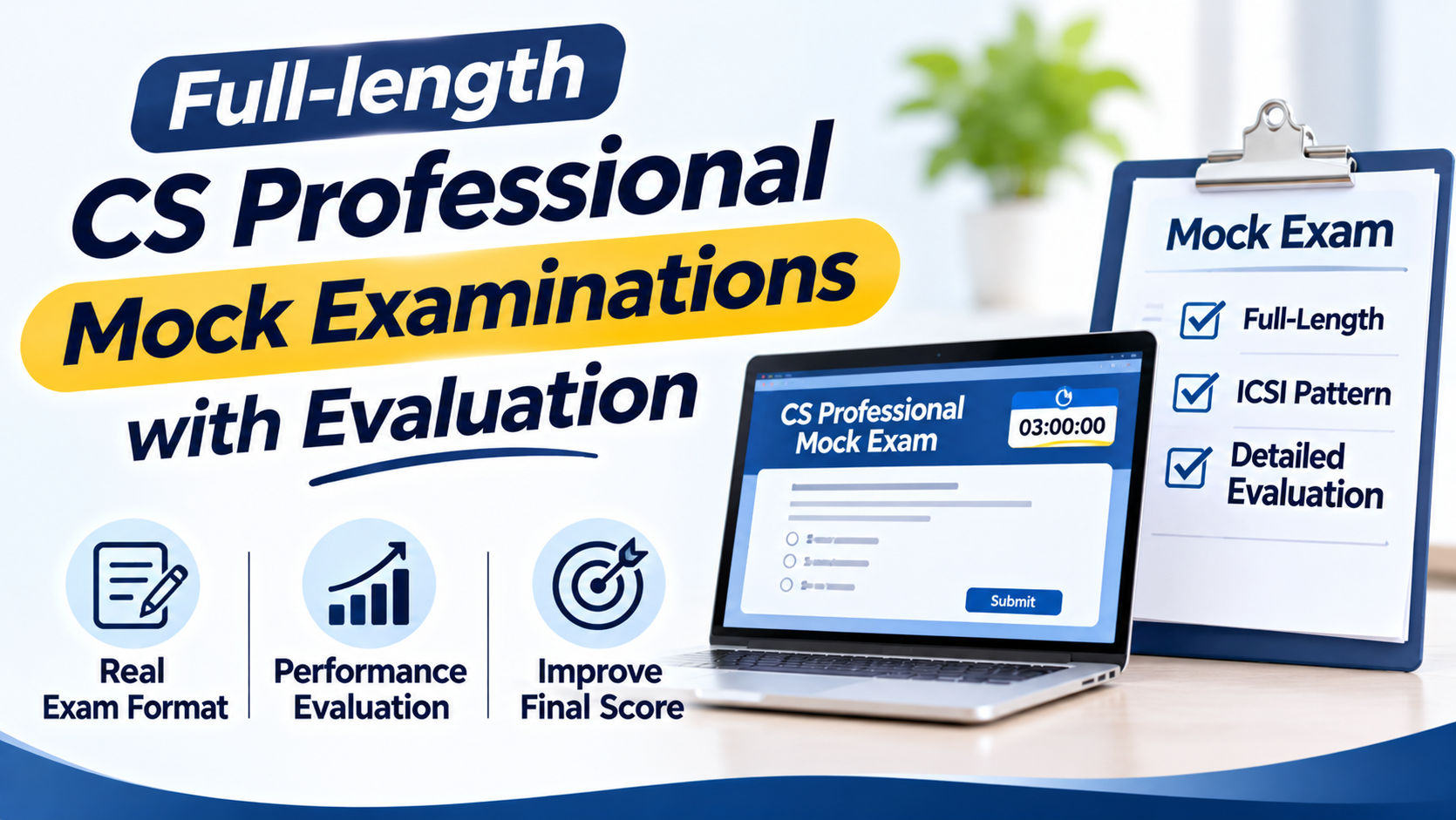
Knowing the CS Professional syllabus is only one part of examination preparation. Students must also organise answers, apply concepts to detailed requirements and manage a complete paper within the prescribed time. Full-length mocks provide an opportunity to practise these skills in one sitting.
Evaluation makes the exercise more useful by showing where marks may be lost and what needs attention. A strong mock routine combines realistic attempts with detailed review, targeted revision and another opportunity to apply the learning.
Why full-length mocks differ from short tests
Chapter tests focus on a limited topic, while a full-length mock requires you to manage an entire paper. You must allocate time, maintain concentration and move between different areas of the syllabus.
This reveals issues short tests may not show. You may understand individual topics but struggle to complete the paper, interpret a long requirement or maintain answer quality towards the end.
Choose papers relevant to your attempt
Check that the mock reflects the syllabus and examination structure applicable to your attempt. Confirm subject, paper coverage, marks distribution and duration from current official information.
Professional-level preparation may involve detailed case-based and application-oriented requirements. Select papers that test knowledge and the ability to connect concepts with facts.
Attempt under realistic conditions
Set aside an uninterrupted time slot and follow the applicable examination duration. Keep only permitted resources and practise writing answers in the format you intend to use.
Read the requirement before beginning. Allocate time according to marks and complexity, and leave a buffer to review unanswered parts. Move forward when a question is taking too long.
Understand what evaluation should cover
Evaluation should assess whether the answer addresses the requirement, includes relevant concepts, applies them to facts and reaches a clear conclusion. Structure, clarity and completeness also matter.
Specific feedback is more useful than general comments. Look for guidance showing which point was missing, where reasoning was unclear or how the answer could be organised.
Use evaluated answers to improve structure
Compare your response with the evaluated answer. Check whether you identified the issue, explained the principle and applied it to the question. Review whether headings and paragraphs made the response easy to follow.
Do not copy model answers mechanically. Understand the suggested structure and practise reproducing essential elements independently.
Classify errors and set corrective actions
Divide errors into knowledge gaps, incorrect interpretation, weak application, incomplete coverage, presentation problems and time-management issues. Each category requires a different response.
Choose a few priority corrections after each mock. Record the action, practise it and check whether it improves in the following attempt.
Use a schedule that allows review
Do not attempt full papers so frequently that you have no time to learn from them. Plan the next test after evaluation, revision of weak areas and practice of similar questions.
Use chapter and sectional tests during learning. As syllabus coverage improves, introduce full-length papers. In final revision, prioritise realistic mocks and focused correction.
Track progress across attempts
Record marks, completion time, unanswered questions, recurring errors and improvement actions. Compare performance across several tests instead of reacting strongly to one score.
Look for changes in answer completeness, time control and repeated mistakes. Improvement may be meaningful even when marks fluctuate between papers.
Avoid common full-length mock mistakes
Do not read solutions before attempting, pause the timer repeatedly or leave evaluation until the examination is close. These habits reduce the value of a realistic simulation.
A mock score is not a prediction or guarantee. It is an indicator of current performance under particular conditions and should guide improvement.
How CS Exams Test Series can support evaluation
CS Exams Test Series can be part of a routine for full-paper practice and performance review. Check the evaluation format, paper coverage, submission process and feedback details before selecting a plan.
Use every evaluated attempt to identify specific changes for the next paper. Consistent practice, current official material and careful review are more useful than mock scores alone.
Quick Reference Table
| Evaluation area | What to review | Improvement action |
|---|---|---|
| Content accuracy | Relevant concepts and provisions | Revise the topic and verify current material |
| Application | Connection between rule and facts | Practise case-based questions |
| Structure | Logical sequence and conclusion | Use a consistent answer framework |
| Completeness | All parts addressed | Underline command words and sub-parts |
| Time management | Time spent and unanswered questions | Practise timed allocation |
| Presentation | Clarity and readability | Rewrite weak answers |
Conclusion
Consistent preparation depends on understanding the syllabus, practising questions and reviewing performance honestly. Keep your study plan aligned with current official ICSI information, and use CS Exams Test Series as one part of a wider routine of learning, revision and examination practice. Focus on correcting weaknesses from one attempt to the next rather than measuring progress only by the number of tests completed.