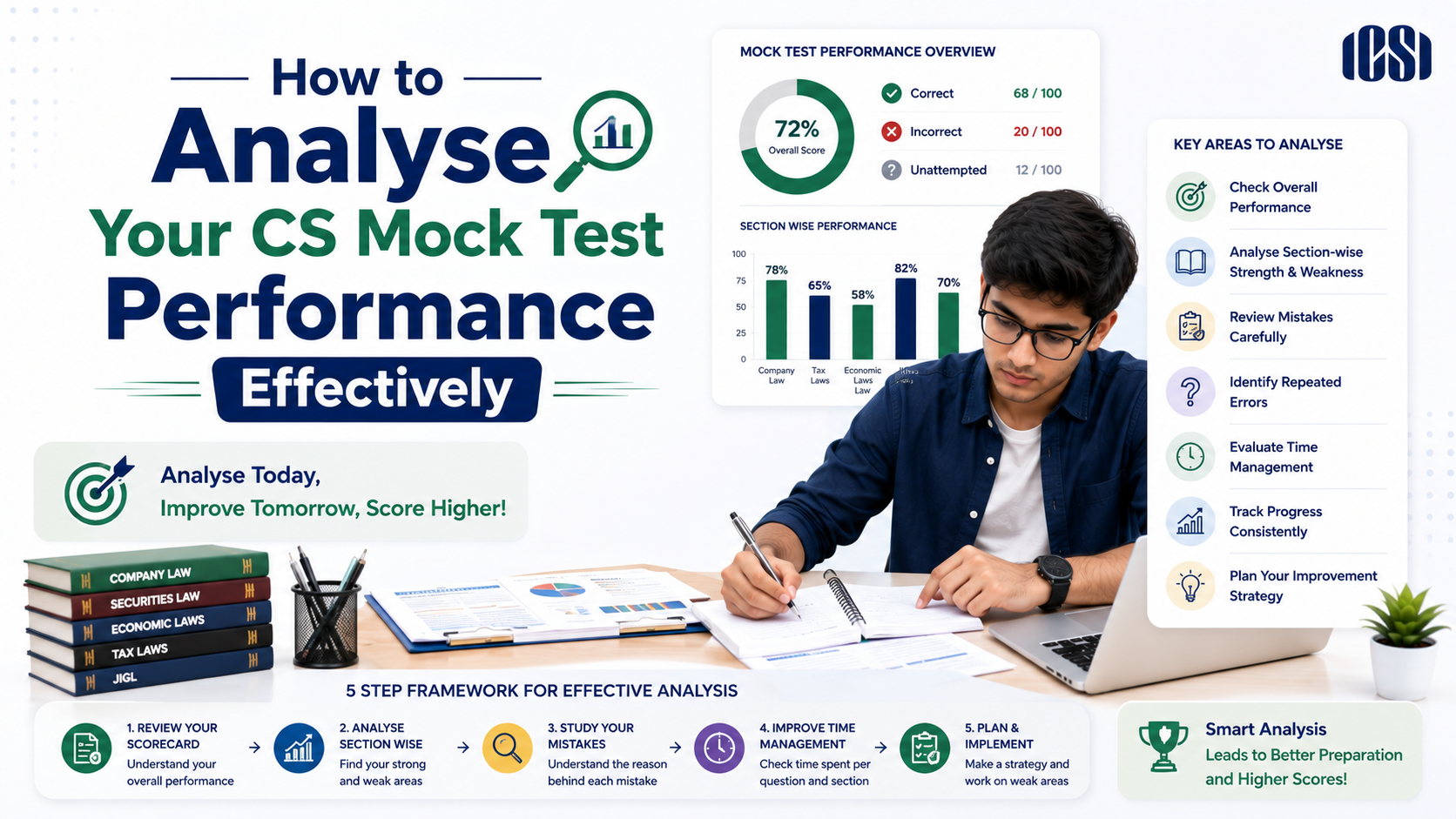
Preparing for the Company Secretary (CS) examinations is not just about completing the syllabus or attempting countless mock tests. The real transformation begins after the mock test is over. Surprisingly, many students spend three hours writing a mock paper but barely fifteen minutes reviewing it. This habit limits improvement and often leads to repeating the same mistakes in the actual ICSI examination.
If you genuinely want to improve your scores, analysing your mock test is just as important as attempting it.
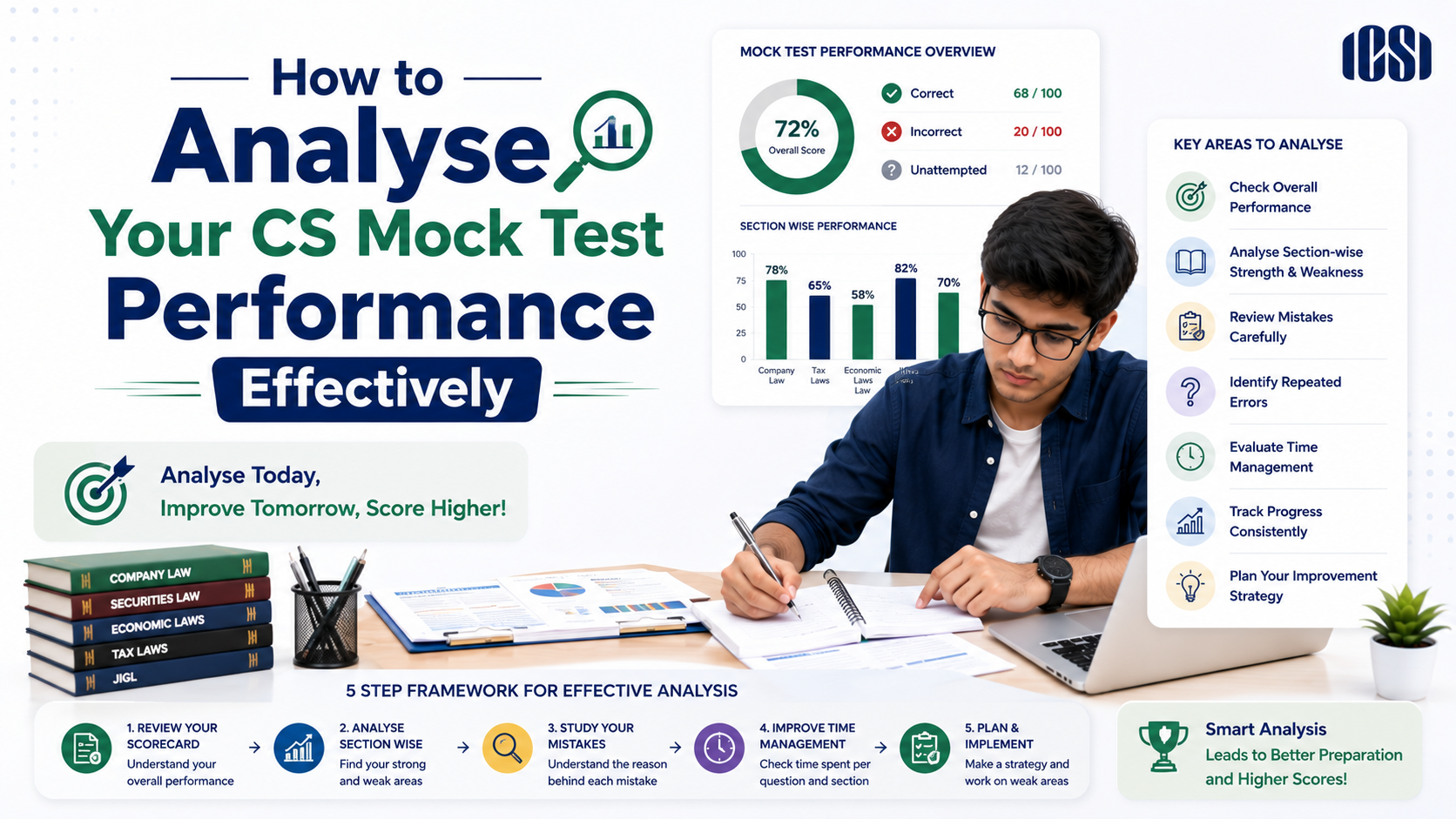
Think of a mock test as a mirror. It doesn't simply tell you your marks—it reveals your strengths, weaknesses, preparation gaps, time management issues, and answer-writing skills. Students who consistently analyse their mock tests usually improve much faster than those who only focus on writing more tests.
In this detailed guide, you'll learn exactly how to analyse your CS mock test performance effectively, identify recurring mistakes, and create an improvement plan that helps you perform confidently in your next ICSI examination.
Why Analysing Mock Tests is More Important Than Attempting More Tests
Imagine two CS students.
- Student A attempts 20 mock tests but never reviews them properly.
- Student B attempts only 10 mock tests but spends two hours analysing each one.
Who is more likely to score better?
In most cases, Student B.
Why?
Because improvement doesn't happen during the test—it happens while understanding your mistakes.
Every mock test provides valuable insights like:
- Which chapters are weak
- Which concepts are repeatedly misunderstood
- Whether time management is effective
- Whether answers match ICSI expectations
- Whether presentation needs improvement
The purpose of a mock test is not to achieve a perfect score. Instead, it is to discover mistakes before they appear in the actual examination.
Attempting vs Analysing Mock Tests
|
Factor |
Only Attempting Tests |
Attempting + Analysing Tests |
|
Score Improvement |
Slow |
Much Faster |
|
Mistake Repetition |
High |
Low |
|
Confidence |
Average |
High |
|
Time Management |
Random |
Well Planned |
|
Exam Readiness |
Incomplete |
Strong |
What to Do Immediately After Completing Your Mock Test
Many students check their marks and move on to the next subject.
This is the biggest mistake.
Instead, follow this simple routine after every mock test.
Step 1: Take a Short Break
Give yourself 20–30 minutes before reviewing the paper.
A fresh mind helps you identify mistakes more objectively.
Step 2: Compare Your Answers with Suggested Solutions
Don't just compare marks.
Compare:
- Structure
- Language
- Keywords
- Legal provisions
- Case laws (if applicable)
- Presentation
- Conclusion
Ask yourself:
- Did I answer exactly what the question asked?
- Did I miss important points?
- Did I over-explain?
- Did I write irrelevant information?
Step 3: Highlight Every Mistake
Use different colours for different mistake categories.
For example:
|
Colour |
Meaning |
|
Red |
Conceptual mistake |
|
Yellow |
Silly mistake |
|
Blue |
Presentation issue |
|
Green |
Time management issue |
This simple technique makes future revisions much easier.
Step-by-Step Process to Analyse Your CS Mock Test Performance
Instead of only checking marks, analyse your paper from five different perspectives.
Concept Accuracy
The first question should always be:
Did I know the concept?
If your concept is incorrect, memorising answers won't help.
Check:
- Incorrect legal provisions
- Wrong interpretation
- Missing concepts
- Confused chapters
- Incomplete understanding
Example
Question:
Explain the Secretarial Audit provisions.
Your answer:
Correct definition but missed applicability criteria.
Analysis:
The issue is not answer writing.
The issue is conceptual understanding.
Action:
Revise Secretarial Audit provisions from study material.
Time Management Analysis
One of the biggest reasons students lose marks is poor time allocation.
Track how much time you spent on each question.
Example Time Analysis
|
Question |
Marks |
Ideal Time |
Actual Time |
Difference |
|
Q1 |
20 |
36 mins |
48 mins |
+12 mins |
|
Q2 |
16 |
29 mins |
25 mins |
-4 mins |
|
Q3 |
16 |
29 mins |
22 mins |
-7 mins |
|
Q4 |
24 |
43 mins |
39 mins |
-4 mins |
|
Q5 |
24 |
43 mins |
46 mins |
+3 mins |
This table quickly reveals whether you are spending too much time on certain questions while rushing through others.
Accuracy vs Guesswork
Not every incorrect answer means you lack knowledge.
Sometimes students:
- Assume facts
- Guess legal provisions
- Forget section numbers
- Mix two concepts together
Categorise every wrong answer honestly.
|
Reason |
Action Required |
|
Didn't Know |
Revise chapter |
|
Forgot |
Regular revision |
|
Confused |
Practice similar questions |
|
Careless |
Improve concentration |
Being honest during this stage is essential because your future study plan depends on it.
Analyse Your Answer Writing Style
ICSI evaluates more than just knowledge.
Presentation matters.
Review your answers from an examiner's perspective.
Ask yourself:
- Is the introduction clear?
- Are headings used properly?
- Are important keywords highlighted?
- Is handwriting readable?
- Is the answer well-structured?
- Is the conclusion relevant?
- Are legal provisions quoted correctly?
A well-presented answer often scores higher than a lengthy but poorly organised one.
Characteristics of a High-Scoring CS Answer
|
Good Practice |
Benefit |
|
Clear headings |
Easy for examiner to evaluate |
|
Bullet points |
Improves readability |
|
Legal keywords |
Demonstrates conceptual clarity |
|
Logical flow |
Better presentation |
|
Proper conclusion |
Leaves a positive impression |
|
Balanced answer length |
Better time management |
Identify Your Strong and Weak Subjects
Every mock test helps you understand where you truly stand.
Create a simple performance tracker after each paper.
|
Subject |
Confidence Level |
Revision Needed |
|
Company Law |
⭐⭐⭐⭐⭐ |
Low |
|
Securities Laws |
⭐⭐⭐⭐ |
Moderate |
|
Economic Laws |
⭐⭐⭐ |
High |
|
Tax Laws |
⭐⭐ |
Very High |
|
Drafting |
⭐⭐⭐⭐ |
Moderate |
After analysing three to five mock tests, you'll start noticing patterns. Maybe you're consistently losing marks in drafting, or perhaps your understanding of tax laws needs strengthening. These insights allow you to revise strategically instead of studying everything again.
Build a Personal Mock Test Performance Tracker
One of the biggest differences between average students and top rankers is that toppers track their progress consistently. They don't rely on memory to remember what went wrong. Instead, they maintain a performance tracker that highlights recurring mistakes and improvement areas.
A performance tracker helps you answer questions like:
- Am I improving after every mock test?
- Which subjects consistently bring my score down?
- Is my answer-writing getting better?
- Am I managing time more effectively?
- Which topics require another revision?
You can create this tracker in Microsoft Excel, Google Sheets, or even a notebook.
Sample Mock Test Performance Tracker
|
Mock Test |
Subject |
Score |
Accuracy |
Time Management |
Presentation |
Major Weakness |
Improvement Needed |
|
Mock 1 |
Company Law |
52/100 |
68% |
Average |
Good |
Case Laws |
Revise Case Laws |
|
Mock 2 |
Company Law |
61/100 |
75% |
Good |
Better |
Secretarial Audit |
Practice Questions |
|
Mock 3 |
Company Law |
74/100 |
86% |
Excellent |
Excellent |
Minor Errors |
Regular Revision |
After 5–10 mock tests, this tracker will clearly show whether your preparation is moving in the right direction.
Create a Mistake Log
This is one habit followed by many successful CS rank holders.
Instead of writing notes again and again, maintain a dedicated Mistake Log.
Every time you make a mistake in a mock test, write it down.
The goal is simple:
Never repeat the same mistake twice.
What Should Your Mistake Log Include?
|
Topic |
Mistake |
Reason |
Correct Approach |
Revised (Yes/No) |
|
Secretarial Audit |
Missed applicability |
Forgot provision |
Revise Section & Conditions |
Yes |
|
FEMA |
Wrong concept |
Confused with RBI Guidelines |
Read Chapter Again |
No |
|
Ethics |
Incomplete answer |
Lack of examples |
Practice Answer Writing |
Yes |
Review this mistake log every weekend.
You'll be surprised how many recurring mistakes disappear after just a few weeks.
Analyse Chapter-Wise Performance
Many students only look at the overall score.
Instead, divide your performance chapter by chapter.
This approach gives a much clearer picture of your preparation.
Example Chapter Analysis
|
Chapter |
Questions Attempted |
Correct |
Accuracy |
|
Company Law |
18 |
15 |
83% |
|
SEBI Regulations |
10 |
6 |
60% |
|
Insolvency Code |
12 |
11 |
92% |
|
FEMA |
8 |
4 |
50% |
|
Ethics & Governance |
14 |
13 |
93% |
Looking at this table, it's obvious that FEMA and SEBI Regulations require immediate attention.
Without such analysis, you might waste time revising chapters you're already strong in.
Evaluate Your Time Management
Time management is often the deciding factor in CS examinations.
Many students know the answers but fail to complete the paper.
Ask yourself these questions after every mock test:
- Which question consumed the most time?
- Which question did I skip?
- Did I panic during difficult questions?
- Did I spend too much time on one answer?
- Did I leave enough time for revision?
Common Time Management Problems
|
Problem |
Impact |
Solution |
|
Spending too much time on first question |
Remaining paper rushed |
Follow fixed time per mark |
|
Writing lengthy answers |
Less questions attempted |
Write point-wise |
|
Thinking too much |
Time loss |
Start writing with available points |
|
Frequent erasing |
Poor speed |
Improve confidence |
|
Poor planning |
Incomplete paper |
Allocate time before starting |
Remember:
Every mark carries equal value, but every minute is limited.
Learning to distribute your time wisely can significantly improve your final score.
Evaluate Your Answer Presentation
Presentation can make a noticeable difference in descriptive papers.
Even if two students have similar knowledge, the one with a better presentation often scores higher.
While reviewing your mock paper, evaluate the following aspects.
Answer Presentation Checklist
|
Parameter |
Self Rating (1–5) |
|
Proper Introduction |
⭐⭐⭐⭐⭐ |
|
Headings Used |
⭐⭐⭐⭐⭐ |
|
Bullet Points |
⭐⭐⭐⭐⭐ |
|
Keywords Highlighted |
⭐⭐⭐⭐⭐ |
|
Legal Provisions Mentioned |
⭐⭐⭐⭐⭐ |
|
Examples Included |
⭐⭐⭐⭐⭐ |
|
Conclusion Written |
⭐⭐⭐⭐⭐ |
|
Neat Handwriting |
⭐⭐⭐⭐⭐ |
Any section scoring below 4 should become your focus during the next mock test.
Compare Your Answers with Topper Copies
One of the fastest ways to improve answer writing is by comparing your answers with high-scoring answer sheets.
Observe:
- Structure
- Flow
- Legal terminology
- Formatting
- Use of headings
- Keyword placement
- Logical explanation
- Conclusion
Don't copy blindly.
Understand why their answers score better.
Identify Score-Losing Patterns
Many students unknowingly repeat the same mistakes in every mock test.
Some common patterns include:
- Missing important legal provisions
- Forgetting section numbers
- Writing unnecessary theory
- Ignoring question requirements
- Poor handwriting
- Weak introductions
- Lack of conclusions
- Not using headings
Create a simple pattern tracker.
Performance Pattern Tracker
|
Issue |
Frequency |
Priority |
|
Time Management |
High |
Immediate |
|
Missing Keywords |
Medium |
High |
|
Weak Conclusions |
Medium |
Moderate |
|
Poor Presentation |
Low |
Moderate |
|
Concept Errors |
High |
Immediate |
This helps you focus on improvements that will have the greatest impact on your score.
Calculate Your Improvement Percentage
Don't only compare marks.
Measure improvement scientifically.
Use this simple formula:
Improvement (%) = ((Latest Score − Previous Score) ÷ Previous Score) × 100
Example
|
Mock Test |
Score |
|
Mock 1 |
48 |
|
Mock 2 |
56 |
|
Mock 3 |
67 |
|
Mock 4 |
74 |
Instead of worrying about not scoring 90 immediately, celebrate consistent progress.
Small improvements every week lead to significant results by exam time.
Focus on High-Weightage Mistakes First
Not all mistakes deserve equal attention.
Prioritize the mistakes that cost you the most marks.
Priority Matrix
|
Priority |
Example |
Action |
|
High |
Wrong legal concept |
Revise immediately |
|
High |
Weak chapter |
Daily practice |
|
Medium |
Presentation issues |
Practice answer writing |
|
Medium |
Time management |
Weekly mock tests |
|
Low |
Minor spelling mistakes |
Improve gradually |
Working on high-impact mistakes first ensures maximum score improvement with limited preparation time.
Turn Every Mock Test into a Learning Session
Many students think success comes from writing more and more mock tests.
In reality, success comes from learning something new after every mock test.
After each paper, ask yourself these five questions:
- What did I do well?
- What mistakes did I make?
- Why did those mistakes happen?
- How can I avoid them next time?
- What will I improve before the next mock test?
If you can answer these honestly after every test, your preparation will improve consistently.
10 Common Mistakes Students Make While Analysing CS Mock Tests
Even after attempting multiple mock tests, many students fail to improve because they analyse them incorrectly—or worse, they don't analyse them at all. Here are the most common mistakes you should avoid.
1. Focusing Only on Marks
Marks are just one indicator of performance. A score of 55 may be more valuable than a 70 if it reveals important learning opportunities. Instead of asking, "How many marks did I score?" ask, "Why did I lose marks?"
2. Ignoring the Examiner's Feedback
If you're using an evaluated CS Test Series, every comment from the evaluator is valuable. Feedback often points out issues like poor presentation, missing legal provisions, or weak conclusions. Ignoring these comments means missing a chance to improve.
3. Not Revising Weak Topics Immediately
Many students identify weak chapters but postpone revising them. This often leads to the same mistakes appearing in future mock tests and even in the final examination.
4. Repeating the Same Errors
Whether it's poor time management or incomplete answers, repeating the same mistakes indicates that your analysis isn't translating into action. Keep a mistake log and review it before every new mock test.
5. Comparing Yourself with Others
Your progress should be measured against your previous performance, not someone else's score. Focus on becoming better with every mock test rather than chasing someone else's numbers.
6. Not Tracking Progress
Without a performance tracker, it's difficult to know whether you're improving or stagnating. Tracking scores, accuracy, and weak areas helps you stay focused.
7. Skipping Presentation Review
Many students only check whether the answer is right or wrong. They forget that presentation, structure, headings, and keywords also influence marks in descriptive papers.
8. Ignoring Time Analysis
Completing the paper within the allotted time is just as important as knowing the answers. Review how much time you spent on each question after every mock test.
9. Not Learning from Topper Copies
Studying well-written answers can teach you how to structure responses, use legal terminology effectively, and present information in an examiner-friendly manner.
10. Taking Mock Tests Without a Purpose
Every mock test should have a clear objective—improving speed, testing revision, strengthening answer writing, or mastering a weak subject. Writing tests without a goal reduces their effectiveness.
Expert Tips to Improve Your CS Mock Test Performance
Students who consistently perform well in ICSI examinations often follow simple yet powerful habits. Here are some practical tips you can start using today.
- Attempt every mock test in a real exam-like environment.
- Follow the official ICSI paper pattern and time limits.
- Analyse your paper within 24 hours while the mistakes are still fresh.
- Revise every incorrect concept before starting a new topic.
- Highlight important legal provisions and keywords in your answers.
- Practice writing concise, structured answers instead of lengthy paragraphs.
- Maintain a separate notebook for recurring mistakes.
- Reattempt difficult questions after one week to check improvement.
- Review your performance tracker every weekend.
- Celebrate small improvements—they build confidence over time.
30-Day Mock Test Improvement Plan
Following a structured improvement plan ensures consistent progress instead of random preparation.
|
Week |
Focus Area |
Goal |
|
Week 1 |
Attempt Mock Test & Analyse Mistakes |
Identify weak areas |
|
Week 2 |
Revise Weak Chapters |
Improve conceptual clarity |
|
Week 3 |
Practice Answer Writing & Time Management |
Increase speed and presentation |
|
Week 4 |
Full-Length Mock Test & Performance Review |
Measure overall improvement |
By the end of these 30 days, you'll have a much clearer understanding of your strengths, weaknesses, and exam readiness.
Quick Self-Assessment Checklist
Before moving to your next mock test, answer these questions honestly.
|
Question |
Yes |
No |
|
Did I analyse every incorrect answer? |
☐ |
☐ |
|
Did I identify conceptual mistakes? |
☐ |
☐ |
|
Did I review time management? |
☐ |
☐ |
|
Did I compare my answers with suggested solutions? |
☐ |
☐ |
|
Did I update my mistake log? |
☐ |
☐ |
|
Did I revise weak topics? |
☐ |
☐ |
|
Did I note presentation improvements? |
☐ |
☐ |
|
Did I create an action plan for the next mock test? |
☐ |
☐ |
If you can confidently tick "Yes" for all these questions after every mock test, you're on the right path.
Key Takeaways
Here's a quick summary of everything discussed in this guide:
|
Step |
Action |
|
1 |
Attempt the mock test seriously under exam conditions. |
|
2 |
Compare your answers with model solutions. |
|
3 |
Identify conceptual, presentation, and time management mistakes. |
|
4 |
Maintain a mistake log and performance tracker. |
|
5 |
Revise weak chapters immediately. |
|
6 |
Practice answer writing based on evaluator feedback. |
|
7 |
Monitor improvement after every mock test. |
|
8 |
Repeat the cycle until the examination. |
Remember, every mock test is an opportunity to improve—not just a way to measure your preparation.
Conclusion
Attempting mock tests is undoubtedly an essential part of CS exam preparation, but the real improvement happens when you analyse them effectively.
Every incorrect answer tells a story. Sometimes it highlights a conceptual gap, sometimes it reveals poor time management, and sometimes it simply reminds you to present your answers more clearly. The students who consistently improve are not necessarily the ones who write the most mock tests—they are the ones who learn the most from each one.
If you make it a habit to review every mock test, maintain a mistake log, track your performance, and revise weak areas systematically, you'll notice steady improvement in your confidence, answer-writing skills, and overall scores.
Whether you're preparing for CS Executive or CS Professional, remember that every mock test is a rehearsal for the final examination. Treat it seriously, analyse it honestly, and improve consistently.
If you're looking for a structured CS Test Series with expert evaluation, detailed feedback, and performance analytics, choosing a quality platform can make your preparation more focused and result-oriented.
Success in the ICSI examination isn't about being perfect from day one—it's about getting a little better after every mock test.