Preparing for your next ICSI attempt is an opportunity to review what worked in your previous preparation and make changes where they are needed. Reading the study material again may help, but it does not always show whether you can recall concepts, apply them to questions and complete answers within the examination time.
A well-planned CS exam test series can help you check your readiness before the actual examination. The key is to use tests as part of a complete routine: revise a topic, attempt relevant questions under suitable conditions, analyse the result and use the findings to guide your next study session. This approach keeps preparation focused instead of turning it into a race to complete as many mock papers as possible.
Start by Reviewing Your Previous Preparation
Before you begin another study cycle, take some time to understand your earlier performance. If you have attempted an examination or mock test before, review the marks, questions you left incomplete and topics where you struggled. Try to identify whether the main issue was a lack of understanding, weak recall, incorrect application, answer presentation or time management.
Be specific about what needs to change. “I need to study harder” is not an actionable plan. “I need to practise case-based questions from two difficult chapters and complete them within a fixed time” gives you a clear task. If you did not attempt a previous mock, begin with a diagnostic test after reviewing the syllabus enough to make the result meaningful.
Also check whether your previous notes and papers match the syllabus and examination session for your next attempt. Use current official ICSI announcements and study resources to confirm applicable requirements and updates. Old notes or practice papers may still help with foundational concepts, but they should not be your only reference when content or exam arrangements have changed.
Set Clear Targets for the Next Attempt
Divide your preparation targets into three categories: syllabus coverage, question practice and revision. Syllabus coverage means learning the topics required for your papers. Question practice checks whether you can use that knowledge. Revision helps you retain it and correct weaknesses revealed by practice.
Set targets that can be measured. Instead of writing “revise law”, define which chapters you will revise and what you will complete afterwards, such as a short test or a set of written answers. For every subject, mark chapters as not started, in progress, studied or ready for revision. Update the status based on your ability to answer questions, not only on the number of pages read.
Make your targets realistic for the time available. If you are preparing for multiple papers, allocate study sessions across them rather than spending most of the week on one preferred subject. A plan should help you maintain momentum, but it should also leave room for extra revision when a test exposes an important gap.
Choose a Suitable CS Exam Test Series
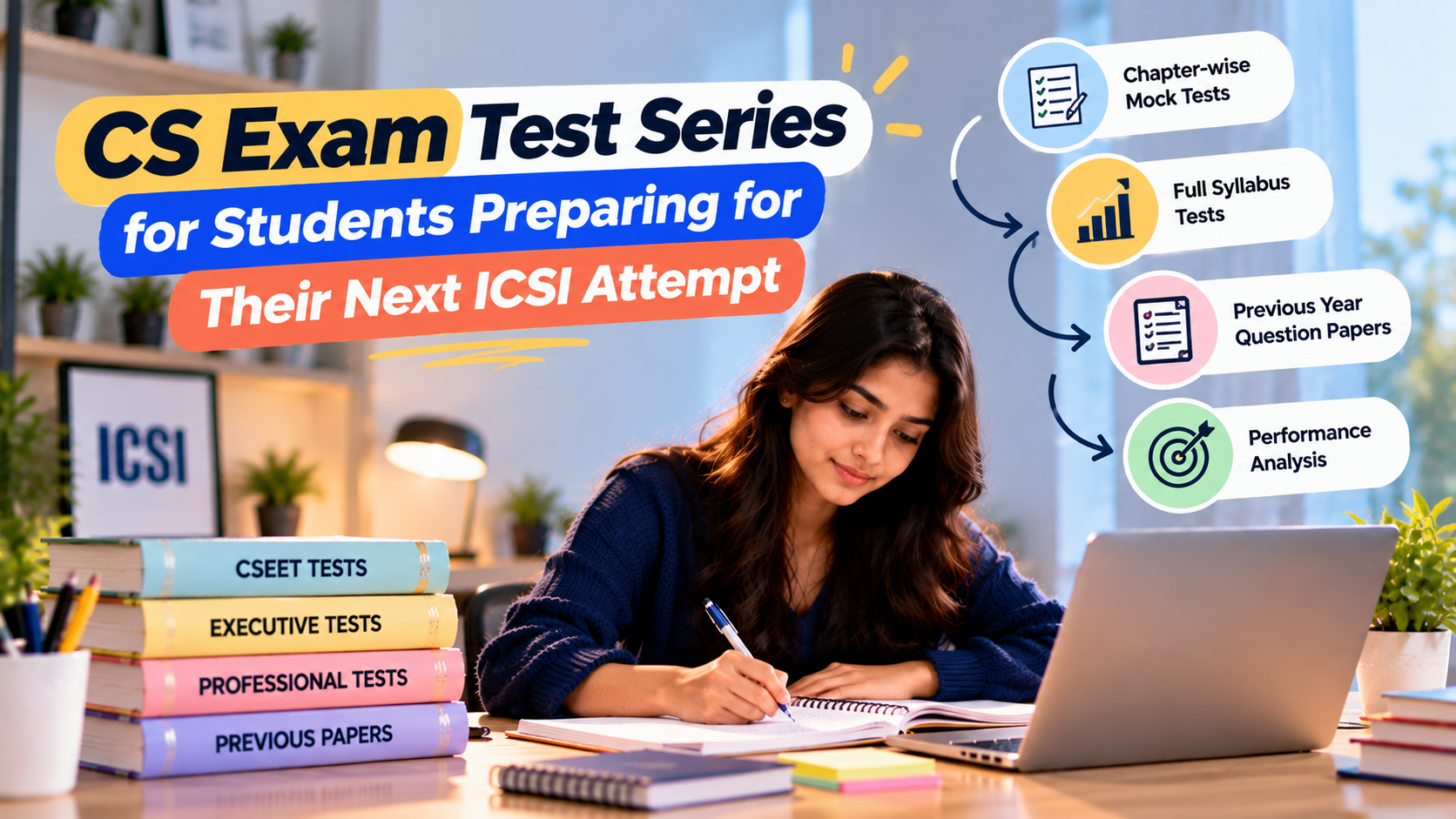
A CS exam test series should match your course level, relevant papers and preparation stage. During the early stage, chapter-wise tests are useful because they focus on recently studied material. Later, subject-wise tests and full-length mocks help you practise switching between topics, interpreting instructions and managing the complete paper.
Check that the test material aligns with the applicable ICSI syllabus and examination session. Look for clear instructions, suitable question coverage and answer guidance that explains why an answer is effective. For descriptive questions, useful guidance should help you understand structure, relevance and application rather than encouraging you to memorise a model response word for word.
CS Exams Test Series can be included in your preparation routine when the available papers and support fit your needs. Treat any test series as a practice and feedback resource, not as a replacement for official study material. Confirm the syllabus coverage, test format and relevance to your attempt before relying on a paper.
Which Types of Tests Should You Attempt?
1. Chapter-Wise Tests
Attempt a short test after completing a chapter or a defined topic. This is a useful way to check understanding before moving on. If you miss several questions, return to the relevant concepts and examples rather than immediately starting another chapter. Chapter-wise tests are especially helpful when you need to rebuild confidence in specific areas.
2. Subject-Wise Tests
After covering a substantial part of a subject, attempt a test that combines multiple chapters. This helps you practise recalling earlier topics and deciding which concept applies to each question. Use the result to identify gaps across the subject, not just the chapter you studied most recently.
3. Case-Based and Application Tests
Where relevant to the paper, practise questions that require you to apply a provision or concept to facts. A good answer addresses the issue, explains the applicable rule, applies it to the situation and reaches a reasoned conclusion. Review whether you answered the specific requirement or wrote general information that did not resolve the question.
4. Full-Length Mock Tests
Use full-length mocks when you have covered and revised enough of the syllabus to benefit from exam-like practice. Set a timer, follow the instructions and avoid checking notes during the attempt. These papers help you evaluate time allocation, concentration, answer completeness and the way you move between questions.
5. Focused Retests
After reviewing a mock, select a few important questions or topics where you made mistakes. Revisit them after a short gap and attempt similar questions independently. A focused retest helps you check whether you corrected the underlying problem instead of simply remembering a model answer.
| Test type | Best time to use it | What it helps you check |
|---|---|---|
| Chapter-wise test | After studying a topic | Understanding and recall |
| Subject-wise test | During revision | Coverage across multiple chapters |
| Case-based test | When practising application | Reasoning and use of concepts |
| Full-length mock | After substantial syllabus coverage | Timing, completion and answer quality |
| Focused retest | After correcting a weakness | Whether the correction has worked |
Create a Practical Weekly Test Plan
Your weekly schedule should balance learning, testing, analysis and revision. If you only schedule tests, you may not leave enough time to correct the problems they reveal. If you only study and revise, you may not discover whether you can apply the material independently.
A workable structure is to use the first part of the week for learning and chapter-wise practice, another session for a mixed or subject test, and a separate session for reviewing mistakes. As the examination approaches, increase full-length timed practice according to your readiness and the time available.
| Weekly activity | Example task | Expected outcome |
|---|---|---|
| Concept study | Cover planned chapters from official material | Core topics studied |
| Topic practice | Attempt questions from recently studied chapters | Immediate gaps identified |
| Mixed practice | Test several chapters together | Recall and application checked |
| Mock test | Complete a timed paper when ready | Timing and paper strategy assessed |
| Review and revision | Update error log and revisit weak areas | Specific improvement actions set |
Adapt the number of tests to your schedule and preparation level. If you are still learning a large portion of the syllabus, short tests may be more useful than frequent full papers. If most topics are covered, timed subject tests can help you identify the last major gaps. Leave enough time to review every test properly.
How to Attempt a Mock Test Effectively
For a realistic attempt, follow the relevant exam duration and instructions as closely as practical. Keep your notes closed, put away distractions and work without checking solutions midway. If you pause to look up information, you lose the opportunity to see what you can recall independently under time pressure.
Read the question carefully and identify the task it sets. Words such as explain, distinguish, analyse, advise or discuss may require different answer structures. Pay attention to marks and allocate time accordingly. If a question is taking too long, move to another question when appropriate and return later if time permits.
For descriptive answers, organise your response around the question requirement. Use clear headings where they improve readability, include relevant provisions or concepts when required and avoid adding unrelated information. For practical questions, show the necessary steps and workings. Before finishing, check that you have answered every part of the question.
Analyse Your Results and Identify the Real Problem
A mock score is useful, but it does not explain why marks were lost. Review each incorrect or incomplete response and classify the reason. Common categories include a forgotten concept, misunderstanding the question, incorrect application, incomplete answer, avoidable error and poor time allocation. Each category needs a different response.
Keep a simple error log with four fields: topic or question, mistake, reason and next action. For example, if you remembered a provision but missed a condition, revise the conditions and attempt a similar question. If your knowledge was sound but the answer was incomplete because time ran out, practise timed responses and improve how you allocate time.
Compare your answer with reliable model answers or evaluation guidance after completing the test. Identify the key elements you missed, then rewrite selected answers in your own words. Avoid memorising the full model answer without understanding the reasoning. You need to be able to adapt your knowledge to a different question in the actual examination.
Track repeated errors across multiple tests. One careless mistake may be temporary, but the same error appearing several times signals a pattern that deserves attention. Use your next study sessions to address that pattern directly.
Use Test Results to Plan Revision
Revision should respond to what your practice reveals. After every test, choose a small number of priority areas rather than attempting to revise every subject from scratch. Revisit the relevant official material, update concise notes and solve fresh questions to check that the concept is clearer.
Return to difficult topics after a gap instead of reviewing them only on the day of the test. A later recall check helps you see whether the correction has lasted. If you forget the same concept again, simplify your notes, revisit the explanation or practise a different type of question.
Keep a compact revision sheet for recurring mistakes, important distinctions, conditions you often forget and answer structures that help you stay relevant. The sheet should be brief enough to review quickly. It is a reminder of your weak points, not a substitute for the detailed study material.
Improve Time Management and Answer Presentation
Students can lose marks even when they understand the topic if they spend too long on one answer or leave questions incomplete. During mock tests, note the time spent on each section and compare it with the marks available. Use this information to adjust your approach for the next paper.
Practise writing answers that are complete but focused. Start with the central issue, include the relevant concept or provision, explain its application and give a conclusion where needed. Avoid lengthy introductions that do not answer the question. For numerical or practical questions, present workings in a logical order so the method is clear.
Presentation improves through repeated practice and review. If your answers are hard to follow, use headings, numbered points or short paragraphs where appropriate. If you consistently run out of time, practise a smaller set of questions under a limit before attempting another full paper.
Mistakes to Avoid Before the Next ICSI Attempt
Repeating the same study routine without review: If the previous approach did not address your weak areas, make a specific change based on your test results.
Attempting too many tests: Tests are useful only when you have time to analyse them. Do not sacrifice all revision time to complete more papers.
Ignoring official updates: Check current ICSI resources for syllabus coverage, examination instructions and applicable updates. Do not depend entirely on old notes.
Reading answers before attempting questions: Looking at a solution first may create false confidence. Complete the attempt independently and then evaluate your response.
Focusing only on marks: Record completion, accuracy, recurring errors and answer quality as well as the score. These details show what to improve.
Changing every resource after one low score: First diagnose whether the problem is content coverage, question difficulty, application or timing. Make changes based on evidence rather than frustration.
How to Use Tests in the Final Weeks
During the final weeks, balance full-length practice with targeted revision. Attempt a mock, analyse it, revise the weakest areas and use a short retest to check whether your correction worked. Avoid filling every day with a full paper if that leaves no time to learn from your mistakes.
Choose practice papers that match your examination session and follow the relevant time limits. Keep broad syllabus coverage in view, even while giving extra time to difficult areas. Do not decide to skip a topic only because it was challenging in a mock or did not appear in a recent paper.
In the last few days, use concise notes, selected questions and your error log to reinforce important concepts. Avoid major changes to your study resources at the last minute. Keep your routine manageable so you can focus on recall, application and clear answer presentation during the examination.
Track Your Progress With a Scorecard
A simple scorecard helps you compare attempts and make better decisions about what to revise. Update it after every mock instead of relying on memory.
| Measure | What to record | Why it matters |
|---|---|---|
| Score | Marks or percentage | Shows the overall trend |
| Completion | Questions attempted and left | Reveals pacing issues |
| Knowledge gaps | Topics or provisions forgotten | Guides content revision |
| Application errors | Incorrect use of a concept | Shows where more practice is needed |
| Presentation | Missing steps or unclear structure | Helps improve answer clarity |
| Repeat mistakes | Errors appearing in several tests | Identifies priorities for focused correction |
Review the scorecard weekly. Look for patterns across attempts rather than reacting to one result. If you are completing more questions with fewer errors, your approach may be improving even if the score changes only slightly. If the same topic remains weak, make it a priority in the next revision cycle.
Conclusion
Preparing for your next ICSI attempt calls for a clear plan, regular practice and honest review. Use chapter-wise tests while learning, subject tests during revision and full-length mocks when you are ready to practise under time limits. Analyse every attempt, record repeated errors and revise the topics that need attention. CS Exams Test Series can support this process when used alongside applicable official ICSI resources. Consistent, focused practice is more useful than completing tests without learning from them.