In this article (18)
- Why BCom with CS works well
- How BCom subjects overlap with CS papers
- A year-by-year plan for BCom with CS
- Regular, distance or online BCom: which suits CS better
- Regular BCom
- Distance or open BCom
- Online degrees
- Already in BCom year 2 or 3: is it too late?
- Managing the time clash
- Common mistakes students make with BCom and CS
- Start with CSEET, then build momentum
- Frequently asked questions
- Can I do CS with BCom?
- Is BCom with CS a good combination?
- When should I start CS during BCom?
- Will CS exams clash with BCom exams?
- Should I do regular BCom or distance BCom with CS?
- Do BCom graduates get exemption in CS?
BCom with CS is one of the most common and sensible combinations for commerce students. ICSI allows you to pursue the CS course alongside your graduation, and the subjects overlap enough that each course makes the other easier. The real work is planning: lining up your CS attempts with college semesters so the two do not collide.
Latest update (18 Nov 2026): CS Executive and CS Professional December 2026 exams run from 21 to 28 December 2026; the next attempt is June 2027. The next CSEET is on 1 to 4 February 2027, and June 2027 CSEET registration is open till 28 February 2027.
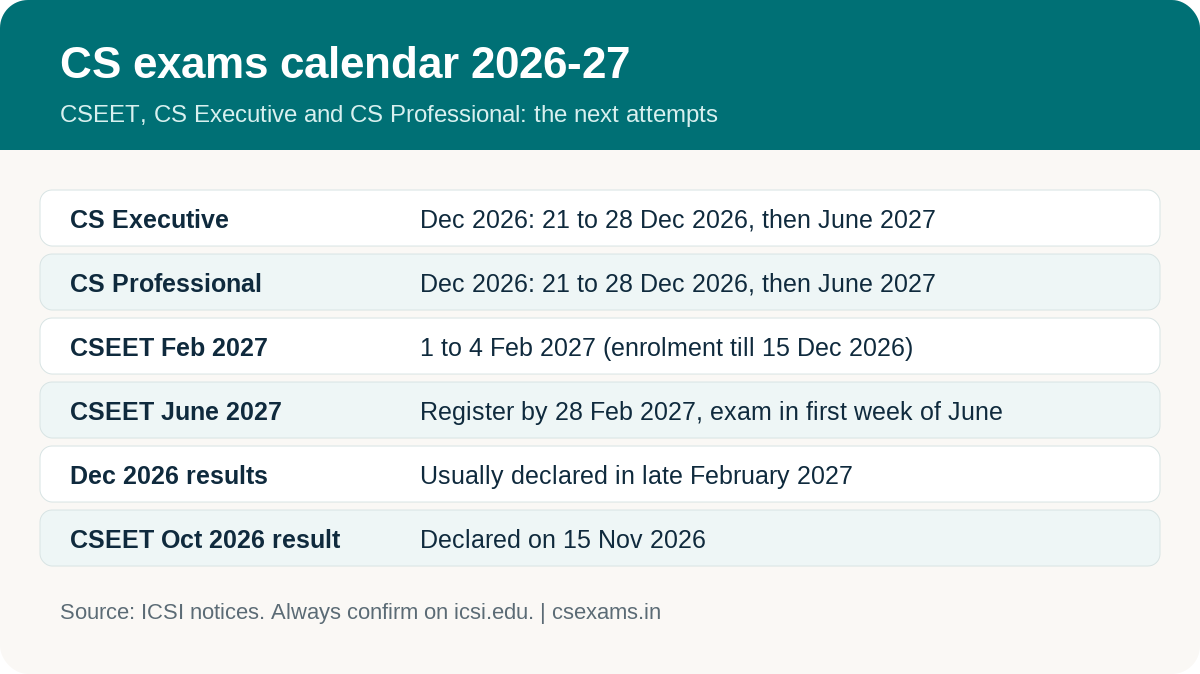
| Exam | Next dates |
|---|---|
| CS Executive | 21 to 28 Dec 2026, then June 2027 |
| CS Professional | 21 to 28 Dec 2026, then June 2027 |
| CSEET | 1 to 4 Feb 2027, then the first week of June 2027 |
| Dec 2026 results | Expected around 25 February 2027, based on past years |
Test series for every level: CSEET, CS Executive and CS Professional, checked by Company Secretaries.
Always confirm dates on the official ICSI website, icsi.edu.
This post explains why the combination works, how the subjects overlap, a practical year-by-year plan and the mistakes we see students make when they try to do both.
Why BCom with CS works well
Three reasons make this pair popular.
- Subject overlap: financial accounting, business law, economics, tax and business communication are in both courses.
- Time saving: if you start early, you can finish CS Executive, and often a good part of CS Professional, by the time you graduate.
- A degree as backup: professional courses take time. A BCom degree keeps your options open for jobs, MBA or government exams while CS is still in progress.
The catch is load. You will have college classes, assignments and semester exams, plus CS exams twice a year at Executive and Professional level. Students who plan well enjoy the combination. Students who drift end up with backlogs in both.
How BCom subjects overlap with CS papers
Exact BCom subjects vary by university, but most programmes cover the areas below. Here is where they help in CS.
| Common BCom subject | Where it helps in CS |
|---|---|
| Financial accounting | CSEET accounting, and Corporate Accounting and Financial Management at CS Executive |
| Business law and company law | CSEET business laws, Company Law and Practice, and Jurisprudence, Interpretation and General Laws |
| Income tax and GST | Tax Laws and Practice at CS Executive |
| Business economics | CSEET economic and business environment |
| Corporate finance and financial management | Corporate Accounting and Financial Management, and later Strategic Management and Corporate Finance at CS Professional |
| Business communication | CSEET business communication and answer presentation in every CS paper |
The overlap is strongest at CSEET and CS Executive. CS Professional goes deep into drafting, due diligence, ESG, restructuring and electives that BCom does not cover, which is why most students leave the bulk of Professional for the final year of college or after graduation.
A year-by-year plan for BCom with CS
Here is a plan that works for most students who start CS right after Class 12. Adjust it to your college calendar.
| Period | BCom | CS |
|---|---|---|
| After Class 12 or first months of BCom year 1 | Settle into college, first semester | Prepare and clear CSEET |
| BCom year 1, second half | Second semester | Register for CS Executive, start Group 1 papers |
| BCom year 2 | Third and fourth semesters | Attempt CS Executive Group 1, then Group 2 |
| BCom year 3 | Fifth and sixth semesters | Register for CS Professional, start Group 1 papers |
| After graduation | Degree complete | Finish CS Professional, complete training, apply for membership |
Taking one group at a time during college is the safer choice for most students. Our CS Executive passing criteria post explains how group passing works, which matters when you plan single-group attempts.
To see what you will study at the first stage, read our CSEET syllabus guide.
Regular, distance or online BCom: which suits CS better
This choice changes how much CS time you have.
Regular BCom
You get campus life, college societies and placements. You also get attendance rules, internal tests and project work. Expect to study CS mostly in the evenings and during college breaks.
Distance or open BCom
You attend far fewer classes and can give your best hours to CS. Many students who want to finish CS quickly choose this route. The risk is discipline, because nobody checks on you.
Online degrees
Recognised online BCom programmes sit between the two. Check that the university and the programme are approved before you enrol.
If you are torn, ask yourself how much you value college life against finishing CS a year earlier. There is no wrong answer, only a plan that fits it.
Already in BCom year 2 or 3: is it too late?
No. Many students only decide on CS in the second or final year of BCom, and they still finish the course well. Your plan just shifts.
If you are in year 2, clear CSEET in the next available window and aim to finish CS Executive by the end of your degree, taking one group at a time. If you are in year 3, prepare for CSEET alongside your final semesters and start CS Executive seriously right after graduation, when you have full days for study.
The good news is that your college subjects are fresh in your mind. Accounting, business law, tax and economics from your BCom years make the early CS papers faster to cover than they are for a student coming straight from Class 12. If you graduate before CS is done, our guide on preparing for CS after graduation covers the next steps.
What changes is the pace after graduation. Without college, treat CS as a full-time job: six to eight hours a day on study, with a fixed routine and weekly tests. Set a target month for each CS group and tell someone at home, so the plan has a real deadline. Students who give themselves a clear date usually stick to it far better than those who say they will attempt "when ready".
Managing the time clash
The clashes are predictable, which means you can plan for them.
- Exam months: CS Executive and Professional exams are held twice a year. Find out when your university holds semester exams and avoid attempting heavy groups in a month that overlaps with them.
- Weekly routine: two hours of CS on college days and four to five hours on weekends is enough for one CS group per attempt.
- Use breaks: winter and summer breaks are your best CS study windows. Plan revision of whole papers in them.
- One deadline at a time: in the last month before a CS exam, keep college work to the minimum required.
Most students lose an attempt here because they underestimate the last month. College internals, a fest and a family function can eat three weeks quickly. Block those weeks for CS early.
Common mistakes students make with BCom and CS
- Starting CS late: waiting till the final year of BCom wastes the overlap. Start CSEET early.
- Taking both CS groups during college exams: it looks fast on paper but often ends in failing both.
- Ignoring answer writing: BCom exams often reward long answers. CS examiners want the provision, its application and a conclusion. Practise the CS format separately.
- Skipping CS study material: college notes are not enough. ICSI questions follow the ICSI modules.
- No mock papers: students who write full papers under time before the exam do much better than those who only read.
Start with CSEET, then build momentum
BCom with CS is worth it if you plan it like a project. Clear CSEET early, take CS Executive one group at a time during college, and leave the heavier CS Professional for the final year and after.
The habit that matters most at every stage is writing answers under time and getting honest feedback. Our CSEET test series and CS Executive test series are planned around college schedules, with papers checked by Company Secretaries, and you can see the options on our plans page.
Frequently asked questions
Can I do CS with BCom?
Yes. ICSI lets you pursue CS alongside a regular, distance or online BCom. You need to manage attendance and exam dates of both, but thousands of students do it.
Is BCom with CS a good combination?
Yes. Accounting, tax, business law and economics in BCom overlap with CSEET and CS Executive papers, so each course helps the other.
When should I start CS during BCom?
The best time is CSEET right after Class 12 or in the first year of BCom, so you can enter CS Executive early and finish most of it during college.
Will CS exams clash with BCom exams?
ICSI holds CS Executive and Professional exams twice a year, and university exams vary by college. Check both calendars before you pick the groups you will attempt each time.
Should I do regular BCom or distance BCom with CS?
Regular BCom gives campus life and placements but less time. Distance or open BCom gives more time for CS. Choose based on how serious you are about finishing CS quickly.
Do BCom graduates get exemption in CS?
BCom alone does not give paper exemptions in CS Executive. ICSI's rules on who must take CSEET have changed over the years, so check the current eligibility on icsi.edu.
Practise what you just read