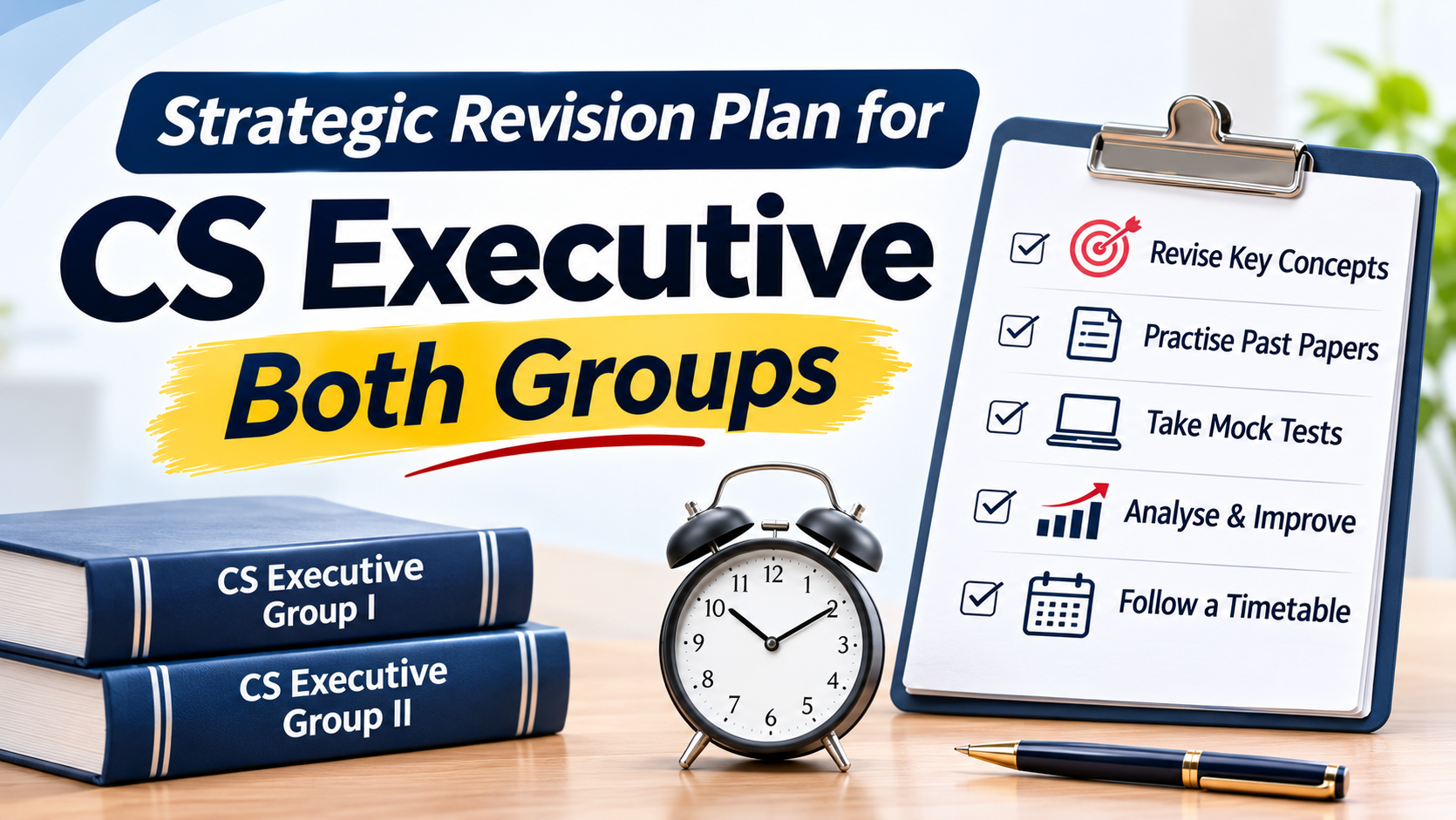
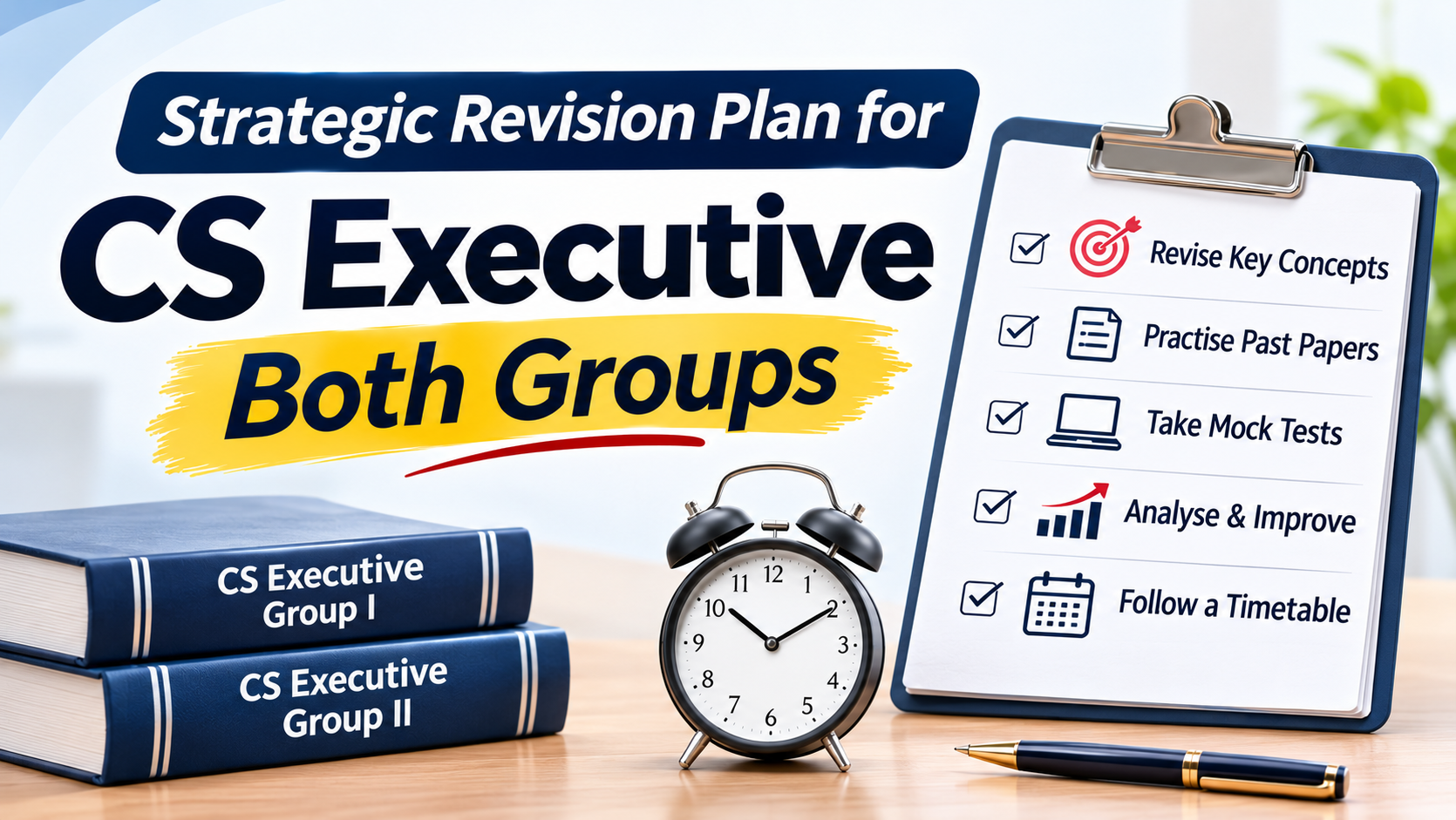
Preparing for both groups of the CS Executive examination requires more than long study hours. Students need a clear order for revising subjects, enough practice to test their understanding, and a system for returning to difficult topics before they are forgotten.
The best plan is one that fits the time you actually have. Rotate subjects across the week, use active recall, and let practice-test results guide your priorities. The framework below is a starting point; adjust it to your syllabus coverage and available study time.
Why both groups need a planned revision strategy
Both groups include papers that make different demands on memory, understanding, application, and answer writing. If you revise only the subjects you enjoy, difficult papers can remain untouched until the final weeks. A planned rotation prevents this imbalance and keeps progress visible.
Make this step measurable: write the next action in your planner, then check what you can explain or solve without notes. Carry unresolved points into the next review instead of assuming that one reading is enough.
Audit the syllabus before making a timetable
List every paper and divide it into chapters or manageable units. Mark each as not started, partly understood, revised once, or practised. Do not call a chapter complete simply because you read it or watched a lecture. Include a short recall check or relevant question practice before marking it secure.
Make this step measurable: write the next action in your planner, then check what you can explain or solve without notes. Carry unresolved points into the next review instead of assuming that one reading is enough.
Create a weekly subject rotation
Use one major subject block, one secondary block, and a short recall session on most study days. Rotate the main block so each paper receives focused attention during the week. Put difficult topics in your most productive hours and use lighter sessions for summaries, provisions, formulas, or error review.
Make this step measurable: write the next action in your planner, then check what you can explain or solve without notes. Carry unresolved points into the next review instead of assuming that one reading is enough.
Set measurable daily targets
Replace vague targets such as “study law” with a defined task: revise a chapter, recall a set of provisions, solve a question set, or write timed answers. A good target tells you what to do and how to verify that the work is finished.
Make this step measurable: write the next action in your planner, then check what you can explain or solve without notes. Carry unresolved points into the next review instead of assuming that one reading is enough.
Use active recall and spaced revision
After studying, close the material and write down the key ideas from memory. Check the source, correct missing points, and revisit the topic after a gap. Brief repeated recall sessions are often more useful than reading the same page several times in one sitting.
Make this step measurable: write the next action in your planner, then check what you can explain or solve without notes. Carry unresolved points into the next review instead of assuming that one reading is enough.
Use a two-pass revision system
During the first pass, cover the syllabus steadily and identify weak areas. During the second pass, focus on difficult chapters, concepts that repeatedly cause errors, and question practice. Do not spend equal time on every topic regardless of how well you know it.
Make this step measurable: write the next action in your planner, then check what you can explain or solve without notes. Carry unresolved points into the next review instead of assuming that one reading is enough.
Practise answer writing and timed questions
Short topic tests help identify gaps early. As coverage improves, attempt sectional and full-paper tests under time limits. Review answers that were wrong, incomplete, poorly structured, or too slow—even if the final answer happened to be correct.
Make this step measurable: write the next action in your planner, then check what you can explain or solve without notes. Carry unresolved points into the next review instead of assuming that one reading is enough.
Keep an error notebook
Record the topic, the mistake, the correct approach, and when you will retry it. Common errors include forgotten provisions, confused concepts, calculation slips, missing steps, and misreading questions. Keep entries brief and review them several times a week.
Make this step measurable: write the next action in your planner, then check what you can explain or solve without notes. Carry unresolved points into the next review instead of assuming that one reading is enough.
Avoid resource overload
Choose a reliable set of study materials and concise revision notes. Repeatedly switching books, videos, or notes can take time away from revision. Use additional explanations only when a concept remains unclear, and keep unresolved doubts for a planned session.
Make this step measurable: write the next action in your planner, then check what you can explain or solve without notes. Carry unresolved points into the next review instead of assuming that one reading is enough.
Adjust the plan in the final weeks
Move away from creating extensive new notes and focus more on recall, timed practice, and correction. Keep a list of topics needing a final review. Do not abandon an uncomfortable paper; use shorter, repeated sessions and protect enough time for sleep and recovery.
Make this step measurable: write the next action in your planner, then check what you can explain or solve without notes. Carry unresolved points into the next review instead of assuming that one reading is enough.
Use tests as feedback, not just scores
A test series can provide deadlines and show where marks are being lost. After every test, choose two or three actions for the next week, such as revising a weak chapter, improving answer structure, or increasing calculation speed. CS Exams Test Series should complement—not replace—self-study.
Make this step measurable: write the next action in your planner, then check what you can explain or solve without notes. Carry unresolved points into the next review instead of assuming that one reading is enough.
Weekly planning example
| Day | Main block | Second block | Short review |
|---|---|---|---|
| Monday | Group 1 paper | Group 2 paper | Recall weak topics |
| Tuesday | Group 1 paper rotation | Group 2 paper rotation | Practise questions |
| Wednesday | Weakest paper | Earlier errors | Key provisions/formulae |
| Thursday | Group 2 focus | Group 1 revision | Timed topic test |
| Friday | Mixed question practice | Weak chapter | Error notebook |
| Saturday | Sectional/full test | Analyse mistakes | Plan next week |
| Sunday | Catch-up and light revision | High-priority topics | Rest and reset |