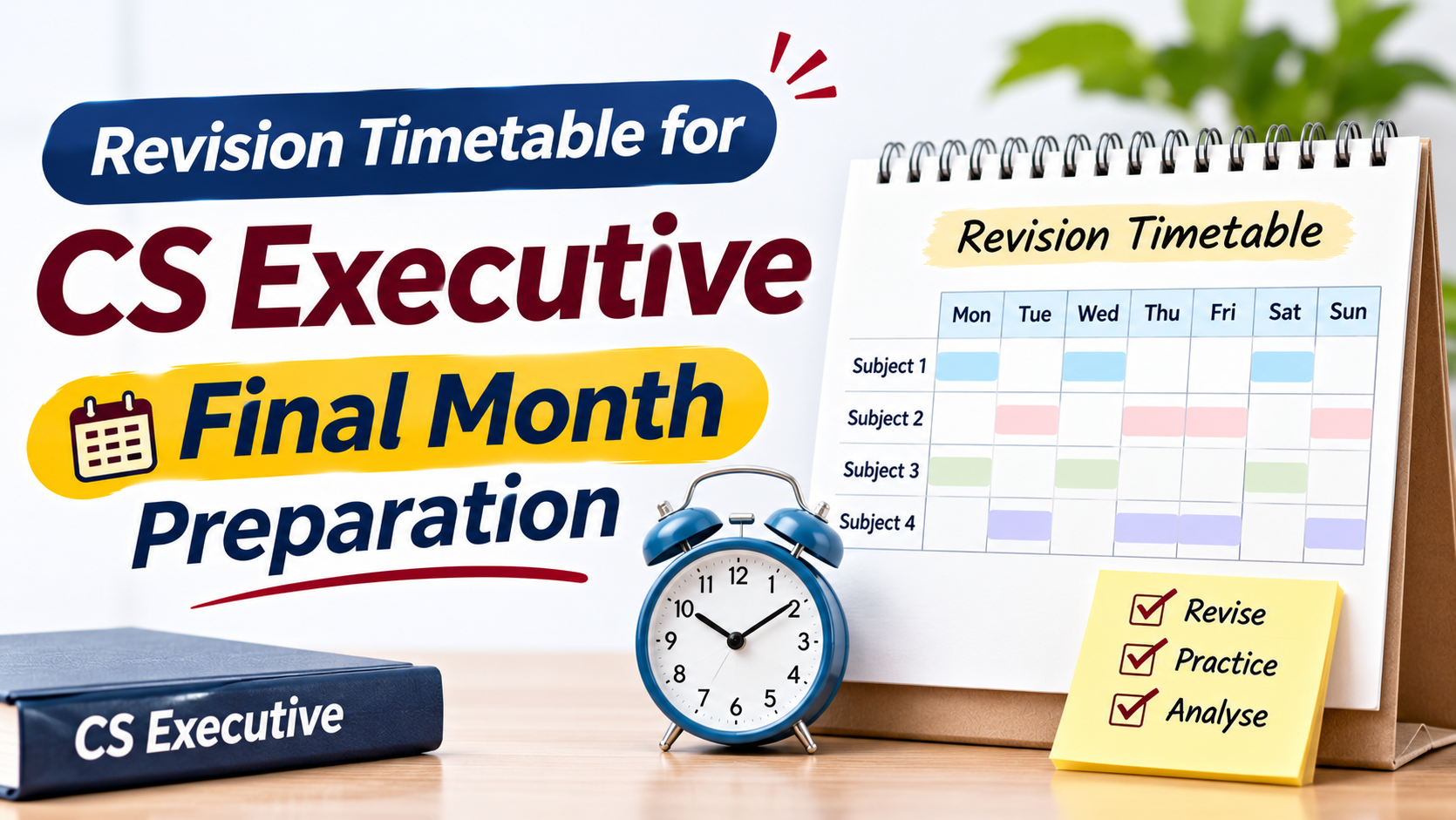
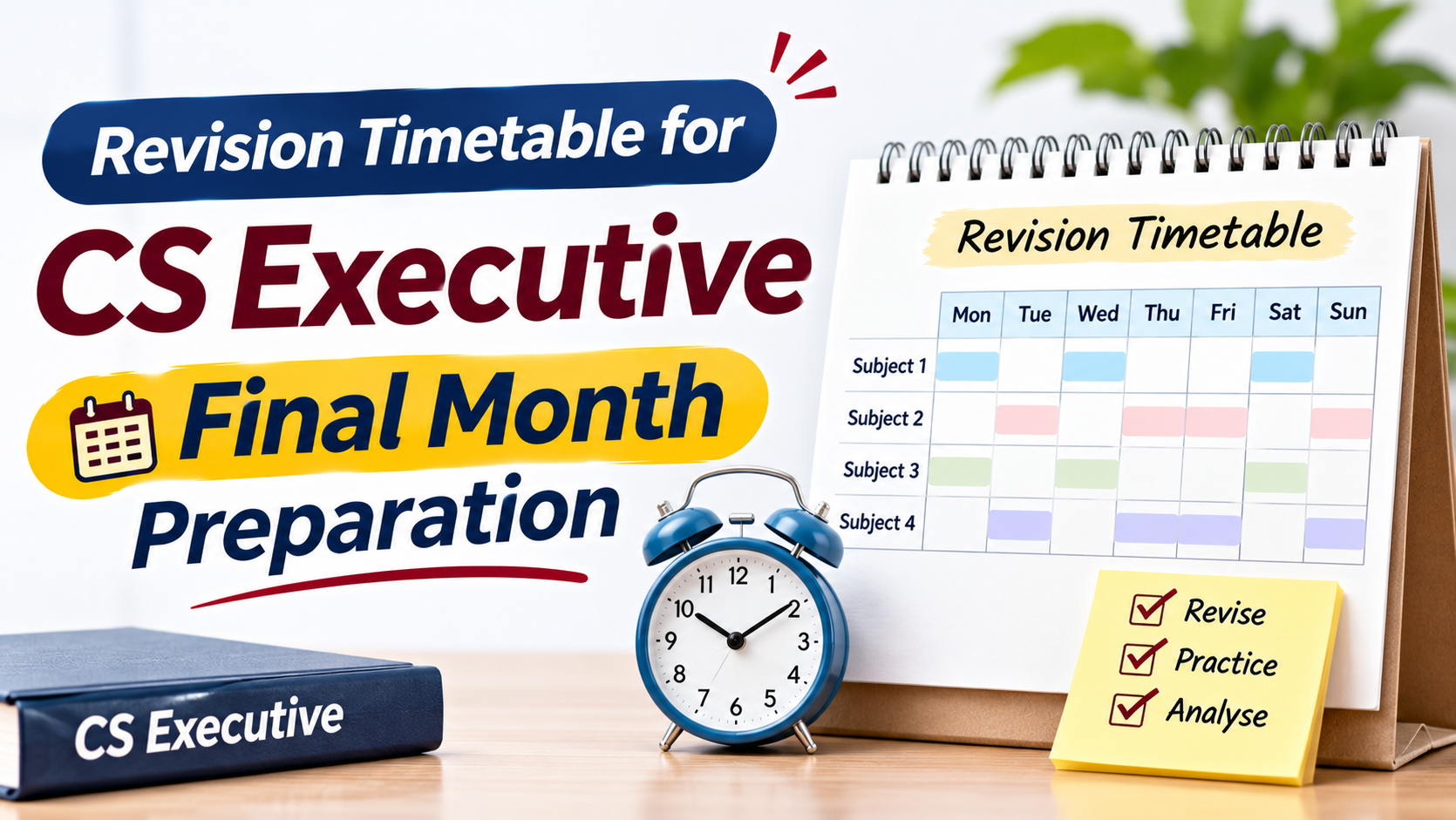
The final month before a CS Executive examination is the time to bring preparation together. New topics may still need attention, but revision, question practice and time management become equally important. A clear timetable helps you decide what to revise each day without repeatedly changing plans or overlooking a paper.
Your best schedule depends on syllabus coverage, the papers you are appearing for and your current strengths. Use this framework as a starting point, then adjust it to the latest ICSI syllabus, examination instructions and your mock-test performance.
Start With a Realistic Preparation Audit
List the papers you are appearing for and divide each syllabus into completed, partly revised and weak areas. Mark topics that require conceptual study separately from topics that mainly need question practice or memorisation. This makes your remaining workload visible and prevents familiar chapters from taking all your time.
Be honest about how much time you have each day. A plan based on ten hours of study when you can usually manage five will become difficult to follow. Set a minimum target for busy days and a fuller target for days when you have longer study blocks.
Divide the Month Into Four Phases
Use the first week to close important syllabus gaps and revise core concepts. During the second week, increase question practice and revisit topics from the first week. In the third week, focus on mixed-topic revision, answer-writing and timed tests. Keep the final week for concise revision, recurring mistakes and exam readiness rather than a complete restart.
These phases should overlap. If a paper is already well prepared, move to timed practice sooner. If a major topic remains unclear, give it a planned learning block while protecting time for other papers. The timetable is a working tool, not a rigid rule.
Build a Subject Rotation Plan
Rotating papers helps you keep earlier subjects active while making progress in others. Avoid spending several consecutive days on one paper unless there is a specific reason. A balanced rotation reduces the risk of forgetting a subject revised at the start of the month.
Assign each study block a purpose: concept revision, written practice, recall or error correction. Before finishing a session, write down the next task so you can begin without wasting time deciding what to do.
Use Active Recall and Short Notes
Read a section and then close your material. Explain the main concepts, list key provisions or steps, or answer a question without looking at your notes. This reveals what you can actually retrieve under exam conditions. Revisit only the points that remain unclear instead of rereading an entire chapter.
Use concise notes prepared earlier wherever possible. If you need to make new revision notes, focus on key terms, frameworks, important distinctions and points you repeatedly forget. The final month is not the best time to rewrite every page of your study material.
Final-Month Sample Timetable
| Period | Main focus | Suggested activity |
|---|---|---|
| Days 30–22 | Close important gaps | Review weak concepts and complete priority topics |
| Days 21–15 | First full revision cycle | Rotate papers and solve topic-wise questions |
| Days 14–8 | Application and testing | Practise written answers and timed sections |
| Days 7–4 | Second revision cycle | Review concise notes and recurring mistakes |
| Days 3–1 | Light revision and readiness | Recall key points, check logistics and rest |
The example below illustrates how you might divide the final month. Move the blocks according to your module combination, exam dates and syllabus status. It is a planning example, not an official ICSI schedule.
Practise Written Answers Every Week
CS examinations require students to understand concepts and communicate them clearly. Reserve time for writing answers rather than relying entirely on reading. Practise identifying the issue, stating the relevant provision or principle, applying it to the facts where required, and presenting a direct conclusion.
After each answer, compare your work with suitable reference material. Look for missing elements, unclear headings, incomplete application and unnecessarily long introductions. Improving these habits can make revision more effective than simply increasing reading hours.
Use Mock Tests for Diagnosis
Take topic tests while revising individual papers and timed papers when you are ready to assess broader coverage. Follow the applicable duration and instructions. After the test, review mistakes instead of moving immediately to another paper.
Classify each error as a knowledge gap, memory issue, misinterpretation, incomplete answer, presentation problem or time-management issue. Choose two or three high-impact corrections for the next study cycle and reattempt selected questions after a gap.
How CS Exams Test Series Fits Into Revision
CS Exams Test Series can provide a structured way to practise exam-style questions and review readiness. Choose tests that match the applicable syllabus and your preparation stage. Use the score as one source of information, alongside your own answer review and current examination requirements.
Plan a correction session after every test. If you lose marks because you know the topic but cannot organise the answer, practise structured writing. If the problem is recall, schedule short revision sessions. Testing becomes valuable when the feedback changes what you do next.
Protect the Final Week From Overloading
In the final week, avoid adding several new resources or making a timetable that leaves no time for rest. Review concise notes, practise selected questions and revisit recurring errors. Confirm exam arrangements and follow official instructions for documents and permitted items.
If one topic is still difficult, focus on its essential concepts and representative questions instead of allowing it to displace every other paper. A calm, realistic plan is more useful than an ambitious schedule that leaves you exhausted.
Review Progress and Adjust Daily
At the end of each day, record what you completed, what remains and what needs to move. Do not treat one missed session as a failed month. Shift the task to a realistic slot and keep the overall balance between papers intact.
Use evidence to make changes. If timed answers are improving, maintain that practice. If you repeatedly forget earlier material, add short spaced-revision sessions. A good timetable adapts to your performance while keeping the exam date and remaining syllabus in view.