In this article (17)
- CS vs CMA at a glance
- What a company secretary actually does
- What a cost and management accountant does
- Subjects and study style: where the real difference shows
- CS papers
- CMA papers
- Difficulty, duration and pass rates
- Career paths and where the jobs are
- A quick test to decide between CS and CMA
- If you choose CS, start the right way
- Frequently asked questions
- Which is easier, CS or CMA?
- Can I do CS and CMA together?
- Is CS or CMA better for a job in a listed company?
- Which body conducts the CS and CMA exams?
- Do CMA students get any exemption in CS?
- Can a commerce student without maths choose CMA?
CS vs CMA is a choice between two very different kinds of work. CS (Company Secretary) is about company law, governance and compliance, so you spend your study time reading and writing legal answers. CMA (Cost and Management Accountant) is about costing, budgeting and financial management, so you spend it solving numerical questions. Pick the one whose daily work you can actually enjoy for ten years.
Latest update (18 Nov 2026): CS Executive and CS Professional December 2026 exams run from 21 to 28 December 2026; the next attempt is June 2027. The next CSEET is on 1 to 4 February 2027, and June 2027 CSEET registration is open till 28 February 2027.
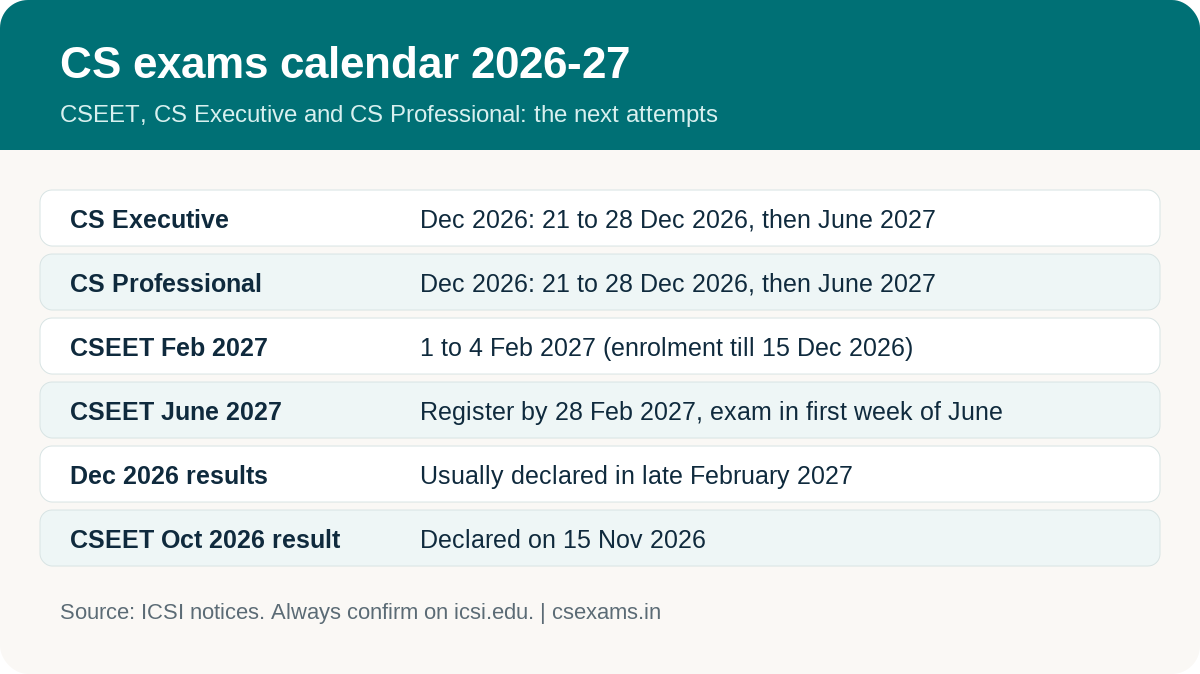
| Exam | Next dates |
|---|---|
| CS Executive | 21 to 28 Dec 2026, then June 2027 |
| CS Professional | 21 to 28 Dec 2026, then June 2027 |
| CSEET | 1 to 4 Feb 2027, then the first week of June 2027 |
| Dec 2026 results | Expected around 25 February 2027, based on past years |
Test series for every level: CSEET, CS Executive and CS Professional, checked by Company Secretaries.
Always confirm dates on the official ICSI website, icsi.edu.
Both are respected professional courses run by statutory institutes, both have three levels, and both lead to proper careers. So the question is not which course is better in general. It is which course is better for you. This post lays the two side by side, explains where each one leads, and gives you a quick way to decide.
CS vs CMA at a glance
Start with the basics. The table below covers the points students ask about most, without fees, because both institutes revise their fee lists from time to time and you should check the latest one on their official sites.
| Point | CS (Company Secretary) | CMA (Cost and Management Accountant) |
|---|---|---|
| Institute | ICSI, set up under the Company Secretaries Act, 1980 | ICMAI, set up under the Cost and Works Accountants Act, 1959 |
| Levels | CSEET, CS Executive, CS Professional | CMA Foundation, CMA Intermediate, CMA Final |
| Main focus | Company law, securities law, governance, compliance, drafting | Cost accounting, management accounting, financial management, tax, cost audit |
| Nature of papers | Mostly descriptive and law based, with practical parts in accounts and tax | Mostly numerical and practical, with some law and theory |
| Legal role after membership | Whole-time company secretary, secretarial audit as a practising CS | Cost audit and cost records work as a cost accountant in practice |
| Practical training | Required before membership | Required before membership |
If you only look at this table, the difference is already clear: CS is a law and governance course with some numbers, and CMA is a numbers course with some law.
What a company secretary actually does
A company secretary keeps a company on the right side of the law. That means board and general meetings, minutes, filings with the Registrar of Companies, SEBI compliance for listed companies, insider trading rules, and advising the board on governance. Under the Companies Act, 2013, every listed company and every other public company with paid-up share capital of Rs 10 crore or more must have whole-time key managerial personnel, and the rules also require a whole-time company secretary in any company with paid-up share capital of Rs 10 crore or more.
A practising company secretary can also do secretarial audits under section 204 of the Companies Act for listed companies and other prescribed companies. That is a statutory role only a CS can sign, which gives the profession a steady base of work.
The day-to-day job is reading, drafting and checking. If you like reading a bare act, spotting what a section really says and writing it out clearly, CS will feel natural to you. You can read more about the role in our post on company secretary career scope.
What a cost and management accountant does
A CMA works on the numbers side of a business. Product costing, standard costing and variance analysis, budgets, pricing decisions, cost control and performance reports are the core. Manufacturing companies, power, telecom, pharma and other sectors where cost records are required use cost accountants heavily.
Under section 148 of the Companies Act, 2013, the government can require certain companies to maintain cost records and get a cost audit, and the cost auditor must be a cost accountant. Like secretarial audit for CS, this is a statutory role that belongs to the profession.
The day-to-day job is spreadsheets, calculations and analysis. If you enjoy solving a long costing question and getting the final number right, CMA will suit you better than CS.
Subjects and study style: where the real difference shows
Most students choose a course by looking at job titles. A better way is to look at how you will spend the next three or four years of evenings.
CS papers
At CS Executive level you study Jurisprudence, Interpretation and General Laws, Company Law and Practice, Setting up of Business, Industrial, Labour and General Laws, Corporate Accounting and Financial Management, Capital Market and Securities Laws, Economic, Commercial and Intellectual Property Laws, and Tax Laws and Practice. Five of these seven papers are law heavy. You can see the full list in our post on CS Executive subjects.
CS answers are judged on how well you quote the provision, apply it to the facts and present the conclusion. Students who do well in CS write clean, structured answers.
CMA papers
CMA papers lean on cost accounting, financial accounting, operations and strategic management, financial management, direct and indirect tax, and cost and management audit. Most of the marks come from practical questions with working notes.
So the real question is simple: would you rather revise 40 sections of company law, or solve 40 costing problems? Your honest answer is worth more than any ranking list.
Difficulty, duration and pass rates
Both courses are demanding, and both have pass percentages that move a lot from attempt to attempt. Instead of comparing averages, compare the type of difficulty.
- CS is hard because of volume. There is a lot of law to remember, amendments to track and long answers to write in three hours.
- CMA is hard because of practice. You cannot pass costing or financial management by reading; you need hundreds of solved questions.
Both courses run their main exams twice a year, so a failed attempt costs you about six months in either case. If you want to know how long CS usually takes from start to finish, our guide on CS course duration explains each stage.
A common mistake we see: students pick CMA because they hear it is less crowded, and then struggle because they never liked numbers in school. Or they pick CS because it sounds easier than CA, and then find law reading tiring. Difficulty is personal.
Career paths and where the jobs are
Both qualifications are recognised in companies, consulting firms and practice. The kind of team you join is different.
| Area | Typical CS roles | Typical CMA roles |
|---|---|---|
| Listed and large companies | Company secretary, compliance officer, secretarial team | Cost controller, management accountant, finance team |
| Practice | Practising CS firm: secretarial audit, ROC work, due diligence | Cost accountant firm: cost audit, cost records, consulting |
| Other sectors | Legal and governance teams, stock exchanges, regulators | Manufacturing, public sector units, budgeting and planning teams |
If you see yourself in boardrooms and legal discussions, CS fits. If you see yourself in plant reviews and budget meetings, CMA fits.
A quick test to decide between CS and CMA
Ask yourself these four questions and be honest.
- In Class 11 and 12, did you enjoy business studies and legal topics more than accountancy problems?
- Can you read a 20 page chapter of theory without getting restless?
- Do you like writing long answers, or do you prefer a question with one correct number?
- When you picture your job, is it drafting resolutions or building a cost sheet?
Mostly yes to the first three and drafting in the last one means CS. Mostly no, with cost sheets in the last one, means CMA. If you are still split, read a CSEET or CS Executive chapter and a CMA costing chapter for one week each. The one you look forward to opening is your answer.
Many students also ask whether they should do both. It is possible, and some students add CS to a CMA or CA path for the governance side. Our post on doing CA and CS together explains how to plan two courses without burning out, and the same logic works for CMA.
If you choose CS, start the right way
Once you pick CS, the first step is CSEET, then CS Executive. The habit that decides your result at both levels is answer writing under time pressure, not just reading the study material. Write full answers early, get them checked, and learn how examiners give marks.
Our CSEET test series and CS Executive test series give you papers in the ICSI pattern, checked by Company Secretaries, so you know where you stand long before the real exam. You can compare options on the plans page.
Frequently asked questions
Which is easier, CS or CMA?
Neither is easy. CS is heavier on reading and remembering law, while CMA is heavier on numerical practice. The easier one is the one that matches how you like to study.
Can I do CS and CMA together?
Yes, ICSI and ICMAI allow students to register for both. It works best if you stagger them, for example finishing CS Executive before taking CMA Intermediate seriously.
Is CS or CMA better for a job in a listed company?
Both are useful. Every listed company must appoint a whole-time company secretary, while cost accountants are needed for costing, budgeting and cost audit work.
Which body conducts the CS and CMA exams?
CS is run by the Institute of Company Secretaries of India (ICSI) under the Company Secretaries Act, 1980. CMA is run by the Institute of Cost Accountants of India (ICMAI) under the Cost and Works Accountants Act, 1959.
Do CMA students get any exemption in CS?
ICSI gives some paper-wise exemptions to qualified cost accountants and certain other degree holders. Check the current exemption list on icsi.edu before you apply.
Can a commerce student without maths choose CMA?
Yes, maths in Class 12 is not compulsory for CMA, but the course has a lot of costing, finance and statistics, so you should be comfortable with numbers.
Practise what you just read