In this article (15)
- Why notes matter so much in CS Executive
- How to make notes for CS Executive law papers
- Tips for each law paper
- Notes for the numerical papers
- When to make notes: a simple timeline
- What a good note looks like in practice
- Handwritten or digital notes
- Mistakes our checkers see from bad notes
- Frequently asked questions
- Should I make notes for CS Executive or study only from the modules?
- Handwritten or digital notes for CS Executive?
- When should I start making notes for CS Executive?
- How short should CS Executive notes be?
- Do I need notes for Corporate Accounting and Tax papers?
- How do I add amendments to my notes?
Good notes for CS Executive are short, written in your own words, and built so you can revise a full paper in a day or two before the exam. The ICSI modules are long, and no one rereads all seven papers in the final month. Your notes are what you will actually revise from, so how you make them decides how much you remember in the exam hall.
Latest update (18 Nov 2026): the CS Executive December 2026 exams run from 21 to 28 December 2026 (2:00 PM to 5:15 PM, no paper on 25 December). The next attempt after that is June 2027; ICSI announces its dates closer to the time.
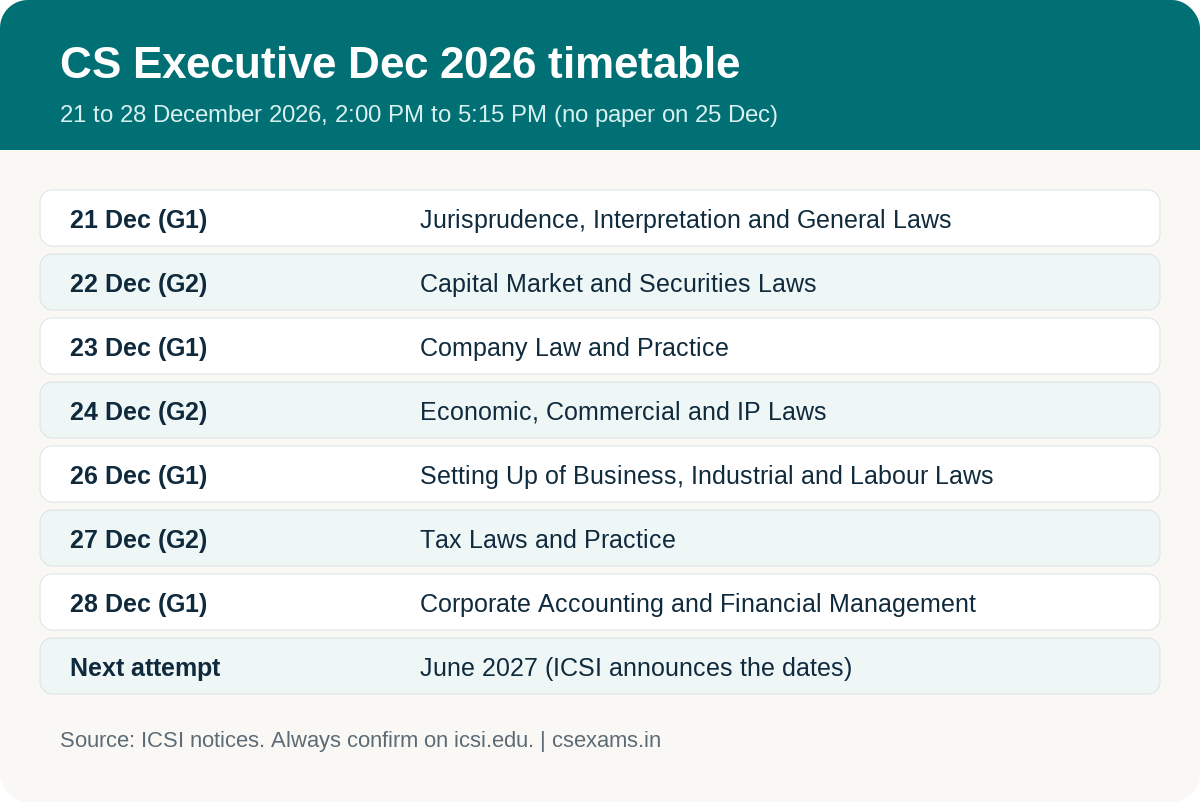
| What | Date |
|---|---|
| CS Executive Dec 2026 exams | 21 to 28 December 2026 |
| Admit card | Expected in the second week of December 2026 on icsi.edu, based on past years (the Dec 2025 cards came on 12 December 2025) |
| Dec 2026 result | Expected around 25 February 2027, based on past years (the Dec 2025 result came on 25 February 2026) |
| Next attempt | June 2027 |
Write full papers under time before the exam: our CS Executive test series has papers on the ICSI pattern, checked by Company Secretaries. See plans and prices.
Always confirm dates on the official ICSI website, icsi.edu.
This guide covers how to make notes for CS Executive paper by paper, a simple format for law sections, a timeline for when to make notes and the mistakes our checkers see in answers that came from weak notes.
Why notes matter so much in CS Executive
CS Executive has seven papers across two groups, and five of them are law heavy: Jurisprudence, Interpretation and General Laws, Company Law and Practice, Setting up of Business, Industrial, Labour and General Laws, Capital Market and Securities Laws, and Economic, Commercial and Intellectual Property Laws. The other two, Corporate Accounting and Financial Management and Tax Laws and Practice, are practical.
In law papers, marks come from quoting the right provision, applying it and concluding. If you cannot recall the section number, the limit or the time period, your answer loses weight. Notes are how you turn hundreds of pages into a list of points you can recall under pressure.
If you want to see which chapters to give the most notes time, our CS Executive chapter-wise weightage post helps you prioritise.
How to make notes for CS Executive law papers
For law, use one fixed format for every provision. When the format is the same each time, your brain learns where to look.
| Part of the note | What to write | Example of the idea |
|---|---|---|
| Heading | Topic and section number | Board meetings, frequency |
| Rule | The rule in one or two lines, in your own words | Minimum number of meetings and the gap allowed between them |
| Numbers | Limits, days, percentages, amounts | Write every number in a box so it stands out |
| Exceptions | Who is exempt or treated differently | Small companies, one person companies, private companies |
| Case or illustration | One line on a case law or practical example from the module | Only if the module gives one |
| Exam use | How it was asked before | A short tag like "asked as practical question" |
Keep each provision to a quarter or half page. Use arrows and boxes, not long sentences. Write section numbers in the margin so you can scan them quickly.
Tips for each law paper
- Company Law and Practice: make a separate list of all time limits (days for filing, notice periods) on one page. This single page saves many marks.
- Jurisprudence, Interpretation and General Laws: note the rules of interpretation with one case each, and keep general laws in a table of act, purpose and key provisions.
- Capital Market and Securities Laws: SEBI regulations have many thresholds. Use tables with regulation, threshold and disclosure timeline.
- Economic, Commercial and Intellectual Property Laws: compare similar laws side by side, such as different IPR laws, in a single table of term, registration and remedies.
- Setting up of Business and labour laws: a flow chart per business form works well, for example the steps to set up an LLP.
Notes for the numerical papers
For Corporate Accounting and Financial Management and Tax Laws and Practice, you do not need long theory notes. You need three things.
- Formats and formulas: one page per chapter with the format of the statement and all formulas, for example cost of capital, ratios, and the computation of total income.
- Adjustments list: the tricky adjustments that keep coming up in questions, written as short rules.
- Mistake log: every time you get a question wrong, write one line on why. Before the exam, this log is worth more than any book.
For tax, note rates, limits and due dates in a table and update it to the law applicable for your attempt. Check the ICSI study material and supplements for that.
When to make notes: a simple timeline
The biggest mistake is planning to make notes "after finishing the syllabus". By then there is no time. Make them as you go.
| Stage | What to do with notes |
|---|---|
| First reading of a chapter | Read the module chapter fully, then write notes in the format above the same day |
| Practice and questions | Add tags for how a topic was asked and update the mistake log |
| Before the exam, about two months out | Read notes only, not the module, for one full round of each paper |
| Last month | Revise from notes two or three times, and write full papers under time |
| Day before each paper | Only the time limits page, numbers page and mistake log |
Our last month revision plan for CS Executive shows how to fit note revision into the final weeks.
What a good note looks like in practice
Take a topic like the appointment of an auditor in Company Law and Practice. The module covers it across several pages with explanations, rules and examples. A good note for it fits on half a page.
At the top you write the topic and section number. Below it, the rule in two lines: who appoints the first auditor, who appoints later ones, and for what term. Next, a box with every number in the topic: the days allowed, the term in years, and the limits on how many companies one auditor can audit. Then a short line on exceptions for certain classes of companies, and a tag like "asked as a practical question" if you saw it in past papers.
Fill each line from the module itself, not from memory, so that every number in your note is correct. When you revise, cover the box with your hand and try to recall the numbers first. If you get them right, move on. If not, mark the note with a small dot. After two or three rounds, the notes with dots are your weak list for the last week.
Handwritten or digital notes
Both work. Pick based on how you remember.
Handwritten notes are better for memory. Writing a section out once, with the number in a box, makes it stick. They are also closer to the exam itself, where you write by hand.
Digital notes are easier to edit and search. They suit amendments, which change between attempts. A practical mix many toppers use: handwritten notebooks for each paper, plus one small digital file or a separate notebook page for amendments that you update from ICSI supplements.
Mistakes our checkers see from bad notes
We check CS Executive answer sheets every attempt, and many weak answers trace back to how the notes were made.
- Notes as long as the module: copying paragraphs is reading twice, not note making. Cut to rule, numbers and exceptions.
- No section numbers: answers without the provision lose marks. Put the number in every note.
- Wrong numbers: one wrong limit in your notes repeats in every revision. Check numbers against the module when you write them.
- Old law: notes from a senior's old attempt can carry repealed or amended provisions. Always check against the study material for your attempt.
- Never testing notes: notes only help if you can write an answer from them. Test that with timed papers.
Most students lose marks here because they revise notes but never write answers from them. Once your notes are ready, write full papers. Our CS Executive test series gives you papers in the ICSI pattern, checked by Company Secretaries, so you can see whether your notes turn into marks. You can compare options on our plans page.
Frequently asked questions
Should I make notes for CS Executive or study only from the modules?
Make short notes. The ICSI modules are long, and you cannot reread all seven papers in the last month. Notes let you revise a whole paper in a day or two.
Handwritten or digital notes for CS Executive?
Handwritten notes help you remember sections better because you write them out. Digital notes are easier to update for amendments. Many students keep handwritten notes and a small digital file for amendments.
When should I start making notes for CS Executive?
Make notes during your first reading of each chapter, not at the end. A short note made while learning takes minutes; one made later takes hours.
How short should CS Executive notes be?
Aim for roughly one notebook page for every 10 to 15 pages of the module. If your notes are as long as the module, they will not help in revision.
Do I need notes for Corporate Accounting and Tax papers?
Yes, but different ones. For numerical papers, note formats, formulas, adjustments and the mistakes you made, and keep solving questions from the module.
How do I add amendments to my notes?
Keep a separate amendments page at the back of each paper's notebook and update it from ICSI supplements for your attempt. Mark the changed section in your main notes too.
Practise what you just read