In this article (20)
- ECIPL Dec 2026: date and where it sits in Group 2
- CS Executive ECIPL syllabus and the 60:40 split
- Which study material applies
- The three blocks that carry the paper
- Foreign exchange block
- Economic offences block
- Intellectual property block
- The shorter chapters that add easy marks
- Competition Law and Consumer Protection
- Foreign Trade Policy, SEZ, Legal Metrology and RERA
- A 30-day ECIPL plan for December 2026
- Answer habits that lose marks in ECIPL
- Practice and checking in the final weeks
- Frequently asked questions
- When is the CS Executive ECIPL exam in December 2026?
- What is the weightage of IPR in CS Executive ECIPL?
- Which study material applies for ECIPL December 2026?
- Is ECIPL a Group 1 or Group 2 paper?
- Which chapters are most important in ECIPL?
- How many days are needed to revise ECIPL?
CS Executive ECIPL, Economic, Commercial and Intellectual Property Laws, is on Thursday, 24 December 2026, from 2:00 PM to 5:15 PM including 15 minutes of reading time. It is Paper 6 in Group 2. You have about a month, and the paper has 19 chapters. That sounds like a lot, but the chapters are short and the questions follow a clear pattern.
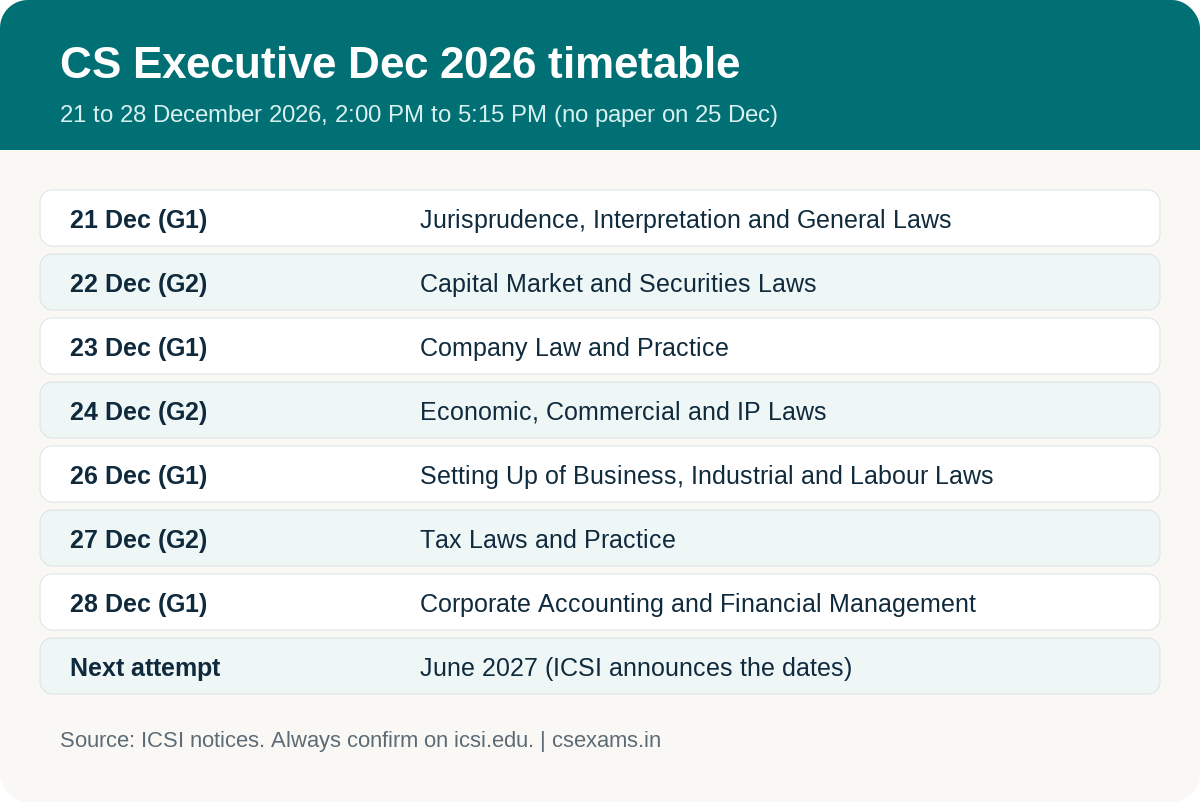
Latest update (18 Nov 2026): the CS Executive December 2026 exams run from 21 to 28 December 2026 (2:00 PM to 5:15 PM, no paper on 25 December). The next attempt after that is June 2027; ICSI announces its dates closer to the time.
| What | Date |
|---|---|
| CS Executive Dec 2026 exams | 21 to 28 December 2026 |
| Admit card | Expected in the second week of December 2026 on icsi.edu, based on past years (the Dec 2025 cards came on 12 December 2025) |
| Dec 2026 result | Expected around 25 February 2027, based on past years (the Dec 2025 result came on 25 February 2026) |
| Next attempt | June 2027 |
Write full papers under time before the exam: our CS Executive test series has papers on the ICSI pattern, checked by Company Secretaries. See plans and prices.
Always confirm dates on the official ICSI website, icsi.edu.
Here is how we would use these 30 days if we were sitting the paper this December.
ECIPL Dec 2026: date and where it sits in Group 2
| Date | CS Executive paper | Group |
|---|---|---|
| 22 Dec 2026 (Tue) | Capital Market and Securities Laws | Group 2 |
| 24 Dec 2026 (Thu) | Economic, Commercial and Intellectual Property Laws | Group 2 |
| 25 Dec 2026 (Fri) | No exam | |
| 27 Dec 2026 (Sun) | Tax Laws and Practice | Group 2 |
There is one day between Capital Markets and ECIPL, and Tax Laws comes three days later. That means your ECIPL revision cannot start on 23 December. It has to be done by mid December, with only the final read left for the gap day. The full timetable is on icsi.edu.
CS Executive ECIPL syllabus and the 60:40 split
As per the ICSI syllabus, Part I Economic and Commercial Laws carries 60 marks and Part II Intellectual Property Laws carries 40 marks.
| Part | Weightage | Chapters |
|---|---|---|
| Part I: Economic and Commercial Laws | 60% | FEMA; FDI; Overseas Direct Investment; ECB; Foreign Trade Policy; SEZ; FCRA; PMLA; Fugitive Economic Offenders; Benami Transactions; Competition Law; Consumer Protection; Legal Metrology; RERA |
| Part II: Intellectual Property Laws | 40% | Patents; Trade Marks; Copyright; Geographical Indications; Industrial Designs |
Part II has only five chapters for 40 marks. That is the best return per hour in the paper. Part I has fourteen chapters for 60 marks, but the foreign exchange block (FEMA, FDI, ODI, ECB) works as one connected unit.
Which study material applies
ICSI's list of study material for the December 2026 exams says Executive Papers 1 to 6 are updated till 30 November 2025, and it asks students to read the supplements for the session. Download the ECIPL supplement from the ICSI site and add its changes to your notes before you revise.
The three blocks that carry the paper
Foreign exchange block
FEMA, FDI, Overseas Direct Investment and ECB together make the heaviest part of Part I. Learn the difference between current account and capital account transactions, the automatic and government approval routes for FDI, the prohibited sectors, and who can raise ECB. Practical questions here usually give a short situation and ask whether it is allowed and under which route.
Economic offences block
PMLA, the Fugitive Economic Offenders Act, the Benami law and FCRA test definitions and procedures: who is a fugitive economic offender, what a benami transaction is, the authorities under each Act. Our earlier note on the Foreign Contribution Regulation Act is a quick revision for FCRA.
Intellectual property block
Patents, trade marks and copyright usually give long questions. Know the term of protection, what cannot be patented or registered, the grounds of refusal for trade marks and the remedies for infringement. Our posts on the Patents Act, 1970 and intellectual property rights cover the basics.
The shorter chapters that add easy marks
After the three big blocks, five chapters remain: Foreign Trade Policy, SEZ, Competition Law, Consumer Protection, Legal Metrology and RERA. Students often push them to the last week, then find they cannot write more than three lines on any of them. These chapters are short and the questions are direct, so a little time here returns good marks.
Competition Law and Consumer Protection
Competition Law questions ask about anti-competitive agreements, abuse of dominant position, regulation of combinations and the powers of the Competition Commission of India. Learn the difference between horizontal and vertical agreements with one example each. Consumer Protection questions cover who is a consumer, the three levels of commissions, their pecuniary limits and the meaning of unfair trade practice and product liability. Check the supplement for any change in limits before you learn them.
Foreign Trade Policy, SEZ, Legal Metrology and RERA
Foreign Trade Policy and SEZ are about schemes, approvals and the benefits a unit gets. Legal Metrology questions usually ask about packaged commodity rules and the declarations required on a package. RERA questions focus on registration of projects and agents, the duties of promoters and the remedies of allottees. One page of notes per chapter is enough.
Give these chapters four or five days in total. Most students who skip them lose 10 to 15 marks without noticing, simply because they leave a question unattempted or write a weak short answer.
A 30-day ECIPL plan for December 2026
This assumes you are also revising the other Group 2 papers, so ECIPL gets around 2 hours a day.
| Days | Focus |
|---|---|
| 1 to 4 | Patents, Trade Marks, Copyright |
| 5 to 6 | Geographical Indications, Industrial Designs, IP revision |
| 7 to 11 | FEMA, FDI, ODI, ECB as one block |
| 12 to 13 | Foreign Trade Policy, SEZ |
| 14 to 16 | FCRA, PMLA, Fugitive Economic Offenders, Benami |
| 17 to 19 | Competition Law, Consumer Protection |
| 20 to 21 | Legal Metrology, RERA, supplement changes |
| 22 to 25 | Two full 3-hour papers and their review |
| 26 to 30 | Fast revision of tables and definitions; gap day 23 Dec for a final read |
If you start late, cut days 22 to 25 down to one paper, but do not skip it. Writing one full ECIPL paper shows you how long the IPR answers actually take. For the overall Group 2 picture, see our CS Executive Dec 2026 last month revision plan.
Answer habits that lose marks in ECIPL
Most students lose marks here because they write general answers to situation questions. If the question asks whether an Indian company can invest in a foreign entity, the examiner wants the rule, the route, the limit if any, and a one-line conclusion. A page on "the importance of foreign investment" scores very little.
- Quote the Act name and section where you are sure of it. If you are not sure, write the provision in plain words instead of guessing a section number.
- In IPR questions, separate the answer into meaning, term, registration and remedies.
- In Competition Law, use the exact terms: anti-competitive agreement, abuse of dominant position, combination.
- End each practical answer with a clear conclusion line.
Mixing up the terms of protection is another common slip. Make a small table of patent, trade mark, copyright, GI and design terms and read it every two days.
Practice and checking in the final weeks
Self-study can cover the chapters. What it cannot do is tell you why a 6-mark answer got 2. That is why we suggest at least one evaluated paper. In our CS Executive test series, a Company Secretary checks your ECIPL answers and marks where structure or provisions are missing. If you have already planned your Group 1 papers, keep the same rhythm for Group 2 and you will reach 24 December with ECIPL revised twice.
One last point on the passing rule. You need 40% in each paper and 50% in the group aggregate. ECIPL is a paper where well-prepared students often score above 60, which lifts the Group 2 aggregate. Our guide on CS Executive passing criteria explains how the aggregate works.
Frequently asked questions
When is the CS Executive ECIPL exam in December 2026?
Economic, Commercial and Intellectual Property Laws is scheduled for Thursday, 24 December 2026, from 2:00 PM to 5:15 PM including 15 minutes of reading time.
What is the weightage of IPR in CS Executive ECIPL?
Part II Intellectual Property Laws carries 40 marks and Part I Economic and Commercial Laws carries 60 marks.
Which study material applies for ECIPL December 2026?
ICSI lists Executive Papers 1 to 6 as updated till 30 November 2025 for the December 2026 exams, along with the supplements published for the session.
Is ECIPL a Group 1 or Group 2 paper?
ECIPL is Paper 6 in Group 2 of the CS Executive Programme under the 2022 syllabus.
Which chapters are most important in ECIPL?
The foreign exchange block (FEMA, FDI, ODI, ECB) and the IP laws on patents, trade marks and copyright carry the most marks, but every chapter can be asked.
How many days are needed to revise ECIPL?
About 25 to 30 days at 2 hours a day is enough for two rounds of revision and one full written paper, if you have read the chapters once before.
Practise what you just read