What Is the Passing Criteria for a CS Executive? A Simple 2026 Guide
If you are preparing for CS Executive, one question matters more than any other: what is the passing criteria for CS Executive? The rule is simple. To pass, you must score a minimum of 40% marks in each paper and a 50% aggregate in each group, in one sitting. But there is more to know — how groups work, how the marking and negative marking apply, and how the powerful exemption rule can help you if you fail a group. This guide explains the full CS Executive passing criteria in plain, easy language so you know exactly what score you need to clear the exam.
What Is the Passing Criteria for CS Executive?
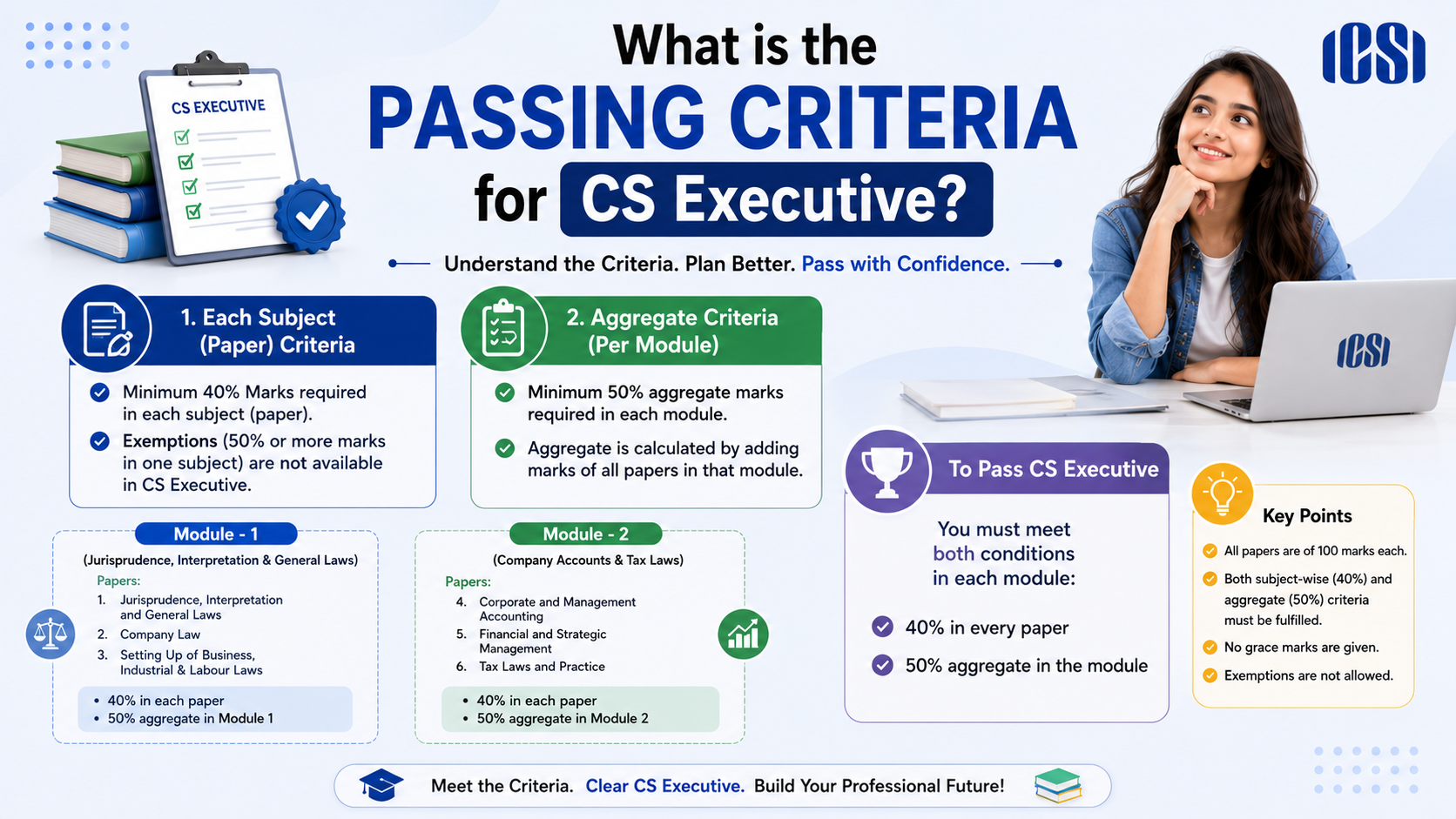
Under the ICSI 2022 syllabus, a candidate is declared passed in a group (module) of CS Executive only if they secure, in one sitting, at least 40% marks in every paper of that group and 50% marks in the aggregate of all papers of that group. You are declared passed in the whole CS Executive programme only when you clear both groups. You may clear the two groups together or separately, in one or more attempts — the choice is yours. There is also no limit on the number of attempts, so you can keep appearing until you clear both groups, though clearing early saves time and money.
CS Executive Exam Structure You Should Know First
To understand the passing marks, first understand the structure. CS Executive has 7 papers in 2 groups, and each paper carries 100 marks:
- Group 1 (4 papers, 400 marks): Jurisprudence, Interpretation & General Laws; Company Law & Practice; Setting up of Business, Industrial & Labour Laws; and Corporate Accounting & Financial Management.
- Group 2 (3 papers, 300 marks): Capital Market & Securities Laws; Economic, Commercial & Intellectual Property Laws; and Tax Laws & Practice.
Each paper is of three hours. Most papers have 20% case-based objective (MCQ) questions and 80% descriptive questions, while Paper 4 (Corporate Accounting & Financial Management) is 100% descriptive.
Minimum Passing Marks in CS Executive
Here is what the passing criteria means in actual marks:
- In every paper, you need at least 40 marks out of 100 (40%).
- In Group 1, you need at least 200 marks out of 400 (50% aggregate) across the four papers.
- In Group 2, you need at least 150 marks out of 300 (50% aggregate) across the three papers.
Both conditions must be met together. Scoring 50% aggregate but only 35 in one paper means you have not passed that group. Likewise, scoring 40+ in every paper but below 50% aggregate also means a fail. You need both the per-paper minimum and the aggregate to clear a group.
Group-Wise Passing: One Group or Both Together
CS Executive gives you flexibility. You can attempt one group at a time or both groups together. If you attempt both together, the 40%-per-paper and 50%-aggregate rule is applied to each group separately, not combined. So you could pass one group and fail the other in the same attempt. The passed group is cleared for good, and you only need to re-attempt the group you did not clear. Many students choose to prepare and clear one group at a time to reduce pressure — ICSI advises prioritising Group 1 first.
CS Executive Marking Scheme and Negative Marking
Each paper is 100 marks and combines objective and descriptive questions. In the 20% objective (MCQ) section, there is negative marking: you get 1 mark for each correct answer and lose 0.25 marks for each wrong answer. The 80% descriptive section rewards well-structured, well-presented answers with correct provisions and reasoning. Because a quarter mark is lost per wrong MCQ, avoid blind guessing in the objective part, and focus on clear, complete answers in the descriptive part where most of the marks lie.
CS Executive Exemption Rule (60% Marks)
The exemption rule is a big relief if you fail a group. If you appear in all papers of a group, score 60% or more in any paper and at least 25% in each of the remaining papers of that group, but still fail the group, the paper in which you scored 60%+ becomes exempted. You do not have to write that paper again.
For example, in Group 1 you score 65 in Paper 1 but your total is below 200, and you have at least 25 in each other paper. Paper 1 is exempted. In your next attempt, you write only Papers 2, 3, and 4, and must secure 40% in each of them and 50% aggregate of those remaining papers. The exempted paper's marks are not counted again. Exemptions are granted automatically by ICSI and shown as 'Exempted' on your SMASH portal — you do not apply separately.
What 'One Sitting' Means for Passing
The phrase 'in one sitting' is important. To pass a group, you must meet both the 40%-per-paper and 50%-aggregate rule in the same attempt for that group. You cannot add marks from Paper 1 in one attempt to Paper 2 from another attempt to reach the aggregate. However, exempted papers are the exception — once a paper is exempted, you carry that benefit forward and are judged only on the remaining papers in the next attempt.
CS Executive Pass Percentage: What It Tells You
The passing criteria may look easy on paper, but the pass percentage shows why smart preparation matters. In recent CS Executive sessions under the 2022 syllabus, only around 15% to 20% of students cleared each group. This is not because 40% and 50% are impossible, but because many students under-prepare one paper, guess in MCQs, or write weak descriptive answers. The lesson is simple: treat 40% as your safety floor, not your target. Aim well above the minimum in every paper, and you will comfortably stay on the right side of these numbers.
Common Passing-Criteria Mistakes Students Make
Many students lose a group not because of knowledge, but because of these mistakes:
- Focusing only on the aggregate and ignoring the 40% minimum in a weak paper.
- Leaving one paper poorly prepared, which drags down the whole group.
- Guessing carelessly in MCQs and losing marks to negative marking.
- Not aiming for 60%+ in strong papers, missing out on valuable exemptions.
- Writing incomplete descriptive answers where most of the marks lie.
Understanding the passing criteria helps you plan smartly — protect every paper's 40% while pushing your strong papers towards the 60% exemption mark.
How to Comfortably Clear the CS Executive Passing Marks
Do not aim to just scrape 40%. Aim higher, so a bad day does not fail you. Study every paper from the ICSI study material, never leave any paper weak, and practise writing full descriptive answers. Solve previous year papers and take regular mock tests so you know your real score before the exam. Target 60%+ in your strongest papers to unlock exemptions, and keep a safe margin above 40% in every paper. A balanced preparation across all papers is the surest way to clear both the per-paper and aggregate conditions of the CS Executive passing criteria.
Why CS Exams (csexams.in) Can Help You Score Above the Passing Marks
Knowing the passing criteria is one thing — actually scoring above it is another, and that is where CS Exams (csexams.in) helps. It is one of India's most focused test platforms, built only for serious CS students, offering precision testing, mentor feedback, and performance tracking for CSEET, CS Executive, and CS Professional. Here is how it helps you cross the passing marks:
- Real ICSI-level difficulty: papers match the actual exam standard, with 50–60% similar questions reported in the real ICSI exam.
- Know your real score: expert evaluation shows exactly where you stand against the 40% and 50% marks before the real exam.
- Fast expert evaluation: answer sheets checked by Qualified CS professionals, with feedback often within 24 hours to 1–2 days.
- Toppers' sheets and doubt solving: learn how high-scoring answers are written so you can aim for exemption-level marks.
Regular evaluated practice turns your preparation into scores, so you clear each paper and each group comfortably instead of just scraping through.
Final Thoughts on CS Executive Passing Criteria
To sum up, the CS Executive passing criteria is clear: 40% in each paper and 50% aggregate in each group, in one sitting, with both groups needed to complete the level. Use the negative marking wisely, protect your weak papers, and chase 60%+ in strong papers to earn exemptions. Once you understand these rules, you can plan your preparation smartly and walk into the exam knowing exactly what score will get you through. Prepare well, practise with mock tests, and clearing CS Executive becomes a realistic, reachable goal.