In this article (19)
- SMCF Dec 2026: date and Group 2 order
- CS Professional SMCF syllabus and weightage
- Part I: strategic management without vague answers
- Competitive positioning and functional strategy
- Part II: corporate finance, where the marks are
- Equity and debt
- Foreign funding
- Intermediaries and project evaluation
- A 30-day SMCF plan ending before 22 December
- How to write SMCF answers
- Common mistakes students make in SMCF
- Last word before the exam
- Frequently asked questions
- When is the CS Professional SMCF exam in December 2026?
- What is the weightage of corporate finance in CS Professional SMCF?
- Is SMCF in Group 1 or Group 2 of CS Professional?
- Which study material applies for SMCF December 2026?
- Does SMCF have numerical questions?
- How should I revise SMCF in the last month?
CS Professional SMCF, Strategic Management and Corporate Finance, is on Tuesday, 22 December 2026, from 2:00 PM to 5:15 PM including 15 minutes of reading time. It is Paper 5 and the first Group 2 paper of the session, just one day after ESG. That timing is the real challenge. Your SMCF revision has to be finished before the exams start, because you will have only the evening of 21 December for it.
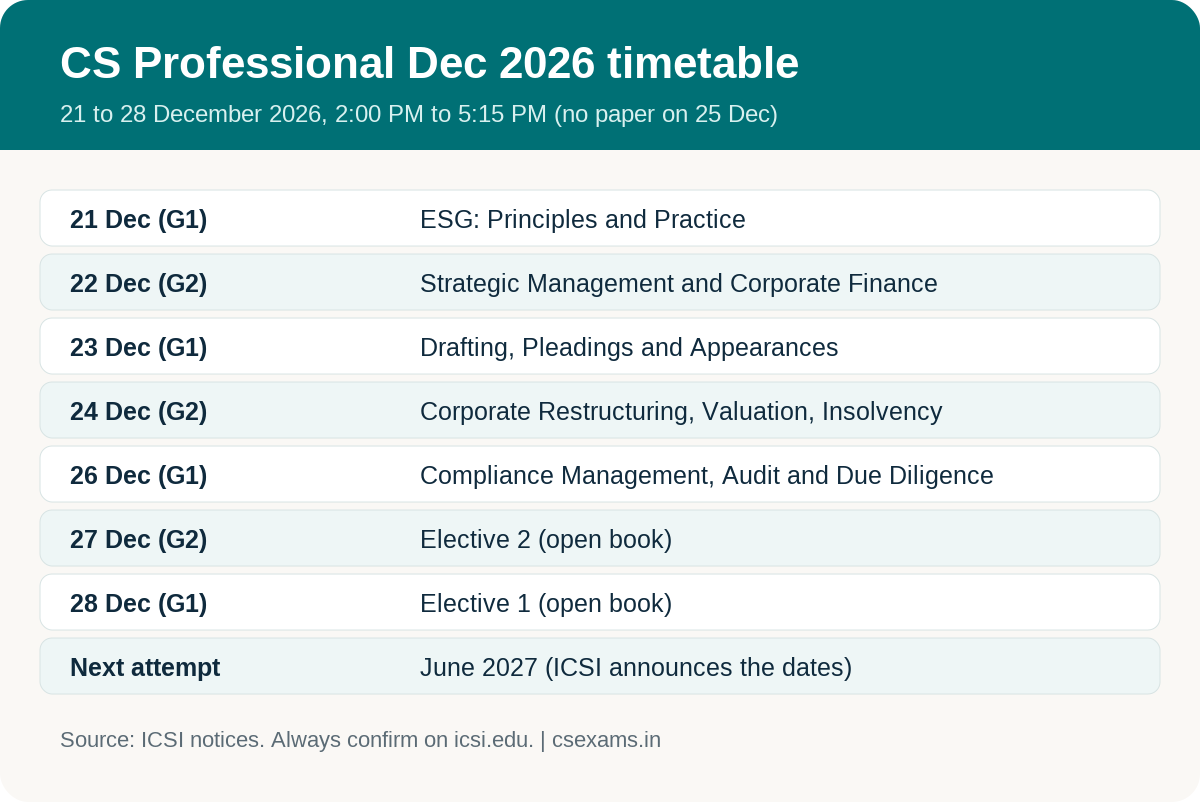
Latest update (18 Nov 2026): the CS Professional December 2026 exams run from 21 to 28 December 2026 (2:00 PM to 5:15 PM, no paper on 25 December). The next attempt after that is June 2027; ICSI announces its dates closer to the time.
| What | Date |
|---|---|
| CS Professional Dec 2026 exams | 21 to 28 December 2026 |
| Admit card | Expected in the second week of December 2026 on icsi.edu, based on past years (the Dec 2025 cards came on 12 December 2025) |
| Dec 2026 result | Expected around 25 February 2027, based on past years (the Dec 2025 result came on 25 February 2026) |
| Next attempt | June 2027 |
Write full papers under time before the exam: our CS Professional test series has papers on the ICSI pattern, checked by Company Secretaries. See plans and prices.
Always confirm dates on the official ICSI website, icsi.edu.
The good news is that the paper is predictable once you see how it is built.
SMCF Dec 2026: date and Group 2 order
| Date | CS Professional paper | Group |
|---|---|---|
| 22 Dec 2026 (Tue) | Strategic Management and Corporate Finance | Group 2 |
| 24 Dec 2026 (Thu) | Corporate Restructuring, Valuation and Insolvency | Group 2 |
| 27 Dec 2026 (Sun) | Elective 2 (open book) | Group 2 |
If you are writing both groups, 21 and 22 December are back to back. Plan to finish SMCF revision by 18 December, then use 19 and 20 December for ESG and only a light read of SMCF notes on the 21st evening. The full timetable is on icsi.edu.
CS Professional SMCF syllabus and weightage
The ICSI 2022 syllabus gives Part I Strategic Management 40 marks and Part II Corporate Finance 60 marks.
| Part | Weightage | Chapters |
|---|---|---|
| Part I: Strategic Management | 40% | Introduction to Strategic Management; External and Internal Environment; Business Policy and Functional Strategy; Strategic Analysis and Planning; Competitive Positioning; Managing the Multi-Business Firm |
| Part II: Corporate Finance | 60% | Sources of Corporate Funding; Raising Funds from Equity; Raising Funds from Debt; Foreign Funding Institutions; Foreign Funding Instruments, Laws and Procedures; Role of Intermediaries; Project Evaluation |
ICSI's list of study material for December 2026 says most Professional papers are updated till 31 May 2026, and it asks students to read the session supplements as well. Check the SMCF section of the supplements page on the ICSI site before you start revision.
Part I: strategic management without vague answers
Strategy answers fail when they sound like management essays. The examiner wants the right model, applied to the facts given. If a case describes a company's strengths and threats, use SWOT and say what it means for the company. If it describes rivals, buyers and suppliers, use Porter's five forces. If it asks about a group with many businesses, use portfolio tools like the BCG matrix.
Make one page per model: what it is, its parts, when to use it and one Indian example. Six or seven such pages cover most of Part I. Most students lose marks here because they name a model and stop. Apply each part of the model to the case in one or two lines, then give a recommendation.
Competitive positioning and functional strategy
Questions on cost leadership, differentiation and focus are common. So are questions on how marketing, finance, HR and operations strategies support the business strategy. Keep a small table matching each generic strategy with an example and its risk.
Part II: corporate finance, where the marks are
Sixty marks sit in Part II, and most of them come from fund raising. This part is closer to securities law and procedure than to pure finance theory.
Equity and debt
Learn the routes for raising equity: public issue, rights issue, preferential allotment, qualified institutions placement, private placement. For each one, know who can use it and the main approvals and steps. For debt, cover term loans, debentures, commercial paper and non-fund-based options like bank guarantees and letters of credit. A comparison table of these routes is the single most useful revision sheet for this paper.
Foreign funding
The two foreign funding chapters cover institutions and instruments such as ECB and depository receipts, and the laws that apply. If you cleared ECIPL at the Executive level, revise your FEMA notes, because the ideas overlap. Listing in an International Financial Services Centre is part of the equity chapter in the syllabus, so read it.
Intermediaries and project evaluation
Know the role of merchant bankers, registrars, underwriters, bankers to the issue and credit rating agencies. Project evaluation can include methods like NPV and IRR, so keep basic formula practice going for a few days.
A 30-day SMCF plan ending before 22 December
This plan gives SMCF about 2 hours a day and ends with a buffer for ESG.
| Days | Focus |
|---|---|
| 1 to 4 | Strategic management models, one page each |
| 5 to 6 | Competitive positioning, multi-business firm |
| 7 to 11 | Sources of funding, equity routes and procedures |
| 12 to 14 | Debt routes and non-fund-based options |
| 15 to 17 | Foreign funding institutions and instruments |
| 18 to 19 | Intermediaries, project evaluation practice |
| 20 to 22 | One full 3-hour paper and its review |
| 23 to 26 | Second revision of comparison tables and models |
| 27 to 30 | Shift to ESG; light SMCF reading on 21 Dec evening |
For the other papers, see our CS Professional Dec 2026 last month revision plan, which sets the order for both groups.
How to write SMCF answers
- For case questions, start with the issue in one line, apply the model or rule, then recommend.
- For procedure questions, write numbered steps in the right order with the approval at each step.
- Use comparison tables when asked to distinguish two routes. Examiners read them fast and award marks easily.
- Show working in project evaluation questions, even if your final figure is off.
A full written paper under time pressure shows you if you can finish. Part II answers tend to grow long, and students often run out of time for the last strategy question. In our CS Professional test series, a Company Secretary evaluates your SMCF paper and points out where your answers ran long or missed the procedure. You can compare options on our plans page.
Common mistakes students make in SMCF
The first mistake is giving Part I and Part II equal time. Strategy carries 40 marks and finance carries 60, and the finance chapters are more procedural, so they need more revision rounds. A 40:60 split of your hours is a fair starting point.
The second is learning fund-raising routes as separate stories. In the exam, questions often ask which route suits a given company: a listed company that needs money fast, an unlisted company with a few investors, a startup looking abroad. If you have only memorised each route, you will struggle to choose. Practise by writing two or three short cases yourself and deciding the route with reasons.
The third is ignoring the IFSC listing topic. It is named in the official syllabus under the equity chapter, but many older notes do not cover it. Read it from the current ICSI study material.
The fourth is writing the same strategy answer for every case. If two questions both ask for analysis, check whether one wants the external environment and the other wants internal capability. Use the model that fits each case, not your favourite one. Most students lose marks here because the examiner sees a memorised SWOT that does not match the facts.
The fifth is skipping numerical practice entirely. Even one capital budgeting question left blank costs real marks in a paper where every 5 marks count toward the group aggregate.
Last word before the exam
SMCF rewards students who prepare tables and models instead of reading long chapters again and again. If you have your equity and debt comparison sheet, your strategy model pages and one full paper done by 18 December, you are in good shape for 22 December, even with ESG the day before.
Frequently asked questions
When is the CS Professional SMCF exam in December 2026?
Strategic Management and Corporate Finance is scheduled for Tuesday, 22 December 2026, from 2:00 PM to 5:15 PM including 15 minutes of reading time.
What is the weightage of corporate finance in CS Professional SMCF?
Part II Corporate Finance carries 60 marks and Part I Strategic Management carries 40 marks under the 2022 syllabus.
Is SMCF in Group 1 or Group 2 of CS Professional?
SMCF is Paper 5 in Group 2 of the CS Professional Programme.
Which study material applies for SMCF December 2026?
ICSI lists most Professional papers as updated till 31 May 2026 for the December 2026 exams, and students should also read the supplements published for the session.
Does SMCF have numerical questions?
The Project Evaluation chapter can include capital budgeting methods, so practise basic NPV and IRR questions, though most of the paper is descriptive.
How should I revise SMCF in the last month?
Make one page per strategy model and a comparison table of equity and debt routes, then write at least one full 3-hour paper before the exams start.
Practise what you just read